
We spend our days surrounded by screens: at work, at home, and everywhere in between. But audio is the one channel that moves with us, from morning routines to evening commutes, from workouts to household chores. More than two-thirds of U.S. consumers will listen to digital audio every month this year, making it one of the fastest-growing ways to connect with audiences. Experian and Audacy are working together to solve the challenges of fragmented listening, cross-platform targeting, and campaign measurement, helping brands reach people in the moments other channels can’t.
Why audio sticks with us
Audio fits into life’s in-between moments, from the commute to the workout to the chores, when other media can’t. Unlike video, it doesn’t demand full attention; it joins the flow of daily routines. This makes audio uniquely personal, creating connections that other formats can’t replicate.
Audacy’s expertise in understanding listener behavior ensures that audio campaigns feel like a natural part of daily life. Experian’s data helps advertisers identify the right audiences, while Audacy ensures the message is delivered at the right time. Together, we help brands create campaigns that resonate deeply with listeners. By meeting audiences in their moments of focus, audio becomes a powerful tool for building meaningful and lasting connections.
“Audio is a companion in people’s daily rituals. Whether it’s doing dishes, folding laundry, or going for a run, you have audio going in your ears, and you’re really engaged with it. From an advertising perspective, that’s incredibly powerful because listeners are paying attention to the content.”
AudacyKevin Greenwald, SVP of Advertising and Audience Products
Making sense of scattered listening habits
Today’s listeners consume audio across a variety of devices and platforms. Devices like smart speakers and smart home hubs now account for over 27% of digital audio time spent daily among U.S. adults, highlighting the growing role of connected devices in audio consumption. When listeners bounce between apps, stations, and devices, it’s easy for advertisers to lose track of them. Audacy’s advanced platform capabilities, combined with Experian’s identity solutions, simplify this process by providing a unified view of audience behavior, ensuring campaigns remain cohesive.
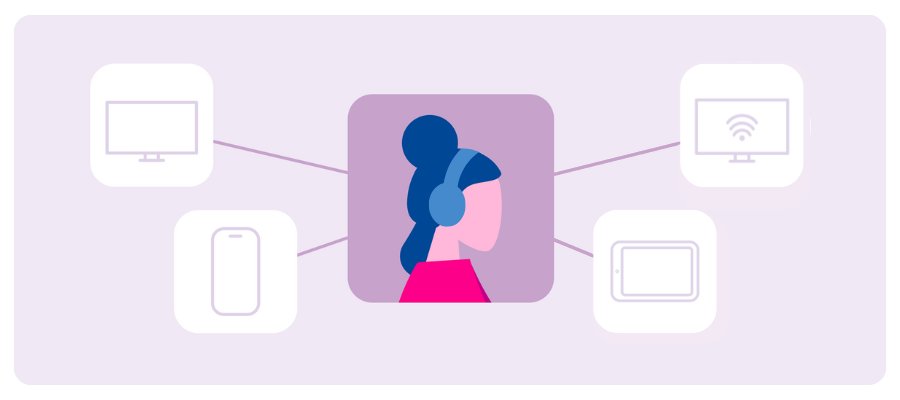
Audio is highly adaptable, letting advertisers tweak a message on the fly by shifting tone, length, or format to stay relevant in the moment. This flexibility ensures that campaigns remain cohesive and impactful, no matter where or how listeners engage.
“Audio has a degree of flexibility that other channels don’t. You’re not tied to a programming clock, and ad lengths can vary. It’s also easy to create a great audio ad quickly, which makes it a channel ripe for experimentation and innovation.”
AudacyKevin Greenwald, SVP of Advertising and Audience Products
Following listeners wherever they go
Today’s listeners don’t stay in one place: they bounce from live radio in the morning to streaming music during the day, then wind down with a favorite podcast at night. For advertisers, that creates a challenge: how do you keep up with an audience that’s always moving? Without a unified view of the listener journey, campaigns can lose impact. With the right insights, though, every handoff becomes an opportunity to stay relevant and connected.

Audacy’s platform, combined with Experian’s identity solutions, bridges these gaps. Together, we help you follow your audience wherever they go, creating consistent experiences that drive results. This approach improves targeting and ensures that messages remain impactful.
“I hope that there’s a day coming where we can understand ad exposure in the car as well as more cars are connected and things like that. That would be really powerful.”
AudacyKevin Greenwald, SVP of Advertising and Audience Products
Your audience is listening, let’s make sure they hear you
Audio helps you connect with your audience in moments other channels miss. With Experian’s marketing data and Audacy’s expertise, you can simplify cross-platform targeting, improve campaign measurement, and create messages that truly resonate. Let’s work together to make your message heard.
Let’s talk audio strategy. Contact us today
About our experts

Kevin Greenwald
SVP of Advertising and Audience Products, Audacy
Kevin Greenwald is the SVP of Advertising & Audience Products, where he partners closely with Audacy’s sales team to deliver leading ad product and measurement capabilities for their clients.

Crystal Jacques
VP of Enterprise Partnerships, Experian
Crystal Jacques is the VP of Enterprise Partnerships, leading Experian’s go-to-market team across all verticals. With over ten years of experience in the Identity space, Crystal brings a wealth of expertise to her role. She joined Experian in 2020 through the Tapad acquisition, following her successful stint as the head of Global Channel Partnerships for Adbrain, which The Trade Desk later acquired.
Latest posts

With the recent announcement of delaying third-party cookie deprecation to 2024, the industry has more time to rethink how to identify and communicate with consumers.

As today’s digital landscape gets more and more complicated there are more ways for brands to connect with users and drive purchases and more ways for ad tech to target and measure those touch points. As in-person shopping picks up steam due to the re-normalization of society post-COVID 19; the connection between digital ads and in-person purchases needs to be made once again. With the rise of Connected TV throughout the pandemic there are even more digital opportunities to target a user. But how do you make sure that those brand engagements are captured and correctly attributed to offline purchases and conversions? The answer lies in a holistic identity resolution strategy. Cross-device identity resolution with The Tapad Graph connects the identifiers and devices of individuals within a household to each other; enabling targeting, frequency capping, extension, segmentation and measurement or attribution between devices; including Connected TV and hashed (privacy-protected) email addresses along with Cookies, Mobile Ad Ids and IP Address. Brands can join their first-party data to The Tapad Graph to execute strategies that connect online and offline data for pre, mid and post-campaign efficiencies. Let’s imagine a scenario in which an outdoor retail brand is targeting users watching specific content on a Connected TV device. Powered by identity resolution, they start with a general ad on CTV and continue targeting down individual paths with each user. When one of them converts in store and makes a purchase; the outdoor retailer can connect that action through location and in-store traffic data with the cross-device identity resolution used to execute the digital campaign. Now the actions of the user online and offline are resolved for more accurate measurement and attribution after the campaign ends. But it doesn’t stop there– the brand's CRM data can be reactivated for the next digital campaign and leveraged to capitalize on the most effective media mix for the user who made the purchase previously. These combined insights can be invaluable in shaping up future campaign strategies with geo-contextual ads, recommended additional products and personalization to help drive more conversions and purchases in-store or online. As in-person shopping picks back up and marketers are tasked once again with balancing online and in-store KPIs, the right identity resolution strategy can unlock necessary efficiencies for retailers, ad tech vendors and agencies tasked with supporting these initiatives. Get in touch

Experian Marketing Services and Data Quality President Genevieve Juillard recently sat down with Zach Rodgers, host of the AdExchanger Talks podcast to discuss the future of identity, the importance of data transparency and privacy, and our recent acquisition of Tapad. Genevieve focused on the opportunity for our industry to reimagine an advertising ecosystem that is resilient and adaptable; one that takes advantage of emerging data and prioritizes data transparency and consumer privacy. She also discussed the importance of advertising strategies that put consumers at the heart of every decision and give them more control over their data. Genevieve shared with AdExchanger that Experian’s acquisition of Tapad, a global leader in digital identity resolution, was a natural fit for our company. Tapad’s approach and role in the ecosystem is very much aligned with Experian’s, which is to develop solutions that are resilient to industry and consumer changes. The combination of our capabilities supports interoperability across all types of identifiers, both online and offline, and will position us to help our clients navigate the post-third-party cookie world. To learn more about Experian’s plans to support an effective advertising ecosystem that will evolve with our dynamic industry, listen to the full podcast Embracing ‘Healthy Fragmentation’ In Ad Tech, With Genevieve Juillard. Get in touch