In 2022, Google began changing the availability of the information available in User-Agent strings across their Chromium browsers. The change is to use the set of HTTP request header fields called Client Hints. Through this process, a server can request, and if approved by the client, receive information that would have been previously freely available in the User-Agent string. This change is likely to have an impact on publishers across the open web that may use User-Agent information today.
To explain what this change means, how it will impact the AdTech industry, and what you can do to prepare, we spoke with Nate West, our Director of Product.
What is the difference between User-Agents and Client Hints?
A User-Agent (UA) is a string, or line of text, that identifies information about a web server’s browser and operating system. For example, it can indicate if a device is on Safari on a Mac or Chrome on Windows.
Here is an example UA string from a Mac laptop running Chrome:

To limit the passive fingerprinting of users, Google is reducing components of the UA strings in their Chromium browsers and introducing Client Hints. When there is a trusted relationship between first-party domain owners and third-party servers, Client Hints can be used to share the same data.
This transition began in early 2022 with bigger expected changes beginning in February 2023. You can see in the above example, Chrome/109.0.0.0, where browser version information is already no longer available from the UA string on this desktop Chrome browser.
How can you use User-Agent device attributes today?
UA string information can be used for a variety of reasons. It is a component in web servers that has been available for decades. In the AdTech space, it can be used in various ad targeting use cases. It can be used by publishers to better understand their audience. The shift to limit access and information shared is to prevent nefarious usage of the data.
What are the benefits of Client Hints?
By using Client Hints, a domain owner, or publisher, can manage access to data activity that occurs on their web properties. Having that control may be advantageous. The format of the information shared is also cleaner than parsing a string from User-Agents. Although, given that Client Hints are not the norm across all browsers, a long-term solution may be needed to manage UA strings and Client Hints.
An advantage of capturing and sharing Client Hint information is to be prepared and understand if there is any impact to your systems and processes. This will help with the currently planned transition by Google, but also should the full UA string become further restricted.
Who will be impacted by this change?
Publishers across the open web should lean in to understand this change and any potential impact to them. The programmatic ecosystem supporting real-time bidding (RTB) needs to continue pushing for adoption of OpenRTB 2.6, which supports the passing of client hint information in place of data from UA strings.
What is Google’s timeline for implementing Client Hints?
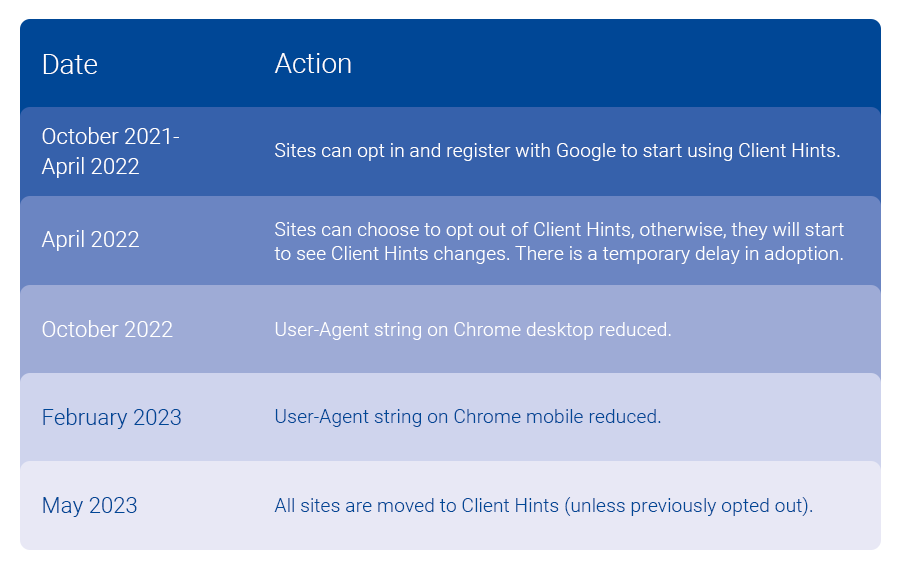
Do businesses have to implement Client Hints? What happens if they don’t?
Not capturing and sharing with trusted partners can impact capabilities in place today. Given Chromium browsers account for a sizable portion of web traffic, the impact will vary for each publisher and tech company in the ecosystem. I would assess how UA strings are in use today, where you may have security concerns or not, and look to get more information on how to maintain data sharing with trusted partners.
We can help you adopt Client Hints
Reach out to our Customer Success team at tapadcustomersuccess@experian.com to explore the best options to handle the User-Agent changes and implement Client Hints. As leaders in the AdTech space, we’re here to help you successfully make this transition. Together we can review the options available to put you and your team on the best path forward.
Get in touch
About our expert

Nate West, Director of Product
Nate West joined Experian in 2022 as the Director of Product for our identity graph. Nate focuses on making sure our partners maintain and grow identity resolution solutions today in an ever-changing future state. He has over a decade of experience working for media organizations and AdTech platforms.
Latest posts

Cross-screen marketing tech firm, Tapad, drove unified campaign; partnered with Statiq to measure cross-screen impact on in-store visits LONDON, March 8, 2016 /PRNewswire/ — Carat North completed the UK’s most comprehensive digital campaign with Tapad, the leader in cross-device marketing technology and now a part of Experian. Coupled with location-based audience data from Statiq, this marks the first time a UK-company has measured the impact of unified, cross-screen campaign on in-store visits. Carat North served display and video ads to grocery shoppers for the leading retailer ASDA from August through October. During the campaign, Tapad utilized Statiq’s audience data to measure which users visited a store after being exposed* to the campaign’s ad on multiple devices. The digital campaign demonstrated a lift of 59% for in-store visits when users were exposed to ads on three devices over people who were shown an ad only on onescreen. Those who engaged with the ad were also 411% more likely to visit an ASDA store. Of those who were exposed to an ad, 248% were more likely to visit a store. Impressions served to mobile devices saw the highest success rate with an in-store visit lift of 67%. The campaign leveraged Tapad’s proprietary technology, The Device Graph™, which Nielsen confirmed Tapad’s cross device accuracy to be 91.2%, to serve ads sequentially on connected devices belonging to the same user. CARAT NORTH: “The ability to know which devices belong to our customer, coupled with the ability to deliver the right ad, and right message, wherever they are and on whatever device they’re using, has been something this industry has long needed,” said Steve Thornton, Digital Account Manager, Carat North. “We’re impressed with the results that have come from the work with Tapad and Statiq for this media-first, and look forward to continuing to offer these solutions to clients like ASDA. Matching unified cross-device capabilities with real insights on campaign performance is an invaluable advantage in the marketing world.” TAPAD: “This campaign is a perfect example of the capabilities of cross-device advertising,” said Are Traasdahl, Founder and CEO, Tapad. “In addition to reaching users across devices, we’re able to analyze campaign results and determine how different combinations of ad exposure, creative type or view frequency affected their decision to visit a location.” STATIQ: “As a location data specialist, Tapad is our ideal partner – they are an industry leader and by working with them we are able to determine the impact unified messaging has on real world consumer behaviours,” said Dean Cussell, Co-Founder of Statiq. “We believe this type of analysis will significantly aid brands in optimising future ad spend.” About Carat North Carat North is a leading independent media planning & buying specialist in digital and non-traditional media solutions. Owned by global media group Dentsu Aegis Network, the Carat network is more than 6,700 people in 130 countries worldwide across 170 cities. Carat defined the sector when established as the world’s first media independent in 1968 and is now Europe’s largest media network, a position held for more than 15 years. For more information visit www.carat.co.uk About Tapad Tapad Inc. is a marketing technology firm renowned for its breakthrough, unified, cross-device solutions. With 91.2% data accuracy confirmed by Nielsen, the company offers the largest in-market opportunity for marketers and technologies to address the ever-evolving reality of media consumption on smartphones, tablets, home computers and smart TVs. Deployed by agency trading desks, publishers and numerous Fortune 500 brands, Tapad provides an accurate, unified approach to connecting with consumers across screens. In 2015, Tapad began aggressively licensing its identity management solution, the Tapad Device Graph™, and swiftly became the established gold-standard throughout the ad tech ecosystem. Tapad is based in New York and has offices in Atlanta, Boston, Chicago, Dallas, Detroit,Frankfurt, London, Los Angeles, Miami, Minneapolis, San Francisco and Toronto. TechCrunch called the powerhouse Tapad team “a hell of a list of entrepreneurs who created some of the most valuable online advertising companies of the last decade.” Among Tapad’s numerous awards: EY Entrepreneur of The Year (East Coast) 2014, among Forbes’ Most Promising Companies two year’s running, Deloitte’s Technology Fast 500, Crain’s Fast 50, Entrepreneur 360, Digiday Signal Award, iMedia ASPY Award, and a MarCom Gold Award. Read the full release here. *Tapad utilized Statiq’s audience data to measure which users visited a store during, or within one month of, being exposed to the campaign’s ad on multiple devices. Contact us today
Welcome emails garner 86 percent higher open rates than regular promotional mailings. What other life cycle marketing programs should you be running?
If information is accurate when collected, loyalty programs have a better chance at engaging consumers and actually seeing the benefit that a loyalty program can provide.