Loading...

Helping you navigate Google’s transition to Client Hints

Published: January 31, 2023 by Experian Marketing Services

In 2022, Google began changing the availability of the information available in User-Agent strings across their Chromium browsers. The change is to use the set of HTTP request header fields called Client Hints. Through this process, a server can request, and if approved by the client, receive information that would have been previously freely available in the User-Agent string. This change is likely to have an impact on publishers across the open web that may use User-Agent information today.

To explain what this change means, how it will impact the AdTech industry, and what you can do to prepare, we spoke with Nate West, our Director of Product.

What is the difference between User-Agents and Client Hints?

A User-Agent (UA) is a string, or line of text, that identifies information about a web server’s browser and operating system. For example, it can indicate if a device is on Safari on a Mac or Chrome on Windows.

Here is an example UA string from a Mac laptop running Chrome:

User-Agent string example

To limit the passive fingerprinting of users, Google is reducing components of the UA strings in their Chromium browsers and introducing Client Hints. When there is a trusted relationship between first-party domain owners and third-party servers, Client Hints can be used to share the same data.

This transition began in early 2022 with bigger expected changes beginning in February 2023. You can see in the above example, Chrome/109.0.0.0, where browser version information is already no longer available from the UA string on this desktop Chrome browser.

How can you use User-Agent device attributes today?

UA string information can be used for a variety of reasons. It is a component in web servers that has been available for decades. In the AdTech space, it can be used in various ad targeting use cases. It can be used by publishers to better understand their audience. The shift to limit access and information shared is to prevent nefarious usage of the data.

What are the benefits of Client Hints?

By using Client Hints, a domain owner, or publisher, can manage access to data activity that occurs on their web properties. Having that control may be advantageous. The format of the information shared is also cleaner than parsing a string from User-Agents. Although, given that Client Hints are not the norm across all browsers, a long-term solution may be needed to manage UA strings and Client Hints.

An advantage of capturing and sharing Client Hint information is to be prepared and understand if there is any impact to your systems and processes. This will help with the currently planned transition by Google, but also should the full UA string become further restricted.

Who will be impacted by this change?

Publishers across the open web should lean in to understand this change and any potential impact to them. The programmatic ecosystem supporting real-time bidding (RTB) needs to continue pushing for adoption of OpenRTB 2.6, which supports the passing of client hint information in place of data from UA strings.

What is Google’s timeline for implementing Client Hints?
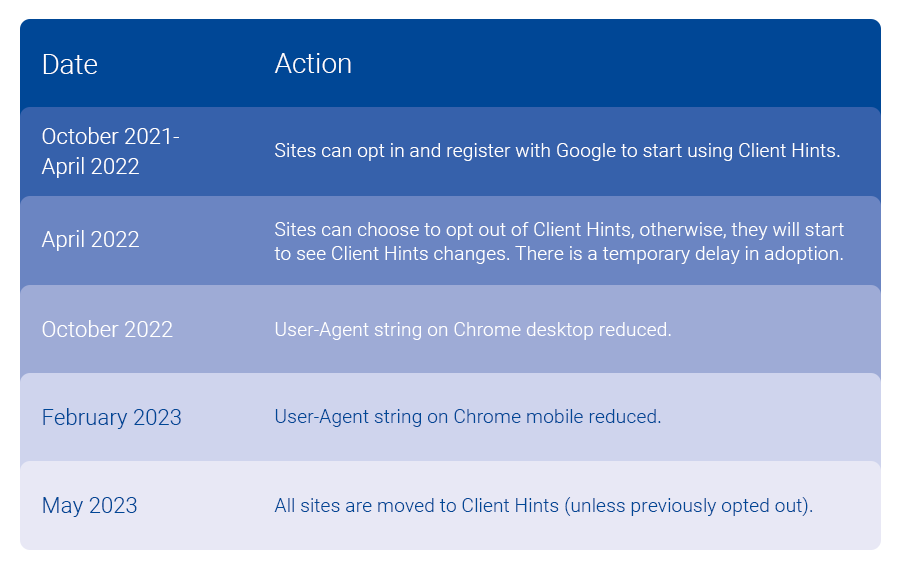
Google's timeline for implementing Client Hints in Chromium browsers
Source: Google

Do businesses have to implement Client Hints? What happens if they don’t?

Not capturing and sharing with trusted partners can impact capabilities in place today. Given Chromium browsers account for a sizable portion of web traffic, the impact will vary for each publisher and tech company in the ecosystem. I would assess how UA strings are in use today, where you may have security concerns or not, and look to get more information on how to maintain data sharing with trusted partners.

We can help you adopt Client Hints

Reach out to our Customer Success team at tapadcustomersuccess@experian.com to explore the best options to handle the User-Agent changes and implement Client Hints. As leaders in the AdTech space, we’re here to help you successfully make this transition. Together we can review the options available to put you and your team on the best path forward.

Get in touch

This site is protected by reCAPTCHA and the Google Privacy Policy and Terms of Service apply.

About our expert

Nate West headshot

Nate West, Director of Product

Nate West joined Experian in 2022 as the Director of Product for our identity graph. Nate focuses on making sure our partners maintain and grow identity resolution solutions today in an ever-changing future state. He has over a decade of experience working for media organizations and AdTech platforms.


Latest posts
Loading…
Six alternatives to third-party cookies

With the impending deprecation of third-party cookies, marketers find themselves at the crossroads of innovation and adaptation. As we bid farewell to this identifier, the emphasis shifts to forging deeper connections, understanding customer needs, and navigating the marketing landscape with data-driven precision. At Experian, we stand as your trusted partner, committed to guiding you through this transition. In this blog post, we'll explore: How third-party cookie deprecation is impacting digital advertising Six alternatives to third-party cookies and where they fall short How Experian can help you navigate a cookieless world Four ways third-party cookie deprecation is impacting digital advertising Third-party cookie deprecation is causing significant challenges within the AdTech industry, manifesting in four key areas: Reach: Advertisers and demand-side platforms (DSPs) will face difficulties in reaching their target customers due to the absence of third-party cookies. Understanding audiences: Advertisers will find it challenging to understand the demographics and behaviors of their customer base without third-party cookies. Similarly, publishers are struggling to identify their audiences accurately, resulting in less addressable and appealing inventory. Measurement: Measurement providers may encounter obstacles in accurately assessing the effectiveness of advertising campaigns. Additionally, DSPs are finding it hard to measure the impact of their ads without the assistance of third-party cookies. Matching: Data providers may experience challenges in matching users with the appropriate audience segments, leading to difficulties in delivering targeted advertising. Six alternatives to third-party cookies As the deadline approaches for Google's removal of third-party cookies from Chrome by the end of 2024, marketers are scrambling to discover alternative methods for delivering effective advertising. Fortunately, various alternatives are emerging. However, the abundance of options can create confusion rather than clarity. Which alternatives are worth considering? Here are six compelling alternatives to third-party cookies: 1. First-party data Acquiring consented first-party data directly from users is becoming increasingly vital as it can lay the groundwork for more precise targeting. 2. Universal IDs Alternative identifiers like The Trade Desk's UID2 and ID5’s Universal ID are becoming increasingly important, offering the ability to maintain a comprehensive consumer view across channels and platforms, leading to enhanced personalization and addressability across various channels, even in cookieless environments. 3. Identity graphs As browser-based IDs shift and digital signals decline, the need for an identity graph grows, with companies adopting a "graph-of-graph" strategy by combining their own robust first-party data with licensed identity graphs, as highlighted in recent announcements by industry giants such as Disney, VideoAmp, and Magnite.   4. Contextual targeting Contextual targeting aligns publisher content with relevant ads, ensuring ad delivery based on content rather than individual identifiers. This privacy-respecting approach is less dependent on third-party cookies, providing effective audience activation.  5. Data collaboration In a cookieless world, it becomes more difficult for companies to "communicate" with one another. We expect to see more pick up of data collaboration in the market, using addressable IDs and identity resolution to power connectivity between partners and their data sets. 6. Google Privacy Sandbox The primary goal of Google’s Privacy Sandbox is to continue to deliver valuable consumer information that yields relevant marketing and media strategies, while protecting a user’s privacy.   How these alternatives to cookies fall short While it's promising to see numerous alternatives to cookies emerging, it's essential to recognize that each alternative has its limitations and is not a perfect one-to-one replacement for third-party cookies. Let’s review the shortcomings of these alternatives, and then we’ll walk through how Experian can help you navigate these alternatives to cookies. 1. First-party data  First-party data, which is data directly collected from your users with their consent, is highly valuable. However, you will likely face limitations in terms of the number of consumers in your database, the identifiers linking them, and the insights into their demographics and behaviors. To overcome these limitations, it's essential to expand both the quantity and quality of your first-party data. 2. Universal IDs  Universal identifiers are valuable for tracking users across different devices and websites. However, no single universal identifier has enough reach to fully replace third-party cookies. Universal IDs are most effective in terms of scaling, when they are combined with other universal identifiers or alternative addressable identifiers. 3. Identity graph  Identity graphs excel at connecting digital audiences. However, establishing an identity graph from scratch is a significant accomplishment, demanding expertise, financial resources, and more. 4. Contextual targeting  Contextual targeting and advertising aim to place your ads next to relevant content. However, there's a risk that your ads might appear alongside misaligned content, reaching audiences who are uninterested or unintended. 5. Data collaboration  Data collaboration is beneficial for enhancing your consumer data and informing your strategies. However, it can introduce potential data security risks, if not done in the right framework, and may lead to subpar matching results due to issues like data hygiene or discrepancies in identifiers. 6. Google Privacy Sandbox  Google’s Privacy Sandbox aims to balance effective advertising with consumer privacy and data security. However, it lacks transparency and has yet to prove its effectiveness, raising concerns about whether it meets industry standards. How Experian can help you navigate a cookieless world As an industry innovator and leader in data and identity, we've developed solutions to address the challenges posed by the shift away from third-party cookies. Our products are designed to adapt to these changes and ensure your success. We've anticipated industry shifts and proactively prepared our offerings to support you through this transition. Below we outline how our products are ready to support you through the transition away from third-party cookies. Graph The Experian Graph facilitates connectivity without relying on cookies. Our Graph helps ensure connectivity by supporting a variety of addressable identifiers, not limited to but including universal IDs, like Unified ID 2.0 (UID2) and ID5's universal ID. Whether you have first-party data or not, our Graph can be used to expand the reach of your first-party data or provide you with access to the full scope of our Graph's 126 million households and 250 million individuals. Activity Feed Supported by our Graph, Activity Feed can help you deliver digital connectivity and resolution in a cookieless environment. Activity Feed can resolve disparate activity to a single, consumer profile. It can expand the quantity of addressable identifiers associated with your first-party consumers. Additionally, Activity Feed, by joining disparate activity and identifiers, provides clearer insights, more addressable targets, and more holistic measurement. Our Marketing Attributes and Audiences In a cookieless environment, our Marketing Attributes and Audiences provide valuable information and insights about who your consumers are, like their demographics, shopping patterns, and more, to facilitate more informed decision-making. You can use our Marketing Attributes and Audiences to enrich your first-party data, giving you crucial insights into your customers so you can make informed, strategic decisions. They can be matched to universal identifiers, expanding their utility. Additionally, our Marketing Attributes and Audiences are sourced from non-cookie dependent offline and digital sources, ensuring they are unimpacted by third-party cookie deprecation.   Collaboration While third-party cookies have primarily served to connect data in the industry, many companies are turning to data collaboration in lieu of having third-party cookies. In doing so, they can connect data with key partners, which they can use to make better media decisions. Experian Collaboration helps make data collaborations better, powering higher match rates by using the various identifiers supported in our offline and digital graphs. Through our current support of collaboration in three environments, within Experian, through crosswalks, and in clean rooms, such as AWS, InfoSum, and Snowflake, we ensure that you only share the data you intend to share, while the sensitive information remains secure. This way, your partner and you can focus on how to use the data to benefit you and not on anything else. Get started with alternatives to third-party cookies today  While many view the deprecation of third-party cookies as disruptive, we see it as an opportunity for the industry to embrace a new era of advertising while prioritizing consumer privacy. Achieving this balance is crucial, and Experian's solutions are here to help you navigate it effectively. As the AdTech industry gravitates toward a few tactics to effectively advertise in the cookieless future, Experian is here to understand your core needs and recommend products that will help.    In a rapidly evolving marketing landscape, Experian stands as your trusted partner, offering expertise in data-driven and identity solutions. Connect with our team to seamlessly transition into these alternatives to third-party cookies, ensuring your marketing strategies remain effective, privacy-compliant, and focused on meaningful connections. Get started today Latest posts

Apr 02,2024 by Hayley Schneider, Sr. Manager, Content Marketing

Unlock omnichannel advertising performance through Experian’s 2,400+ syndicated audiences within the Flashtalking platform

In the ever-evolving and soon-to-be cookieless advertising world, brands and agencies need help finding and maintaining access to accurate and comprehensive marketing data that enables them to reach the audience segments that matter most. Flashtalking by Mediaocean and Experian have a collaboration in place to do just that. Through this partnership, Experian’s more than 2,400 syndicated audiences are available for activation within the Flashtalking platform and its Social Ads Manager. “There are a lot of audience segments and data disappearing within the advertising industry right now because of the deprecation of third-party cookies, but Experian’s syndicated audiences are built for this new privacy-first world. Through this partnership, Flashtalking's clients gain access to some of the industry's most actionable on-the-shelf and custom audience capabilities for activation and targeting across the publishers and social platforms that matter most. It’s as easy as identifying the segments that matter to your brand and activating them everywhere they exist with a few simple clicks.” – Ben Kartzman, COO, Flashtalking by Mediaocean This partnership unites the power of Flashtalking's best-in-class independent omnichannel advertising platform with Experian’s comprehensive audience intelligence, which spans 126 million households and 250 million consumers. “For the same reason that brands are investing more deeply in first-party data in the wake of third-party cookie deprecation, having access to the right audience segments has never been more important. Mediaocean offers access to the only independent ad server that’s powering truly omnichannel, personalized experiences, and we’re thrilled to be amplifying their ability to do that through Experian’s expansive audience segments.” – Colleen Dawe, Director, Sell-Side Sales, Experian The Flashtalking Social Ads Manager has long-standing relationships and technical integrations with all major platforms, including Facebook, Google Demand Gen, Instagram, LinkedIn, Pinterest, Snap, TikTok, and a forthcoming integration with Reddit. Experian data can be deployed through custom and syndicated segments within these platforms, providing clients with both reach and precision. The power of the Experian – Flashtalking collaboration Benefits to marketing organizations that tap Experian data and audience segments via the Flashtalking platform include the following: A unified customer view: Marketers can use Experian's comprehensive data within Flashtalking to create a unified view of the customer across multiple channels. This helps craft cohesive marketing strategies that deliver consistent messages, enhancing customer experiences and brand perception. Enhanced targeting and personalization: Marketers can access Experian's detailed audience segmentation and insights within Flashtalking to target campaigns effectively. They can personalize messages at scale based on demographic, psychographic, and behavioral data to increase engagement and conversion rates across all channels. Optimized cross-channel strategies: With Flashtalking's cross-channel capabilities, marketers can integrate Experian's insights to understand how different segments interact with various channels. This enables the design of optimized cross-channel strategies that cater to the preferences and behaviors of different audiences. Data-driven decision-making: This partnership combines Experian's in-depth consumer insights with Flashtalking's analytics and reporting tools to help marketers make informed decisions. This data-driven approach can improve campaign performance, optimize media spend, and reveal untapped market opportunities. Local market activation: Marketers can also use Experian's geographic and location-based data within Flashtalking to tailor campaigns to local markets. This localized approach can enhance relevance and response rates, providing a competitive edge in regional marketing efforts. Improved media efficiency: This collaboration also enables organizations to harness the power of Experian's data within Flashtalking to improve media planning and buying. They can identify the most effective channels and timeframes for reaching specific audiences, leading to more efficient and cost-effective media investments. Why choose Experian in Flashtalking For over 50 years, we have been a trusted single-source provider of data management solutions. Our expertise in offline and digital identity has enabled us to curate data from over 200 direct and active sources, offering a comprehensive view of consumers with granularity, accuracy and scale. Using this data, we can craft our syndicated audiences to cover many verticals and specialty categories. For example, a Flashtalking client in the automotive industry can supercharge its campaign efforts. Experian has found that automotive advertisers build segmentation using four major data categories: Automotive Demographics Lifestyles and Interests Retail Shoppers: Purchase-Based Directly within the Flashtalking platform, multiple syndicated audiences from Experian in each major data category specific to automotive are available that brands and agencies can activate on-the-shelf to reach consumers with targeted messaging and retargeting. Experian and Flashtalking are future-proofing advertising Together, Flashtalking and Experian will ensure advertisers can continue to deliver personalized, relevant, and impactful messages and experiences to consumers despite ongoing shifts within the data-driven marketing landscape, including the deprecation of third-party cookies in Chrome. This partnership offers greater access to audience segments built on privacy-safe insights with expansive reach, scale, and flexibility. Connect with us to learn more about how you can access Experian’s syndicated audiences through Flashtalking by Mediaocean. Contact us today About Flashtalking by Mediaocean Flashtalking unleashes the power of creative to make media work better. As the leading independent platform for personalization and intelligence across all marketing channels, our Creative Ad Tech bridges the gap between creative and media. We provide AI and automation to connect the silos between teams and deliver more efficient production, versioning, and distribution of creative. Our solutions operate at scale across CTV, Video, Display, Social, Native, Audio, DOOH, and Retail Media channels. As part of Mediaocean, Flashtalking is tied into the industry’s core ad infrastructure for omnichannel planning, buying, and billing. Visit flashtalking.com to learn more. Latest posts

Mar 28,2024 by Experian Marketing Services

Four takeaways from Shoptalk 2024

Shoptalk 2024, the premier event for retail and e-commerce professionals, brought together industry leaders to discuss the latest trends and innovations shaping the future of retail. As the retail landscape continues to evolve, here are four key takeaways from Shoptalk 2024: 1. The continuing rise of retail media networks The evolution of retail media is propelling us into a new era of advertising and first-party data monetization. Retailers are using their valuable first-party data to offer targeted advertising opportunities on both their owned and operated channels — from sponsored content to personalized ads — and through offsite programmatic ads. However, the full potential of retail media networks (RMNs) is hindered by challenges in understanding and targeting shoppers beyond retail data, reaching customers across channels and validating measurement. To unlock the true value of RMNs, and turn these challenges into opportunities, companies should focus on four areas: Gain insights: Learn more about your customers and the customers your marketing partners care about. Create audiences: Use enriched data to build addressable audience segments for advertisers to target. Maximize reach: Expand your addressability and monetize your data on and off platform. Demonstrate success: Validate marketing impact by connecting ad exposures to outcomes. “It was evident at Shoptalk 2024 that the rise of retail media is unstoppable. The conversations, collaborations, and insights shared at the event cemented the position of retail media networks as the driving force behind the future of commerce.”Alison Hofelich, Sr. Account Executive, Big Box Retail & Grocery 2. Content-led commerce Content is becoming increasingly pivotal in driving commerce, with retailers investing in shoppable video to stimulate conversations and foster customer engagement. While video may not always lead to immediate transactions, it can start dialogues, offering retailers a platform to enhance customer loyalty and influence future sales. Retailers talked about their focus on connecting with Gen Z on a deeper level. PacSun highlighted initiatives like the launch of a gender-fluid line and continuous engagement with young consumers via social media for feedback. Additionally, PacSun talked about embracing "conscious capitalism" by co-creating with influencers and customers, recognizing the growing consumer preference for brands that make a positive impact. By collaborating with influencers and using user-generated content, retailers can create authentic experiences that resonate with their customers. 3. Data privacy and trust With data playing a central role in retail strategies, ensuring data privacy, and building trust with consumers are imperative. Retailers must prioritize transparency and security to safeguard customer information and nurture long-term relationships. While the focus may currently be on capturing Gen Z market share, businesses need to anticipate shifts in consumer demographics and adapt their strategies accordingly. Using customer data in a privacy-compliant way enables retailers to implement effective personalization strategies that drive long-term engagement and loyalty. “Retail media networks were at the center of Shoptalk 2024. In addition to retail media networks, the seamless integration of data to enhance customer personalization and the rising importance of targeting Gen Z were recurring themes."Kai Rood, Account Executive, Retail Apparel 4. The time to embrace AI is now Technology continues to drive innovation in retail, with advancements in AI reshaping the shopping experience. From virtual try-ons to personalized product recommendations, retailers are using AI to engage consumers and enhance product discovery. Testing and learning are essential for AI implementation, as companies navigate the risks and rewards of technological innovation. Navigate the future of retail with Experian Shoptalk 2024 provided invaluable insights into the future of retail, highlighting the importance of retail media networks, content-led commerce, data privacy, and tech innovation. By embracing these trends and innovations, retailers can position themselves for success in an ever-evolving marketplace. At Experian, our solutions are tailored to empower businesses in navigating this dynamic landscape. Through our Consumer Sync solutions, we bridge the gap between online and in-store touchpoints, ensuring a unified strategy for reaching audiences across channels and evaluating campaign performance. Our Consumer View solutions enable you to tap into 5,000 demographic and behavioral attributes to fill in any gaps on your customer. Go beyond category buyers by combining your first-party data and Experian's top ranked data to build custom audiences that lead to higher ROI for your advertisers. Connect with a member of our team today to get started. Latest posts

Mar 28,2024 by Hayley Schneider, Sr. Manager, Content Marketing

Subscribe to our newsletter

Enter your name and email for the latest updates

This site is protected by reCAPTCHA and the Google Privacy Policy and Terms of Service apply.

About Experian Marketing Services

At Experian Marketing Services, we use data and insights to help brands have more meaningful interactions with people. As leaders in the evolution of the advertising landscape, Experian Marketing Services can help you identify your customers and the right potential customers, uncover the most appropriate communication channels, develop messages that resonate, and measure the effectiveness of marketing activities and campaigns.

Visit our website

Subscribe to our newsletter

Stay up to date on the latest industry news and receive expert tips from our marketing experts.
Subscribe now!