Healthcare organizations have invested heavily in digital engagement over the past decade. Patient portals. CRM platforms. Campaign automation. Consumer data platforms. And yet, personalization in healthcare still feels stuck.
Outreach is often generic. Preventive care reminders go unopened. Screening campaigns underperform. Value based care programs struggle to engage the very patients they are designed to support.
I hear a version of the same frustration from health system and life sciences leaders. Their engagement stack keeps expanding, but their impact on the patient experience remains limited.
While many healthcare organizations have abundant data, most have an identity and context gap.
Personalization stalls when identity never moves beyond the EHR
A diagnosis tells you what care is needed, but it doesn’t tell you how to reach someone, when they are most receptive, or what barriers might prevent follow-through.

When identity stops at the electronic health record (EHR), engagement becomes a series of educated guesses about a real person’s needs, preferences, and circumstances.
Patients don’t live inside the EHR
Consider how most preventive outreach works today. A patient leaves the hospital with instructions and a recommended follow-up appointment, and the system triggers a standard sequence of reminders.
The intent is right. The execution is usually constrained by missing context.
- Will they see the message in the channel you chose?
- Is a caregiver involved in coordinating next steps?
- Is the barrier logistics, or clarity on what to do next?
These factors determine whether follow-up happens. They also determine whether “personalization” actually feels personal, or just automated.
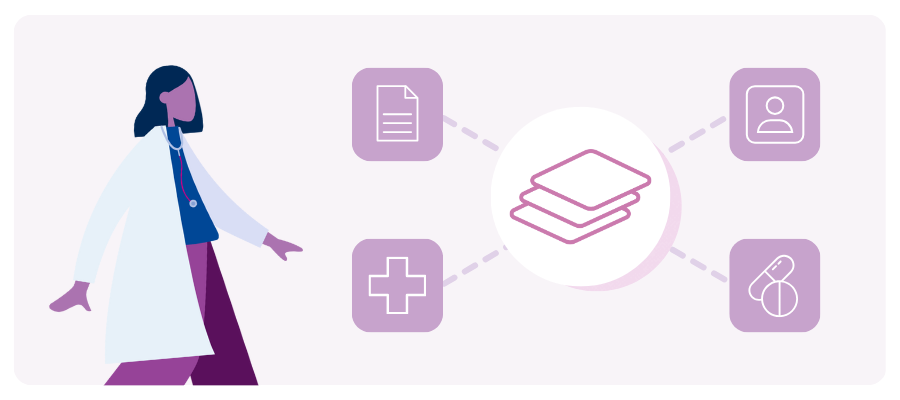
In other industries, personalization advanced by connecting transactional data with behavioral and household context. In healthcare, those signals remain separate to protect patient data, often resulting in a disconnect between strong clinical insights and effective patient engagement.
Connecting the dots is the hard part
There’s a common narrative that healthcare needs more data to improve personalization. In practice, the bigger challenge is connecting what you already have in a way teams can trust. Identity, preference, household context, and engagement history often live in different systems, and they rarely resolve cleanly to a usable profile.
A privacy-safe identity foundation changes that. When organizations can link records across sources with strong match discipline, governance, and tokenization, they can turn fragmented data into more relevant decisions without exposing more than is necessary.
Watch our Q&A with Cristin Liberatore from IQVIA Digital on healthcare marketing
How we approach this at Experian
At Experian, this is the lens we use:
What privacy-safe identity makes possible in regulated patient engagement
In regulated categories, accuracy, governance, and privacy are non-negotiable. That’s why I push teams to think about identity as infrastructure, because people move, households change, and preferences shift.
At Experian, that infrastructure includes:
- Marketing Attributes and Enrichment: Adding context to first-party data so planning and decisioning reflect the person you’re trying to reach.
- Offline and Digital Graphs: Connect identity across touchpoints so experiences stay consistent as people move between channels.
- First-Party Onboarding and data marketplace: Activate consented consumer and patient data across digital environments in a privacy-safe way. Our data marketplace extends that strategy with third-party partner segments, improving your personalization efforts to encourage a more proactive approach to healthcare.
- Curated Deals: Support upper-funnel awareness by aligning audience insight with higher-quality inventory in environments that can improve visibility, context, and campaign efficiency.
Watch our healthcare marketing panel from CES 2026
Identity must come first in healthcare marketing
Healthcare personalization has plateaued because engagement strategies have stayed too narrow and disconnected from the realities that shape follow-through.
The next phase of healthcare engagement will be defined by organizations that treat identity and additional patient context as the foundation for decisioning, activation, and measurement. When identity connects to real-world context through privacy-safe, governed, and tokenized practices, outreach becomes more relevant, easier to receive, and easier to act on.
About the author

Kevin Dunn
Chief Revenue Officer, Experian
Kevin Dunn joins Experian Marketing Services with more than 20 years of leadership experience across marketing and advertising technology, most recently serving as Senior Vice President of Brands and Agencies at LiveRamp. In that role, he led growth across retail, CPG, travel, hospitality, financial services, and healthcare, overseeing new business, account expansion, and channel partnerships.
Kevin is known for building cohesive, accountable teams and leading with optimism, clarity, and a strong sense of shared purpose. His leadership philosophy centers on empowering people, driving positive outcomes for clients and fostering a culture where teams can grow, take smart risks, and succeed together.
Latest posts

NEW YORK, May 4, 2016 /PRNewswire/ – Tapad, the leader in cross-device marketing technology and now a part of Experian, has been honored with two iMedia ASPY Awards. Announced on May 3rd at the iMedia Summit in Lost Pines, TX, Tapad's 2016 ASPY Awards include "Best Customer Service" and "Best Mobile Partner." In 2015, Tapad's proprietary technology, Tapad Device Graph™, was named "Best New Media Innovation" and Tapad employee Chris Martin was awarded the "Rising Star Award." The iMedia ASPY Awards – determined exclusively by agency votes – recognize the industry's top marketing technology, media companies and publishers for outstanding service to agencies. The award for "Best Customer Service" recognizes Tapad's client services team and their dedication to helping agencies fully understand their consumers' behavior and achieve the best cross-screen campaign ROI through Tapad's Campaign Pulse and TV Pulse analytics reporting. The "Best Mobile Partner" win recognizes the abilities of the Tapad Device Graph™ to deliver unified cross-screen solutions for the company's partners. "We are privileged to have a talented and dynamic group of people on our client services team, and we are honored to be recognized by iMedia Connection and our agency partners," said Tapad Founder and CEO, Are Traasdahl. "We have always strived to provide the best solutions and the best customer support, so it's extremely gratifying to be rewarded for our efforts. If our clients and partners are happy, we are happy." For more information on the iMedia ASPY Awards please visit: http://aspyawards.com. Read the full press release here. Contact us today
Cross-screen marketing tech firm, Tapad, drove unified campaign; partnered with Statiq to measure cross-screen impact on in-store visits LONDON, March 8, 2016 /PRNewswire/ – Carat North completed the UK's most comprehensive digital campaign with Tapad, the leader in cross-device marketing technology and now a part of Experian. Coupled with location-based audience data from Statiq, this marks the first time a UK-company has measured the impact of unified, cross-screen campaign on in-store visits. Carat North served display and video ads to grocery shoppers for the leading retailer ASDA from August through October. During the campaign, Tapad utilized Statiq's audience data to measure which users visited a store after being exposed* to the campaign's ad on multiple devices. The digital campaign demonstrated a lift of 59% for in-store visits when users were exposed to ads on three devices over people who were shown an ad only on onescreen. Those who engaged with the ad were also 411% more likely to visit an ASDA store. Of those who were exposed to an ad, 248% were more likely to visit a store. Impressions served to mobile devices saw the highest success rate with an in-store visit lift of 67%. The campaign leveraged Tapad's proprietary technology, The Device Graph™, which Nielsen confirmed Tapad's cross device accuracy to be 91.2%, to serve ads sequentially on connected devices belonging to the same user. CARAT NORTH: "The ability to know which devices belong to our customer, coupled with the ability to deliver the right ad, and right message, wherever they are and on whatever device they're using, has been something this industry has long needed," said Steve Thornton, Digital Account Manager, Carat North. "We're impressed with the results that have come from the work with Tapad and Statiq for this media-first, and look forward to continuing to offer these solutions to clients like ASDA. Matching unified cross-device capabilities with real insights on campaign performance is an invaluable advantage in the marketing world." TAPAD: "This campaign is a perfect example of the capabilities of cross-device advertising," said Are Traasdahl, Founder and CEO, Tapad. "In addition to reaching users across devices, we're able to analyze campaign results and determine how different combinations of ad exposure, creative type or view frequency affected their decision to visit a location." STATIQ: "As a location data specialist, Tapad is our ideal partner – they are an industry leader and by working with them we are able to determine the impact unified messaging has on real world consumer behaviours," said Dean Cussell, Co-Founder of Statiq. "We believe this type of analysis will significantly aid brands in optimising future ad spend." About Carat North Carat North is a leading independent media planning & buying specialist in digital and non-traditional media solutions. Owned by global media group Dentsu Aegis Network, the Carat network is more than 6,700 people in 130 countries worldwide across 170 cities. Carat defined the sector when established as the world's first media independent in 1968 and is now Europe's largest media network, a position held for more than 15 years. For more information visit www.carat.co.uk About Tapad Tapad Inc. is a marketing technology firm renowned for its breakthrough, unified, cross-device solutions. With 91.2% data accuracy confirmed by Nielsen, the company offers the largest in-market opportunity for marketers and technologies to address the ever-evolving reality of media consumption on smartphones, tablets, home computers and smart TVs. Deployed by agency trading desks, publishers and numerous Fortune 500 brands, Tapad provides an accurate, unified approach to connecting with consumers across screens. In 2015, Tapad began aggressively licensing its identity management solution, the Tapad Device Graph™, and swiftly became the established gold-standard throughout the ad tech ecosystem. Tapad is based in New York and has offices in Atlanta, Boston, Chicago, Dallas, Detroit,Frankfurt, London, Los Angeles, Miami, Minneapolis, San Francisco and Toronto. TechCrunch called the powerhouse Tapad team "a hell of a list of entrepreneurs who created some of the most valuable online advertising companies of the last decade." Among Tapad's numerous awards: EY Entrepreneur of The Year (East Coast) 2014, among Forbes' Most Promising Companies two year's running, Deloitte's Technology Fast 500, Crain's Fast 50, Entrepreneur 360, Digiday Signal Award, iMedia ASPY Award, and a MarCom Gold Award. Read the full release here. *Tapad utilized Statiq's audience data to measure which users visited a store during, or within one month of, being exposed to the campaign's ad on multiple devices. Contact us today
Welcome emails garner 86 percent higher open rates than regular promotional mailings. What other life cycle marketing programs should you be running?