Loading...

Healthcare personalization is stuck. Privacy-safe identity is the key to empathetic engagement

by Kevin Dunn, Chief Revenue Officer 5 min read April 2, 2026

Healthcare personalization needs privacy-safe identity

Healthcare organizations have invested heavily in digital engagement over the past decade. Patient portals. CRM platforms. Campaign automation. Consumer data platforms. And yet, personalization in healthcare still feels stuck.

Outreach is often generic. Preventive care reminders go unopened. Screening campaigns underperform. Value based care programs struggle to engage the very patients they are designed to support.

I hear a version of the same frustration from health system and life sciences leaders. Their engagement stack keeps expanding, but their impact on the patient experience remains limited.

While many healthcare organizations have abundant data, most have an identity and context gap.

Personalization stalls when identity never moves beyond the EHR

A diagnosis tells you what care is needed, but it doesn’t tell you how to reach someone, when they are most receptive, or what barriers might prevent follow-through.

Illustrated consumer profile card showing a person with icons representing interests like wellness, music, and fitness

When identity stops at the electronic health record (EHR), engagement becomes a series of educated guesses about a real person’s needs, preferences, and circumstances.

Patients don’t live inside the EHR

Consider how most preventive outreach works today. A patient leaves the hospital with instructions and a recommended follow-up appointment, and the system triggers a standard sequence of reminders.

The intent is right. The execution is usually constrained by missing context.

  • Will they see the message in the channel you chose?
  • Is a caregiver involved in coordinating next steps?
  • Is the barrier logistics, or clarity on what to do next?

These factors determine whether follow-up happens. They also determine whether “personalization” actually feels personal, or just automated.
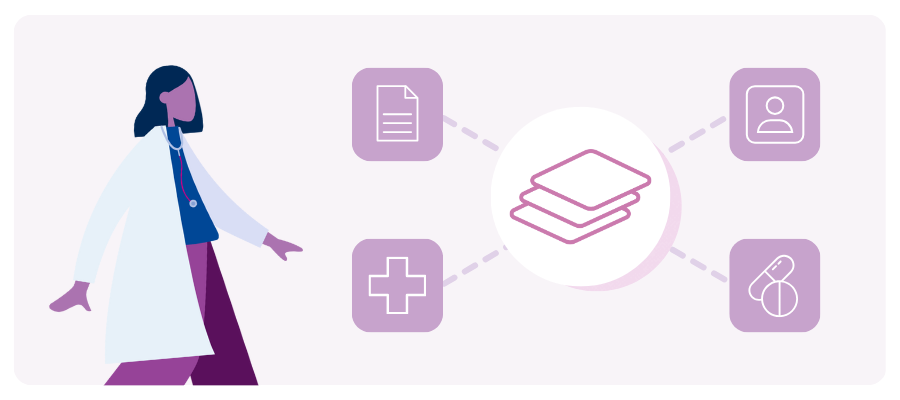
Woman with health icons

In other industries, personalization advanced by connecting transactional data with behavioral and household context. In healthcare, those signals remain separate to protect patient data, often resulting in a disconnect between strong clinical insights and effective patient engagement.

Connecting the dots is the hard part

There’s a common narrative that healthcare needs more data to improve personalization. In practice, the bigger challenge is connecting what you already have in a way teams can trust. Identity, preference, household context, and engagement history often live in different systems, and they rarely resolve cleanly to a usable profile.

A privacy-safe identity foundation changes that. When organizations can link records across sources with strong match discipline, governance, and tokenization, they can turn fragmented data into more relevant decisions without exposing more than is necessary.

Watch our Q&A with Cristin Liberatore from IQVIA Digital on healthcare marketing

How we approach this at Experian

At Experian, this is the lens we use:

Predict

Build an AI-ready data foundation from first-party data, then enrich it responsibly so models and segmentation reflect patient and consumer context.

Activate

Reach people in the channels they actually use, using privacy-safe identity, tokenized activation, and governance that supports compliant engagement in regulated environments.

Connect

Keep identity consistent across channels, so communications feel relevant and coordinated, not repetitive or fragmented, while maintaining compliance in a tokenized or de-identified fashion.

Prove

Tie engagement back to meaningful outcomes using our identity spine, so teams can learn what reduces friction and improves follow-through.

What privacy-safe identity makes possible in regulated patient engagement

In regulated categories, accuracy, governance, and privacy are non-negotiable. That’s why I push teams to think about identity as infrastructure, because people move, households change, and preferences shift.

At Experian, that infrastructure includes:

  • Marketing Attributes and Enrichment: Adding context to first-party data so planning and decisioning reflect the person you’re trying to reach.
  • Offline and Digital Graphs: Connect identity across touchpoints so experiences stay consistent as people move between channels.
  • First-Party Onboarding and data marketplace: Activate consented consumer and patient data across digital environments in a privacy-safe way. Our data marketplace extends that strategy with third-party partner segments, improving your personalization efforts to encourage a more proactive approach to healthcare.
  • Curated Deals: Support upper-funnel awareness by aligning audience insight with higher-quality inventory in environments that can improve visibility, context, and campaign efficiency.

Watch our healthcare marketing panel from CES 2026

Identity must come first in healthcare marketing

Healthcare personalization has plateaued because engagement strategies have stayed too narrow and disconnected from the realities that shape follow-through.

The next phase of healthcare engagement will be defined by organizations that treat identity and additional patient context as the foundation for decisioning, activation, and measurement. When identity connects to real-world context through privacy-safe, governed, and tokenized practices, outreach becomes more relevant, easier to receive, and easier to act on.


About the author

Kevin Dunn, Chief Revenue Officer, Experian

Kevin Dunn

Chief Revenue Officer, Experian

Kevin Dunn joins Experian Marketing Services with more than 20 years of leadership experience across marketing and advertising technology, most recently serving as Senior Vice President of Brands and Agencies at LiveRamp. In that role, he led growth across retail, CPG, travel, hospitality, financial services, and healthcare, overseeing new business, account expansion, and channel partnerships.

Kevin is known for building cohesive, accountable teams and leading with optimism, clarity, and a strong sense of shared purpose. His leadership philosophy centers on empowering people, driving positive outcomes for clients and fostering a culture where teams can grow, take smart risks, and succeed together.


Latest posts

Loading…
The future of retail advertising: Embracing retail media standardization

Discover how retail media standardization can streamline your marketing efforts, enhance campaign efficiency, and drive better results.

Published: August 20, 2024 by Experian Marketing Services
An interview with Webbula’s Jordan Feivelson, Vice President of Digital Audiences

In our Ask the Expert Series, we interview leaders from our partner organizations who are helping to lead their brands to new heights in ad tech. Today’s interview is with Jordan Feivelson, VP, Digital Audiences at Webbula. Jordan is a 22-year advertising industry veteran who has worked for media properties such as WebMD and Disney. Over the past ten years, he has transitioned to the data and programmatic space, including growing the data business for Kantar Shopcom and Adstra.  What types of advertisers might benefit from utilizing Webbula audiences across various verticals? Can you provide examples of how different industries successfully leverage your data to achieve specific campaign goals?  Most advertisers can leverage Webbula’s award-winning attributes for their activation initiatives. Webbula offers approximately 3,000 syndicated segments covering categories such as Demographics, Automotive, Political, Mortgage, B2B, Hobby/Interest/Lifestyle, and Interests & Brand Preferences (brand name targeting).  Audience insights and marketing strategies  What specific types of audience segments does Webbula provide? How can advertisers leverage these segments to craft more effective, personalized marketing strategies?   Webbula has incredible depth and breadth within its verticals, giving marketers the tools to deliver targeted messaging effectively. Our Demographic, B2B, Mortgage, Automotive, and Interest and Brand Preferences segments each contain 500-1,000 segments, all built on deterministic, self-reported, and individually linked data. We ensure the best accuracy with multiple deterministic data points tied to the real world (ex., first name, last name, postal address, and email address).   Some examples of our unique syndicated audience types:  B2B: A view of the latest industry trends with detailed cuts of the professional world, such as companies with and not within the Fortune 500 companies and job positions that are directors and below. This also includes custom capabilities, including ABM (list of target companies in an activation campaign or by industry code (ex. NAICS, SIC).   Interest and Brand Preferences: Consumers who have shown interest and affinity to hundreds of brands (ex., Nike), genres (ex., comedy, hip hop), sports teams, and more.  Mortgage: A detailed view of homebuyers’ purchase range, loan type (ex. jumbo loan, standard loan), mortgage amount, interest rate, and more.   With Webbula’s audience data, brands can create a comprehensive picture of their audiences down to the individual level and reach them accurately.   Data quality, sourcing, and differentiation  How is consumer data sourced and curated at Webbula? Are there data quality standards that Webbula establishes for consumer data, and how do you ensure your sources and methods meet these standards consistently?   Webbula’s data is aggregated from over 110 trusted and authenticated sources, including publishers, data partners, social media, and more. The data collected comes directly from consumers who self-report information through surveys and other methods. We apply our hygiene filters to mitigate fraud and accurately score the data.  Data Collection: The data collected comes directly from consumers who self-report information through surveys, questionnaires, transactions, and sign-ups. This ensures that brands display ads to audiences based on self-identified, cross-channel behaviors, not modeled assumptions.  Hygiene Solutions: Webbula applies multi-method hygiene solutions to mitigate fraud and accurately score the data before onboarding, ensuring that all data meets the highest quality standards.  Examples of Data Sources:  Questionnaires: Self-reported data through surveys, offer submissions, and telemarketing.  Transactions: Deterministic data from aftermarket parts, online purchases or services, and more.  Sign-ups: Individually linked data from information entered through sweepstakes, infomercials, newsletters, and forms.  What differentiates Webbula’s data from other data providers in the market? Can you explain the unique value proposition that Webbula offers in terms of data depth and breadth?   Due to our extensive experience in data cleansing, we provide the most accurate data within the programmatic ecosystem. TruthSet, the leading programmatic accuracy measurement company, has ranked Webbula as having the highest number of top attributes compared to other data providers with 150M+ HEMs. Additionally, Publicis Groupe and Neutronian further validate Webbula’s data quality, underscoring its position as a leader in the industry.  Webbula’s data stands out in the market due to its unmatched accuracy and quality, achieved through years of expertise in data cleansing. Unlike other providers, Webbula’s foundation lies in its robust email hygiene process, ensuring that all data entering the programmatic ecosystem is thoroughly cleansed.   Privacy, compliance, and future-proofing  What measures does Webbula take to maintain data privacy and compliance? How do these efforts benefit advertisers in an evolving regulatory landscape and ensure ethical standards?   Webbula was created over a decade ago with a future-proof, privacy-compliant foundation. We understand the industry’s rapid changes, including government and state legislation and cookie depreciation. Our goal has always been to build long-term partnerships and ensure we are prepared for industry changes. We rely on validated offline data sources, making us resilient to external influences.  Success stories  Can you share success stories where advertisers saw significant campaign improvements using Webbula’s data? What were the key factors that contributed to these successes?   Our success is measured by client feedback and increased client spend. Webbula has helped several key advertisers achieve six-figure monthly thresholds by providing the most accurate data to meet campaign KPIs. Clients consistently return to use our data, validating our belief that “the proof is in the pudding.”  Thanks for the interview. Any recommendations for our readers if they want to learn more?  For those interested in learning more about Webbula, reach out for a personalized consultation. Contact us   Latest posts

Published: August 13, 2024 by Experian Marketing Services

Subscribe to our newsletter

Enter your name and email for the latest updates

This site is protected by reCAPTCHA and the Google Privacy Policy and Terms of Service apply.

About Experian Marketing Services

At Experian Marketing Services, we use data and insights to help brands have more meaningful interactions with people. As leaders in the evolution of the advertising landscape, Experian Marketing Services can help you identify your customers and the right potential customers, uncover the most appropriate communication channels, develop messages that resonate, and measure the effectiveness of marketing activities and campaigns.

Visit our website

Subscribe to our newsletter

Stay up to date on the latest industry news and receive expert tips from our marketing experts.
Subscribe now!