At A Glance
Healthcare marketing now runs across mixed-identity conditions, where authenticated data, contextual signals, and aggregated measurement all show up in the same campaign. Pharma brands need infrastructure that keeps DTC and HCP identity separate and still connects fragmented signals across activation, privacy, and measurement. Experian acts as an independent, privacy-first identity, data, and workflow layer for pharma marketers, designed specifically for this operating environment.Originally published in Digiday
Key takeaways
- Pharma campaigns now span environments with very different identity conditions, from strong addressability to contextual only signals, which makes coordination a core infrastructure challenge.
- Privacy and compliance rules require DTC (patient) and HCP (healthcare professional) data to stay in separate, non-overlapping workflows at every stage.
- Experian’s identity and workflow layer governs DTC tokenized matching and HCP deterministic National Provider Identifier (NPI) resolution as two distinct processes, never one merged identity path.
- Partner-enabled measurement connects exposure data to outcomes like script lift and qualified HCP engagement through trusted partners including IQVIA Digital, PurpleLab, and OptimizeRx.
A pharmaceutical brand launching a campaign today might rely on authenticated data in one environment, contextual signals in another, and aggregated measurement somewhere else entirely. That’s the reality of healthcare marketing right now, and most brands are still building the operational model to match it.
In a mixed-identity ecosystem, performance comes from the ability to coordinate multiple signal types across activation, privacy, and measurement workflows. Accuracy and scale depend on knowing which approach fits which environment and having the infrastructure to execute across all of them.
From onboarding to outcomes
Pharma marketing teams need identity workflows that can support accurate audience creation, governed activation, and partner-enabled measurement without combining DTC and HCP identity paths.
Download our pharma marketing playbook to help your team:
- Plan DTC and HCP identity strategies with clearer separation
- Prepare audiences for activation across approved channels and partners
- Evaluate audience quality, usable reach, and governance

Healthcare campaigns run across different signal conditions
Healthcare campaigns now run across environments with very different identity conditions, from fully addressable channels to contextual only placements. Digital advertising has long assumed that better identity leads to better targeting, frequency management, orchestration, and measurement, but healthcare has always operated with more constraints than most categories. Those constraints are becoming impossible to ignore as budgets move into connected TV (CTV), point-of-care, publisher-direct, programmatic and retail media-adjacent environments.
That shift changes the operating model. Marketers now have to manage audience strategy, supply quality and performance across channels that don’t support the same level of addressability, interoperability, or measurement visibility. In some environments, identity is strong and can support targeting and measurement. In others, identity is limited or unavailable, and marketers have to rely on contextual or aggregated signals. Managing across both environments is now a core infrastructure challenge for healthcare marketers, and it’s one that requires a deliberate strategy rather than a channel-by-channel patch.
Privacy risk is a media infrastructure issue
Privacy risk in healthcare marketing now shapes how campaigns get built and run from the ground up, extending well beyond compliance into media infrastructure itself. Tighter privacy and compliance expectations mean audience construction, exposure management, and outcomes analysis all get more complex once tracking is restricted.
Data can’t move freely across partners or workflows, and DTC and HCP data environments need to stay isolated from one another. This is especially true in pharma, where the stakes of a compliance misstep extend well beyond a campaign. This creates a more demanding operating model. Healthcare marketers have to balance identity-based and privacy-forward approaches while maintaining reach, relevance, and accountability. That balance requires governance that’s built into the infrastructure, not layered on top of it after the fact.
Experian acts as an independent, privacy-first identity, data, and workflow layer for pharma marketers, designed specifically for this operating environment:
These workflows are governed separately by design, with governed onboarding connecting fragmented DTC and HCP signals to activation-ready audiences without collapsing the two identity paths.
The mixed-identity playbook starts with matching the approach to the environment
The right mixed-identity approach depends on what each environment can support and what the campaign is needs to achieve. A pharmaceutical team may want more addressability, a publisher may only offer contextual or cohort signals, and a measurement partner may need exposure data, while platforms limit how identifiers can be shared.
Healthcare marketers need an operating model built for multiple identity conditions, with clear rules for how signals can be connected, activated, and measured without increasing privacy or compliance risk. That may include:
Experian’s infrastructure supports all three modes:
The missing layer in pharma marketing. Watch our Q&A
Supply quality is a prerequisite for measurement
Supply quality determines whether measurement in a mixed-identity environment can be trusted. When tracking and addressability vary across channels, advertisers need confidence that impressions ran in the right environments and under the right conditions before they can trust any downstream outcomes.
This is especially true in CTV and programmatic, where campaigns span fragmented supply paths, publishers, devices, and partners. Outcomes like script lift or provider engagement are only meaningful if the underlying exposure is reliable and well understood. In healthcare, this also ties directly to brand suitability and disclosure control. Curated supply, publisher-direct deals and placement-level transparency help campaigns run in appropriate environments and give measurement a more defensible foundation.
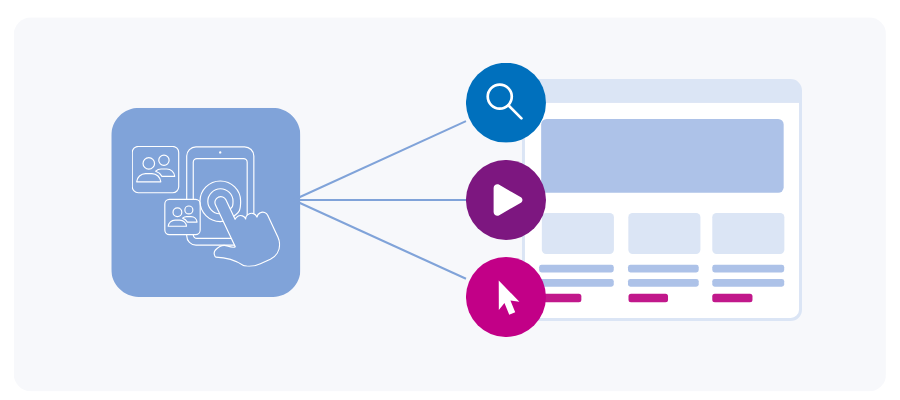
Clean rooms and tokenization support this, but their effectiveness depends on governance, interoperability, and whether insights can move cleanly across partners and workflows. Partner-enabled measurement, connecting exposure data to outcomes through trusted partners including IQVIA Digital, PurpleLab, and OptimizeRx, is structured in two steps:
- Link activation and measurement IDs without collapsing them into an open identity environment
- Produce aggregated, defensible outcomes including script lift, qualified HCP engagement, and verified delivery
Mixed-identity is the operating reality, and infrastructure is how you manage it
Mixed-identity is now the operating reality for healthcare marketing, not a temporary phase to work around. Performance depends on working across environments where identity is sometimes strong and sometimes limited by design. Healthcare marketers don’t need to pick a single identity approach and apply it everywhere. Building infrastructure that connects deterministic identity, tokenized matching, and contextual signals, keeping compliance, operational flexibility, and trust intact at every step, is what separates the brands managing this well from the ones still patching it channel by channel.
Talk to our team about your healthcare identity strategy
Whether you’re running DTC, HCP, or both, our team can help you build an infrastructure that works across identity environments. Let’s connect.
About the author

Kevin Dunn
Chief Revenue Officer, Experian
Kevin Dunn joins Experian Marketing Services with more than 20 years of leadership experience across marketing and advertising technology, most recently serving as Senior Vice President of Brands and Agencies at LiveRamp. In that role, he led growth across retail, CPG, travel, hospitality, financial services, and healthcare, overseeing new business, account expansion, and channel partnerships.
Kevin is known for building cohesive, accountable teams and leading with optimism, clarity, and a strong sense of shared purpose. His leadership philosophy centers on empowering people, driving positive outcomes for clients and fostering a culture where teams can grow, take smart risks, and succeed together.
FAQs
Mixed-identity means a healthcare campaign relies on more than one type of signal at once, such as authenticated data in one channel, contextual data in another, and aggregated measurement in a third. Pharma brands increasingly need infrastructure that coordinates all of these signal types together instead of treating each channel as a separate problem.
Experian keeps DTC and HCP identity in distinct, non-overlapping workflows so patient data and healthcare professional data never combine. DTC activation runs on high-fidelity tokenized matching, and HCP activation relies on deterministic National Provider Identifier (NPI) resolution using verified attributes like specialty and practice location.
Supply quality matters because outcomes like script lift or provider engagement only mean something if the underlying ad exposure is reliable. Curated supply, publisher-direct deals, and placement-level transparency give healthcare marketers a more defensible foundation before they trust any downstream measurement result.
Partner-enabled measurement connects exposure data to outcomes through trusted third parties such as IQVIA Digital, PurpleLab, and OptimizeRx, without merging activation and measurement identifiers into one open identity environment. The result is aggregated, defensible outcomes like script lift, qualified HCP engagement, and verified delivery.
Healthcare marketers don’t have to choose one approach over the other, since most campaigns already run across both conditions at the same time. Building infrastructure that connects deterministic identity, tokenized matching, and contextual signals is what allows a campaign to stay compliant while still reaching the right audience.
Latest posts

Tapad’s technology enhances Bidtellect clients frequency capping and audience extension capabilities cross device. NEW YORK, Feb. 28, 2019 /PRNewswire/ — Tapad, part of Experian, is a global marketing technology company and leader in digital identity resolution solutions, today announced a new partnership with Bidtellect (now Simpli.fi), a leading native Demand-Side Platform (DSP). Bidtellect’s paid content distribution platform will leverage The Tapad Graph™ as its first cross-device partner. The integration will offer Bidtellect’s clients in the U.S. and Canada cross-device frequency capping and enhanced audience extension capabilities. The combination of Tapad’s leading cross-device technology, with Bidtellect’s unparalleled scale and optimization capabilities, will allow content marketers within brands and agencies to develop even more strategic, effective content marketing campaigns. The Tapad Graph™ will allow content marketers to gain greater reach and create more relevant, unified messaging with targeted delivery, when used in conjunction with Bidtellect’s technology. Marketers can expect to benefit from amplified reach, and enhanced, privacy-safe engagement with desired audiences as a result of this partnership. “Partnering with Tapad, the leaders in cross-device data, provides Bidtellect with a complete solution that leverages both probabilistic and deterministic mapping strategies,” said Mike Conway, Chief Technology Officer at Bidtellect. “The Tapad relationship expands our audience size by providing the opportunity to reach the same user across multiple devices and, when used in conjunction with our frequency capping functionality, ensures increased reach, reduced ad saturation, and elimination of wasted ad spend.” As the partnership progresses, Tapad will also work with Bidtellect to provide advanced attribution for conversions and engagement metrics including connectivity and amplification. These advanced insights will help brands and agencies develop a more holistic approach to content marketing, so they can build audiences and influence bidding algorithms that directly impact their business. Contact us today
The Tapad Graph Now Offered in Adobe Audience Manager, part of Adobe Analytics Cloud New York, NY — August 7, 2018 — Tapad, now part of Experian, is advancing personalization for the modern marketer, announced today that its proprietary Tapad Graph is now integrated with Adobe Audience Manager, part of Adobe Analytics Cloud, helping marketers expand their view of consumers and boost results through Tapad’s probabilistic solution. Tapad has been working closely with the Adobe Audience Manager team on this integration. With the Tapad Graph integration, customers based in the U.S. and Canada can use the Tapad Device Graph to expand the reach of audiences defined and activated in Adobe Audience Manager to extend first- and third-party data and deliver personalization across paid, earned and owned channels, publisher sites, programmatic, and more. Tapad worked closely with Adobe to develop the integration, allowing marketers to enable first-party data that has been previously tied to cookies and mobile. This offering has been beta-tested by leading organizations across retail, financial services, telecom providers, and more. Tapad has repeatedly proven its ability to provide marketers with a unified view of the customer across channels and screens. With the Tapad Graph, a global identity graph that currently supports more than 100 enterprise customers and 200 integration partners, marketers can extend their reach and customize messages based on user and household-level data. Contact us today
Marketers Can Now Harness The Tapad Graph In Concert With Twine’s Vetted, Verified TrueData™ Identity Graph. Los Angeles and New York – August 2, 2018 – Tapad, now part of Experian, is reinventing personalization for the modern marketer, today announced that it is partnering with mobile data leader Twine Data (now TrueData) to bring Twine’s hundreds of millions of deterministic mobile identity connections to The Tapad Graph. Together, the two companies will create one of the largest portable identity graph & CRM onboarding services in the U.S., through the integration of Tapad’s best in class cross-device capability and Twine’s deterministic identity graph. At the core of one-to-one marketing and true personalization is identity resolution. For marketers, the ability to accurately and safely connect customer activity across desktop/laptop, mobile, CTV, tablets, as well as CRM and offline touchpoints is ultimately what enables informed and personalized future conversations with each customer. Tapad is known for the precision, accuracy, and scale of their cross device connections, setting them up as an ideal partner for Twine’s TrueData deterministic identity graph. “We believe that by combining Tapad’s renowned cross-device connectivity and our deterministic identity graph, marketers will finally be able to seamlessly segment users based on digital and offline behaviors as well as easily distribute those audiences to both DMP and DSP environments for personalized messaging,” said Elliott Easterling, CEO of Twine Data. With this partnership, Tapad will build a client’s cross-device graph off of identities onboarded by Twine from a client’s offline CRM. The resulting identity graph can either be delivered directly to brands looking to host their own identity graph, or can be leveraged in a managed fashion for marketers looking for simple connectivity of their offline CRM audiences to their DSPs. To date, Twine & Tapad have seen full connectivity rates* for CRM segments from advertisers at between 259 percent and 322 percent at major DSPs. *Full Connectivity Rate is defined as {total unique desktop, laptop, and mobile devices active at DSP} / {unique CRM users in original audience post cleansing}. It represents the final match rate of the clean audience in CRM format to onboarded audience at a client’s DSP instance. This metric encompasses Twine’s onboarding & linkage validation and Tapad’s cross-device amplification. About TapadTapad, Inc. is the marketing technology company reinventing personalization for the modern marketer through its identity-driven solutions. The company’s signature Tapad Graph connects millions of consumers across billions of devices. The world’s largest brands and most effective marketers entrust Tapad to provide an accurate, privacy-conscious and unified approach to connecting with consumers across screens. In 2018, Tapad introduced its Tapad Customer Data Platform (CDP), purpose-built to offer marketers a highly personalized and privacy-safe platform to convert first-, second- and third-party data into actionable, results-driven campaigns. Tapad is based in New York and has offices in Chicago, London, Oslo, Singapore and Tokyo. Tapad’s numerous awards include: Forbes’ Most Promising Companies, Deloitte’s Technology Fast 500, Crain’s Fast 50, TMCnet Tech Culture Award and Global Startup Award’s “Startup Founder of the Year.” Tapad was acquired by the Telenor Group in 2016. Telenor Group is one of the world’s largest mobile operators across Scandinavia and Asia. About TwineTwine is a mobile data platform that believes true, honest, accurate data is the fuel that helps our partners grow their businesses efficiently and effectively; Twine’s TrueData is used by brands, agencies, and ad tech partners across the country and across the globe. Twine’s app publisher partners generate revenue while maintaining control over their data; their marketer partners get comprehensive, high quality mobile targeting and intelligence. To learn more about Twine, visit their website. Contact us today