At A Glance
Your first-party data delivers the most value once it's activated. Learn how identity resolution can help you overcome silos and inconsistent identifiers so you can activate addressable audiences across email, programmatic, connected TV (CTV), social, and prospecting campaigns.In this article…
Key takeaways:
- Resolve fragmented customer records into addressable audiences before activation so inconsistent identifiers don’t limit reach and measurement.
- Fill gaps, update outdated information, and remove duplicate records to improve match rates, targeting accuracy, and measurement.
- Suppress existing customers from acquisition campaigns to reduce wasted prospecting spend.
- Start with one high-value audience and one or two destinations, then scale through tools such as Experian’s Audience Engine, which supports 200+ platforms.
What is first-party data?
First-party data is consented information a brand collects directly through interactions with customers and prospects across its owned touchpoints — unlike third-party data, which is licensed or aggregated from external providers. First-party data can include customer relationship management (CRM) records, purchase history, loyalty program activity, website and app behavior, email engagement, and other information generated through the brand’s relationship with its audience.
In the activation context, first-party data can help you build addressable audiences for paid and owned channels. Identity resolution connects fragmented records and identifiers, enabling more consistent audience creation, activation, and measurement across the media ecosystem. This is likely why, in 2026 and beyond:
- 70% of B2B marketers plan to increase their use of first-party data, more than any other data strategy.
- 67% of brands and 80% of publishers expect to grow their first-party data sets in the next year.
First-party data vs. zero-party, second-party, and third-party data
While it’s often the foundation of an activation strategy, first-party data isn’t the only useful data type. Depending on the campaign goal, other data sources can add declared preferences, extend reach beyond known customers, or provide helpful context for targeting and modeling.
- Zero-party data is information that customers intentionally and proactively share with a brand, such as interests, purchase intentions, or survey responses. It tends to be narrower in scale and coverage than first-party data, but it can still help you personalize messaging and experiences to customers’ stated needs.
- First-party data is what a brand collects through direct customer interactions and observed activity, such as account activity, responses to brand campaigns, customer service encounters, and so on. It helps you build known audiences, suppress existing customers, and support lifecycle and cross-channel campaigns.
- Second-party data is another organization’s first-party data shared through a direct partnership. It can extend audience reach beyond a brand’s known customer base or enrich existing profiles with complementary partner data, while maintaining a connection to the original data source.
- Third-party data comes from external providers and can add demographic, behavioral, lifestyle, and other insights. It helps you enrich first-party audience data, extend reach, support prospecting, and build modeled audiences at a greater scale.
First-party data tends to be the strongest starting point for activation since it provides a broader view of a brand’s direct customer relationships.
Why does activation expand the value of first-party data?
On its own, first-party data can reveal who customers are, how they behave, and what they value. It supports insight, personalization, and engagement through owned touchpoints. But in 2026, you can expand that value by activating first-party data across owned and paid media channels. Activation is how existing data investments scale beyond CRMs into broader audience strategies.
When you resolve fragmented records and create addressable audiences, you can put audience insights to work at a greater scale. However, the value you unlock through activation depends on the quality of the data beneath it. Incomplete, outdated, or duplicate records can weaken match rates, audience accuracy, and measurement.
Accurate data and persistent identity resolution, on the other hand, help you reach the right audiences, reduce waste, and connect activation to outcomes. Once you have a strong data and identity foundation, the next step is activating it across the ecosystem.
How are marketers shifting from data collection to data connection?
As signals fragment, marketers are shifting from data collection to data connection to make first-party data usable across channels. We support this shift by helping you onboard and resolve your data into a clean, connected foundation using our identity graphs.
Connecting offline and online interactions allows you to unify customer data across touchpoints to make it actionable. That connection enables a wider range of use cases, from audience activation and measurement to personalization and cross-channel optimization.
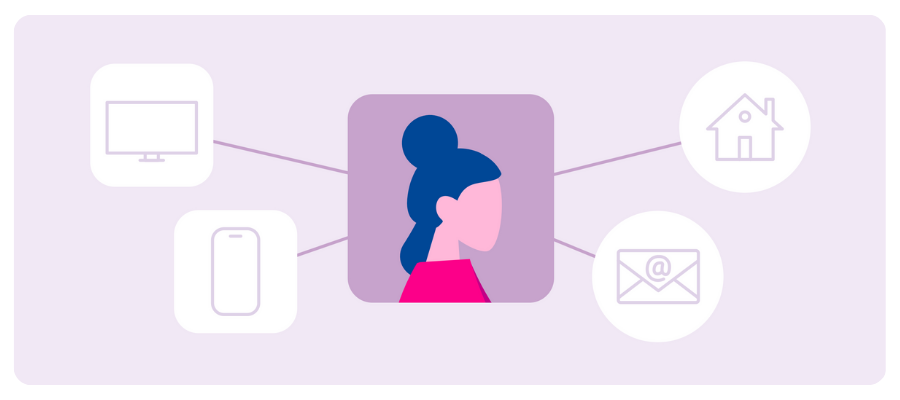
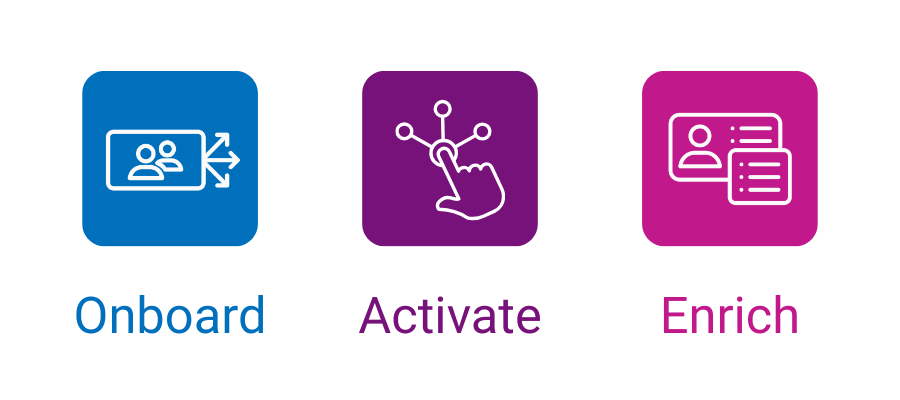
With our identity foundation in place, first-party data becomes more widely usable. You can enrich your first-party data with behavioral, demographic, and lifestyle insights from trusted partner data, then activate it across social, programmatic, and TV from a single environment.
Common challenges in first-party data activation
While building a connected foundation can make first-party data more broadly useful, several factors can also make that foundation difficult to build and maintain, determining how effectively you can activate first-party data across channels.
Disconnected data silos
First-party data often lives across CRM systems, point-of-sale platforms, email tools, websites, apps, and analytics environments. Without a shared identity foundation, those systems may treat the same customer as multiple people, which makes it challenging to create a consistent audience view or coordinate cross-channel activation. We help connect fragmented online and offline signals through identity resolution to give you a more unified data foundation for audience creation, activation, and measurement.
Incomplete or outdated records
Customer data changes over time. Email addresses become inactive, contact details change, and behavioral signals lose relevance. Without ongoing data maintenance and identity resolution, match rates can decline, reducing the accuracy of activated audiences and measurement.
Inconsistent identifiers across channels
Various platforms rely on different identifiers, so a customer recognized in one environment may not be recognized in another. Identity resolution helps connect fragmented signals, reduce duplicate profiles, and improve consistency throughout the activation process.
Limited reach and audience scale
A brand’s first-party data may not be extensive or detailed enough to support every campaign objective. Experian’s Enrichment can add demographic, behavioral, and lifestyle attributes to help you better understand known audiences and create more informed segments. When you need to reach beyond your existing customer base, our syndicated audiences can help extend prospecting reach with relevant, privacy-forward audience data.
Privacy and governance requirements
Activating first-party data requires you to account for permissions, opt-outs, data-use policies, and applicable privacy regulations. Building those considerations into the activation process from the start helps you maintain control of your data while supporting responsible use across partners and platforms.
Fragmented measurement
It can be difficult to connect media exposure and outcomes when audience identity varies across activation and measurement environments. A consistent identity foundation helps link the audiences you activate with the outcomes you measure, supporting more complete, cross-channel performance measurement.
The importance of first-party data in media planning
As media environments fragment, first-party data gives you a more durable foundation for planning audiences, personalizing campaigns, and measuring performance.
At the same time, first-party data isn’t the only input to an effective media strategy. You can combine it with trusted partner and syndicated data to enrich known audiences, extend reach, and fill gaps in your customer insights. We help make those data sources more usable across activation and measurement environments with a consistent identity foundation.
2026 Digital trends and predictions report
Our 2026 Digital trends and predictions report reveals five trends that will define 2026. From curation becoming the standard in programmatic to AI moving from hype to implementation, each trend reflects a shift toward more connected, data-driven marketing. The interplay between them will define how marketers will lead in 2026.
What business impact does first-party data activation deliver?
First-party data activation can improve campaign efficiency and performance by helping you reach more relevant audiences, reduce wasted media spend, and connect marketing activity to measurable business outcomes. It also helps you use existing customer relationships more strategically — for example, by suppressing current customers from acquisition campaigns, personalizing outreach, and prioritizing audiences that are more likely to respond.
That shift can have a meaningful business impact. Research suggests that activating first-party data can reduce customer acquisition costs by up to 50% and drive a 10–15% lift in revenue by helping you prioritize more relevant audiences and avoid spending against people you already know or are unlikely to convert.
Those outcomes depend on making first-party data usable beyond the CRM. When fragmented records are connected into more complete, addressable audiences, you can apply customer insights more consistently across planning, targeting, personalization, activation, and measurement.
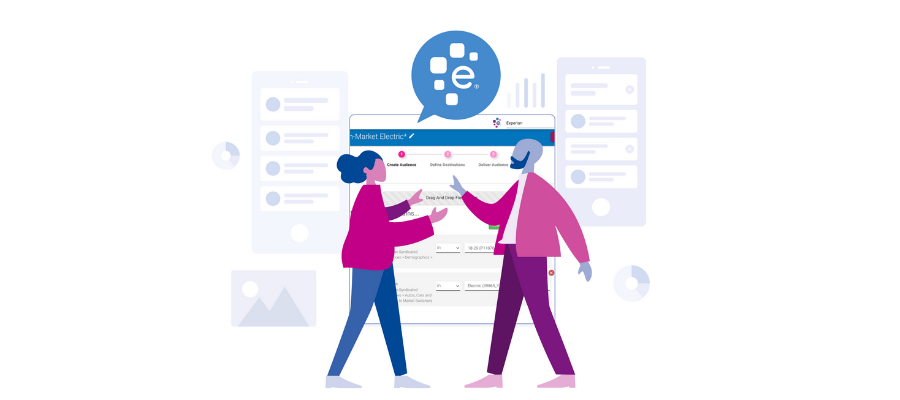
Audience Engine helps you put this strategy into practice by bringing together first-party data, audience insights, and activation in a single workflow. You can build custom audiences, activate them across 200+ platforms, and use 3,500+ syndicated audiences and partner data to enrich your strategy or extend reach when needed.
Key channels and strategies for first-party data activation
To drive business impact, you need to activate addressable audiences in the places where you reach and engage customers. First-party data activation can support both paid media and owned experiences. The right mix depends on your audience, campaign objective, available identifiers, and the platforms you use to reach and measure customers.
Email and direct mail
Email and direct mail are core first-party activation channels for retention, loyalty, and lifecycle marketing. You can use customer data to tailor messages, suppress irrelevant outreach, and coordinate communications based on purchase history, engagement, or customer status.
Programmatic display
When you onboard first-party audiences to compatible programmatic platforms for targeting, suppression, and measurement, you can extend customer insights into paid media, reduce wasted spend on existing customers, and support more relevant prospecting strategies.
Connected TV
Identity-resolved first-party data can support audience activation across compatible connected TV (CTV) environments. This gives you another way to reach customers and high-value prospects with more relevant messaging while connecting household-level exposure to broader campaign measurement.
Social platforms
First-party audiences can be matched to supported social platforms for targeting, suppression, audience expansion, and measurement. Used alongside platform signals, first-party data gives you more control over who you reach and how campaigns align with existing customer relationships.
Modeled audiences and prospecting
Use high-value first-party segments, such as repeat purchasers or high-lifetime-value customers, as the foundation for modeled audiences. Partner and syndicated data can add scale and context, helping you identify new prospects who share characteristics with your best customers.
Owned websites and apps
Activation isn’t limited to paid media. First-party data can also inform personalized website and app experiences, product recommendations, offers, and messaging based on known customer behavior and preferences.
The best activation strategies connect these channels through a consistent identity foundation, helping you coordinate audiences, reduce duplication, and support more consistent measurement.
What should marketers plan for first-party data activation in 2026?
Once you know where first-party audiences can be activated, the next question is how to build an activation approach that can scale across those channels.
In 2026, it’s important to plan for first-party data to operate across onboarding, activation, and measurement as a connected workflow. Planning now centers on interoperability, scalable activation tools, and privacy-forward enrichment rather than isolated data use cases. Identity underpins each of these shifts.
1. First-party onboarding is table stakes
Onboard CRM and other first-party data into compatible programmatic and connected TV environments to make known audiences more usable across channels. You can then combine those audiences with trusted syndicated and partner data when additional scale is needed.
2. Unified activation tools accelerate execution
A unified activation tool like Audience Engine helps you bring first-party data and partner audiences into a single workflow, supporting first-party data activation across 200+ platforms, including display, connected TV, and social.
This reduces the operational friction of managing separate, platform-specific audience views. With identity-resolved data connected to activation, you can create more complete audiences and apply first-party data targeting more consistently across platforms.
For smaller teams, start with a focused onboarding and test use case, such as customer suppression, retargeting, or prospecting from a high-value customer segment. You can then expand activation as your data, measurement needs, and channel strategy mature.
3. AI-driven enrichment enhances performance
Machine learning can identify patterns, predict behavior, model lookalikes, and uncover actionable insights to increase reach and relevance, even as traditional signals fragment.
With our in-house modeling capabilities, you gain faster access to advanced machine learning and the ability to define your own model parameters. This gives you direct control over how audiences are built and optimized, allowing you to activate insights quickly, iterate as strategies evolve, and avoid the limitations of black-box third parties and long development cycles.
Best practices for getting started with first-party data activation
A successful activation strategy starts with a clear use case, reliable data, and a foundation that can scale over time. You don’t need to activate every record or channel at once. Starting with a focused audience and measurable objective makes it easier to test performance, refine the approach, and confidently expand.
Start with a clear business objective
Define what you want the activation effort to accomplish, whether that’s improving retention, reducing acquisition waste, reaching high-value prospects, or increasing cross-sell performance. Your objective should guide the data, audience, channels, and metrics you prioritize.
Prioritize high-value audiences
Begin with segments tied to a meaningful business outcome, such as repeat purchasers, high-lifetime-value customers, recent converters, or lapsed customers. Starting with a focused audience can produce clearer insights than deploying an entire customer database at once.
Build suppression into prospecting campaigns
Use first-party data to exclude existing customers from acquisition campaigns when appropriate. Suppression can reduce wasted spend, limit repetitive messaging, and protect the customer experience.
Test before expanding
Start with one or two activation destinations and establish benchmarks for reach, engagement, efficiency, or conversion. Use the results to refine audience definitions, messaging, and channel strategy before expanding across the broader media mix.
Refresh audiences regularly
First-party data changes as customer behavior, contact information, and preferences evolve. Review and refresh audiences regularly to keep activation relevant and accurate over time.
Choose a flexible activation approach
Look for partners and tools that can support your first-party data alongside partner and syndicated audiences across the platforms you already use. A flexible, interoperable approach makes it easier to add use cases, extend reach, and connect activation with measurement as your strategy matures.
Why first-party data activation matters to marketers in 2026
First-party data activation turns customer records into connected audiences you can use across the media ecosystem. Audience Engine enables you to onboard, enrich, and activate first-party data through a secure, interoperable platform that supports more relevant targeting and measurable outcomes.
To explore this trend and the others shaping marketing in 2026, download our 2026 Digital trends and predictions report.
Ready to connect with our team?
Click here to view Experian’s U.S. Consumer Data Privacy Notice.
This site is protected by reCAPTCHA and the Google Privacy Policy and Terms of Service apply.
About the author

Doug McLennan
Sr. Director, Product Management, Experian
Doug McLennan is the Senior Director of Product Management at Experian Marketing Services where he is focused on product strategy for activation. His past work includes managing syndicated audiences at Oracle Data Cloud and building personalized video ad products at an agency. Doug lives in Colorado and skis as much as his family will allow.
Frequently asked questions about first-party data activation
First-party data is information collected directly from a brand’s own audience with consent, including purchase history, CRM records, and site or app behavior. Experian helps marketers resolve this data against our identity graphs for activation.
First-party data matters because it gives marketers a direct, controlled foundation for understanding and engaging their audiences as signals and media environments fragment. While it can support customer insights and personalization on its own, activation and identity resolution make that data usable at scale for audience targeting, suppression, cross-channel engagement, and measurement.
First-party data activation means using a brand’s own customer data to build addressable audiences across paid and owned channels. Our identity spine connects, enriches, and activates that first-party data consistently while preserving control and privacy.
First-party data needs identity to connect customer records across devices, platforms, and environments into a unified view. Experian identity resolution makes it possible to activate, measure, and manage frequency consistently across paid and owned media.
First-party data activation improves efficiency by reducing waste and increasing relevance. Marketers focus spend on known and modeled audiences, suppress existing customers in prospecting, and optimize toward outcomes rather than impressions.
We support first-party data activation by resolving, enriching, and activating customer data using identity as the foundation. Through Audience Engine, we enable onboarding, audience creation, cross-channel activation, and measurement within one environment.
Latest posts
Discover how retail media standardization can streamline your marketing efforts, enhance campaign efficiency, and drive better results.

Discover Experian’s 19 new holiday shopping audiences designed for you to reach the most relevant shoppers this holiday season.

In our Ask the Expert Series, we interview leaders from our partner organizations who are helping to lead their brands to new heights in ad tech. Today’s interview is with Jordan Feivelson, VP, Digital Audiences at Webbula. Jordan is a 22-year advertising industry veteran who has worked for media properties such as WebMD and Disney. Over the past ten years, he has transitioned to the data and programmatic space, including growing the data business for Kantar Shopcom and Adstra. What types of advertisers might benefit from utilizing Webbula audiences across various verticals? Can you provide examples of how different industries successfully leverage your data to achieve specific campaign goals? Most advertisers can leverage Webbula’s award-winning attributes for their activation initiatives. Webbula offers approximately 3,000 syndicated segments covering categories such as Demographics, Automotive, Political, Mortgage, B2B, Hobby/Interest/Lifestyle, and Interests & Brand Preferences (brand name targeting). Audience insights and marketing strategies What specific types of audience segments does Webbula provide? How can advertisers leverage these segments to craft more effective, personalized marketing strategies? Webbula has incredible depth and breadth within its verticals, giving marketers the tools to deliver targeted messaging effectively. Our Demographic, B2B, Mortgage, Automotive, and Interest and Brand Preferences segments each contain 500-1,000 segments, all built on deterministic, self-reported, and individually linked data. We ensure the best accuracy with multiple deterministic data points tied to the real world (ex., first name, last name, postal address, and email address). Some examples of our unique syndicated audience types: B2B: A view of the latest industry trends with detailed cuts of the professional world, such as companies with and not within the Fortune 500 companies and job positions that are directors and below. This also includes custom capabilities, including ABM (list of target companies in an activation campaign or by industry code (ex. NAICS, SIC). Interest and Brand Preferences: Consumers who have shown interest and affinity to hundreds of brands (ex., Nike), genres (ex., comedy, hip hop), sports teams, and more. Mortgage: A detailed view of homebuyers’ purchase range, loan type (ex. jumbo loan, standard loan), mortgage amount, interest rate, and more. With Webbula’s audience data, brands can create a comprehensive picture of their audiences down to the individual level and reach them accurately. Data quality, sourcing, and differentiation How is consumer data sourced and curated at Webbula? Are there data quality standards that Webbula establishes for consumer data, and how do you ensure your sources and methods meet these standards consistently? Webbula’s data is aggregated from over 110 trusted and authenticated sources, including publishers, data partners, social media, and more. The data collected comes directly from consumers who self-report information through surveys and other methods. We apply our hygiene filters to mitigate fraud and accurately score the data. Data Collection: The data collected comes directly from consumers who self-report information through surveys, questionnaires, transactions, and sign-ups. This ensures that brands display ads to audiences based on self-identified, cross-channel behaviors, not modeled assumptions. Hygiene Solutions: Webbula applies multi-method hygiene solutions to mitigate fraud and accurately score the data before onboarding, ensuring that all data meets the highest quality standards. Examples of Data Sources: Questionnaires: Self-reported data through surveys, offer submissions, and telemarketing. Transactions: Deterministic data from aftermarket parts, online purchases or services, and more. Sign-ups: Individually linked data from information entered through sweepstakes, infomercials, newsletters, and forms. What differentiates Webbula’s data from other data providers in the market? Can you explain the unique value proposition that Webbula offers in terms of data depth and breadth? Due to our extensive experience in data cleansing, we provide the most accurate data within the programmatic ecosystem. TruthSet, the leading programmatic accuracy measurement company, has ranked Webbula as having the highest number of top attributes compared to other data providers with 150M+ HEMs. Additionally, Publicis Groupe and Neutronian further validate Webbula’s data quality, underscoring its position as a leader in the industry. Webbula’s data stands out in the market due to its unmatched accuracy and quality, achieved through years of expertise in data cleansing. Unlike other providers, Webbula’s foundation lies in its robust email hygiene process, ensuring that all data entering the programmatic ecosystem is thoroughly cleansed. Privacy, compliance, and future-proofing What measures does Webbula take to maintain data privacy and compliance? How do these efforts benefit advertisers in an evolving regulatory landscape and ensure ethical standards? Webbula was created over a decade ago with a future-proof, privacy-compliant foundation. We understand the industry’s rapid changes, including government and state legislation and cookie depreciation. Our goal has always been to build long-term partnerships and ensure we are prepared for industry changes. We rely on validated offline data sources, making us resilient to external influences. Success stories Can you share success stories where advertisers saw significant campaign improvements using Webbula’s data? What were the key factors that contributed to these successes? Our success is measured by client feedback and increased client spend. Webbula has helped several key advertisers achieve six-figure monthly thresholds by providing the most accurate data to meet campaign KPIs. Clients consistently return to use our data, validating our belief that “the proof is in the pudding.” Thanks for the interview. Any recommendations for our readers if they want to learn more? For those interested in learning more about Webbula, reach out for a personalized consultation. Contact us Latest posts