As Earth Day approaches, it’s the perfect opportunity for marketers to explore innovative ways to engage with eco-conscious customers. With a strong and growing interest in sustainable business practices worldwide, green audiences are becoming increasingly influential. In addition to being good for the planet, engaging these customers is great for any brand or organization striving to become more eco-friendly and socially responsible. By taking advantage of this timely event and using appropriate tools, you can create personalized campaigns that will both promote your brand and increase customer loyalty.
Eco-conscious audiences
In this blog post, we’ll cover three eco-conscious audiences to target this Earth Day:
- Solar energy
- GreenAwareTM
- Electric vehicles
Solar energy
Our first eco-conscious audience is Solar energy. Consumers in this audience show an inclination toward harnessing the power of the sun as a clean, renewable energy source. Our audience data can provide valuable insights into the Solar energy consumer base, including their age, education level, occupation, household income, and communication preferences. Let’s explore these metrics to better understand how to reach this group effectively.
Age and living situation
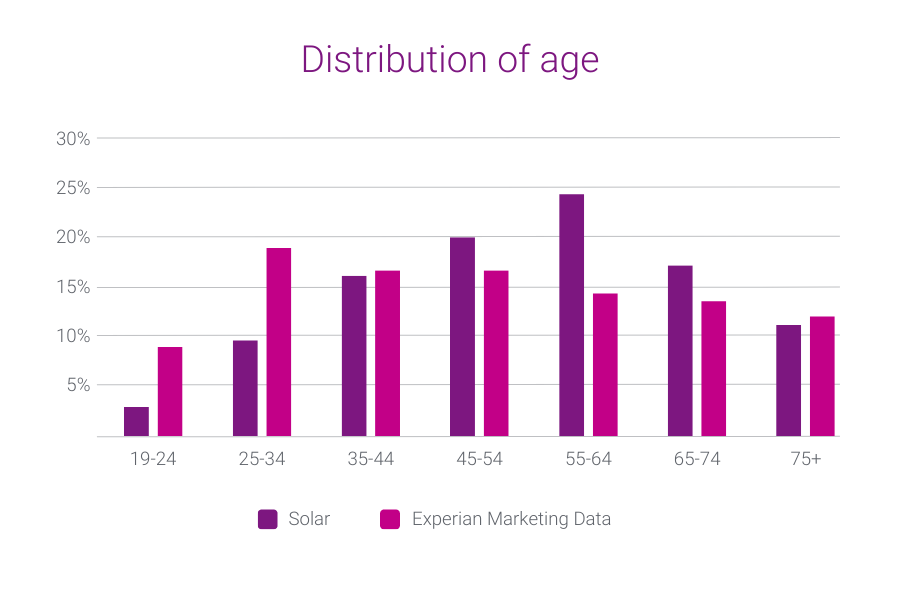
Consumers in our Solar energy audience are more likely to live in a home with two or more adults and are between the ages of 45-74.
Education level and occupation
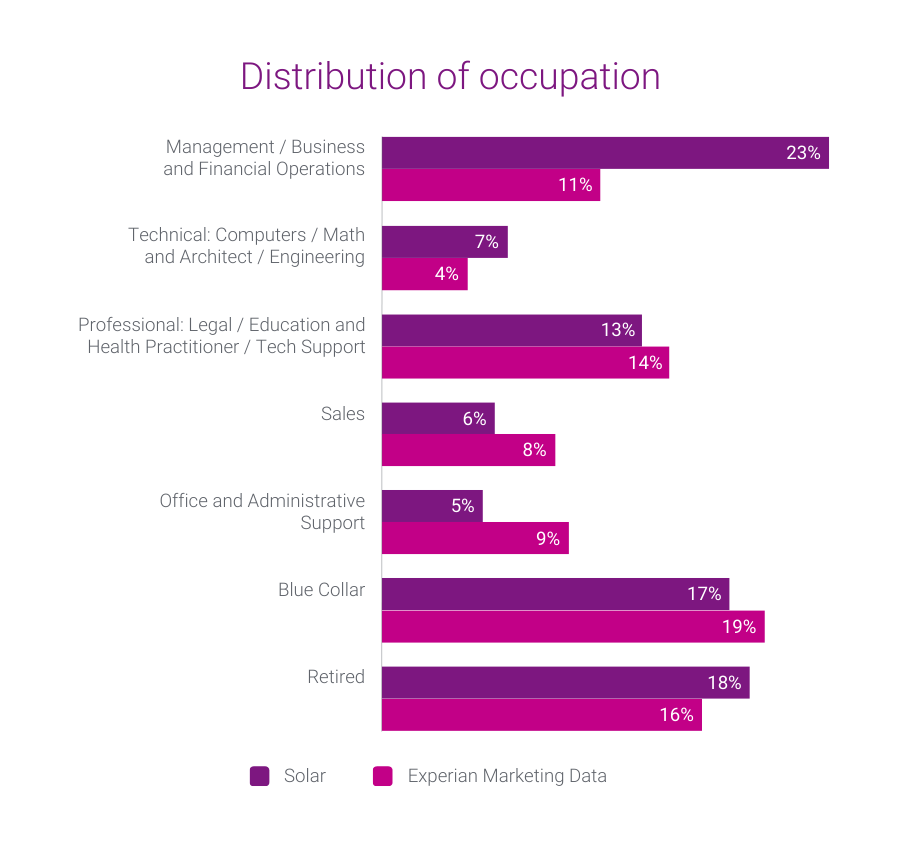
Consumers in our Solar energy audience are more likely to have graduated from college or graduate school and work in management-level occupations.
Household income
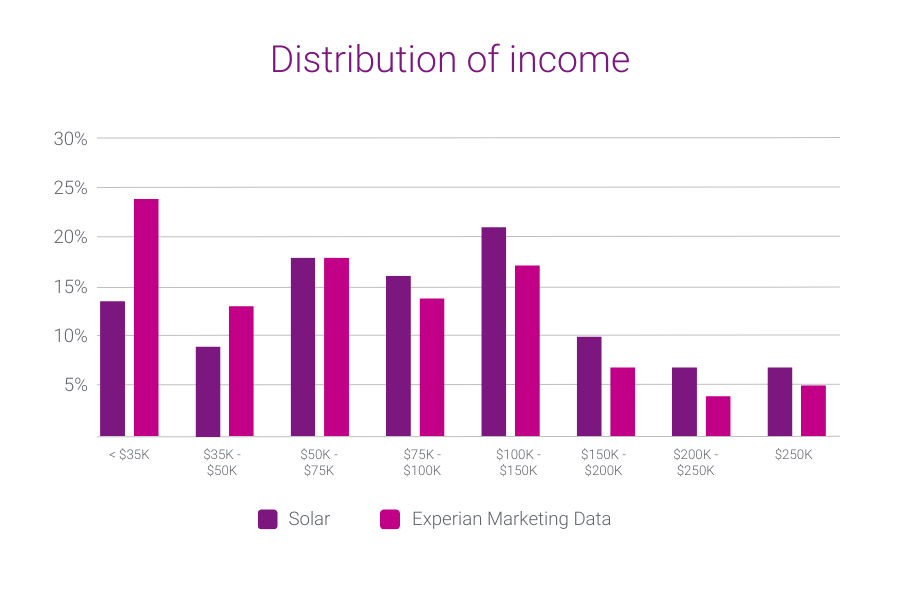
Consumers in our Solar energy audience have household incomes of more than $75,000 and their homes are valued at over $550,000.
Preferred engagement channels
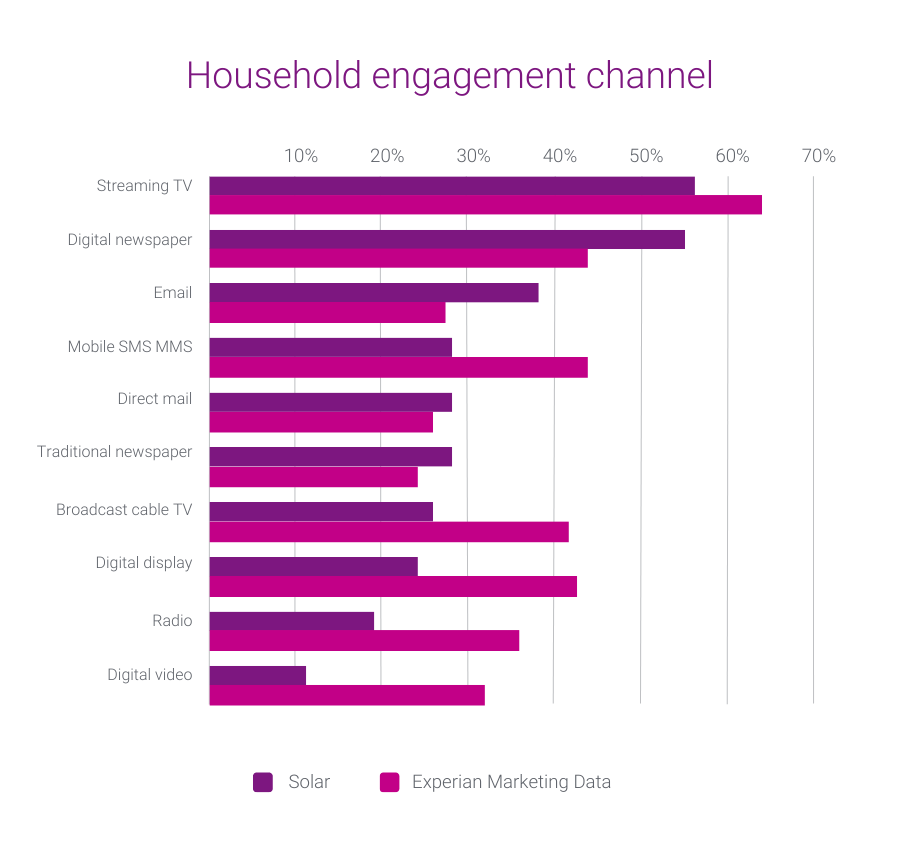
Consumers in our Solar energy audience are most receptive to ads served through digital channels like digital newspapers and email.
Solar energy audience pairings
Consumers in our Solar energy audience also belong to three of our Mosaic® USA groups:
- Power Elite
- Flourishing Families
- Booming with Confidence
Our consumer segmentation portal of 126 million households and 650 lifestyle and interest attributes empowers marketers like you to precisely target your ideal audience and communicate with them on a personal level. Mosaic’s data segments the U.S. into 19 overarching groups and 71 underlying types, giving you the insights needed to anticipate the behavior, attitudes, and preferences of your most profitable customers and communicate with them on their preferred channels, with messaging that resonates.
GreenAware
Our second eco-conscious audience is GreenAware.
GreenAware segments the 126 million U.S. households within Experian Marketing Data into four distinct groups. Each group differs in their attitudes and behaviors toward purchasing products that are environmentally safe and working with companies that are eco-conscious. We created these groups using an enhanced application of traditional statistical clustering techniques based on environmentally relevant measurements in Simmons’ National Consumer Study.
Based on the distinctive mindset of consumers toward the environment, you can learn how environmental concerns fit into their lives through four major consumer segments:
- Eco-Friendly Enthusiasts
- Sustainable Spectators
- Passive Greenies
- Eco Critics
Let’s dive deeper into each group to understand their unique perspective on the environment and how this impacts their attitudes and behaviors.
Eco-Friendly Enthusiasts
This eco-conscious segment prioritizes a green lifestyle and takes pride in avoiding products that harm the planet. With traditional and liberal values, they embrace optimism and prioritize family. With their children out of the house, they take the time for some well-deserved rejuvenation and are committed to a healthy lifestyle. Some members of this group are transitioning into retirement and welcoming a new chapter in their life.
- Mature adults and retirees
- College graduate or more
- Above average income
- May be married or single
- Typically own their homes
Sustainable Spectators
This segment aspires to be more sustainable, but they struggle with translating their green ideas into action. They have a soft spot for a cozy home. While their love for interior design and taking care of their own space is evident, they’re always looking for new experiences and opportunities to learn. Staying healthy and active is a top priority for this group, so it’s no surprise that they’re always looking for ways to stay fit and feel their best.
- Established and mid-life adults
- College graduate or more
- High income
- Typically married
- Likely to own their homes
Passive Greenies
This is the largest and one of the most youthful groups. Known for their love of exploration and self-discovery, they may not have fully embraced eco-conscious behaviors yet, but they are eager to stay current with the latest technology and trends. With their incredible ability to multitask, they’re always on-the-go, and constantly seek the next best thing.
- Mainly young adults and diverse
- Education ranges from high school through some college
- Below average income
- More likely to be single or divorced
- Typically rent
Eco Critics
This group is not likely to be eco-conscious and may have negative attitudes about the environment. They are confident, driven, and focused on their personal growth. They crave instant gratification, seeking out quick and easy solutions to their everyday decisions. They place a high value on entertainment, their social life, and carefully curate their image.
- Young and established adults
- Education ranges from high school through post-graduate studies
- High income
- Married or single
- Typically own their homes
Let’s take a look at how the GreenAware segments stack up against each other in terms of age, household income, education level, and media preference. How do they compare? Let’s find out.
Age
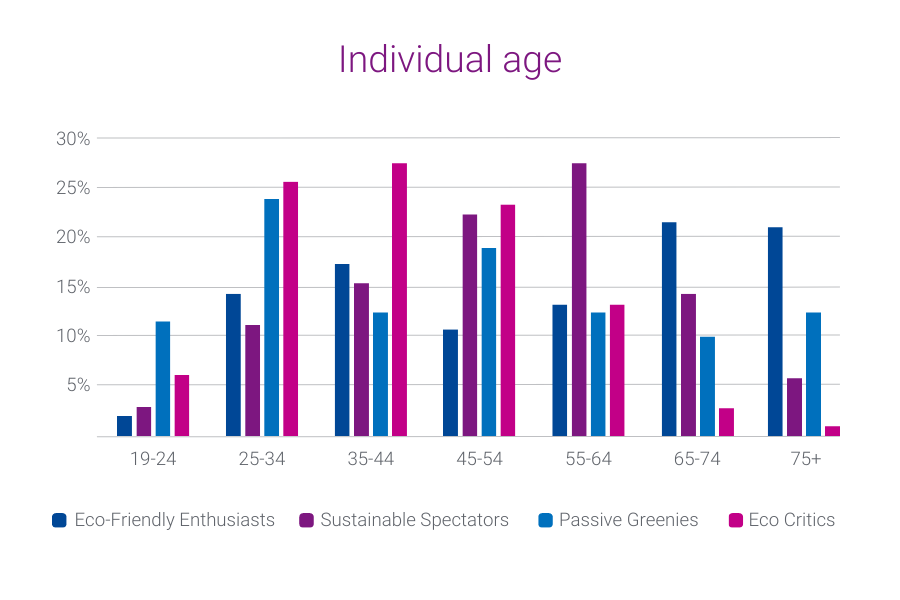
Consumers in the Eco-Friendly Enthusiasts segment are the oldest of the four GreenAware segments – about half of the consumers are 65 or older. Eco Critics are the youngest segment, with over half of consumers in this group between ages 25-44.
Household income
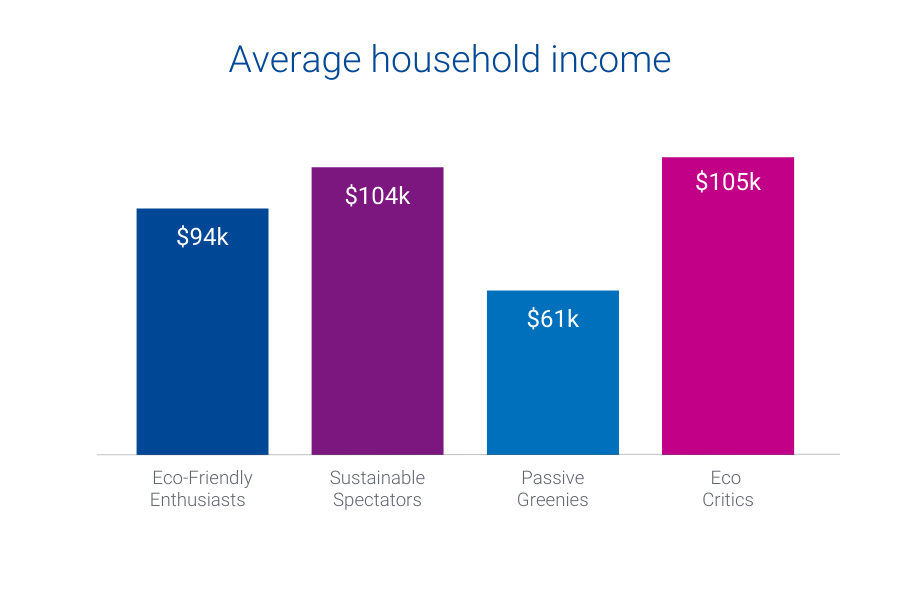
Sustainable Spectators and Eco Critics are the wealthiest GreenAware segments. The average household income of consumers in these segments is above $100,000. Passive Greenies have the lowest household income, with a majority below $50,000.
Education level and occupation
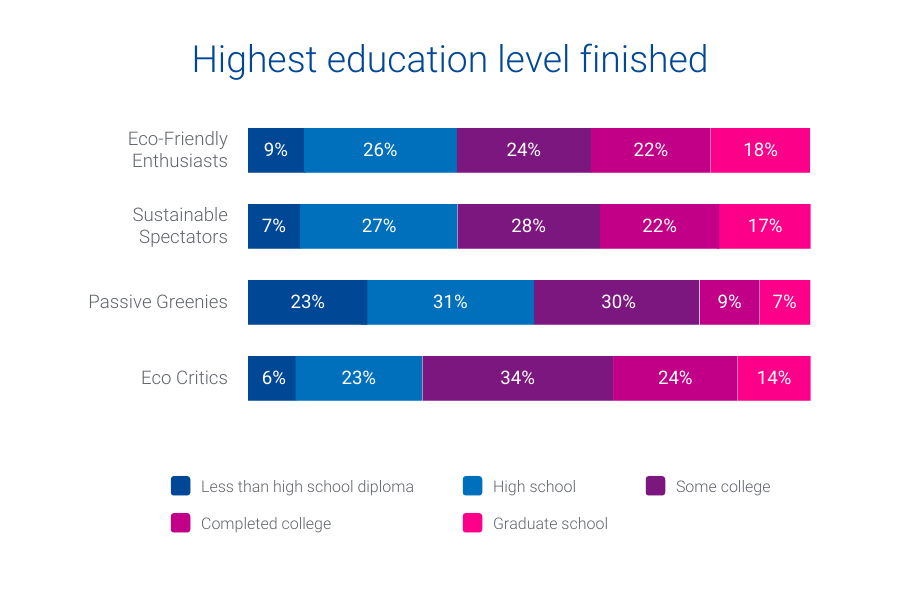
Passive Greenies are more likely to work Blue Collar jobs and have the lowest level of education. As the wealthiest segments, Sustainable Spectators and Eco Critics have the highest levels of college degrees and work in management, business, and financial operations. Eco-Friendly Enthusiasts are the most likely to be retired and out of the workforce.
Preferred engagement channels
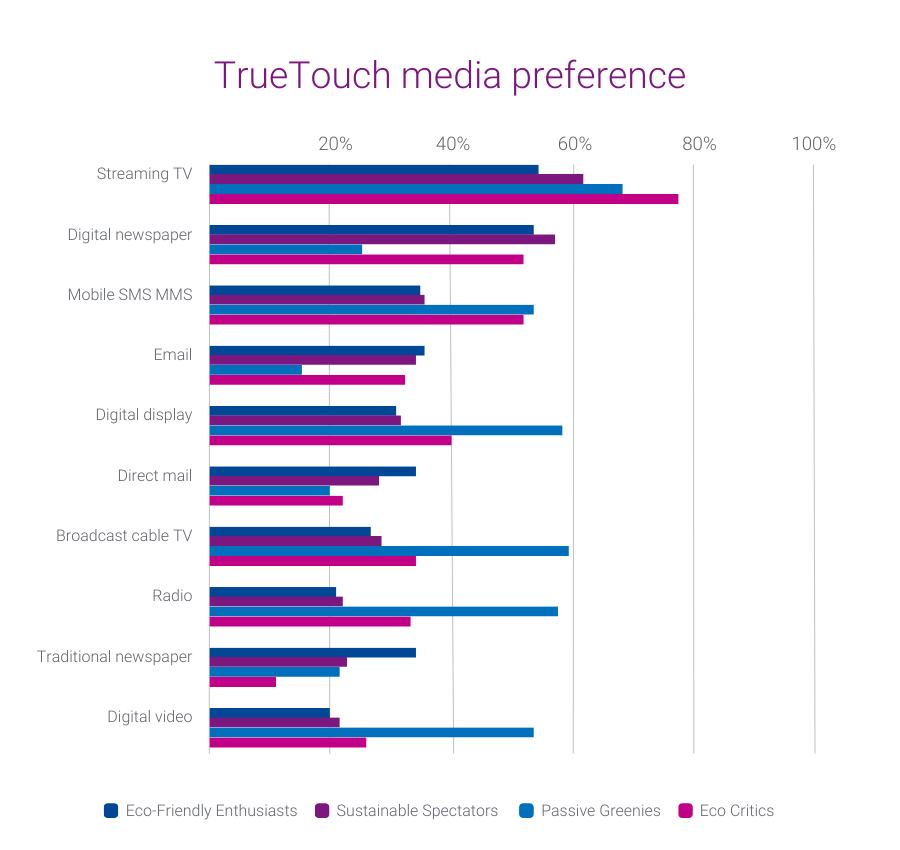
- Streaming TV is the preferred engagement channel for all GreenAware segments.
- Eco-Friendly Enthusiasts prefer digital channels like digital newspapers, mobile SMS, and email. They also engage with traditional channels like direct mail and newspaper.
- Passive Greenies have a high preference for digital display, mobile SMS, digital video, broadcast cable TV, and radio.
- Eco Critics have a high preference for digital channels like digital newspapers, mobile SMS, and digital display.
- Sustainable Spectators strongly prefer digital newspapers. They don’t show as strong of a preference for mobile SMS and digital display as Eco Critics and Passive Greenies.
GreenAware audience pairings
Six of our Mosaic groups have at least one GreenAware segment with 10% or more of the population. For more precise targeting, below are suggested Mosaic audiences you can pair with each GreenAware segment:
| Eco-Friendly Enthusiasts | Sustainable Spectators | Passive Greenies | Eco Critics |
| Booming with Confidence | Power Elite | Singles and Starters | Power Elite |
| Autumn Years | Booming with Confidence | Golden Year Guardians | Suburban Style |
| Golden Year Guardians | Singles and Starters |
Electric vehicles
Our third eco-conscious audience is electric vehicles.
Electric vehicles (EVs) are having a major moment in the automotive industry. This is no surprise given that new EV models are being released and an increasing number of charging stations are popping up around the country. As EVs become more prominent, it’s essential to stay up to date on relevant trends to make informed decisions about what lies ahead.
The demand for electric vehicles (EVs) is on the rise
Consumers are embracing the EV revolution, showing their desire for a cleaner, greener future. Automotive marketers are increasingly looking to reach in-market EV shoppers and current alternative fuel vehicle owners due to the growing availability of electric vehicles, improved infrastructure, and rising popularity. In 2022, EVs charged up the market and accounted for a remarkable 6% of new retail registrations.
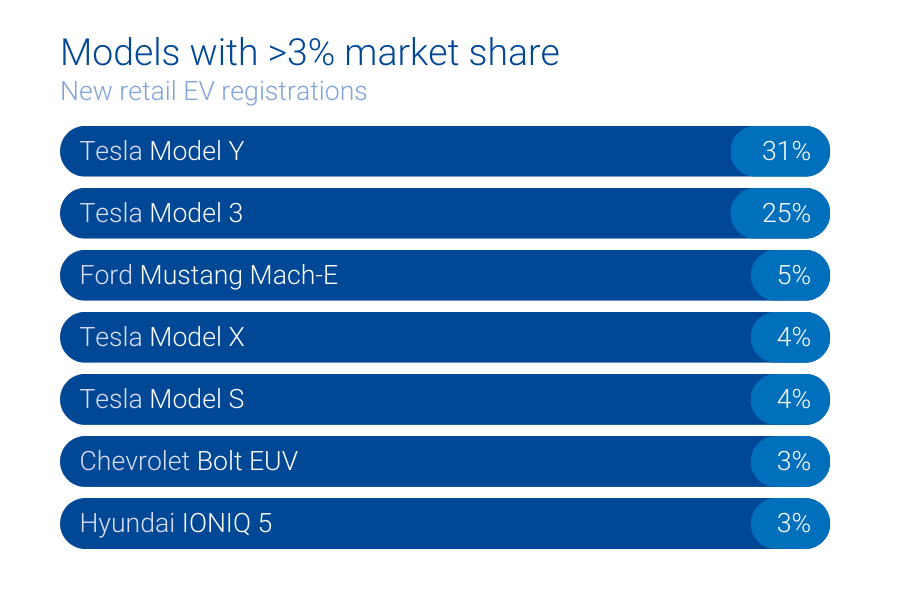
While Tesla continues to dominate the EV market, Ford, Chevrolet, and Hyundai are starting to compete, each holding more than 3% of the market share of new retail EV registrations.
Geography
Where are we seeing the most new retail EV registrations? The top designated market areas (DMAs) for new retail EV registrations are mostly located in heavily populated, coastal cities like Los Angeles, CA and New York, NY.
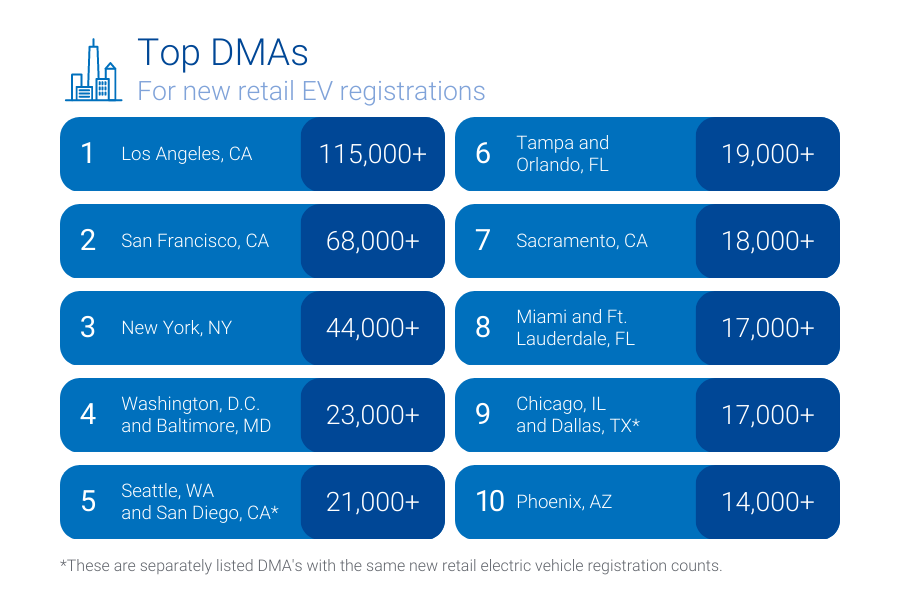
The fastest growing DMAs, however, are in smaller cities like Tucson, AZ and Oklahoma City, OK.
Generational demographics
Gen X and Millennials make up the largest percentage of new retail EV buyers at 37.5% and 34.4%. Gen Z and the Silent generation represent the smallest shares at 5% and 2.1%. Boomers hover between Gen X and Millennials’ share and account for 20.6% of new EV retail purchases.
EV audience pairings
Our top five Mosaic groups for new EV buyers include:
- American Royalty
- Cosmopolitan Achievers
- Philanthropic Sophisticates
- Couples with Clout
- Fast Track Couples
How to target consumers in-market for electric vehicles
We offer 70+ audiences that are focused on likely buyers and owners of EV and plug-in hybrid (PHEV) vehicles. We also offer a subset of 28 audiences focused on individual EV/PHEV vehicle models.
Below is how you can find a few of these audiences on-the-shelf of most trusted advertising platforms:
- Autos, Cars, and Trucks > In Market-Fuel Type > Electric
- Autos, Cars, and Trucks > In Market-Fuel Type > Used Electric
- Autos, Cars, and Trucks > In-Market Make and Models > Tesla
- Autos, Cars, and Trucks > In-Market Make and Models > Chevrolet Bolt EV
We can help you reach eco-conscious consumers
Earth Day is a great opportunity to get creative with your marketing efforts with our three eco-conscious audiences: Solar energy, GreenAware, and electric vehicles. To find out how you can add eco-conscious audiences to your marketing plan, contact us.
Get in touch
Latest posts

Tapad, a part of Experian and the future of cookies Earlier this week, Google announced plans to create “.. a path towards making third-party cookies obsolete”; which will result in the phasing out of support for third-party cookies in its Chrome browser within two years. While there has been much discussion and debate on the future of the third-party cookie, an announcement from Google has been anticipated for some time. As many have said this week, the use of cookies and other identifiers has and will continue to evolve. What will never change is the value exchange between publishers and consumers that is enabled by relevant advertising. Notably, the need for independent companies to develop solutions that enable this value exchange has never been greater to ensure that publishers, consumers, and advertisers derive the most value from their relationship. We are well-positioned for the future From the start, Tapad, a part of Experian has led with a consumer-first, privacy-centric approach to technology as the use and proliferation of devices and global privacy regulations continue to evolve. Over the past two years, Tapad, a part of Experian has gone through a technical overhaul. Calling on almost ten years of expertise in identity resolution, we have created a modern platform that is flexible in terms of identity input as well as output. Anticipated change in the identity landscape was the driver behind our architecture decisions and what enables us to be responsive to a dynamic market. Consumer behavior and device use continue to change, bringing additional digital IDs into the equation – namely across the mobile and CTV environments. Our technology, however, is not tied to any specific type of identifier, but rather is focused on associating disparate identifiers at the individual and household level. Where do we go from here? Google’s announcement has been characterized as a conversation starter, but we see it more as a call to action. With a timeline set, there is a need to converge on one or more solutions that can scale across the web. In a post cookie world, publishers and advertisers will continue to require ways to create fair marketplaces across platforms and devices. Further, the platforms that currently power the programmatic advertising ecosystem will need to be able to invest and differentiate to bring value to their customers. Scaled privacy-safe identity solutions will be needed not only for classic targeting, attribution, measurement, and frequency capping use cases but also to carry consumer preferences and consent. Tapad, a part of Experian will continue to play a leading role here. However, we are not going to do this alone. As solutions around Google’s Chrome browser evolve, we will continue to take a leadership position and will work with Google, key industry groups, partners and customers to meet current and future needs for an independent identity solution at scale. In the meantime, we will continue to support an independent ecosystem where consumers come first and privacy standards are a priority. It’s business as usual…for now. There will not be any changes to our graph products or services as a result of Google’s announcement in the near term. Any changes related to the Chrome third-party cookie will evolve and will no doubt be subject to significant industry participation and feed-back, indeed at the invitation of Google. We will proactively communicate any changes and product updates during this time period. We look forward to the opportunities resulting from these changes and ushering in a new era of identity resolution in digital advertising. Contact us today
Tapad's integration with Knorex's XPO™ platform will complement cross-channel optimization capabilities for brands and agencies in the U.S. and APAC markets NEW YORK and SINGAPORE, Dec. 10, 2019 /PRNewswire/ — Tapad, part of Experian and a global leader in digital identity resolution, has partnered with Knorex, a leading provider of digital performance marketing. Knorex's self-service online advertising platform, Knorex XPO™, enables marketers to advertise globally in real-time across different media channels, formats, platforms and devices. Tapad's global, privacy-safe digital cross-device solution, The Tapad Graph, will compliment Knorex XPO™'s own device data set for enhanced marketing capabilities. For Knorex, the integration enables their brand direct and agency customers to gain a more accurate understanding of consumers across devices to reduce campaign inefficiencies and duplication, and to effectively manage frequency capping and attribution. Abhishek Kumar, VP of Engineering at Knorex commented, "Today's digital consumer is raising the bar for marketers. With increasing marketing complexities and consumer device usage, this integration enables marketers to understand the consumer decision journey with heightened ease. Our combined offering will empower agencies in the APAC and US markets, providing an improved marketing solution that will help to streamline their efforts." Abhay Doshi, Head of APAC at Tapad added: "The Tapad Graph, when integrated with the Knorex XPO platform, should not only help U.S. and APAC marketers optimize campaign performance through cross device marketing – but also increase the opportunity for brands to reach out to their target customers within a desired time." To learn more about Tapad and our digital identity resolution capabilities, visit https://www.experian.com/marketing/consumer-sync. About TapadTapad, Inc. is a global leader in digital identity resolution. The Tapad Graph and its related solutions provide a transparent, privacy-safe approach connecting brands to consumers through their devices globally. Tapad is recognized across the industry for its product innovation, workplace culture, and talent, and has earned numerous awards including One World Identity's 2019 Top 100 Influencers in Identity Award. Headquartered in New York, Tapad also has offices in Chicago, London, Oslo, Singapore, and Tokyo. About KnorexKnorex provides programmatic advertising products and technologies to advertising buyers worldwide. With its cloud-based online advertising platform, Knorex XPO™ enables ad buyers to self-serve and advertise real-time across the globe regardless of the media channels (social, search, OTT/CTV, video, web/mobile etc.), ad formats (display, native, search, social, video etc) and devices (desktop, laptop, smartphones and tablets) to deliver personalized marketing messages to the target audience in an automated way, powered by machine learning/AI. Underpinned by a multi-layered data-driven approach, XPO simplifies the execution and optimization of marketing campaigns, while delivering measurable and attributable performance. Contact us today
Tapad, now part of Experian, technology now powers Lifesight's real world intelligence platform with cross-device and reach expansion in the Asia Pacific Region SINGAPORE, Nov. 20, 2019 /PRNewswire/ — Tapad, part of Experian and a global leader in digital identity resolution, today announced a new partnership with Lifesight, a leading provider of real world intelligence for advertisers in the Asia Pacific region (APAC). With the combined offering of The Tapad Graph, Tapad's global, privacy-safe digital cross-device solution, and Lifesight's real world intelligence platform, brands and agencies across APAC can benefit from better consumer targeting, expanded reach for targeted audiences and web-to-mobile footfall attribution. Through this multi-layered offering, Lifesight's brand and agency partners can access an omnichannel view of consumers' paths to purchase, thereby enabling them to increase the reach, measurability and ROI of their advertising campaigns. Rohit Maheswaran, Co-founder of Lifesight commented, "The consumer journey is getting increasingly more complex with ever changing digital and physical world behaviours, making it difficult for marketers to make strategic marketing spend decisions. That's why it's our mission at Lifesight to empower the brands and agencies within the APAC market to achieve better targeting and measurement capabilities, and our partnership with Tapad will help further this cause." Abhay Doshi, Head of APAC at Tapad added, "The Tapad Graph, which enables a unified view of consumers across their multiple digital devices, has a reach of 1 billion devices across the APAC market today. Paired with Lifesight's consumer insights of more than 500 million unique devices, this valuable partnership will offer the market extended consumer reach and prove beneficial to brands and advertisers across APAC who have historically struggled with resolving attribution." To learn more about Tapad and our digital identity resolution capabilities, visit www.experian.com/marketing/consumer-sync About Tapad Tapad, Inc. is a global leader in digital identity resolution. The Tapad Graph, and its related solutions, provide a transparent, privacy-safe approach connecting brands to consumers through their devices globally. Our one-of-a-kind Graph Select offering enables marketers the flexibility and freedom of choice to correlate devices to varied objectives, driving campaign effectiveness and business results. Tapad is recognized across the industry for its product innovation, workplace culture and talent, and has earned numerous awards including One World Identity's 2019 Top 100 Influencers in Identity Award. Headquartered in New York, Tapad also has offices in Chicago, London, Oslo, Singapore and Tokyo. About Lifesight Lifesight is Asia's leading real world intelligence company that helps marketers understand, target, and measure consumers based on their real world behaviour. Lifesight's robust platform and data solutions power business decisioning, audience activation, footfall measurement, and in-depth location analytics for leading brands and enterprises. The company is headquartered in Singapore with a rapidly expanding footprint in the Asia Pacific region operating in India, Malaysia, Indonesia, UAE, Saudi Arabia, Thailand, Philippines, Vietnam, Japan, Australia and New Zealand. To learn more, visit https://www.lifesight.io/. Contact us today