Loading...

Three eco-conscious audiences for Earth Day

Published: April 18, 2023 by Experian Marketing Services

As Earth Day approaches, it’s the perfect opportunity for marketers to explore innovative ways to engage with eco-conscious customers. With a strong and growing interest in sustainable business practices worldwide, green audiences are becoming increasingly influential. In addition to being good for the planet, engaging these customers is great for any brand or organization striving to become more eco-friendly and socially responsible. By taking advantage of this timely event and using appropriate tools, you can create personalized campaigns that will both promote your brand and increase customer loyalty.

Eco-conscious audiences

In this blog post, we’ll cover three eco-conscious audiences to target this Earth Day:

  1. Solar energy
  2. GreenAwareTM
  3. Electric vehicles

Solar energy

Our first eco-conscious audience is Solar energy. Consumers in this audience show an inclination toward harnessing the power of the sun as a clean, renewable energy source. Our audience data can provide valuable insights into the Solar energy consumer base, including their age, education level, occupation, household income, and communication preferences. Let’s explore these metrics to better understand how to reach this group effectively.

Age and living situation

Consumers in our Solar energy audience are more likely to live in a home with two or more adults and are between the ages of 45-74.
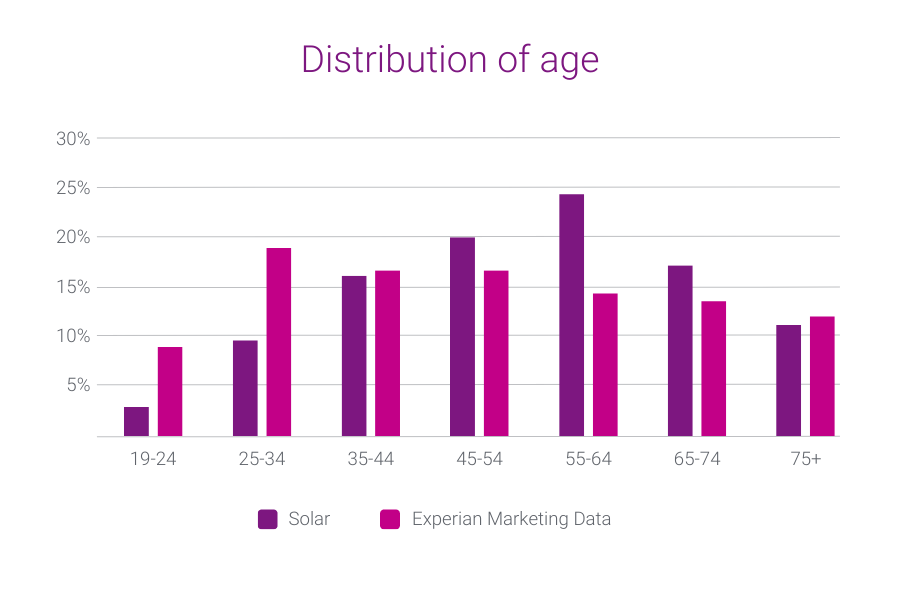
consumers in the eco-conscious solar energy audience are more likely to be between ages 45-74

Education level and occupation

Consumers in our Solar energy audience are more likely to have graduated from college or graduate school and work in management-level occupations.
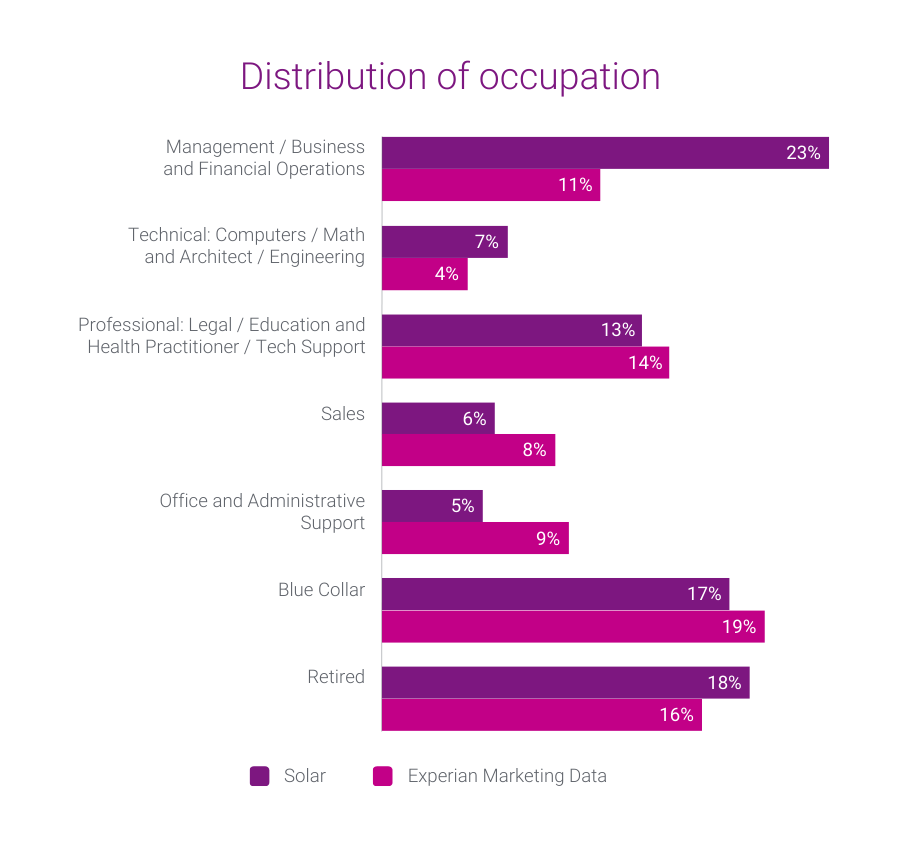
consumers in the eco-conscious solar energy audience are more likely to work in management-level occupations

Household income

Consumers in our Solar energy audience have household incomes of more than $75,000 and their homes are valued at over $550,000.
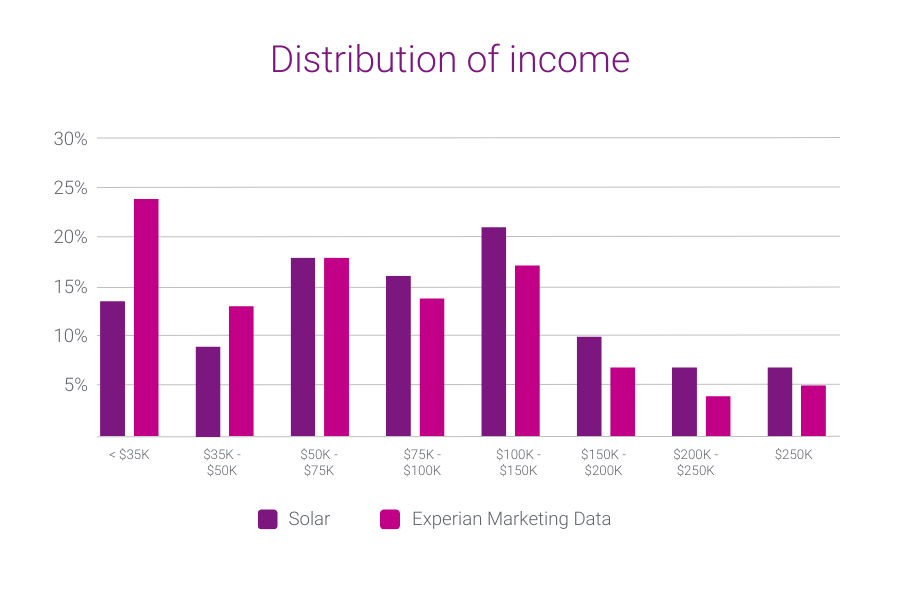
consumers in the eco-conscious solar energy audience have household incomes of more than $75,000

Preferred engagement channels

Consumers in our Solar energy audience are most receptive to ads served through digital channels like digital newspapers and email.
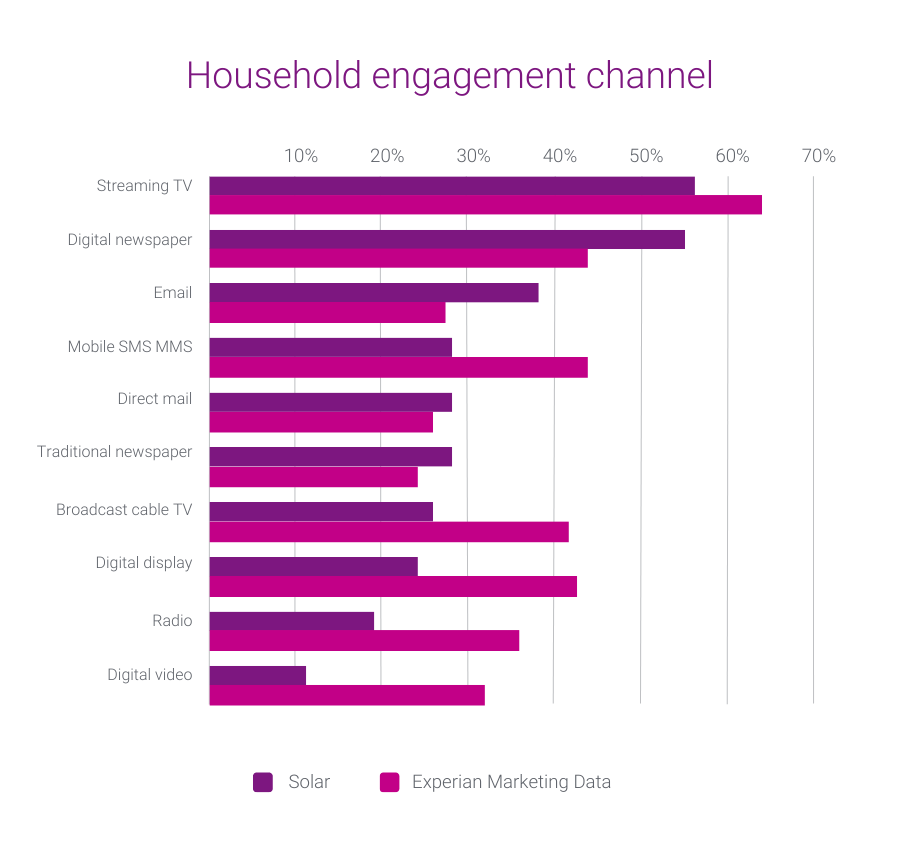
consumers in the eco-conscious solar energy audience are most receptive to ads through streaming tv and digital newspaper

Solar energy audience pairings

Consumers in our Solar energy audience also belong to three of our Mosaic® USA groups:

  1. Power Elite
  2. Flourishing Families
  3. Booming with Confidence

Our consumer segmentation portal of 126 million households and 650 lifestyle and interest attributes empowers marketers like you to precisely target your ideal audience and communicate with them on a personal level. Mosaic’s data segments the U.S. into 19 overarching groups and 71 underlying types, giving you the insights needed to anticipate the behavior, attitudes, and preferences of your most profitable customers and communicate with them on their preferred channels, with messaging that resonates.

GreenAware

Our second eco-conscious audience is GreenAware.

GreenAware segments the 126 million U.S. households within Experian Marketing Data into four distinct groups. Each group differs in their attitudes and behaviors toward purchasing products that are environmentally safe and working with companies that are eco-conscious. We created these groups using an enhanced application of traditional statistical clustering techniques based on environmentally relevant measurements in Simmons’ National Consumer Study.

Based on the distinctive mindset of consumers toward the environment, you can learn how environmental concerns fit into their lives through four major consumer segments:

  1. Eco-Friendly Enthusiasts
  2. Sustainable Spectators
  3. Passive Greenies
  4. Eco Critics

Let’s dive deeper into each group to understand their unique perspective on the environment and how this impacts their attitudes and behaviors.

Eco-Friendly Enthusiasts

This eco-conscious segment prioritizes a green lifestyle and takes pride in avoiding products that harm the planet. With traditional and liberal values, they embrace optimism and prioritize family. With their children out of the house, they take the time for some well-deserved rejuvenation and are committed to a healthy lifestyle. Some members of this group are transitioning into retirement and welcoming a new chapter in their life.

  • Mature adults and retirees
  • College graduate or more
  • Above average income
  • May be married or single
  • Typically own their homes

Sustainable Spectators

This segment aspires to be more sustainable, but they struggle with translating their green ideas into action. They have a soft spot for a cozy home. While their love for interior design and taking care of their own space is evident, they’re always looking for new experiences and opportunities to learn. Staying healthy and active is a top priority for this group, so it’s no surprise that they’re always looking for ways to stay fit and feel their best.

  • Established and mid-life adults
  • College graduate or more
  • High income
  • Typically married
  • Likely to own their homes

Passive Greenies

This is the largest and one of the most youthful groups. Known for their love of exploration and self-discovery, they may not have fully embraced eco-conscious behaviors yet, but they are eager to stay current with the latest technology and trends. With their incredible ability to multitask, they’re always on-the-go, and constantly seek the next best thing.

  • Mainly young adults and diverse
  • Education ranges from high school through some college
  • Below average income
  • More likely to be single or divorced
  • Typically rent

Eco Critics

This group is not likely to be eco-conscious and may have negative attitudes about the environment. They are confident, driven, and focused on their personal growth. They crave instant gratification, seeking out quick and easy solutions to their everyday decisions. They place a high value on entertainment, their social life, and carefully curate their image.

  • Young and established adults
  • Education ranges from high school through post-graduate studies
  • High income
  • Married or single
  • Typically own their homes

Let’s take a look at how the GreenAware segments stack up against each other in terms of age, household income, education level, and media preference. How do they compare? Let’s find out.

Age

Consumers in the Eco-Friendly Enthusiasts segment are the oldest of the four GreenAware segments – about half of the consumers are 65 or older. Eco Critics are the youngest segment, with over half of consumers in this group between ages 25-44.
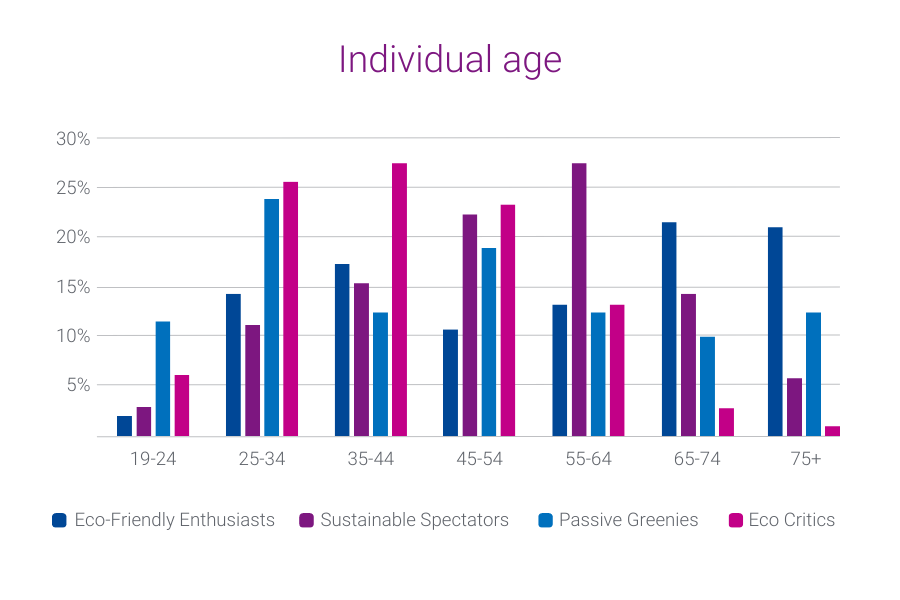
consumers in the "eco-friendly enthusiasts" audience are the oldest of the eco-conscious audience segments

Household income

Sustainable Spectators and Eco Critics are the wealthiest GreenAware segments. The average household income of consumers in these segments is above $100,000. Passive Greenies have the lowest household income, with a majority below $50,000.
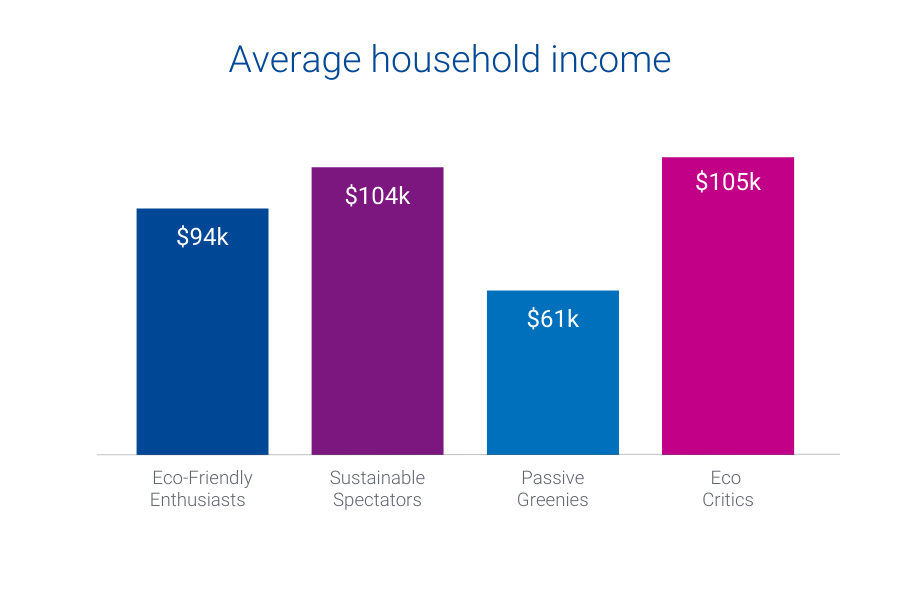
sustainable spectators and eco critic consumers are the wealthiest of the eco-conscious audiences

Education level and occupation

Passive Greenies are more likely to work Blue Collar jobs and have the lowest level of education. As the wealthiest segments, Sustainable Spectators and Eco Critics have the highest levels of college degrees and work in management, business, and financial operations. Eco-Friendly Enthusiasts are the most likely to be retired and out of the workforce.
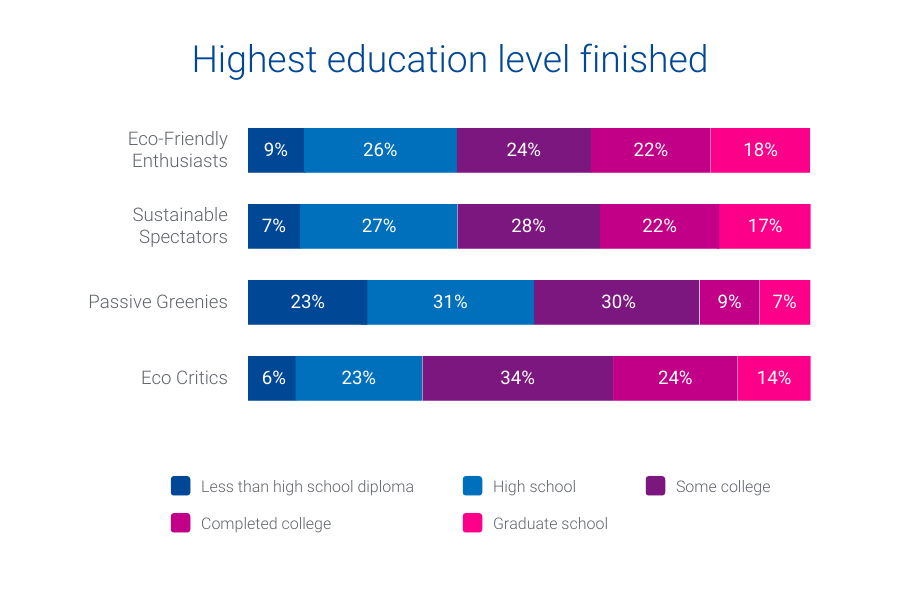
graph of eco-conscious audiences and the highest education level they have finished

Preferred engagement channels

  • Streaming TV is the preferred engagement channel for all GreenAware segments.
  • Eco-Friendly Enthusiasts prefer digital channels like digital newspapers, mobile SMS, and email. They also engage with traditional channels like direct mail and newspaper.
  • Passive Greenies have a high preference for digital display, mobile SMS, digital video, broadcast cable TV, and radio.
  • Eco Critics have a high preference for digital channels like digital newspapers, mobile SMS, and digital display.
  • Sustainable Spectators strongly prefer digital newspapers. They don’t show as strong of a preference for mobile SMS and digital display as Eco Critics and Passive Greenies.
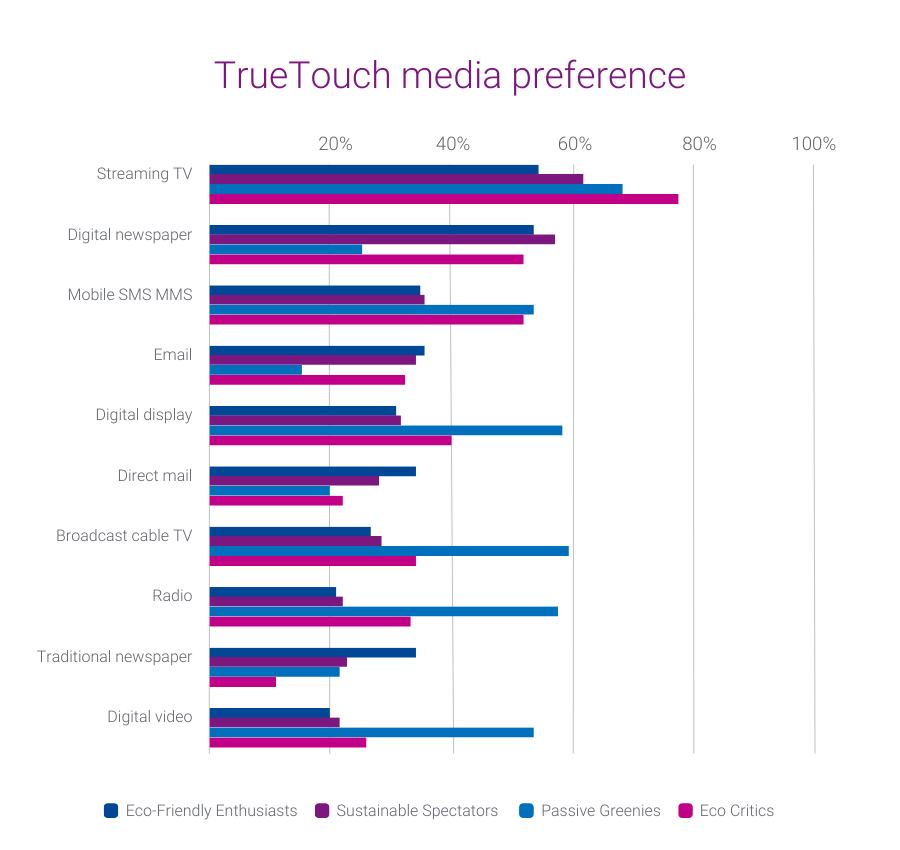
graph of the eco-conscious audiences' preferred engagement channels

GreenAware audience pairings

Six of our Mosaic groups have at least one GreenAware segment with 10% or more of the population. For more precise targeting, below are suggested Mosaic audiences you can pair with each GreenAware segment:

Eco-Friendly EnthusiastsSustainable SpectatorsPassive GreeniesEco Critics
Booming with ConfidencePower EliteSingles and StartersPower Elite
Autumn YearsBooming with ConfidenceGolden Year GuardiansSuburban Style
Golden Year GuardiansSingles and Starters

Electric vehicles

Our third eco-conscious audience is electric vehicles.

Electric vehicles (EVs) are having a major moment in the automotive industry. This is no surprise given that new EV models are being released and an increasing number of charging stations are popping up around the country. As EVs become more prominent, it’s essential to stay up to date on relevant trends to make informed decisions about what lies ahead.

The demand for electric vehicles (EVs) is on the rise

Consumers are embracing the EV revolution, showing their desire for a cleaner, greener future. Automotive marketers are increasingly looking to reach in-market EV shoppers and current alternative fuel vehicle owners due to the growing availability of electric vehicles, improved infrastructure, and rising popularity. In 2022, EVs charged up the market and accounted for a remarkable 6% of new retail registrations.

While Tesla continues to dominate the EV market, Ford, Chevrolet, and Hyundai are starting to compete, each holding more than 3% of the market share of new retail EV registrations.
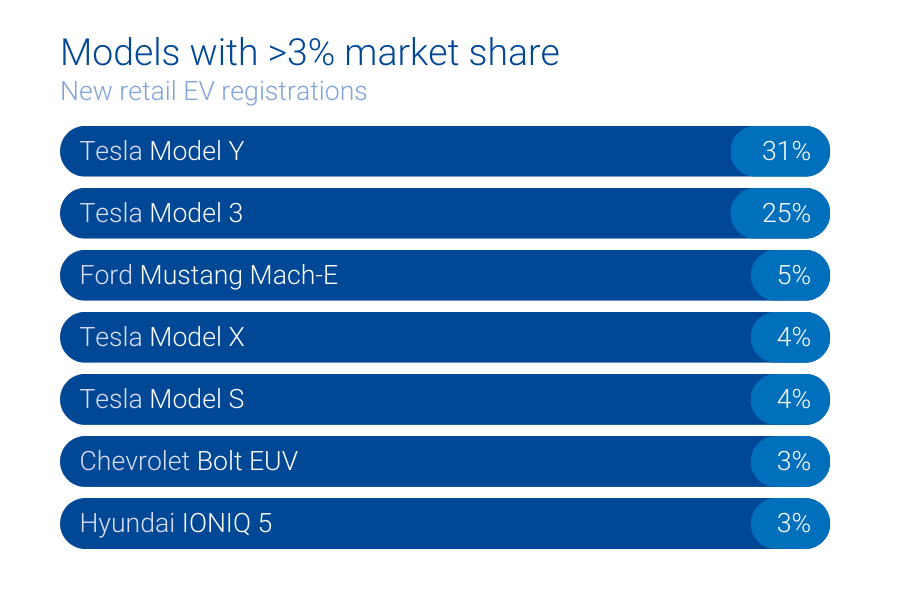
graph showing the demand for electric vehicles by model

Geography

Where are we seeing the most new retail EV registrations? The top designated market areas (DMAs) for new retail EV registrations are mostly located in heavily populated, coastal cities like Los Angeles, CA and New York, NY.
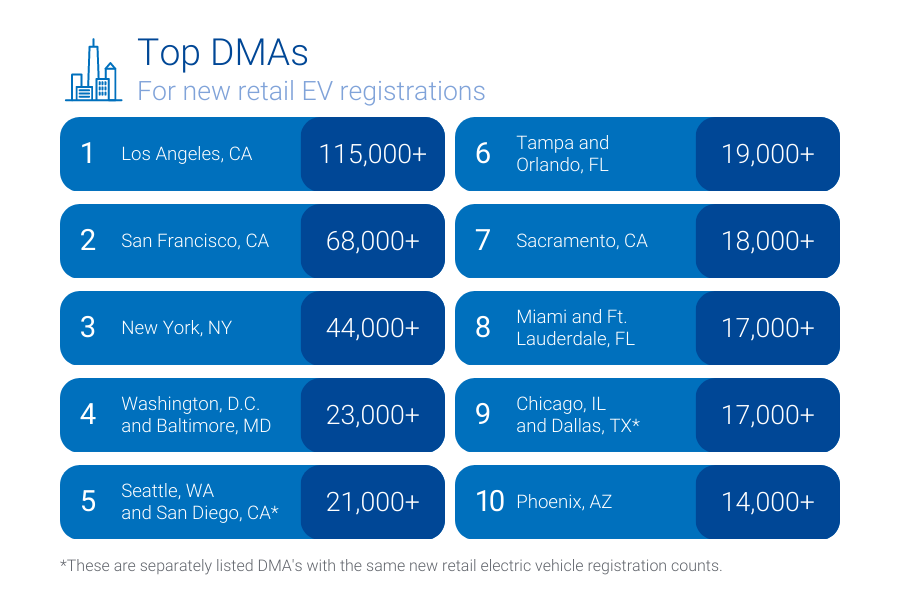
graphic showing the top designated market areas for new retail EV registrations

The fastest growing DMAs, however, are in smaller cities like Tucson, AZ and Oklahoma City, OK.

Generational demographics

Gen X and Millennials make up the largest percentage of new retail EV buyers at 37.5% and 34.4%. Gen Z and the Silent generation represent the smallest shares at 5% and 2.1%. Boomers hover between Gen X and Millennials’ share and account for 20.6% of new EV retail purchases.

EV audience pairings

Our top five Mosaic groups for new EV buyers include:

  1. American Royalty
  2. Cosmopolitan Achievers
  3. Philanthropic Sophisticates
  4. Couples with Clout
  5. Fast Track Couples

How to target consumers in-market for electric vehicles

We offer 70+ audiences that are focused on likely buyers and owners of EV and plug-in hybrid (PHEV) vehicles. We also offer a subset of 28 audiences focused on individual EV/PHEV vehicle models.

Below is how you can find a few of these audiences on-the-shelf of most trusted advertising platforms:

  • Autos, Cars, and Trucks > In Market-Fuel Type > Electric
  • Autos, Cars, and Trucks > In Market-Fuel Type > Used Electric
  • Autos, Cars, and Trucks > In-Market Make and Models > Tesla
  • Autos, Cars, and Trucks > In-Market Make and Models > Chevrolet Bolt EV

We can help you reach eco-conscious consumers

Earth Day is a great opportunity to get creative with your marketing efforts with our three eco-conscious audiences: Solar energy, GreenAware, and electric vehicles. To find out how you can add eco-conscious audiences to your marketing plan, contact us.

Get in touch

This site is protected by reCAPTCHA and the Google Privacy Policy and Terms of Service apply.


Latest posts

Loading…
AI won’t save your holiday advertising campaign

Originally appeared in Adweek  This holiday advertising season, identity is the real differentiator Marketers are betting big on AI to run their holiday advertising, using it to build predictive audiences, generate creative at scale, and optimize media buys in real time. The draw is clear: greater efficiency, delivered at scale.  But here’s the problem: without a solid identity foundation, AI is just guessing. And in a year when consumers are cautious and competition is fierce, guesses won’t deliver the outcomes you need. Experian’s 2025 Holiday spending trends and insights report shows that success this season will depend on connecting the right data to the right audiences in real time. Download the report now Are shoppers really using AI to make holiday purchases?  Not yet. Only 12% of consumers plan to use AI tools to shop this season, mostly for finding discounts. Instead, trusted influences (like retailer websites, product reviews, and recommendations) still guide buying decisions.  For marketers, that’s a signal to focus on credibility and connection. AI can support your holiday advertising strategy, but trust still wins the sale. Consumer sentiment heading into the holidays is low, but that could mislead marketers Here's why How marketers are really using AI in holiday advertising  Behind the scenes, AI is working overtime. Teams use it to segment audiences, test creative, and optimize media in real time. These capabilities are powerful, but only if they’re grounded in accurate, persistent data.  Think about the typical holiday shopper. They may browse a product online, validate it in store, and finally purchase days later from a different device than they used while browsing. If AI isn’t anchored in identity, it struggles to connect those touchpoints. Instead of amplifying relevance, it amplifies noise. See our predictions for Black Friday 2025 Why identity is the GPS for AI-driven holiday advertising  Identity is what turns AI from a blunt instrument into an accurate tool. By unifying fragmented signals across channels and devices, identity provides the consistent consumer view that AI needs to be effective.  With that foundation, AI can do more than churn out models. Instead, it can: Identify the right audiences and filter out waste  Personalize with context, not just scale Measure real outcomes, linking exposures to visits and purchases Identity doesn’t just improve efficiency; it creates accountability. And in a season where every holiday advertising campaign dollar is scrutinized, accountability is the difference between investment and waste. Why connected data will make or break Cyber Week How to turn complexity into clarity this holiday season  This year's holiday advertising season is complicated. Marketers are confident, consumers are cautious, and AI is somewhere in the middle. The challenge isn’t just speed or volume, it’s accuracy.  By pairing AI with identity, you can adapt to real behavior instead of assumptions. You can build campaigns that are consistent across connected TV, retail media, and social platforms. And you can prove results when it matters most.  AI isn’t a holiday miracle. But when it’s powered by identity, it can give you clarity in a noisy season and proof of performance when budgets are under scrutiny. Explore Experian's holiday audiences to activate this season What’s the real takeaway for marketers this season?  Don’t assume AI alone will save your holiday advertising strategy. It won’t. Consumers still trust human voices more than machines, and your AI models are only as strong as the data beneath them. Identity is the difference between guesswork and accuracy, between activity and impact.  This holiday season, the winners won’t be the brands that simply spend more or automate faster. They’ll be the ones that put identity at the core of their AI strategy and meet consumers where they really are.  Download Experian’s 2025 Holiday spending trends and insights report to see where consumers are spending and how identity can help your holiday advertising campaigns more effective. Download now About the author Colleen Dawe VP, Advertiser Partnerships, Experian Colleen Dawe is VP, Advertiser Partnerships at Experian Marketing Services, where she oversees revenue growth and client success, helping advertisers harness data and identity to fuel marketing strategies. With over 15 years of experience spanning TV and digital media, she brings deep expertise in data, identity, activation, and measurement to help her clients connect innovation with business outcomes. Holiday advertising FAQs Why isn’t AI enough on its own for holiday advertising? AI works best when it’s grounded in accurate data. Without identity, it can’t connect actions across devices or channels, which limits its effectiveness. How does identity improve AI-driven campaigns? Identity creates a single, persistent view of your audience. That means AI can personalize content, measure conversions, and cut waste with far greater accuracy. What does “identity” mean in marketing terms? It’s the data layer that connects people across their devices, browsers, and behaviors—so your campaigns reach real individuals. How can marketers prove ROI in holiday advertising? By tying exposure to verified outcomes—like store visits or purchases—using identity-linked data. That’s how Experian helps brands move from impressions to impact. Latest posts

Oct 16,2025 by Colleen Dawe, VP, Advertiser Partnerships

How a pet brand beat audio campaign goals by 63% with Experian Curated Deals

What challenge did the pet brand face? A national e-commerce pet supplier wanted to expand into audio advertising to diversify beyond display campaigns. But with only one team member available to test this new channel, they faced three hurdles: Prove performance in a new channel  Run lean with limited bandwidth  Show purchase intent, engaged site visits, and completion rates fast  They needed a partner to handle execution and supply optimization so their lean team could focus on strategy and selling audio internally.  Hear how we're working with Audacy to help our clients connect beyond the screen Tune in here The solution: How did Experian Curated Deals help? Audigent, a part of Experian, ran point on setup, optimization, and real-time reporting. The brand turned to Experian Curated Deals. Together we: Streamlined access to curated inventory, cutting intermediaries and boosting efficiency Handled campaign setup and supply-side optimization Delivered real-time demand-side platform (DSP) reporting for agile targeting refinements Provided an extension of their in-house team, giving them bandwidth to focus on pitching audio internally “What stood out about Experian was their real-time control and the depth of their trading team. I knew I could hand them a campaign, and they’d run with it.”Programmatic Media Lead, National e-commerce pet supplier Want to see the full case study? Download it here What results did the campaign deliver?  In just a few months, audio transformed from a small test into a top-performing channel:  Exceeded KPIs by 63%  Increased purchase intent and engagement vs. competing platforms  Matched display performance without creative refreshes or incentive overlays  Earned budget increases, positioning audio as a long-term investment  Reduced internal setup time, freeing the team for strategic projects  “Experian became more than just a media partner: they filled critical gaps that would typically require outsized investment in internal resourcing.”CMO, National e-commerce pet supplier Explore more examples of how brands are driving performance with Experian Windstar Cruises Leading athletic retailer Swiss Sense Why does this matter for marketers?  For marketers, audio isn’t experimental anymore. It’s a proven channel that can drive both engagement and conversions.  This case study shows how brands can:  Use Experian Curated Deals to validate new channels with minimal risk.  Lean on Experian to handle execution, freeing teams to focus on growth.  Drive meaningful engagement and purchase intent, not just impressions.  For marketers navigating limited resources and pressure to prove ROI fast, Experian Curated Deals provides both performance and confidence. Want to beat your campaign goals by double digits? Contact us today Curated Deals FAQs What is Experian Curated Deals? Experian Curated Deals streamline access to premium media inventory by eliminating unnecessary intermediaries, optimizing efficiency, and ensuring campaigns perform against KPIs. Why use curated deals for audio advertising? Curated deals help brands test and validate audio quickly, without the heavy lift of manual setup and supply path management. Can audio really drive conversions? Yes. In this case, audio campaigns not only exceeded awareness and engagement goals but also matched the conversion performance traditionally associated with display. How does Experian support lean teams? By managing setup, supply optimization, and reporting, Experian acts as an extension of your team, reducing internal workload while driving performance. Latest posts

Oct 15,2025 by Experian Marketing Services

A deep dive with an Experian partner, Index Exchange

In our Ask the Expert Series, we interview leaders from our partner organizations who are helping lead their brands to new heights in AdTech. Today’s interview is with Paul Zovighian, VP of Marketplaces at Index Exchange.  Sell-side activation vs. buy-side packaging What’s fundamentally changed with sell-side decisioning, and how does it now diverge from traditional buy-side packaging? Sell-side decisioning is programmatic’s next major evolution – one that redefines how intelligence enters the transaction. Advances in infrastructure and computing power now allow supply-side platforms(SSPs) to act in the crucial pre-bid moment, enriching impressions with context, quality, and data before they reach the buy side. This isn’t just about efficiency; it’s about unlocking new value. Smarter requests mean buyers see only the most relevant opportunities, while publishers gain recognition for the true worth of their audiences and environments. We’re still at the beginning of this shift. Many players still package inventory without engaging in real pre-bid intelligence. As the market matures, the companies that evolve toward sell-side decisioning will be the ones to set the pace for programmatic’s future. Economic shifts with scaled curation As curation scales, what economic levers shift for both publishers and buyers, and how do those shifts influence deal structure and media planning? As curation scales, one of the most powerful levers is data. It’s the industry’s most valuable asset, and on Index it keeps its full worth. We don’t take a platform cut or add hidden fees, so data partners benefit from the clearest, most efficient economics in the market. Data vendors gain confidence that their economics aren’t eroded by a platform tax. For publishers, this means stronger yield and more ad spend flowing directly into working media. When data retains its full value, it enhances how impressions are packaged, priced, and differentiated—driving more competition for quality inventory and more opportunities for revenue.   For buyers, it means compressed supply paths and total transparency – they know exactly what they’re paying for. With no intermediaries and full transparency into economics, buyers gain a clearer view of where their budgets go and the confidence that their investments reach real audiences in trusted environments. They benefit from cleaner supply chains, better performance, and more meaningful alignment between spend and outcome. The result is a healthier marketplace where both sides benefit from efficiency, fairness, and scale. Moving decisions upstream for value What decisions historically made in DSPs should now move upstream to publishers or SSPs to unlock more value, and which should remain buy-side? Decisioning is no longer confined to demand-side platforms(DSPs). We can enrich impressions by applying intelligence — via data, algorithms, creative technology, and more, before they even reach the buy side — adding context, filtering out low-quality supply, and expanding audience discovery. This isn’t about shifting roles; DSPs remain critical for campaign strategy, optimization, and budget allocation. The sell side simply ensures every bid request is smarter from the start, creating more value for all parties. In doing so, we also alleviate pressure on DSPs — enabling more comprehensive data discovery by searching for signals at the top of the funnel, prior to optimization. That means DSPs can focus on what they do best, supported by a cleaner, more transparent supply path. Index Marketplaces use cases explained Index Marketplaces is designed to enable the strength of our partners, and Experian brings one of the broadest sets of demographic and audience insights in the industry. That scale enables a wide variety of applications, from more precise audience activation to deeper measurement and analytics. What’s different on the sell side is how those insights are applied. By activating Experian’s syndicated audiences directly at the point of decision, their value is realized in real time and across the full scale of the open internet. Buyers gain a clearer path to relevant audiences, and publishers benefit from stronger alignment between data and media. It’s an approach that ensures partners like Experian can maximize the impact of their assets while helping the market move toward more intelligent, performance-driven activation. Identity signals with stronger privacy For identity partners like Experian, what’s the right way to bring audience, context, and propensity signals into sell-side activation?  The beauty of sell-side decisioning is that it reduces the hops in how identity signals are applied. Without it, IDs have to travel through multiple platforms, creating extra handoffs and additional risks of data loss or leakage. With sell-side decisioning, those signals are obfuscated under a deal ID and applied directly at the point of decision. That means audience, context, and propensity data are activated securely, without ever leaving the sell-side environment. For partners like Experian, it’s the cleanest path to value: fewer hops, stronger privacy protection, and clearer economics for everyone in the chain. Contact us About our expert Paul Zovighian VP of Marketplaces, Index Exchange Paul Zovighian carries over a decade of industry expertise, stemming from his analytics and optimization roots to his current post as VP, Marketplaces, where he is focused on the commercial activation of Index’s newest product, Index Marketplaces. Previously, in his role as VP of corporate development, Paul led Index’s first-ever business acquisition. In his spare time, he enjoys long walks on the beach and befriending cats in NYC’s thriving bodega community. About Index Exchange Index Exchange is a global advertising supply-side platform enabling media owners to maximize the value of their content on any screen. They’re a proud industry pioneer with over 20 years of experience connecting leading experience makers with the world’s largest brands to ensure a quality experience for consumers.  FAQs What is sell-side decisioning, and why is it important? Sell-side decisioning allows publishers to add intelligence, like audience data and context, before ad impressions are sent to buyers. This makes the process more efficient and ensures advertisers see only the most relevant opportunities.  How does sell-side decisioning differ from traditional buy-side packaging?  Traditional buy-side packaging happens after impressions are sent to demand-side platforms (DSPs). Sell-side decisioning moves some of that intelligence upstream, enriching impressions earlier and reducing inefficiencies.  What does "curation" mean in this context, and how does it benefit publishers and advertisers? Curation refers to the process of organizing and enriching ad inventory with data and context. For publishers, it leads to better yield and more ad spend going directly to their media. For advertisers, it means clearer, more transparent supply paths.  How does sell-side decisioning improve privacy?  By applying audience and identity signals directly on the sell side, data stays within a secure environment. This reduces the number of platforms handling sensitive information, lowering the risk of data loss or leakage.  What role does Experian play in sell-side decisioning?  Experian provides demographic and audience insights that are activated directly at the point of decision. This helps advertisers reach the right audiences more effectively while ensuring publishers can maximize the value of their inventory.  Why is moving decisioning upstream beneficial for DSPs? When publishers and SSPs handle some decisioning earlier, DSPs can focus on campaign strategy and optimization. This creates a cleaner, more efficient process for everyone involved.  What is a deal ID, and how does it enhance privacy?  A deal ID is a unique identifier used in programmatic advertising to bundle audience and context signals securely. It ensures data is applied without being exposed or shared across multiple platforms.  Latest posts

Oct 13,2025 by Experian Marketing Services

Subscribe to our newsletter

Enter your name and email for the latest updates

This site is protected by reCAPTCHA and the Google Privacy Policy and Terms of Service apply.

About Experian Marketing Services

At Experian Marketing Services, we use data and insights to help brands have more meaningful interactions with people. As leaders in the evolution of the advertising landscape, Experian Marketing Services can help you identify your customers and the right potential customers, uncover the most appropriate communication channels, develop messages that resonate, and measure the effectiveness of marketing activities and campaigns.

Visit our website

Subscribe to our newsletter

Stay up to date on the latest industry news and receive expert tips from our marketing experts.
Subscribe now!