Loading...

Three eco-conscious audiences for Earth Day

Published: April 18, 2023 by Experian Marketing Services

As Earth Day approaches, it’s the perfect opportunity for marketers to explore innovative ways to engage with eco-conscious customers. With a strong and growing interest in sustainable business practices worldwide, green audiences are becoming increasingly influential. In addition to being good for the planet, engaging these customers is great for any brand or organization striving to become more eco-friendly and socially responsible. By taking advantage of this timely event and using appropriate tools, you can create personalized campaigns that will both promote your brand and increase customer loyalty.

Eco-conscious audiences

In this blog post, we’ll cover three eco-conscious audiences to target this Earth Day:

  1. Solar energy
  2. GreenAwareTM
  3. Electric vehicles

Solar energy

Our first eco-conscious audience is Solar energy. Consumers in this audience show an inclination toward harnessing the power of the sun as a clean, renewable energy source. Our audience data can provide valuable insights into the Solar energy consumer base, including their age, education level, occupation, household income, and communication preferences. Let’s explore these metrics to better understand how to reach this group effectively.

Age and living situation

Consumers in our Solar energy audience are more likely to live in a home with two or more adults and are between the ages of 45-74.
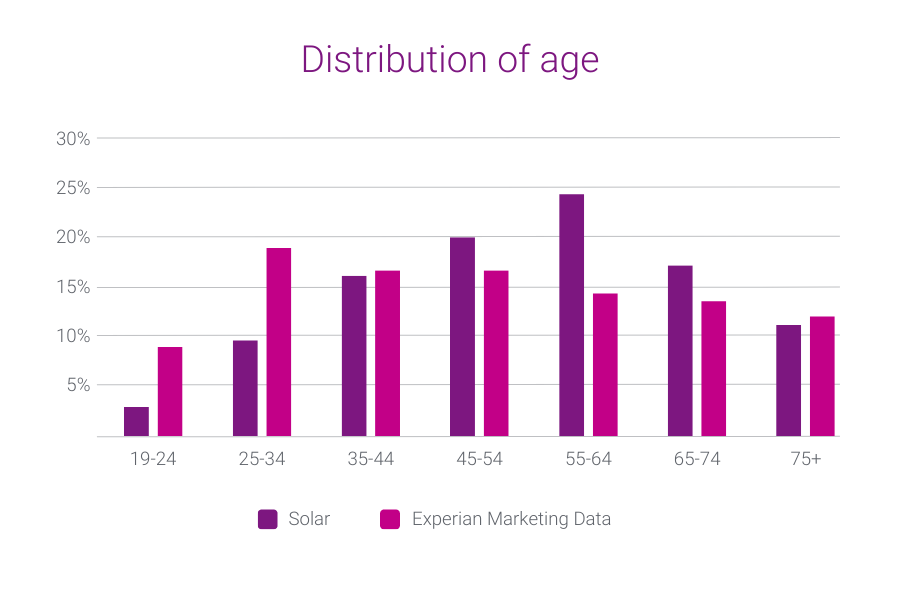
consumers in the eco-conscious solar energy audience are more likely to be between ages 45-74

Education level and occupation

Consumers in our Solar energy audience are more likely to have graduated from college or graduate school and work in management-level occupations.
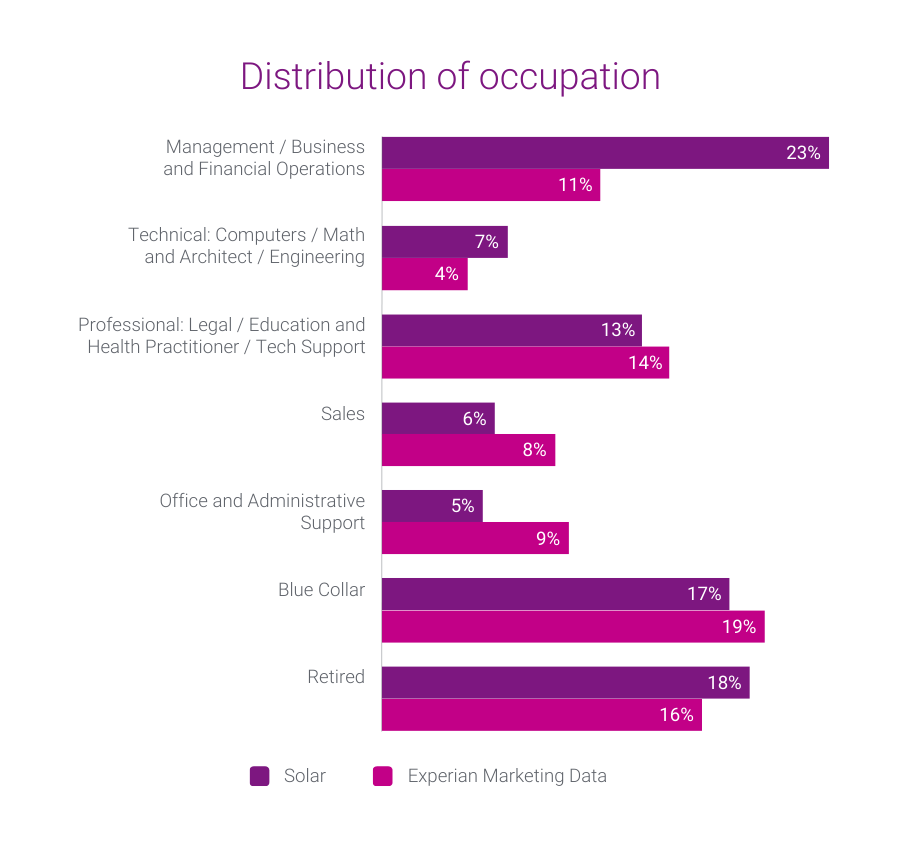
consumers in the eco-conscious solar energy audience are more likely to work in management-level occupations

Household income

Consumers in our Solar energy audience have household incomes of more than $75,000 and their homes are valued at over $550,000.
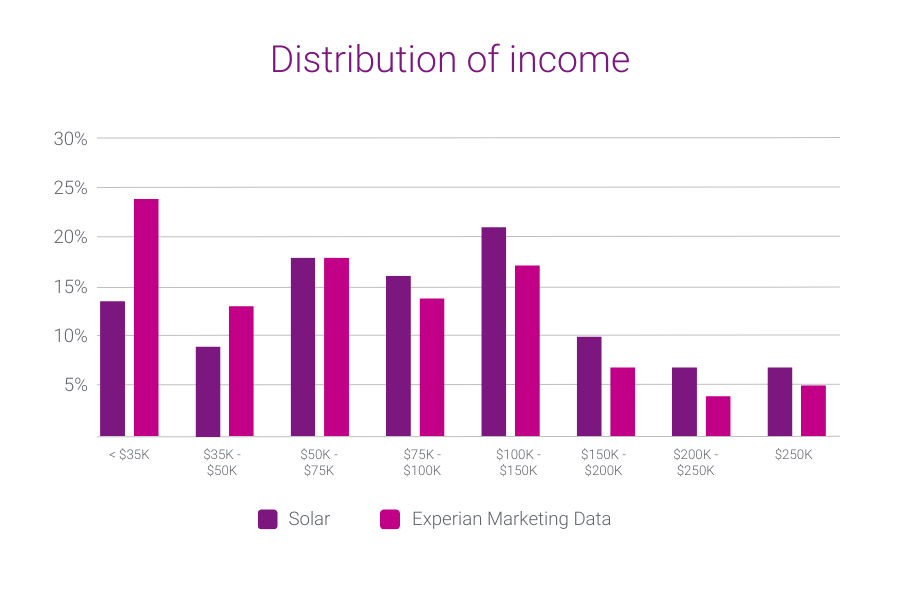
consumers in the eco-conscious solar energy audience have household incomes of more than $75,000

Preferred engagement channels

Consumers in our Solar energy audience are most receptive to ads served through digital channels like digital newspapers and email.
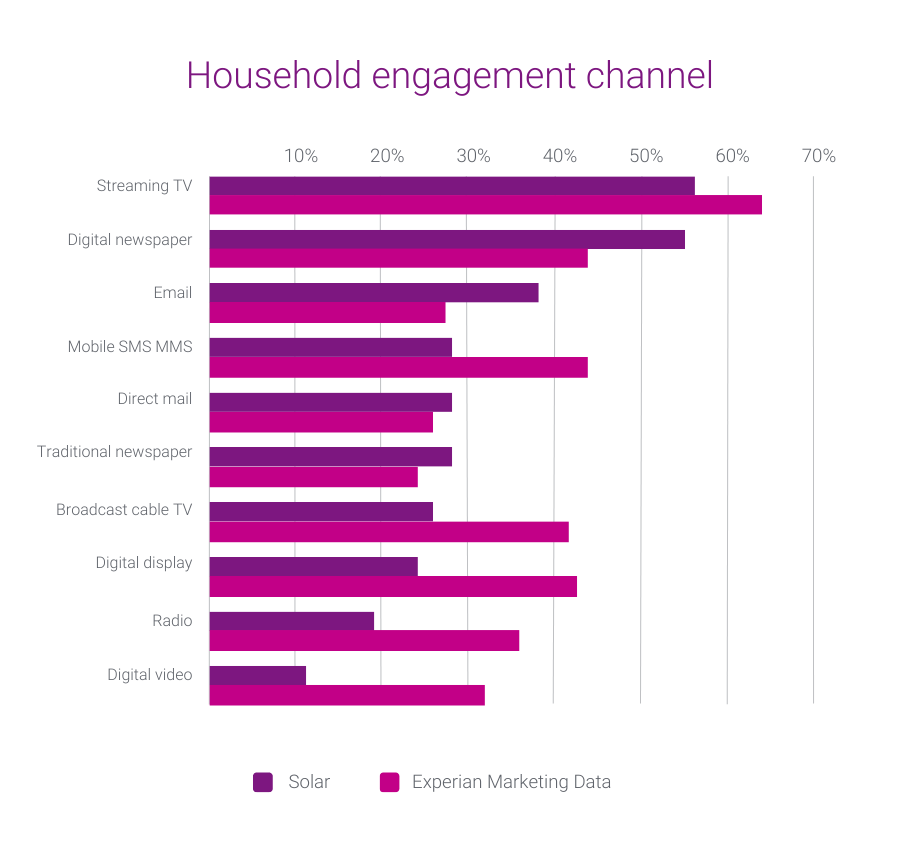
consumers in the eco-conscious solar energy audience are most receptive to ads through streaming tv and digital newspaper

Solar energy audience pairings

Consumers in our Solar energy audience also belong to three of our Mosaic® USA groups:

  1. Power Elite
  2. Flourishing Families
  3. Booming with Confidence

Our consumer segmentation portal of 126 million households and 650 lifestyle and interest attributes empowers marketers like you to precisely target your ideal audience and communicate with them on a personal level. Mosaic’s data segments the U.S. into 19 overarching groups and 71 underlying types, giving you the insights needed to anticipate the behavior, attitudes, and preferences of your most profitable customers and communicate with them on their preferred channels, with messaging that resonates.

GreenAware

Our second eco-conscious audience is GreenAware.

GreenAware segments the 126 million U.S. households within Experian Marketing Data into four distinct groups. Each group differs in their attitudes and behaviors toward purchasing products that are environmentally safe and working with companies that are eco-conscious. We created these groups using an enhanced application of traditional statistical clustering techniques based on environmentally relevant measurements in Simmons’ National Consumer Study.

Based on the distinctive mindset of consumers toward the environment, you can learn how environmental concerns fit into their lives through four major consumer segments:

  1. Eco-Friendly Enthusiasts
  2. Sustainable Spectators
  3. Passive Greenies
  4. Eco Critics

Let’s dive deeper into each group to understand their unique perspective on the environment and how this impacts their attitudes and behaviors.

Eco-Friendly Enthusiasts

This eco-conscious segment prioritizes a green lifestyle and takes pride in avoiding products that harm the planet. With traditional and liberal values, they embrace optimism and prioritize family. With their children out of the house, they take the time for some well-deserved rejuvenation and are committed to a healthy lifestyle. Some members of this group are transitioning into retirement and welcoming a new chapter in their life.

  • Mature adults and retirees
  • College graduate or more
  • Above average income
  • May be married or single
  • Typically own their homes

Sustainable Spectators

This segment aspires to be more sustainable, but they struggle with translating their green ideas into action. They have a soft spot for a cozy home. While their love for interior design and taking care of their own space is evident, they’re always looking for new experiences and opportunities to learn. Staying healthy and active is a top priority for this group, so it’s no surprise that they’re always looking for ways to stay fit and feel their best.

  • Established and mid-life adults
  • College graduate or more
  • High income
  • Typically married
  • Likely to own their homes

Passive Greenies

This is the largest and one of the most youthful groups. Known for their love of exploration and self-discovery, they may not have fully embraced eco-conscious behaviors yet, but they are eager to stay current with the latest technology and trends. With their incredible ability to multitask, they’re always on-the-go, and constantly seek the next best thing.

  • Mainly young adults and diverse
  • Education ranges from high school through some college
  • Below average income
  • More likely to be single or divorced
  • Typically rent

Eco Critics

This group is not likely to be eco-conscious and may have negative attitudes about the environment. They are confident, driven, and focused on their personal growth. They crave instant gratification, seeking out quick and easy solutions to their everyday decisions. They place a high value on entertainment, their social life, and carefully curate their image.

  • Young and established adults
  • Education ranges from high school through post-graduate studies
  • High income
  • Married or single
  • Typically own their homes

Let’s take a look at how the GreenAware segments stack up against each other in terms of age, household income, education level, and media preference. How do they compare? Let’s find out.

Age

Consumers in the Eco-Friendly Enthusiasts segment are the oldest of the four GreenAware segments – about half of the consumers are 65 or older. Eco Critics are the youngest segment, with over half of consumers in this group between ages 25-44.
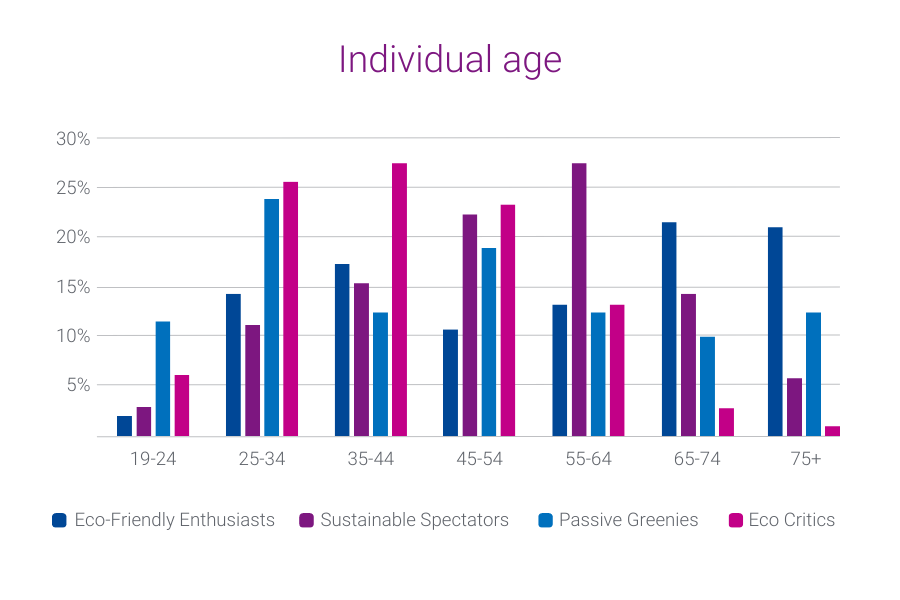
consumers in the "eco-friendly enthusiasts" audience are the oldest of the eco-conscious audience segments

Household income

Sustainable Spectators and Eco Critics are the wealthiest GreenAware segments. The average household income of consumers in these segments is above $100,000. Passive Greenies have the lowest household income, with a majority below $50,000.
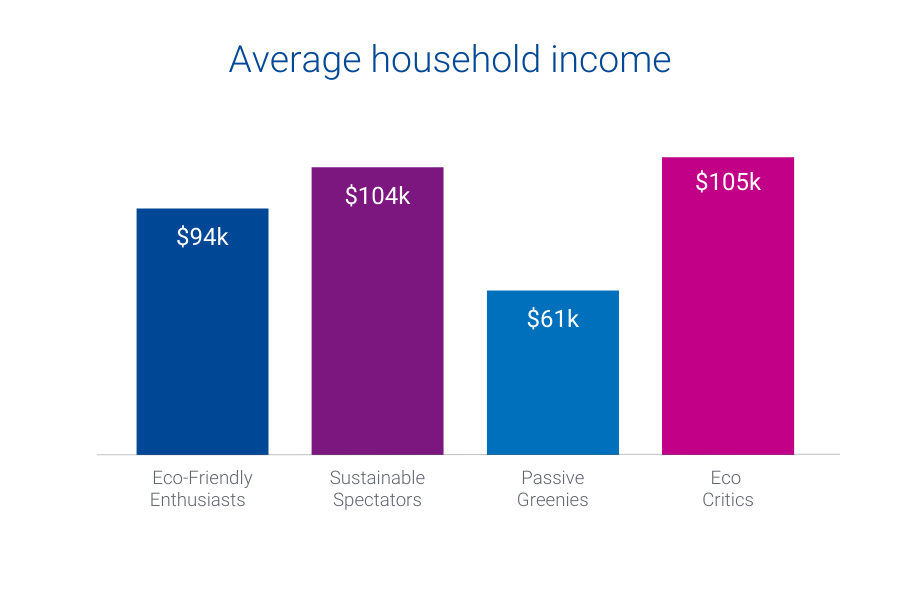
sustainable spectators and eco critic consumers are the wealthiest of the eco-conscious audiences

Education level and occupation

Passive Greenies are more likely to work Blue Collar jobs and have the lowest level of education. As the wealthiest segments, Sustainable Spectators and Eco Critics have the highest levels of college degrees and work in management, business, and financial operations. Eco-Friendly Enthusiasts are the most likely to be retired and out of the workforce.
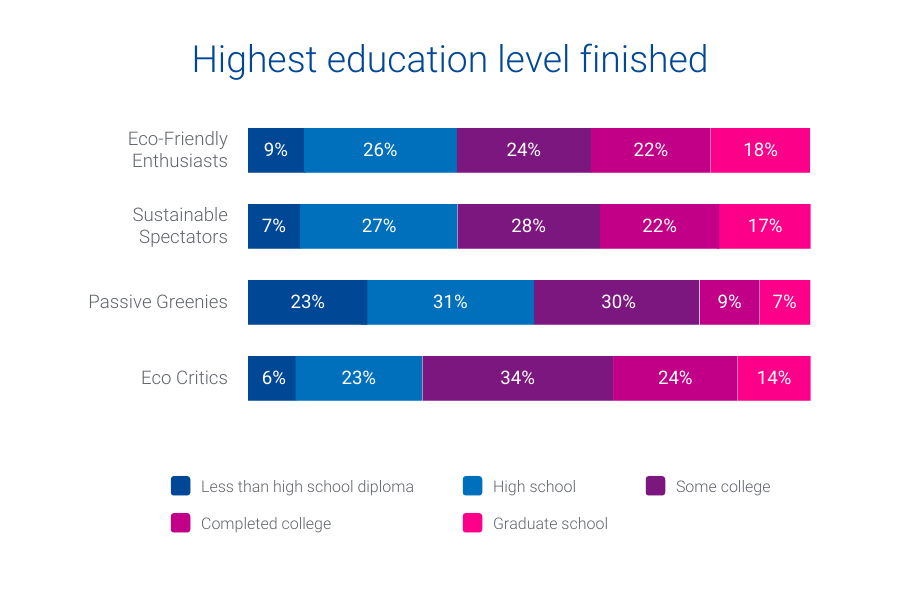
graph of eco-conscious audiences and the highest education level they have finished

Preferred engagement channels

  • Streaming TV is the preferred engagement channel for all GreenAware segments.
  • Eco-Friendly Enthusiasts prefer digital channels like digital newspapers, mobile SMS, and email. They also engage with traditional channels like direct mail and newspaper.
  • Passive Greenies have a high preference for digital display, mobile SMS, digital video, broadcast cable TV, and radio.
  • Eco Critics have a high preference for digital channels like digital newspapers, mobile SMS, and digital display.
  • Sustainable Spectators strongly prefer digital newspapers. They don’t show as strong of a preference for mobile SMS and digital display as Eco Critics and Passive Greenies.
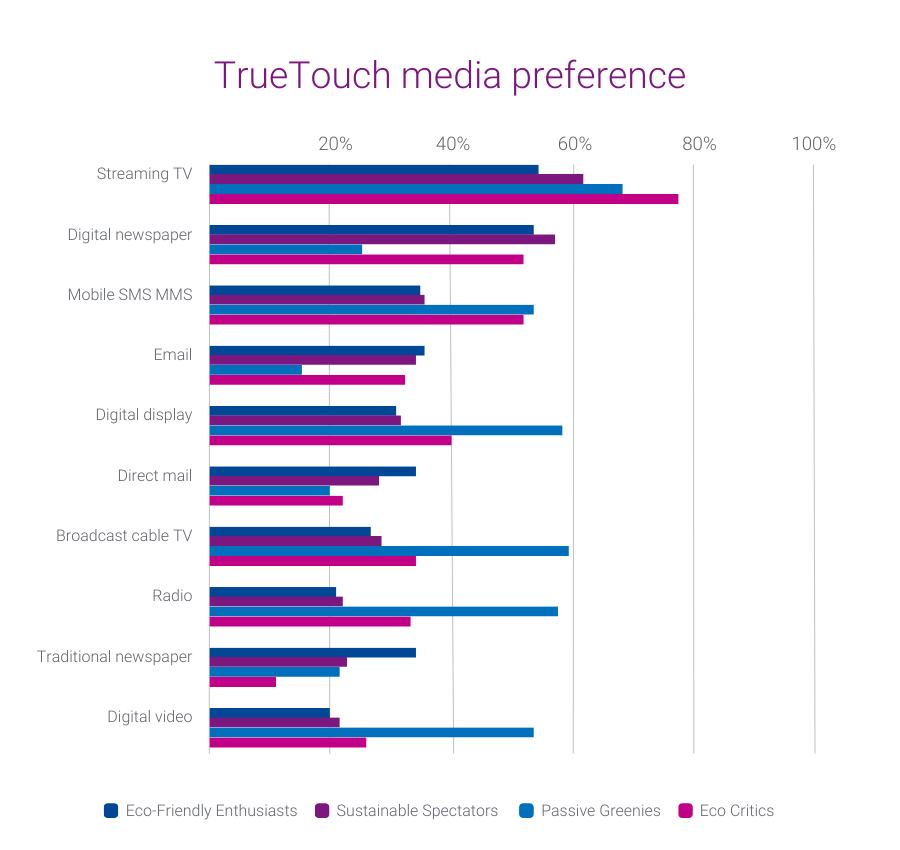
graph of the eco-conscious audiences' preferred engagement channels

GreenAware audience pairings

Six of our Mosaic groups have at least one GreenAware segment with 10% or more of the population. For more precise targeting, below are suggested Mosaic audiences you can pair with each GreenAware segment:

Eco-Friendly EnthusiastsSustainable SpectatorsPassive GreeniesEco Critics
Booming with ConfidencePower EliteSingles and StartersPower Elite
Autumn YearsBooming with ConfidenceGolden Year GuardiansSuburban Style
Golden Year GuardiansSingles and Starters

Electric vehicles

Our third eco-conscious audience is electric vehicles.

Electric vehicles (EVs) are having a major moment in the automotive industry. This is no surprise given that new EV models are being released and an increasing number of charging stations are popping up around the country. As EVs become more prominent, it’s essential to stay up to date on relevant trends to make informed decisions about what lies ahead.

The demand for electric vehicles (EVs) is on the rise

Consumers are embracing the EV revolution, showing their desire for a cleaner, greener future. Automotive marketers are increasingly looking to reach in-market EV shoppers and current alternative fuel vehicle owners due to the growing availability of electric vehicles, improved infrastructure, and rising popularity. In 2022, EVs charged up the market and accounted for a remarkable 6% of new retail registrations.

While Tesla continues to dominate the EV market, Ford, Chevrolet, and Hyundai are starting to compete, each holding more than 3% of the market share of new retail EV registrations.
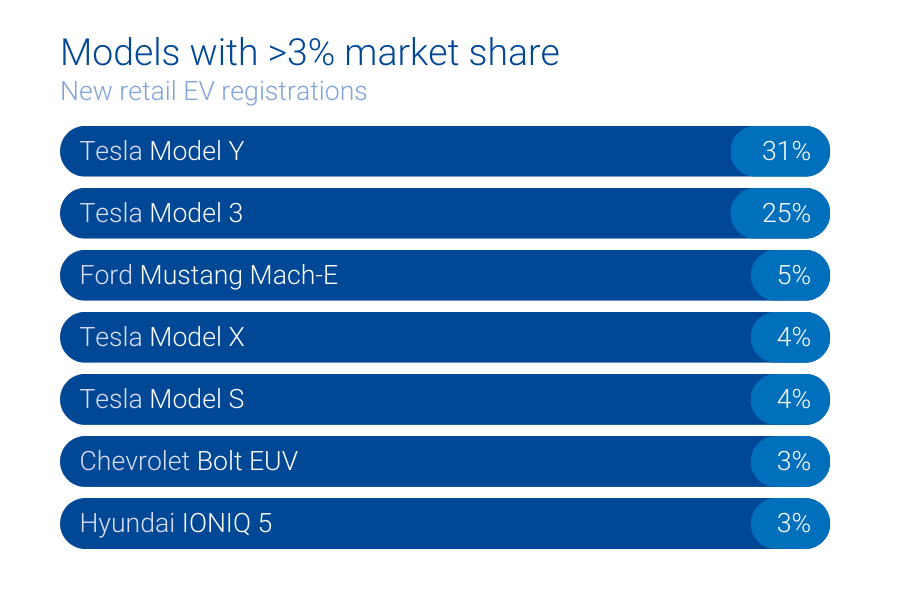
graph showing the demand for electric vehicles by model

Geography

Where are we seeing the most new retail EV registrations? The top designated market areas (DMAs) for new retail EV registrations are mostly located in heavily populated, coastal cities like Los Angeles, CA and New York, NY.
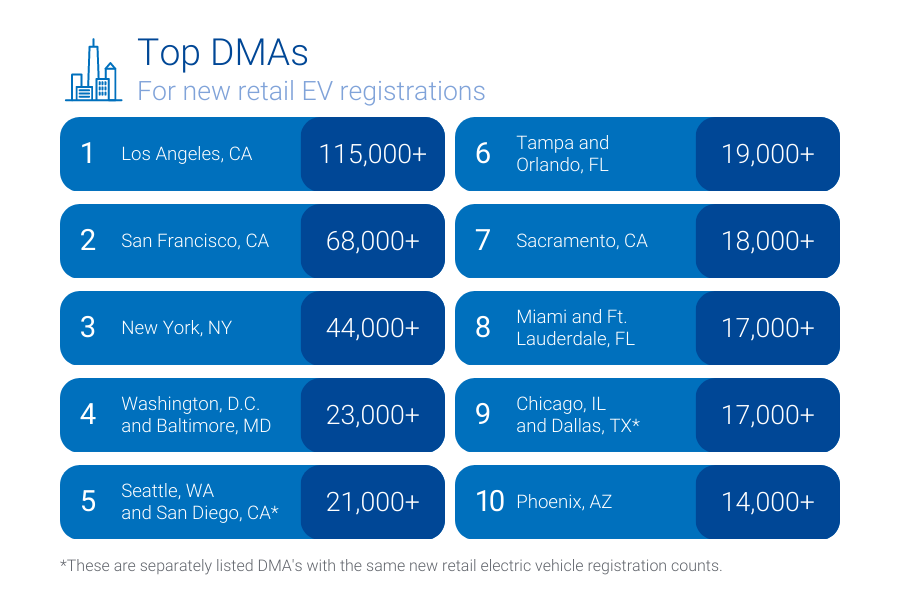
graphic showing the top designated market areas for new retail EV registrations

The fastest growing DMAs, however, are in smaller cities like Tucson, AZ and Oklahoma City, OK.

Generational demographics

Gen X and Millennials make up the largest percentage of new retail EV buyers at 37.5% and 34.4%. Gen Z and the Silent generation represent the smallest shares at 5% and 2.1%. Boomers hover between Gen X and Millennials’ share and account for 20.6% of new EV retail purchases.

EV audience pairings

Our top five Mosaic groups for new EV buyers include:

  1. American Royalty
  2. Cosmopolitan Achievers
  3. Philanthropic Sophisticates
  4. Couples with Clout
  5. Fast Track Couples

How to target consumers in-market for electric vehicles

We offer 70+ audiences that are focused on likely buyers and owners of EV and plug-in hybrid (PHEV) vehicles. We also offer a subset of 28 audiences focused on individual EV/PHEV vehicle models.

Below is how you can find a few of these audiences on-the-shelf of most trusted advertising platforms:

  • Autos, Cars, and Trucks > In Market-Fuel Type > Electric
  • Autos, Cars, and Trucks > In Market-Fuel Type > Used Electric
  • Autos, Cars, and Trucks > In-Market Make and Models > Tesla
  • Autos, Cars, and Trucks > In-Market Make and Models > Chevrolet Bolt EV

We can help you reach eco-conscious consumers

Earth Day is a great opportunity to get creative with your marketing efforts with our three eco-conscious audiences: Solar energy, GreenAware, and electric vehicles. To find out how you can add eco-conscious audiences to your marketing plan, contact us.

Get in touch

This site is protected by reCAPTCHA and the Google Privacy Policy and Terms of Service apply.


Latest posts

Loading…
How the AI revolution is transforming the future of commerce

In this article…Understanding the AI revolution in commerceFour benefits of the AI revolution coming to commerceFuture trends and predictionsChart the future of commerce with Experian Technology is pushing the boundaries of commerce like never before. Artificial intelligence (AI) is one of the primary driving technologies at the forefront of the commerce evolution, using advanced algorithms to revolutionize marketing and personalize customer experiences. As of 2024, AI adoption in e-commerce is skyrocketing, with 84% of brands already using it or gearing up to do so.  This article explores the AI revolution coming to commerce, focusing on what makes AI a driving force for e-commerce in particular, and the ways it's reshaping how businesses engage with consumers. Understanding the AI revolution in commerce AI is quickly reshaping commerce as we know it by democratizing access to sophisticated tools once reserved for large corporations, breaking down functional silos within organizations, and integrating data from multiple sources to achieve deeper customer understanding. It’s paving the way for a future where every brand interaction is uniquely crafted for the individual, powered by AI systems that anticipate preferences proactively.  AI is a broad term that encompasses: Data mining: The gathering of current and historical data on which to base predictions Natural language processing (NLP): The interpretation of human language by computers   Machine learning: The use of algorithms to learn from past experiences or examples to enhance data understanding The capabilities of AI have significantly matured into powerful tools that can improve operational efficiency and boost sales, even for smaller businesses. They have also fundamentally changed how businesses interact with customers and handle operations. As AI continues to develop, it has the potential to provide even more seamless, personalized, and ethically informed commerce experiences and establish new benchmarks for engagement and efficiency in the marketplace. Four benefits of the AI revolution coming to commerce Major commerce players like Amazon have benefited from AI and related technologies for a while. Through machine learning, they’ve optimized logistics, curated their product selection, and improved the user experience. As this technology quickly expands, businesses have unlimited opportunities to see the same efficiency, growth, and customer satisfaction as Amazon. Here are four primary benefits of AI adoption in commerce. 1. Data-driven decision making AI gives businesses powerful tools to analyze large amounts of data more quickly and accurately than a person. Through advanced algorithms and machine learning, AI can sift through historical sales data, customer behavior patterns, and market trends to uncover insights and suggest actions that might not be immediately obvious to human analysts. By transforming raw data into actionable insights, AI empowers businesses to make more informed decisions, reduce risks, and capitalize on opportunities. As a real-world example, Foxconn, the largest electronics contract manufacturer worldwide, worked with Amazon Machine Learning Solutions Lab to implement AI-enhanced business analytics for more accurate forecasting. This move improved forecasting accuracy by 8%, saved $533,000 annually, reduced labor waste, and improved customer satisfaction through data-driven decisions. 2. A better customer experience AI is set to make customer interactions smoother, faster, and more personalized by recommending products based on preferences and behaviors, making it easier for customers to find what they need. When consumers visit an online store, AI also provides instantaneous help via a chatbot that knows their order history and preferences. These AI-powered assistants offer real-time help like a knowledgeable store clerk. They give the appearance of higher-touch support and can answer basic questions at any hour, provide personalized product recommendations, and even troubleshoot issues. Chatbots free up human customer service agents for more complicated matters, and these agents can then use AI to obtain relevant information and suggestions for the customer during an interaction. 3. Personalized marketing Data-driven personalization of the customer journey has been shown to generate up to eight times the ROI, as data shows 71% of consumers now expect personalized brand interactions. Until AI came around, personalization at scale was complex to achieve. Now, gathering and processing data about a customer’s shopping experience is easier than ever based on lookalike customers and past behavior. Many businesses have adopted AI to glean deeper insights into purchase history, web browsing, and social media interactions to drive better segmentation and targeting. With AI, advertisers can analyze behavioral and demographic data to suggest products someone is likely to love. Consumers can now browse many of their favorite online stores and see product recommendations that perfectly match their tastes and needs.  AI can also offer special discounts based on purchasing habits, and send personalized emails with products and content that interest customers to make their shopping experience more engaging and relevant. This personalization helps businesses forge stronger customer relationships. Personalization across digital storefronts Retail media involves placing advertisements within a retailer's website, app, or other digital platform to help brands target consumers based on their behavior and preferences within that environment. Retail media networks (RMNs) expand this capability across multiple retail platforms to create seamless advertising opportunities throughout the customer journey.  Integrating AI into RMNs can improve personalization across digital storefronts with personalized, relevant ads and custom offers in real time that improve the customer experience. 4. Operational efficiency AI can also be beneficial on the back end, enabling more efficient resource allocation, pricing optimization, efficiency, and productivity. Customers can be frustrated when they visit a store for a specific product only to find it out of stock or unavailable in a particular size. With AI, these situations can be prevented through algorithms that forecast demand for certain items. Retailers like Amazon and Walmart both use AI to predict demand, with Walmart even tracking inventory in real time so managers can restock items as soon as they run out.  AI can automate and streamline operational tasks to help businesses run smoother, faster, and more cost-effective operations. It can: Offload tedious data entry, scheduling, and order processing tasks for greater fulfillment accuracy.  Analyze historical data and market trends, predicting demand to help businesses optimize inventory, reduce waste, track online and in-store sales, and prevent shortages. Forecast demand levels, transit times, and shipment delays to make better predictions about logistics and supply chains. Improve data quality using machine learning algorithms that find and correct product information errors, duplicates, and inconsistencies. Adjust prices based on competitor pricing, seasonal fluctuations, and market conditions to maximize profits. Pinpoint bottlenecks, identify issues before they escalate, and provide improvements for suggestions. Future trends and predictions If you want to stay ahead in e-commerce, it’s just as important to know what’s coming as it is to understand where things are today. Here are some of the trends expected to shape the rest of 2024 and beyond. Conversational commerce Conversational commerce allows real-time, two-way communication through AI-based text and voice assistants, social messaging apps, and chatbots. Generative AI advancements may soon enable more seamless, personalized interactions between customers and online retailers. This technology can improve customer engagement and satisfaction while providing helpful insights into preferences and behaviors for better personalization and targeting. Delivery optimization AI-driven delivery optimization uses AI to predict ideal routes for each individual delivery, boosting efficiency, reducing costs, promoting sustainability, and improving customer satisfaction throughout the delivery process. Visual search AI-driven visual search is quickly improving in accuracy, speed, and contextual understanding. Future developments may integrate seamlessly with augmented reality (AR) so shoppers can search for products by pointing their devices at physical objects. Social media and e-commerce platforms may soon incorporate visual search more prominently, allowing users to find products directly from images. AI content creation AI is already automating and optimizing aspects of content production: Algorithms can generate product descriptions, blog posts, and social media captions personalized to specific customer segments.  AI tools also enable the creation of high-quality visuals and videos.  NLP advancements ensure content is compelling and grammatically correct.  AI-driven content strategies analyze consumer behavior and refine messaging to meet changing preferences and trends. This automation speeds up content creation while freeing resources for strategic planning and customer interaction. IoT integration Integrating AI with Internet of Things (IoT) devices could help make the ecosystem more interconnected in the future. AI algorithms can use data from IoT devices like smart appliances, wearables, and sensors to gather real-time insights into consumer behavior, preferences, and product usage patterns. This data enables personalized marketing strategies, predictive maintenance for products, and optimized inventory management. AI-driven IoT data analytics can also streamline supply chain operations to reduce costs and inefficiencies. Fraud detection and security There will likely be an increased focus on the ethical use of AI and data privacy regulations to strengthen consumer trust and transparency. AI-powered systems will get better at detecting and preventing fraud in e-commerce transactions, which will heighten security measures for both businesses and consumers. Chart the future of commerce with Experian AI has changed how marketers approach e-commerce in 2024. With AI-driven analytics and predictive capabilities, marketers can extract deeper insights from extensive data sets to gain a clearer understanding of consumer behavior. This enables refined segmentation, precise targeting, and real-time customization of messages and content to fit individual preferences. Beyond insights, AI automates routine tasks like ad placement, content creation, and customer service responses, freeing marketers to concentrate on strategic planning and creativity. Through machine learning, marketers can predict trends, optimize budgets, and fine-tune strategies faster and more accurately than ever. The time to embrace AI is now.  At Experian, we’re here to help you make more data-driven decisions, deliver more relevant content, and reach the right audience at the right time. Using AI in your commerce marketing strategy with our Consumer View and Consumer Sync solutions can help you stay competitive with effective, engaging campaigns.  Contact us to learn how we can empower your commerce advertising strategy today. Contact us Latest posts

Sep 10,2024 by Experian Marketing Services

An interview with Ampersand’s Rachel Herbstman and Anastasia Dukes-Asuen

In our Ask the Expert Series, we interview leaders from our partner organizations who are helping lead their brands to new heights in AdTech. Today’s interview is with Rachel Herbstman, VP of Data Innovation, and Anastasia Dukes-Asuen, Senior Director of Advanced TV Data & Insights at Ampersand. Could you introduce us to Ampersand and discuss your approach to TV advertising? Ampersand, a joint venture between Comcast, Charter, and Cox, is a media sales organization that offers a unified footprint, unlocking unparalleled scale and unique data/insights for local and national advertisers. Ampersand gives advertisers true audience first planning, scale in execution, and advanced measurement of their TV investments, representing 117 million multiscreen households and over 75% of addressable households in the U.S. (64 million households). We help clients reach their unique target audience and deliver their stories – anytime, anywhere, and on whatever device. How does adding streaming to a linear campaign, or vice versa, enhance overall campaign performance for marketers?  Herbstman: Marketers have recognized that multiscreen media strategies are the strongest as viewership continues to fragment. Unique audiences exist in traditional TV and streaming, and failure to include either media channel will reduce the total reach opportunity. These channels have proven to validate unduplicated audiences. In our local business, adding streaming to a historically traditional linear-only media strategy increased campaign reach by 33%. Conversely, adding linear TV to a historically streaming-only media strategy increased reach by 209%. These metrics are validated by matching media exposures to an authenticated households subscriber ID and represent mass opportunities to reach new audiences with a multiscreen media strategy. When considering reallocating media investments, how does Ampersand help clients determine the most effective channels for specific campaigns?  Herbstman: For a brand that historically invested in traditional TV, either national or local broadcast, we can provide insights to analyze the performance of any media campaign. The insights can include high-level metrics like reach and frequency and more granular metrics like unique reach per network. By seeing both the high-level results and more detailed granularity, we can provide optimization recommendations for funding other activation opportunities. Our database of past campaigns consistently demonstrates that gaining new eyeballs with a national TV campaign usually plateaus after a few weeks. In other words, if most of your intended audience is reached after about three or four weeks of national television, reaching any new viewers can be exponentially more expensive. We’ve built an Addressable Simulator tool for national advertisers that shows the potential impact of shifting a portion of the national media weight, specifically from the latter part of a flight, into addressable TV. Using our licensed Experian data set, we can measure any standard age/gender target or any advanced target to understand the complementary impact that addressable audience has on national media. This tool has dynamic inputs of CPMs and incidence rates, flight lengths, and budgets to simulate different scenarios and give marketers some intelligence on what holistic reach against that Experian segment they could expect with one given budget using brand-safe, traditional, and streaming inventory with an addressable activation. Additionally, we've developed an interactive eCPM calculator that helps national advertisers assess the cost efficiency of adding addressable TV to their traditional campaigns. By dynamically inputting CPMs, marketers can evaluate tradeoffs between media types for upcoming campaigns. Are there audience demographics that benefit from these combined media strategies, and what indicators or data points guide your recommendations to add cable to a local broadcast campaign versus other reallocations? Herbstman: By including cable or streaming in a local effort, a client can use a data-driven approach to find more intended viewers in other premium content. Utilizing the vast library of Experian audience segments paired with our robust sample of 64 million data-enabled homes enables Ampersand to provide insights into the most valuable networks and dayparts that the intended viewer will likely watch on either platform.  With identity and viewing insights at scale, we can understand how consumers watch TV, even for inventory we have yet to sell. Our goal is to help marketers understand what’s happening as a result of their investments at a holistic level. We can analyze a campaign running across hundreds of designated market areas to quickly and simply understand the holistic delivery of their broadcast and cable weight by pulling back set-top-box exposures on broadcast and Ampersand-purchased cable on our measurable footprint. Then, we can determine the share of measurable reach that each portion’s media weight contributes to. We recommend optimizing towards a more balanced approach, where the reach levels for broadcast and cable mirror each other, creating a more effective market media mix. Once we confirm cable's potential in a market, we analyze network and daypart metrics to adjust key areas to optimize the campaign. We invite marketers to use these insights to measure their local or national TV campaign performance and garner unique perspectives to re-balance investments to drive reach and optimal frequencies. Are there common missteps to avoid? Dukes-Asuen: Ampersand's decades of experience with media and data insights have allowed us to create an extensive database complete with targeting and measurement benchmarks. We use this database to curate best practices for brands and help set them up for success, keeping their goals and objectives for reach and frequency in mind.  Some clients spread their investment levels too thin, whether through short flight windows, low weekly frequencies, or targeting overly niche audiences that don't fully support KPI goals. One way to avoid these missteps is to set up a test-and-learn plan to validate a hypothesis and refine media strategies, ensuring campaigns are structured to garner meaningful insights. Ampersand can help ensure the test itself is constructed and supported to yield statistically relevant results, and the learnings can then be applied to the next campaign. How does Experian’s data enhance your campaigns at Ampersand?  Dukes-Asuen: Within our Experian license, we can map the Experian Consumer View databases against our multichannel video programming distributors subscriber base in a privacy-compliant way to plan and activate them seamlessly. Experian has a rich set of audience targets and segmentation that we utilize to identify households that can be used for audience-based media execution with Ampersand. By defining the right audience—whether consumers are likely to purchase a product, exhibit certain behaviors, or demonstrate specific values—we enhance campaign performance and improve media spending efficiency for our advertisers. Additionally, how do you believe AI and other new technologies will impact your media buying approaches in the future, and how might these innovations improve campaign effectiveness and provide value to your clients? Herbstman: We have a strong use case on the measurement and analytics end. Using AI, we can aggregate a massive amount of historical data—viewership and exposure data. AI helps us understand overarching market trends and media performance to analyze campaign results and inform future campaign optimizations. The value of AI is in its role as an additional technology layer, enriching our insights portfolio and providing faster intelligence that enhances campaign effectiveness and delivers greater value to our clients. Can you share an example of how precise audience targeting and segmentation, powered by Experian, have led to significantly better media spend reallocations and campaign performance for marketers? One great example is how a national cruise brand dramatically improved its media spend and campaign performance by utilizing precise audience targeting and segmentation through Experian. By combining Ampersand’s addressable TV with Experian’s data-driven insights, they achieved a 14% incremental reach, a 3.1x higher frequency, and a 24% lower effective CPM. This strategic approach allowed them to reallocate their media spending more effectively, ensuring every impression reached their custom target audience. Thanks for the interview. For those interested in learning more about Ampersand, reach out for a personalized consultation. Contact us Latest posts

Sep 05,2024 by Experian Marketing Services

The future of retail advertising: Embracing retail media standardization

In this article…How much standardization currently exists?Why is standardization important?Who is promoting standardization?The benefits of industry standardizationStrategies for implementing retail media standardizationFuture retail media standardization trendsJoin forces with a strategic RMN partner Retail media is quickly outpacing other areas of digital advertising and is projected to grow 29% by 2025. Despite this trajectory, retail media is still relatively new compared to traditional digital media and operates like a startup in terms of tech capabilities. Sustained growth will require retail media standardization — creating consistent ways to measure and compare ad performance across retail media networks (RMNs). This standardization will be key for RMNs wanting to understand what’s driving the most value and sales for their business. In an Interactive Advertising Bureau (IAB) study, 62% of ad buyers pointed to standardization as a top growth challenge. The current ecosystem’s inconsistent standards have prevented effective investment in measurement and limited ad buyer participation. Standardization will be necessary moving forward for effective adoption and trust in these new channels. This article explores the challenges marketers face without retail media standardization and the collaborative efforts needed to establish consistent measurement standards across the industry. How much standardization currently exists? Retail media standardization is limited industry-wide, with each RMN using its own metrics and definitions; what one network calls a "conversion" might be defined differently by another. Some retail companies also sell ad space within siloed, walled-garden shopping environments, which makes it difficult for advertisers to compare performance across platforms. As a result, the current landscape lends itself to inconsistency, campaign measurement complications, and an unclear view of return on investment (ROI) across RMNs. This fragmentation stems from how retailers have historically developed and managed customer data platforms and e-commerce websites independently, causing disparities in the types and quality of customer data available and the technologies used to manage it. Each retailer uses a unique technology stack and customer experience strategies, which means data is collected, utilized, and integrated into advertising platforms differently. Why is standardization important? A 2023 State of Retail Media Survey highlighted the industry's lack of standardization as a significant obstacle to growth. The Association of National Advertisers also found that advertisers can't fully take advantage of their retail media investments because of inconsistent measurement practices. Standardized retail media measurement practices are critical for growth. By setting consistent measurement standards across different platforms, it becomes easier for various players to: Assess how ads are performing See which strategies work across RMNs Optimize ad spending Make informed decisions Extract more value from advertising budgets Ultimately, standardized metrics are a must for improving transparency, strategic effectiveness, and ROI. Who is promoting standardization? We’re seeing a collective push for retail media standardization by several industry stakeholders wanting a more cohesive and effective advertising ecosystem. One of the most recent efforts came from the IAB and the Media Rating Council (MRC). These organizations collaborated with brands, agencies, and RMNs to develop new guidelines for standardized measurement practices and have given the ecosystem a proposed common language for retail media measurement. These guidelines were released in January 2024 to provide a consistent framework for the following across retail media platforms: Audience measurement Reporting Incrementality Transparency Viewability Ad delivery In-store advertising Microsoft Retail Media, an early adopter of the framework, has experienced greater data transparency, accuracy, privacy, and security, which has benefited advertisers and retailers and advanced Microsoft’s position as a retail media industry leader. Widespread adoption of these guidelines has the potential to drive innovation, attract more advertisers, strengthen collaboration, grow the industry, and improve the consumer experience. The benefits of industry standardization A standardized retail media framework for performance measurement can benefit advertisers, retailers, media agencies, and other stakeholders in the ecosystem. Here are some ways each entity stands to benefit. Benefits for retailers Standardization makes it easier for retailers to demonstrate their credibility and the value of their retail media program. With uniform measurement across channels and campaigns, they can provide clear, comparable data that reflects their impact, builds trust, and encourages advertiser investment. Better campaign management efficiency also reduces the operational burden, so retailers can focus on improving customer experiences and driving sales. Experian’s Activity Feed helps you measure performance — and understand how ads impact shopping behavior — by providing you with ad exposures in one environment (web or connected TV) that you can connect to an action in another (in-store purchase). Learn more about Activity Feed and see it in action here. Benefits for media agencies and marketers With standardized metrics, advertisers and media agencies have an easy, reliable way to compare metrics and assess the effectiveness of various campaigns across RMNs. This “apples to apples” comparison helps them determine which channels are truly driving better ROI so they can effectively optimize spending. Standardization also improves collaboration with retailers and leads to more effective campaigns. Consistent guidelines can help teams create, carry out, and optimize retail media strategies and easily compare platform effectiveness. Benefits for industry stakeholders Industry stakeholders like technology providers and regulatory bodies can greatly benefit from standardized retail media measurement practices. Consistent measurement provides a common framework that improves transparency and trust among parties. With reliable and comparable metrics, standardization helps everyone speak the same language when it comes to performance evaluation and decision-making. This uniformity facilitates smoother interactions and partnerships between the buy and sell sides, so it’s easier to negotiate and collaborate. Strategies for implementing retail media standardization Standardizing measurement will require industry-wide coordination around several strategies, as outlined in best practices frameworks from standardization proponents like IAB/MRC and the Albertson's Media Collective. Unify reporting and performance measurement To address the lack of standardization in performance metrics, RMNs must adopt uniform definitions and calculation methodologies for key metrics. Unified reporting in retail media requires successful stakeholder collaboration to: Agree on critical KPIs and reporting metrics like impressions and conversion rates Adopt standardized data formats and reporting tools Educate stakeholders Ensure data quality and compliance Continuously improve based on industry feedback The IAB/MRC framework provides a basis for standardizing metrics for media delivery and engagement, as well as sales and conversions. This consistency helps advertisers compare performance across platforms effectively, enhancing transparency and decision-making. Standardize product specifications It's important for advertisers to have consistent product specifications, as it makes it easier to create and deploy ads across multiple RMNs. To achieve this, RMNs should align ad formats, file sizes, animations, and video specifications with IAB guidelines. Following these standards will help RMNs eliminate compatibility issues, simplify adoption, and save time and resources. It's also vital for RMNs to maintain flexibility for unique ad formats in order to encourage innovation while still benefiting from standardized specifications. Introduce third-party verification and disclose capabilities Introducing third-party verification for ad placement, fraud detection, brand safety, and competitive separation can improve an RMN’s credibility and transparency. By disclosing the third-party providers used and the types of verification offered, RMNs build trust with advertisers and give them the confidence they need to invest. Additionally, RMNs should disclose their staffing, processes, technology, inventory management, targeting, creative management, and self-service offerings. Transparency in these areas helps advertisers make informed decisions, optimize ad buys, and increase efficiency. Using existing IAB verification and capability disclosure guidelines ensures reliability and a more trustworthy, efficient advertising environment. Future retail media standardization trends The future of retail media is poised for significant growth, especially as standardization guidelines are widely adopted and implemented. Here are some trends we expect to see as retail media ad spending grows. Widespread RMN adoption and spending Standardization could spur greater RMN spending and drive broad adoption by advertisers who hesitated before due to concerns about metrics and performance comparability. New partnerships and collaborations Standardization may lead to new partnerships that weren't possible before: Brands and retailers might team up to blend advertising and sales data for better-targeted campaigns. AdTech companies could also partner with multiple retailers to offer unified advertising solutions. Retail media networks and analytics firms could collaborate to provide deep insights into consumer behavior and campaign performance. Partnerships among retailers, including smaller ones seeking retail media measurement uniformity, may drive further standardization and create new advertising opportunities across product categories with audience overlap. Ad format innovation Agreeing on common standards simplifies how ads are measured and understood. Standardization may drive down costs and free up space for more imaginative, engaging ads in the future. For instance, the IAB/MRC’s common language is helping to promote consistency and clarity and fuel innovation across the board. Incrementality focus As standardization becomes more widespread, there may be a growing trend toward incrementality measurement, which measures the additional impact of advertising campaigns compared to what would have happened without them. Standardized metrics can help advertisers accurately gauge and optimize campaign effectiveness and maximize their marketing investments. Growth of cross-platform ad targeting Standardization may drive the growth of cross-platform ad targeting. With consistent metrics and measurement standards, advertisers will be able to track and compare their ad performance across platforms more accurately. This unified approach will improve ad targeting precision and ensure a consistent impact across RMNs. Commerce media Commerce media is changing retail advertising with its focus on verified data and real-time transaction insights, making campaigns more efficient. This shift could push for more uniform measurement standards across platforms and level the playing field. As commerce media gains traction, its emphasis on targeted advertising and ROI measurement might pave the way for universal metrics and clearer guidelines across retail networks. Where does this leave modern advertisers? Retail media is still at a crossroads. If standardization doesn’t occur soon, its growth may slow. For now, advertisers are resorting to custom strategies or relying on whichever network they feel is most effective for their products. They are likely to continue investing significantly in retail media, maintaining or increasing spending in the next year. Although RMNs continue to be challenging without formally recognized standardization guidelines, the proposed IAB/MRC guidelines provide an effective starting point. Join forces with a strategic RMN partner RMN success requires overcoming complicated technical hurdles that may exceed non-media business capacities. Managing data complexities, resolving identities, utilizing audience insights, and ensuring precise measurement requires specialized expertise and technologies. We recently announced a solution tailored for RMNs. This offering enhances RMNs’ strength in first-party shopper data by using Experian’s #1 ranked identity and audience services. Our solution helps RMNs unlock expanded customer insights, enriched audiences for activation, identity resolution for cross-channel audience targeting, and real-time measurement and attribution. This comprehensive solution is designed to help RMNs capture more advertising revenue. Read the full announcement If your organization could benefit from a partner with the requisite technological tools and insights into the retail media landscape, contact us to discover how we can help you achieve RMN success. Contact us Latest posts

Aug 20,2024 by Experian Marketing Services

Subscribe to our newsletter

Enter your name and email for the latest updates

This site is protected by reCAPTCHA and the Google Privacy Policy and Terms of Service apply.

About Experian Marketing Services

At Experian Marketing Services, we use data and insights to help brands have more meaningful interactions with people. As leaders in the evolution of the advertising landscape, Experian Marketing Services can help you identify your customers and the right potential customers, uncover the most appropriate communication channels, develop messages that resonate, and measure the effectiveness of marketing activities and campaigns.

Visit our website

Subscribe to our newsletter

Stay up to date on the latest industry news and receive expert tips from our marketing experts.
Subscribe now!