Loading...

Brewing clarity: A café guide to AdTech jargon

Published: September 23, 2025 by Brandon Alford, Group Product Manager

At A Glance

AdTech can feel overwhelming with all its jargon, but we're breaking it down café-style. From first-party data and identity resolution to clean rooms and ID-free targeting, this guide breaks down the essential terms marketers need to know.

If you’ve ever sat in a meeting and heard an AdTech term you didn’t understand, you’re not alone. The industry evolves as quickly as a café turns over tables on a busy weekend. Even seasoned regulars can get tripped up by the jargon.

So instead of scratching your head over the “menu,” let’s walk through some of the most common terms: served café-style.

The ingredients: The many flavors of first-party data

Every meal starts with ingredients, and in AdTech, those ingredients are data. First-party data is not just one thing: it’s more like everything your favorite neighborhood café knows about you.
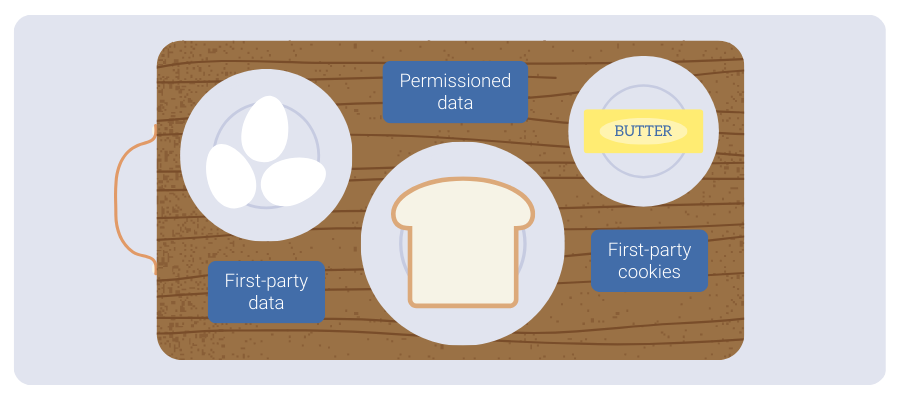
The ingredients of AdTech: first-party data (shown as eggs), permissioned data (shown as bread), first-party cookies (shown as butter)

First-party data

The café knows your coffee preferences because you’ve told them directly; whether by ordering at the counter, calling in, or placing an order online. This is information you’ve willingly provided through your interactions, and it belongs only to that café.

First-party cookies

The barista writes down your preferences in a notebook behind the counter, so next time you walk in, they don’t have to ask. First-party cookies remember details to make your experience smoother, but only for that café.

Authenticated identity

A loyalty app that connects online orders to in-person visits. By logging in, you’re saying, “Yes, it’s really me.” Authenticated identity is proof that the customer isn’t just a face in line, but someone with a verified profile.

Persistent identity

Recognizing you whether you order through the app or in person. Persistent identity enables the ability to keep track of someone across different touchpoints, consistently, without confusing them with someone else.

Permissioned data

Agreeing to join the loyalty program and get emails. Permissioned data is a connection to the customer that the customer proactively shared with the café by signing up for their loyalty program or email newsletter.

Each piece comes from direct interactions, stored and used in different ways. That’s what makes first-party data nuanced. The saga of third-party cookie deprecation and changing privacy regulations makes it important to understand which types of data you can collect and use for marketing purposes.

And once you have those ingredients, the next step is making sure you recognize how they fit together, so you can see each customer clearly. That’s where identity resolution comes in.

The recipe: Bringing the ingredients together with identity resolution

At the café, identity resolution is what helps the staff recognize you as the same customer across every interaction. Without it, they might think you’re two different people; one who always orders breakfast and another who sometimes picks up pastries to go.

Matching

The café has a loyalty program, and the pet bakery next door has one too. When they match records across their two data sets, they realize “M. Jones” from the café is the same person as “Michelle Jones” from the bakery. That connection means they can activate a joint promotion, like free coffee with a dog treat, without either business handing over their full customer lists. In marketing, matching works the same way, linking records across data sets for activation so campaigns reach the right people.

Two receipts that represent the same customer: M. Jones and Michelle Jones

Deduplication

Collapses duplicate profiles into a single, clean record, so you don’t get two birthday coupons, even though that would be nice to get.

That’s what Experian does at scale: we connect billions of IDs in a privacy-safe way, so you can get an accurate picture of your audience.

And once you can recognize your customers across touchpoints, the next challenge is collaborating across systems and partners for deeper insights. That’s where the behind-the-counter processes come in.

Behind the counter: Crosswalks and clean rooms

At a café, these terms are like the behind-the-counter processes that keep everything running smoothly. They may sound technical, but they all serve the same purpose: helping data collaborate across different sources, while keeping sensitive information safe. The goal is a better “meal” for the customer, deeper insights, better targeting, and more personalized campaigns. Here’s how they work.

Crosswalks

The café partners with the pet bakery next door. They both serve a lot of the same people, but they track them differently. With a crosswalk, they can use a shared key to recognize the same customer across both businesses, so you get a coffee refill, and your dog gets a treat, without either one handing over their full customer list. A crosswalk is the shared system that lets both know it is really you, without swapping personal details. It’s the bridge connecting two silos of data.

A woman walking between a cafe and a pet bakery and picking up items from both

Clean rooms

The café and the pet bakery want to learn more about their shared customers, like whether dog owners are more likely to stop by for brunch on weekends. Instead of swapping their full records, they bring their data into another café’s private back room, a clean room, where they can compare trends safely and privately. Both get useful insights, while customer details stay protected. That’s a clean room: secure collaboration without exposing sensitive data.

Of course, sharing and protecting data is only part of the picture. The real test comes when you need to serve customers in new ways, especially as the industry moves beyond cookies.

Serving customers in new ways: Cookie-free to ID-free

Targeting has evolved beyond cookies, just like cafés no longer rely only on notebooks to remember regulars.

ID-free targeting

The café looks at ordering patterns, like cappuccinos selling on Mondays and croissants on Fridays, without tracking who’s ordering what. Instead of focusing on who the customer is, the café tailors choices based on the context of the situation, like time of day or day of the week. This is like contextual targeting, serving ads based on the environment or behavior in the moment, rather than on personal identity.

On the left, a waiter takes an order from a customer, with a notepad that is crossed out. On the right, a waiter shows the customer the weekly specials, cappuccinos on Monday and croissants on Friday.

ID-agnostic targeting

The café realizes customers show up in all sorts of ways: walk in, online ordering, delivery. Each channel has its own “ID,” a name on the app, a credit card, or a loyalty profile. ID-agnostic targeting means no matter how you order, the café can still serve you without being locked into one system.

Just like cafés no longer rely only on notebooks to keep track of regulars, marketers no longer have to depend solely on cookies. Today, there are multiple paths, cookie-free, ID-free, and ID-agnostic, that can all help deliver better, more relevant experiences.

But even with new ways to reach people, one big question remains: how do you know if it’s actually working? That’s where measurement and outcomes come into play.

Counting tables vs. counting sales

At the café, measurement and outcomes aren’t the same.

Measurement

Tables filled, cups poured, specials ordered.

Outcomes

What it all means: higher revenue, more loyalty sign-ups, or increased sales from a new promotion.
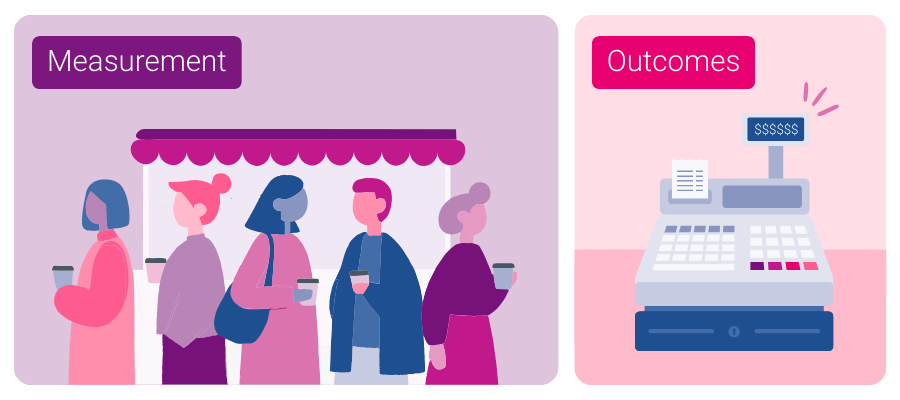
Both matter. Measurement shows whether the café is running smoothly, but outcomes prove whether the promotions and strategies are truly paying off. Together, they help connect day-to-day activity to long-term success.

All of this brings us back to the bigger picture: understanding the menu well enough to enjoy the meal.

From menu to meal

In AdTech, there will always be new terms coming onto the menu. What matters most is understanding them well enough to know how they help you reach your business goals. Just like at the café, asking a question about the specials isn’t foolish. It’s how you make sure you get exactly what you want. The more we, as an industry, understand the “ingredients” of data and identity, the better we can cook up new solutions that serve both brands and consumers. After all, the goal isn’t just to talk about the menu, it’s to enjoy the meal.

At Experian, we help brands turn that menu into action. From identity resolution to privacy-safe data collaboration, our solutions make it easier to connect with audiences, activate campaigns, and measure real outcomes.

If you’re ready to move from decoding the jargon to delivering better customer experiences, we’re here to help

This site is protected by reCAPTCHA and the Google Privacy Policy and Terms of Service apply.


About the author

Brandon Alford, Group Product Manager, Experian

Brandon Alford

Group Product Manager, Experian

Brandon Alford is a seasoned professional in the AdTech ecosystem with a focus on identity, audience, measurement, and privacy-forward solutions. He has spent his career helping advertisers and publishers navigate the complexities of digital advertising and privacy, bringing a practical and forward-looking perspective to industry challenges and innovation.


AdTech jargon FAQs

What is first-party data, and why is it important?

First-party data is information a customer shares directly with a brand, like purchase history, preferences, or sign-ups. It’s the most valuable and privacy-safe data marketers can use to build personalized campaigns.

How do identity resolution and matching work in marketing?

Identity resolution ensures a brand can recognize the same customer across different touchpoints. Matching links records across data sets (e.g., between partners) so campaigns reach the right people without exposing full customer lists.

What’s the difference between a crosswalk and a clean room?

A crosswalk bridges two data systems with a shared key to recognize the same customer, while a clean room allows partners to analyze data together securely without exposing sensitive details.

What does “cookie-free” or “ID-free” targeting mean?

Cookie-free and ID-free targeting shift focus away from tracking individuals, instead tailoring ads based on context (like time of day or content being viewed) or allowing flexibility across multiple IDs.

How is measurement different from outcomes?

Measurement tracks activity (like clicks or visits), while outcomes prove business impact (like sales, loyalty, or revenue). Both are essential, but outcomes show whether strategies are truly effective.

How does Experian help marketers with these AdTech challenges?

Experian provides tools for identity resolution, privacy-safe data collaboration, and campaign measurement, helping marketers move from understanding the “menu” of AdTech terms to achieving real results.


Latest posts
Loading…
What’s curation in AdTech?

Programmatic media buying isn’t getting any easier. Buyers face rising signal loss, shrinking margins, and growing pressure to perform in a privacy-first world. Add in fragmented tech, shifting privacy regulations, and inconsistent identity signals, and reaching the right audience at scale has never been more complex (or costly). Meanwhile, advertisers demand more transparency, publishers want control, and consumers expect relevance without feeling watched. Open exchanges, legacy data management platforms (DMPs), and spray-and-pray strategies just aren’t cutting it. That’s why curation has become a trending topic in the AdTech space. In programmatic advertising, curation refers to the strategic integration of enriched data and quality inventory into a single package — often executed as a private marketplace (PMP) deal. This approach reshapes how campaigns are built, activated, and optimized by enabling performance-ready buys that reduce waste, increase relevance, and give marketers greater control over outcomes. It’s no wonder then that curation investments are accelerating, PMPs are gaining traction, and buyers are shifting budgets accordingly. Over 66% of the $150 billion+ open exchange programmatic market now flows through curated PMPs, with industry giants like Google publicly backing curation as a core strategy. So what exactly is programmatic curation, and why is it becoming essential for privacy-conscious, performance-driven marketers? Let’s break it down. What does programmatic curation mean in AdTech? Programmatic curation is the process of filtering, structuring, and packaging enriched data with high-quality programmatic inventory — enhanced by real-time optimization to create more targeted, efficient, and transparent media buys. Instead of buying at scale and hoping for the best, curation prioritizes accuracy and value over volume, resulting in more targeted, efficient, and transparent media buys. As privacy regulations reshape targeting, curation is becoming a key differentiator in an increasingly crowded AdTech space. It connects robust data with quality supply, helping marketers stay effective while giving publishers new ways to monetize with control. But not all curation is created equal. Programmatic curation requires three core elements: 1. Unique data Unique, privacy-compliant, and valuable. 2. Strong supply connections Access to quality inventory from publishers at scale. 3. Optimization tools To measure, refine, and improve performance during a campaign and improve performance throughout the campaign lifecycle. Without all of these elements, a so-called “curator” may simply be repackaging inventory without delivering the full value of a curated approach. Why does curation still matter with cookies sticking around? While third-party cookies and mobile IDs like IDFA haven’t gone away, the industry has already pivoted in anticipation of their decline.  Even without Google flipping the switch, signal loss is here thanks to Apple’s ATT, tighter compliance rules, and new tracking restrictions. Marketers are dealing with less data, more fragmentation, and fewer reliable IDs. So if you want to run an effective, scalable media campaign today, you need tools that go beyond third-party cookies. That’s why programmatic curation is gaining ground as a better, more sustainable way to buy media. Investments in programmatic curation are growing, and not just for identity resolution. Marketers are leaning in because it: Combines verified audience data with premium inventory Supports ID-free or context-aware targeting Enables scalable, identity-agnostic strategies Improves data quality through enrichment Creates more controlled, pre-approved media paths via PMPs Experts anticipate that, at some point, publishers will have to lean into this method. “Curation will be bigger than header bidding and as big as programmatic or RTB — that’s our bet.”Andrew Casale, CEO Whether cookies stay or go in the future, curation works for an ecosystem that demands smarter, cleaner, and adaptable media buying. What are the benefits of curation and who wins? Curation is one of the few innovations in AdTech delivering meaningful wins across the ecosystem. By bringing better data, cleaner supply, and more intentional targeting into programmatic advertising, it helps brands, agencies, and media buyers drive stronger performance, gives publishers more control, and creates a more respectful experience for consumers. And unlike traditional approaches, curation is built for what’s now and what’s next. Here’s how each group benefits and why it matters. Brands and agencies Curation helps brands and agencies run smarter, more efficient campaigns by connecting high-quality data with premium supply. It delivers: More efficient supply paths with less waste and better performance Lower costs than DMP segments and open exchange buys Cleaner, pre-vetted inventory that aligns with audience and brand goals Future-proofed buying via cookieless and log-level data integrations Stronger targeting and measurement driven by enriched data and actual usage signals instead of modeled assumptions Better outcomes through real-time supply and data optimization Publishers For publishers, curation makes inventory more addressable without giving up control. It enables: Smarter packaging that aligns with buyer needs and campaign goals Higher CPMs by curating inventory above open exchange floors More control over how audiences are accessed and how inventory is monetized Access to higher-value demand through curated, data-backed deals Better protection of proprietary audience in a privacy-conscious environment Consumers At the end of the chain, curation improves the ad experience for those who matter most: your audience. It supports: Higher-quality content alignment for more natural, less disruptive ad experiences tailored to their interests  Less invasive tracking, as targeting becomes more data-smart and privacy-aware, with reduced reliance on legacy identifiers and personally identifiable information (PII). Curation is setting a new standard for how data, inventory, and experience come together across the ad ecosystem. When media is smarter, cleaner, and more intentional, everyone wins. What’s Experian’s role in powering curation? With the acquisition of Audigent, Experian is now more than just a premier data provider. We’re also a full-service curation partner. Together, we deliver end-to-end programmatic curation across data, inventory, and optimization, helping brands and publishers unlock smarter, more scalable media strategies. What Experian + Audigent enable Whether you need speed-to-market with pre-curated deals or white-glove custom deals, Experian and Audigent make it easier to activate high-performing, privacy-compliant campaigns at scale with: End-to-end curation across data, inventory, and real-time optimization Pre-packaged and custom PMP deals with built-in performance signals Scalable, privacy-first media solutions aligned to brand objectives, verticals, and KPIs These aren’t just theoretical; curated marketplace deals are already delivering measurable gains. In OpenX, Audigent-curated campaigns increased bid competition by 20% and drove a 118% spike in impressions won over a two-month period. Key benefits for partners By bringing together our data depth and Audigent’s curation technology, we offer our partners a full suite of value-added capabilities, including: High-quality, verified data ranked #1 in accuracy by Truthset and powered by Experian’s identity graph and deep programmatic data insights Data enrichment layers that boost addressability, accuracy, and contextual relevance Privacy-compliant infrastructure built for secure, cookieless data use at scale Platform integration across leading demand-side platforms (DSPs) and supply-side platforms (SSPs) for seamless activation and optimization How Boiron achieved smarter reach with Audigent’s curated PMP strategy A leading homeopathic brand partnered with Audigent to scale customer acquisition for its flu relief product without increasing media investment. They wanted to reach new, privacy-compliant audiences while improving CPA across display and video.  Using Audigent’s curated SmartPMPs and CognitivePMPs, the campaign delivered measurable performance improvements: 80% lower CPA on display than historical benchmarks 40% lower CPA on video 30% reduction in data costs Significant media efficiency gains through real-time supply and data optimization Fully future-proof targeting with zero reliance on cookies or MAIDs See how Boiron’s success story is just one example of how curated deals backed by Experian identity and Audigent’s optimization technology can deliver efficiency and impact in a privacy-conscious environment. Our curation capabilities Together with Audigent, our curated solutions go beyond basic packaging. Every deal is designed for performance, privacy, and relevance, so you can activate smarter media with greater confidence: Deal ID-ready audiences for fast, turnkey activation Performance-specific curation, including viewability, CTR, and outcome-based targeting Custom audience + inventory packages tailored to campaign goals Vertical-specific curation for industries like auto, retail, CPG, and financial services Real-time optimization signals embedded into every curated deal Don’t wait: Curate today The future of programmatic advertising won’t be won by those waiting for perfect signals, clean cookies, or simplified tech stacks. It’ll be won by marketers and publishers who embrace smarter, cleaner ways to activate their data, inventory, and strategy now. With Experian and Audigent, you’re not just getting better data but also a partner that helps you activate it with accuracy, privacy, and performance at scale. Whether you’re trying to reduce media waste, gain supply path control, or future-proof your campaigns, curated deals can get you there faster. Let’s build a curation strategy that gives you control in a chaotic ecosystem. Latest posts

Sep 03,2025 by Experian Marketing Services

Identity that pays off: How to turn quality data into measurable ROI

Traditional audience signals are fading, and the industry is facing a new reality: identity is no longer just about connectivity, it’s about outcomes. At Cannes Lions 2025, leaders from AdRoll, LG Ad Solutions, Magnite, MiQ, OpenAP, PubMatic, Stirista, Tatari shared how innovative identity approaches are cutting through the noise, improving performance, and delivering real ROI. Their insights reveal a clear path forward for those ready to turn identity into a performance driver. Here’s how you can apply the same principles to drive performance. 1. Make identity a performance engine Treating identity as a performance driver leads to measurable results by creating a clear connection between marketing efforts and outcomes. Identity resolution enables the effective retargeting of audiences, accurate performance attribution across connected TV (CTV), and personalized campaigns across multiple channels. By building household-level graphs and incorporating alternative identifiers, marketers can maintain accuracy as traditional signals change. Activating first-party data across both digital and offline channels ensures that every interaction, whether on-screen or in-store, can be tied back to specific actions, helping optimize campaigns, and improve ROI.  How Experian helps Experian’s Consumer Sync solutions create a clean foundation and persistent identity spine by resolving and expanding your first-party data across digital and offline IDs (hashed emails, mobile ad IDs, CTV IDs). This enables activation across omnichannel campaigns, from CTV to social, and connects data to outcomes.  "Identity resolution is very important to our overall strategy today. Without that identity linkage, we couldn’t speak the same language as our clients. For example, a client might want to target people who engaged with their brand’s website four days ago via CRM data. Without identity resolution, that’s not possible. But with it, we’re changing the narrative – making TV a hospitable place for deploying first-party data and driving outcomes."Mike Brooks 2. Build trust through responsible data practices Consumer trust begins with responsible data practices that prioritize transparency and privacy. Deterministic match rates ensure accuracy by connecting data points with confidence, while clear methodologies provide visibility into how data is used. These practices improve overall campaign performance and protect consumer privacy by ensuring that every interaction is respectful. How Experian helps Experian’s privacy-first approach ensures that all data activation occurs with compliance and consent. By maintaining high match rates and adhering to transparent methodologies, Experian helps build trust and strengthen long-term connections with audiences. "If people don't take any precautions and they don't actually care about data in the public, they probably don't care about it in private. Experian cares about data privacy and compliance, and that made it a no-brainer for us to work with them. When we combined our focus on privacy with Experian’s expertise, we knew we had to do it right – and we did."Henry Olawoye 3. Expand reach while maintaining high match rates Having more data points to identify individuals leads to higher match rates and broader reach. Enriching records with additional identifiers, like hashed emails, MAIDs, and CTV IDs, makes it easier to connect data across channels and create a unified view of each person. This approach ensures that campaigns can scale effectively while maintaining the accuracy needed to deliver personalized experiences. How Experian helps With a database of over 5,000 attributes spanning 15 verticals and categories, Experian provides a comprehensive view of consumers through a single provider. By sourcing data from over 200 sources (including public records, consumer surveys, and purchase records), Experian enables the creation of detailed audience profiles. This enriched data focuses on identity, creating a unified view of individuals that helps pinpoint the best opportunities to engage effectively across channels and deliver measurable outcomes tailored to specific audience needs. "We’ve been able to extend our IDs by an average of 6.5 different identifiers, with a 70% match rate. That extension is huge – it underpins a lot of the connectivity in our platform and allows us to bring 300 data feeds together to make the most of them."Georgiana Haig 4. Create unified campaigns with interoperability Fragmented data often leads to fragmented results. Interoperability ensures that data from different platforms and systems can work together, creating a unified view that makes measurement and attribution more actionable.  How Experian helps Experian simplifies interoperability by ensuring consistent data usage from activation and measurement. By connecting data from various sources, Experian enables a cohesive strategy where insights can be shared across publishers, measurement providers, and ad servers, ensuring campaigns remain aligned and effective at every stage. "The ecosystem benefits from optimized interoperability. We’re focused on allowing advertisers to work seamlessly across IDs and identity solutions – from activation to resolution – so the same data set is used consistently across publishers, measurement providers, currencies, programmatic ecosystems, and ad servers."Chris LoRusso 5. Use AI to amplify, not replace, strategy Artificial intelligence (AI) is transforming how campaigns are optimized, but its success depends on clean, consented identity foundations. AI can analyze vast amounts of data to refine targeting, manage frequency, and uncover new efficiencies, but only when built on a strong identity framework. How Experian helps Experian uses AI and machine learning to deliver highly personalized marketing solutions. Advanced clustering algorithms in Experian’s Digital Graph analyze and create household and individual device connections, improving targeting and measurement accuracy, while machine learning models improve consumer insights by inferring household composition where data is limited. These innovations enable AI tools to quickly generate tailored audience solutions, analyze contextual signals in real time, and identify opportunities that improve results while maintaining a human centered approach to decision making. "AI is a copilot to your marketing initiatives. For it to perform, it needs insights and information to learn from. That’s why having a strong foundational data asset rooted in deterministic data is so important."Howard Luks Five moves to turn identity into profit Here are five steps to get started: 1. Audit your data health Make sure your audience data is accurate, up-to-date, and complete so you’re starting from a strong foundation. 2. Layer in more context Enrich your records with details, like lifestyle, interests, or buying behaviors, that help you speak your audience’s language. 3. Unify touchpoints across channels Link your data so you can see the same person or household whether they’re engaging on CTV, mobile, desktop, in-store, or through other touchpoints. 4. Activate AI for stronger campaigns Use AI tools to fine-tune targeting, control ad frequency, and find hidden opportunities once your foundation is solid. 5. Align data across systems Ensure interoperability so data from different platforms and systems can work together, creating a unified view for actionable insights. The common thread across these insights is connection: connecting data, teams, and outcomes. Marketers who act on these imperatives will be ready for whatever new channel, format, or privacy rule comes next. Let’s start a conversation about how Experian can help you turn identity into ROI Latest posts

Aug 27,2025 by Experian Marketing Services

Audigent now offers turnkey open internet deals through Amazon DSP

Audigent, a part of Experian, now offers turnkey, outcome-driven deals for brands through Amazon DSP, expanding advertisers’ options for advertising across the open internet.   While buyers continue to activate through established supply paths with Amazon DSP, this collaboration introduces sell-side curation that expands data access and reduces overall buyer costs.  Three paths to activation With Audigent's curation services now available through Amazon DSP, buyers have streamlined access to premium open-internet inventory and measurable results.  Advertisers now have three simple ways to build or tap into curated deals:   Off-the-shelf deals in Inventory Hub on Amazon DSP Buyers can access hundreds of pre-built curated deals, each designed to align with common campaign goals and accelerate time to market. Custom deal libraries built around KPIs Advertisers can work directly with Audigent and Amazon Ads to build tailored deal libraries that reflect their unique performance objectives. SimplePMP with AI-driven intelligence Audigent's proprietary AI technology powers its SimplePMP product, offering advertisers sophisticated segment recommendations to identify relevant audiences and inventory with enhanced accuracy. Data that drives performance Turnkey curation only works if the data behind it is immediate, precise, and actionable. With Audigent providing curation via Amazon DSP, each deal fuses premium, real-world signals with hand-picked inventory so every impression can move the needle. How turnkey curation works Here are three ready-made examples to spark ideas 1. Weather in real time When the temperature climbs above 85°F, a beverage brand’s “Hot-Day Hydration” creative can launch automatically. Twenty-four hours before a heavy-rain forecast, big-box retailers can push “Storm-Ready Supplies” for generators and batteries. Weather-triggered audiences from The Weather Company mean you buy only when conditions drive demand. 2. Moments that matter to fans Live Nation ticket-purchase signals that pinpoint two peak travel-booking windows—right after fans secure out-of-town concert or game tickets and again during the week leading up to the event—so airlines, online travel agencies, and hotels can serve timely seat-sale or last-minute lodging offers when intent (and conversion rates) are highest.  3. Intent you can see Bombora B2B signals surface companies researching topics like “zero-trust security” or “cloud cost reduction.” A cybersecurity SaaS can reach those accounts with demo ads, and an office-furniture brand can court firms exploring “hybrid-workspace redesign.” Media spend zeroes in on buyers already in-market.  A customer-centric approach Audigent delivers turnkey, customer-centric solutions across the open internet through Amazon DSP, prioritizing quality over quantity through premium web inventory. As buyers and sellers embrace more direct, transparent, and addressable supply paths, this streamlined approach boosts efficiency and drives meaningful outcomes for brands. Interested in trying this new path with Amazon Ads and Audigent? Email: audigent_sales@experian.com. What's next? Audigent is committed to enhancing our curation services available through Amazon DSP. We're focusing on: Expanding our suite of turnkey solutions to address evolving advertiser needs in the open internet space Developing new data-driven insights to further refine audience segmentation and inventory selection Continuously improving our technology to deliver even greater value and efficiency for advertisers As the advertising landscape evolves, Audigent will continue to innovate, ensuring our offerings complement and enhance the capabilities available through Amazon DSP.  Ready to cut supply path costs? Connect with us to design your first curated library Latest posts

Aug 25,2025 by Experian Marketing Services

Subscribe to our newsletter

Enter your name and email for the latest updates

This site is protected by reCAPTCHA and the Google Privacy Policy and Terms of Service apply.

About Experian Marketing Services

At Experian Marketing Services, we use data and insights to help brands have more meaningful interactions with people. As leaders in the evolution of the advertising landscape, Experian Marketing Services can help you identify your customers and the right potential customers, uncover the most appropriate communication channels, develop messages that resonate, and measure the effectiveness of marketing activities and campaigns.

Visit our website

Subscribe to our newsletter

Stay up to date on the latest industry news and receive expert tips from our marketing experts.
Subscribe now!