At A Glance
Yahoo DSP is building toward a “DSP as infrastructure” model that plugs into advertisers’ existing workflows, tools, and agents. In this Q&A, Yahoo DSP shares how Yahoo ConnectID, interoperability, and Yahoo Blueprint Performance support targeting and measurement across CTV, live sports, and the open web. The interview closes with practical activation plays using Experian Audiences in Yahoo DSP.
In our Ask the Expert Series, we interview leaders from our partner organizations who are helping lead their brands to new heights in AdTech. Today’s interview is with Jessica Rocco, a Business Development Senior Director at Yahoo DSP (demand-side platform), about the shift toward agentic workflows and identity-led performance.
How is Yahoo DSP shifting from a platform to infrastructure?
Yahoo DSP has been positioning itself as more of a data backbone than a destination UI. What are the most important integrations you’re building for, and what does ‘plug-in ready’ look like in practice for an advertiser?

We’re moving from DSPs as destinations to DSPs as infrastructure, as the industry shifts toward agentic workflows. This transformation is driven by data-led decisioning, greater standardization, with the ecosystem ready for it.
The last decade DSP competition has been primarily about UI features. That era is behind us. Today, differentiation comes from exclusivity, integrations, and interoperability. This means at Yahoo DSP we are thinking about where our partners and advertisers are and where they want to be. In practice, that may mean they never log into our UI at all.
Instead, Yahoo DSP becomes a flexible, plug-in-ready infrastructure that integrates directly into their workflows, tools, and agents. That’s why we’re building around two themes:
- Data: Yahoo DSP’s data can be made accessible through performance tools, transforming it into actionable insights that drive better outcomes for advertisers.
- Agentic AI: We see the opportunity to make a range of human and non-human activities more efficient, and we offer different paths based on the advertisers’ needs:
- Use our native agents in Yahoo DSP for better performance and faster execution.
- Combine our tools with external agents to unlock better decisioning and increased automation.
- Fully decouple the concept of UI and enable end-to-end workflows powered by your or your partners’ agents.
In summary, we’re building a flexible and interoperable environment where advertisers can bring their planning, buying, and measurement technologies and leverage the Yahoo data and tools to enable more efficient and higher-performing media buying.
Why does identity sit below the interface at Yahoo DSP?
When you say the advantage sits below the interface, what are the core identity building blocks today, and how are you measuring progress, authenticated reach, match rates, deduplication, or something else?
Yahoo DSP treats identity as the performance layer that runs through the full campaign lifecycle. At Yahoo DSP, the core building block of that advantage is Yahoo ConnectID. It’s always activated in Yahoo DSP and powers every step of the campaign lifecycle. Built on top of our Identity Graph and today reaches 213 million logged-in users in the U.S. and 345 million globally (Yahoo data Q1 2026).
The building blocks of our Identity Graph include:
The proof is in the numbers: 90% of Yahoo DSP spend runs on Yahoo ConnectID-enabled supply, reflecting the scale, trust, and performance that identity-driven activation delivers.
Why do CTV and live sports validate Yahoo DSP’s approach to identity?
Live sports are one of the toughest environments to get right on connected TV (CTV). Why is it a strong showcase for the Yahoo DSP identity approach, and can you share an example of impact you’ve seen on deduplicated reach or cost per unique household?

When it comes to live sports, the challenge is the scale of concurrent viewers. When an ad break occurs during a live sports event, our platform receives a spike of bid requests, which can cause buyers to exhaust their budgets too quickly, leaving valuable inventory unfilled later in the event.
We address this challenge with Yahoo Blueprint Performance, our enhanced AI-driven algorithm, which bids and paces more effectively, with 10x faster response times that consider the size of the spike and the advertiser’s remaining budget and flight (Internal Yahoo DSP data, Q4 2025). The result is not only more of the advertiser’s budget being spent during the event, but also a smoother distribution of impressions throughout the entire event.
Yahoo ConnectID is a key input into Yahoo Blueprint Performance. It enhances effectiveness by enforcing reliable frequency capping at the Household and/or user level, eliminating wasted impressions, improving media budget allocation, and ultimately driving better, more cohesive consumer experiences.
How should marketers activate commerce signals for intent with Yahoo DSP?
As shopper intent and transaction signals come in from commerce partners, what’s the recommended activation workflow, and where do those signals deliver the biggest lift alongside CTV and the open web?

Commerce signals have indeed brought new opportunities for advertisers. Commerce media networks are goldmines of deep audience insights such as consumer behavior, purchasing patterns, product preferences, and more. These addressable audiences offer a perfect opportunity for advertisers to activate effective campaigns. At Yahoo DSP we enable advertisers to activate data from all leading commerce data companies, from retail media networks to travel media networks and a wide range of complementary data partners.
The recommended activation for advertisers is to maximize the effect of these data signals by tying them to a strong identity. This ensures that they maximize their scale and reach consumers across devices and channels. That’s why in Yahoo DSP, Yahoo ConnectID is always on to ensure precision and scale.
Additionally, it’s important that data is being activated across channels, especially CTV. Combining commerce data with CTV enables advertisers to reach engaged audiences while delivering premium, relevant ad experiences. Today, CTV is increasingly influencing mid- and lower-funnel performance. At Yahoo DSP, we provide access to 100% non-walled garden CTV inventory, giving advertisers scaled reach beyond closed ecosystems and enabling consistent identity-based activation across the open web.
Finally, commerce media networks can maximize impact by leveraging solutions that enable them to use their data for measurement and optimization. For example, Yahoo In-Flight Outcomes (IFO) allows advertisers to tie programmatic media investments to sales – even on a SKU level – and in-store visits in near real time. Yahoo Blueprint Performance, our advanced AI model, uses this data for in-flight optimizations that drive results. For example, a leading retail network saw a 22% lift in ROAS when activating Yahoo IFO (Yahoo DSP Q1-Q2 2025).
What drives DSP selection/decision in buyer evaluations in 2026?
In competitive bake-offs, what’s pushing brands and agencies towards their choice of DSP right now: Identity, supply quality, measurement, service model, or economics? And what objections are you hearing most that you’ve had to address head-on?
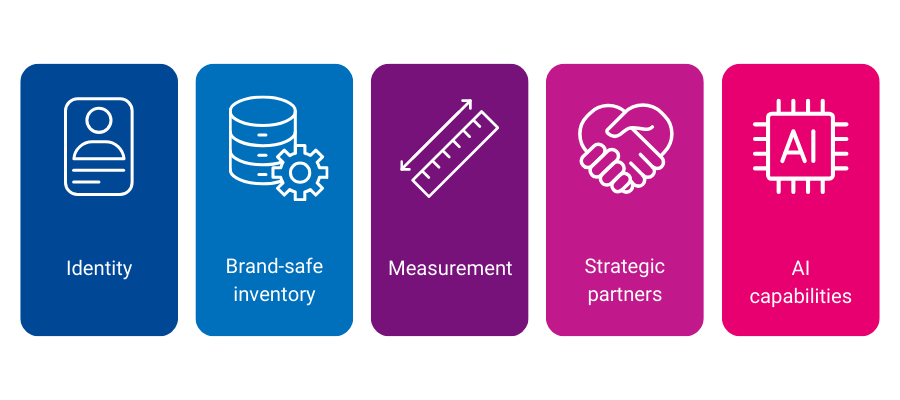
Identity remains top of mind, as advertisers seek scaled, deterministic reach in a privacy-centric manner. Yahoo ConnectID provides that through the scale and quality of Yahoo data, built on hundreds of millions of authenticated users, enriched by interoperability with all leading data companies, such as Experian. Our foundation enables accurate targeting, holistic frequency management, and true omnichannel measurement, while delivering more cohesive ad experiences for consumers.
Second, supply quality and transparency are common concerns. Advertisers want assurance that they are accessing premium, brand-safe inventory and that their investments are working as intended. We address this through direct publisher relationships, curated supply paths, and transparent buying models that allow advertisers to make efficient, informed decisions.
Measurement is another challenge. Brands increasingly expect programmatic investments to prove impact against real business outcomes, not just media metrics. We meet this head-on with proprietary measurement solutions powered by Yahoo data, such as proprietary studies and Yahoo In-Flight Outcomes, complemented by partnerships with leading third-party vendors.
Our teams act as an extension of internal marketing teams, helping unlock smarter budget allocation and performance optimization. Ultimately, the connective tissue across identity, supply, measurement, and optimization is data. That’s why we continue to see programmatic investment consolidate around platforms that have scaled, high-quality first-party data. Strong 1P data is the backbone of effective programmatic, and we continue to see investment shift toward platforms that can offer it at scale and with quality, and Yahoo DSP remains top of mind for advertisers.
Finally, through our Agentic AI solutions, we increase team efficiency and minimize time spent on manual tasks, allowing them to focus on higher-value strategic decisions.
What are practical use cases for Experian Audiences in Yahoo DSP?
With Experian audiences available in Yahoo DSP, what are 2–3 ‘go-to’ plays advertisers should run (e.g., prospecting, mid-funnel qualification, suppression, measurement improvement), and what success metrics should they watch to prove incrementality?

I’ll start with a prospecting use case. Yahoo DSP advertisers can activate Experian’s demographic, lifestyle, household and credit propensity segments to identify high-value prospects, while suppressing their own first-party audiences such as CRM lists, site visitors or recent purchasers to ensure that they are truly reaching net new customers.
Advertisers can easily leverage the Yahoo Conversion API (CAPI) to send conversion data back to Yahoo DSP and be able to track incremental conversions from these new audiences.
Another example is reaching audiences that are in the market for a purchase. In this case, advertisers can combine Experian’s category-specific audiences, such as auto intenders, with Yahoo search signals to intersect household qualification with real-time intent. For example, an automotive brand can reach consumers who not only fall within priority income bands but are also actively searching for vehicle models or categories.
Contact us
About our experts

Jessica Rocco, Senior Director, Business Development at Yahoo DSP
Jessica Rocco is a Senior Director of Business Development for Yahoo Demand-Side Platform (DSP), with over 15 years of experience driving strategic data initiatives and partnerships across the programmatic advertising ecosystem, with a focus on identity, targeting, and measurement.
Latest posts

Study reveals that brands with more mature identity programs were significantly more likely to be successful in achieving their key objectives Tapad, a part of Experian, a global leader in cross-device digital identity resolution and a part of Experian, has commissioned Forrester Consulting, part of a leading research and advisory firm, to conduct a new study that evaluates the current state of customer data-driven marketing and explores how marketers can use identity solutions to deliver privacy safe and engaging experiences, in an evolving data landscape. The study highlights the changing ground rules for digital marketing and the threat that poses to marketers’ ability to deliver against long standing KPIs and campaign goals. Nearly two-thirds (62%) of respondents said that the forces of data deprecation will have a significant (40%) or critical (21%) impact on their marketing strategies over the next two years. Among those surveyed, identity resolution strategies have surfaced as an opportunity to create more powerful customer experiences, with 66% aiming to have it help improve customer trust and implement more ethical data collection and use practices, while nearly 60% believe it will point the way to more effective personalization and data management practices. Although organizations are eager to implement identity resolution strategies, a complex web of solutions and partners makes execution a challenge. For example, respondents report using at least eight identity solutions on average, across nearly six vendor partners, and they expect that fragmentation to persist in the ‘cookieless’ future. Additionally, brands’ identity resolution technologies typically represent a patchwork of homegrown and commercial solutions. Eighty-one percent of respondents use both in-house and commercial identity resolution tools today, and 47% use a near-equal blend of the two. Despite the challenges, many brands have the foundation for a strong identity resolution strategy in place, and they are thriving as a result. Specifically, more mature brands were 79% more successful at improving privacy safeguards to reduce regulatory and compliance risk, 247% more successful at improving marketing ROI, and over four times more effective at improving customer trust compared to their low-maturity peers. Additional insights include: Marketers Are Increasingly Playing a Key Strategic Role Within the Organization, But There is a Mandate to Demonstrate Value. Nearly three-quarters of respondents in our study agree the marketing function is more strategically important to their organization than it used to be, while almost two-thirds agree there’s more pressure than ever to prove the ROI or business performance of their activities. Consumers Expect Brands to Deliver Engaging Experiences Across Highly Fragmented Journeys: Tapad, a part of Experian found that 72% of respondents agree that customers demand more relevant, personalized experiences at the time and place of their choosing. At the same time, 67% of respondents recognize that customer purchase journeys take place over more touchpoints and channels than ever, and 59% of respondents agree that those journeys are less predictable and linear than they once were. Marketing Runs on Data, But the Rules Governing Customer Data Usage are Ever-Evolving: According to the study, 70% of decision-makers agree that consumer data is the lifeblood of their marketing strategies – fueling the personalized, omnichannel experiences customers demand. At the same time, 69% of respondents recognize that customers are increasingly aware of how their data is being used. At least two-thirds agree that data deprecation, including tighter restrictions on data use (66%), as well as operating system and browser changes impacting third-party cookies (68%) means that legacy marketing strategies are unlikely to remain viable in the long-term.“ Our latest survey findings give us a better understanding of how our customers and other companies around the world are trying to master the relationship between people, their data and their devices,” said Mark Connon, General Manager at Tapad, a part of Experian. “This research shows why it’s fundamental for the industry to continuously work to develop solutions that are agnostic. Tapad, a part of Experian has worked tirelessly to deliver on this with our Tapad Graph, and by introducing solutions like Switchboard to help the evolving ecosystem and in turn helping customers reap the benefits of better identity in both short and long-term.” The study is founded on an online survey of over 300 decision-makers at global brands and agencies, which was fielded from March to April, 2021. Data deprecation and identity are fast-developing, moving targets, so this study delivers targeted insights and recommendations for how to prepare for coming shifts in customer data strategies – whether they manifest tomorrow or a year from now. Get in touch

With the recent announcement of delaying third-party cookie deprecation to 2024, the industry has more time to rethink how to identify and communicate with consumers.
As today’s digital landscape gets more and more complicated there are more ways for brands to connect with users and drive purchases and more ways for ad tech to target and measure those touch points. As in-person shopping picks up steam due to the re-normalization of society post-COVID 19; the connection between digital ads and in-person purchases needs to be made once again. With the rise of Connected TV throughout the pandemic there are even more digital opportunities to target a user. But how do you make sure that those brand engagements are captured and correctly attributed to offline purchases and conversions? The answer lies in a holistic identity resolution strategy. Cross-device identity resolution with The Tapad Graph connects the identifiers and devices of individuals within a household to each other; enabling targeting, frequency capping, extension, segmentation and measurement or attribution between devices; including Connected TV and hashed (privacy-protected) email addresses along with Cookies, Mobile Ad Ids and IP Address. Brands can join their first-party data to The Tapad Graph to execute strategies that connect online and offline data for pre, mid and post-campaign efficiencies. Let’s imagine a scenario in which an outdoor retail brand is targeting users watching specific content on a Connected TV device. Powered by identity resolution, they start with a general ad on CTV and continue targeting down individual paths with each user. When one of them converts in store and makes a purchase; the outdoor retailer can connect that action through location and in-store traffic data with the cross-device identity resolution used to execute the digital campaign. Now the actions of the user online and offline are resolved for more accurate measurement and attribution after the campaign ends. But it doesn’t stop there– the brand’s CRM data can be reactivated for the next digital campaign and leveraged to capitalize on the most effective media mix for the user who made the purchase previously. These combined insights can be invaluable in shaping up future campaign strategies with geo-contextual ads, recommended additional products and personalization to help drive more conversions and purchases in-store or online. As in-person shopping picks back up and marketers are tasked once again with balancing online and in-store KPIs, the right identity resolution strategy can unlock necessary efficiencies for retailers, ad tech vendors and agencies tasked with supporting these initiatives. Get in touch