At A Glance
Psympl shares how financial institutions can use audience motivations to inform targeting, messaging, channel selection, and customer engagement. In this Q&A, Brent Walker explains how Psympl Financial Segmentation, the Consumer Console™, Psymplifier™, and Experian data support practical financial marketing applications during the Great Wealth Transfer.In our Ask the Expert series, we interview leaders from our partner organizations who are helping lead their brands to new heights in AdTech. Today’s interview is with Brent Walker, Co-Founder and Chief Strategy Officer at Psympl.
Psympl helps financial institutions understand the motivations behind consumer financial decisions and put those insights to work across targeting, messaging, channel planning, and customer engagement. This conversation focuses on how Psympl applies those insights in financial services. For a broader explanation of how marketers group audiences based on attitudes, values, interests, and lifestyles, read our guide to psychographic segmentation.
What value does psychographic data add to financial marketing?
Demographic data tells financial marketers WHO a consumer is (like age, gender, or income), but it doesn’t predict decisions. Behavioral data shows WHAT a consumer does, but people can take the same action for different reasons. Understanding these reasons helps marketers engage consumers more effectively.
Psychographics reveal people’s attitudes, values, lifestyles, and personalities, the core of their motivations. This layer helps marketers understand WHY people act, anticipate needs, and connect in more meaningful ways.
This matters now as the “Great Wealth Transfer” unfolds: $124 trillion will be transferred from older to younger generations by the 2040s. Psychographics vary widely across generations, and up to 80% of heirs may switch financial institutions.
Using psychographic insights gives financial marketers a competitive edge during this historic wealth shift.
How can marketers apply Psympl Financial Segmentation?
Psympl Financial Segmentation groups households into five psychographic profiles, each with distinct approaches to money, investing, and engagement with financial advisors.
Psympl’s platform, the Consumer ConsoleTM, offers reference materials for understanding and engaging each Financial Segment, as well as access to extensive market research data conducted with Ipsos on the Segments to inform marketing strategy and campaign planning.
Psympl collaborates with Experian to map psychographic segments for all U.S. adults over 18. This allows financial services brands to enrich their consumer databases and find target customers based on psychographic, demographic, and socioeconomic profiles.
Experian Marketing Data also powers Psympl’s Geo-Targeting tool, which heatmaps the U.S. by psychographic segments down to the zip code, with filters for demographics, socioeconomic factors, and household counts.
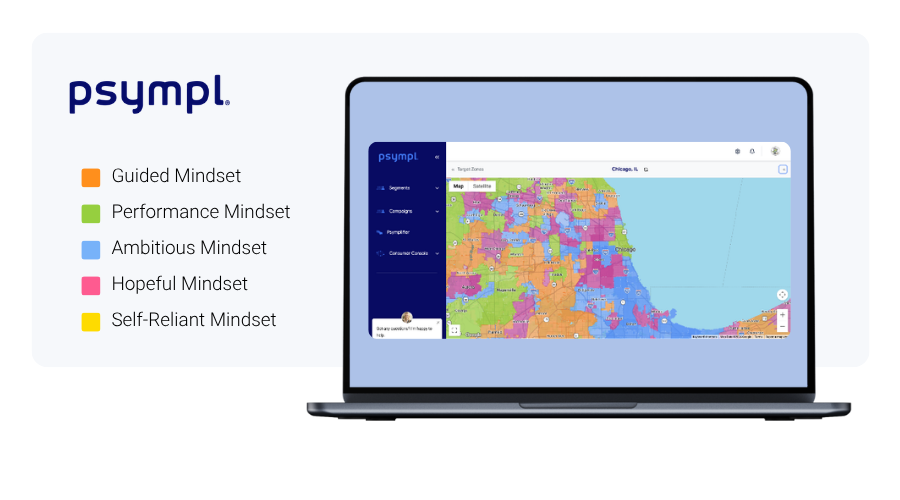
Psympl’s platform also includes the PsymplifierTM, which uses Psychographic AITM to create, analyze, and rewrite marketing content tailored to specific segments or generate new content from simple prompts.
How do Psympl and Experian aid targeting strategies?
Psympl and Experian support targeting strategies by connecting psychographic insight with consumer data, geography, and channel preferences. That combination gives financial institutions a more actionable view of who to target, where to reach them, and what message is likely to resonate.
By connecting psychographic insights with consumer data, geography, and channel preferences, Psympl and Experian show financial institutions who to target, where to reach them, and what message will resonate, forming the foundation for effective targeting.
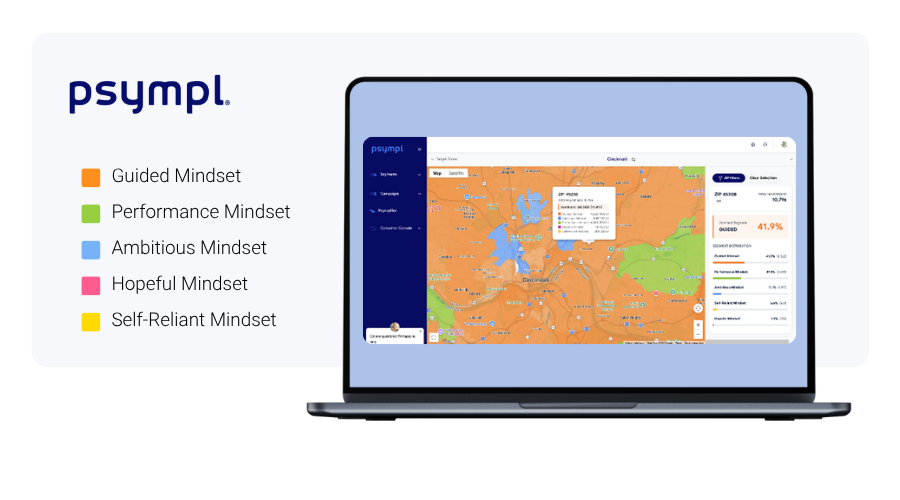
For example, a bank can pinpoint areas with consumers who prefer in-person service. Psympl’s Consumer Console™ highlights the Guided Mindset segment, those seeking expert financial help with $250,000+ in assets, as prime prospects. Psympl’s Geo-Targeting feature, powered by Experian Marketing Data, heat-maps where Guided Mindset households with $250,000+ in assets are concentrated.
In this example, one location stands out with a high representation (41.9%) and concentration (10,796 households) of the targeted Guided Mindset segment with $250,000+ in investable assets, shown in orange on the heat map. While nearby areas are dominated by Ambitious Mindset (blue) or Performance Mindset (green), the data suggests that ZIP code 45208 is an excellent candidate for a new branch, supported by targeted print, outdoor, or digital marketing.
Beyond location, Psympl’s research and Experian TrueTouch help firms choose the best channels for each segment and predict responses to direct mail, email, digital, and broadcast channels. Enriching customer databases with Psympl segments lets firms tailor messages—like notifying Guided Mindset customers about new locations, and use the Psymplifier™ to quickly generate targeted marketing content.
How are financial marketers using Psympl profiles across the customer lifecycle?
By addressing customer motivations and priorities at every stage, organizations drive consistency, align communications, and deliver on customer expectations, whether acquiring, retaining, or upselling clients.
Relationships with Baby Boomer clients often do not carry over to younger heirs, who typically have Ambitious and Hopeful Mindsets instead of the Guided, Performance, and Self-Reliant Mindsets more common among older generations. Psychographics reveal these generational differences, distinct needs, values, and engagement preferences, so firms can anticipate, address, and communicate more effectively across generations.
Tools like Psympl’s Consumer Console and Psymplifier, combined with Experian TrueTouch Engagement data, equip financial professionals to tailor interactions and marketing content to each segment’s unique preferences, maximizing impact and receptivity.
Firms that fail to adapt to the needs and preferences of younger generations will inevitably lose AUM. The Psympl platform, enhanced by Experian data, positions organizations to turn The Great Wealth Transfer into an opportunity rather than a threat.
How can financial institutions get started with Psympl Financial Segmentation?
After 20 years leading psychographic initiatives at Procter & Gamble, I wish I’d had Experian’s data and capabilities; they make planning and measurement much easier.
To start, enrich your CRM with Psympl psychographic Financial Segments from Experian. Analyze your customers to see which segments are over- or under-represented, revealing strengths and growth opportunities. Identify which segments most use specific products to target Prime Prospects. Then set a campaign goal and test psychographic messaging against a control group or with pre- and post-measures. Start small, earn, and adapt as you go.
Once you see results with relevant, psychographic-based content, expand this approach to prospecting, customer experience, and other applications.
Where can readers learn more?
I appreciate this opportunity! To learn more, readers can visit the psympl.com website, and more specifically, the Resources Page on the website, which includes videos, whitepapers, and guides for utilizing the Psympl psychographic Financial Segments for customer acquisition, retention, and enhanced engagement.
Contact us
Click here to view Experian’s U.S. Consumer Data Privacy Notice.
This site is protected by reCAPTCHA and the Google Privacy Policy and Terms of Service apply.
About our expert

Brent Walker, Co-Founder and Chief Strategy Officer, Psympl
Brent Walker is Co-Founder and Chief Strategy Officer for Psympl, helping wealth management firms, banks, credit unions, and financial services enhance customer acquisition, retention, and cross-sell initiatives. Brent started his career in Brand Management at Procter & Gamble, and over 20 years he led teams in product management, customer marketing, and psychographic segmentation initiatives. In 2012, he cofounded his first company focused on psychographics in healthcare, which saw a series of multiple acquisitions. Brent has delivered a variety of publications covering critical marketing topics, featured in Forbes, The Ohio Bankers League, The Commonwealth Fund, and Healthcare Finance.
Latest posts

With Tapad, part of Experian, technology, AdsWizz AudioMatic is the first Audio buying platform to offer cross-device identity resolution across the U.S. and EMEA NEW YORK and LONDON, July 17, 2019 /PRNewswire/ — Tapad, part of Experian and a global leader in digital identity resolution, today announced a new joint capability with AdsWizz , the leading technology provider for digital audio advertising solutions. The partnership combines Tapad’s digital cross-device technology with AdsWizz’s AudioMatic buying platform, enabling the ability to connect audio ad experiences across screens. AudioMatic, AdsWizz’s audio-centric buying platform, supports programmatic audio buying and entirely new audio ad experiences for listeners. The integration of The Tapad Graph onto its platform enables new opportunities for marketers to reach, engage and measure each interaction with their desired consumers on digital radio and podcasts channels, and across devices. This partnership makes AdsWizz the first audio buying platform to offer this enhanced cross-device identity capability in the US and EMEA markets. “Marketers need privacy-safe digital identity resolution to reach their consumers,” says Tom Rolph, VP of EMEA at Tapad. “With audio becoming an increasingly powerful medium for engagement, it’s important that our technology extends to this channel, which is why we are excited to announce our integration with AdsWizz’s AudioMatic platform.” Digital audio is experiencing high growth, with 84% of advertisers and agencies saying it will play a bigger role in their media plans in the future. Today, 60% of digital audio is consumed via a mobile device.* The Tapad Graph is the largest digital identity resolution graph with differentiated global scale. The partnership enables audio advertisers to leverage The Tapad Graph for enhanced attribution, analytics, and targeting. Alexis van der Wyer, CEO at AdsWizz, added, “Digital audio is increasingly becoming ubiquitous in our media consumption and in our daily digital interactions, and because of that, audio advertising offers tremendous opportunity to personally interact with consumers in every moment of their daily lives. By integrating with Tapad, we enable our advertising partners to increase the effectiveness and the relevance of their marketing messages across audio channels.” To learn more about Tapad and our digital identity resolution products, visit our identity solutions page. *Digital Audio Exchange, “The Rise of Digital Audio Advertising,” https://thisisdax.com/wp-content/uploads/2019/07/DAX-Whitepaper.pdf About Tapad Tapad, Inc. is a global leader in digital identity resolution. The Tapad Graph, and its related solutions, provide a transparent, privacy-safe approach connecting brands to consumers through their devices globally. Our one-of-a-kind Graph Select offering enables marketers the flexibility and freedom of choice to correlate devices to varied objectives, driving campaign effectiveness and business results. Tapad is recognized across the industry for its product innovation, workplace culture and talent, and has earned numerous awards including One World Identity’s 2019 Top 100 Influencers in Identity Award. Headquartered in New York, Tapad also has offices in Chicago, London, Oslo, Singapore and Tokyo. About AdsWizz: AdsWizz has created the end-to-end technology platform that is powering the digital audio advertising ecosystem. AdsWizz powers well-known music platforms, podcasts and broadcasting groups worldwide with a comprehensive digital audio software suite of solutions that connect audio publishers to the advertising community. From dynamic ad insertion to advanced programmatic platforms to innovative new audio formats, AdsWizz efficiently connects buyers and sellers in digital audio. AdsWizz is headquartered in San Mateo, California, with an IT Development hub in Bucharest, Romania, and presence in 39 markets around the world. About AudioMatic: AdsWizz Demand Side, audio-centric DSP and audio buying platform, AudioMatic, enables programmatic audio buying and entirely new audio ad experiences that are proven to be more engaging and more effective, and have delivered measurable results for agencies and their brands all over the world. All the biggest ad agencies have used our programmatic trading platform, including Omnicom, GroupM, Havas, Publicis, Mobext, and more. Contact us today

Sixty-Nine Percent Organic Sales Growth Spurred by Expanded Business and Continued Investment in The Tapad Graph™ NEW YORK, May 7, 2019 /PRNewswire/ — Tapad, a part of Experian, a global leader in digital identity resolution, today announced a record start to the year, following its highest earning year in the company’s history. Since January, Tapad has experienced a 69 percent organic increase in global revenue; with strategic investments in talent, continued high retention rates, and an expanded range of clients across global markets. Globally, Tapad increased its client base across multiple categories and verticals, catering to agencies, brands, telecoms, and data providers. The Tapad Graph™’s varied use cases and differentiated global scale have been instrumental to the company’s overall success to-date. With an ongoing investment in product, and expected feature releases slated for 2019, the company anticipates these accomplishments to continue. “Since the inception of our business, Tapad has heavily focused on enabling marketers to boost the performance of their campaigns with the help of our advanced digital identity resolution technologies,” said Sigvart Voss Eriksen, CEO at Tapad. “While we continue to grow, creating privacy-safe solutions that solve marketers evolving needs remains integral to our evolution. As pioneers in cross-device, we’re constantly innovating and pushing ourselves to be at the forefront of industry change. Our leadership in the space is recognized across the industry, as is evident by our current success.” In addition to partner expansions, Tapad also invested in new talent. In February, Tapad announced Ajit Thupil as the company’s first Senior Vice President of Identity, deepening the company’s commitment to creating ground-breaking digital identity resolution products for brands, agencies and platforms. Tapad’s investment in talent has been recognized by One World Identity’s 2019 Top 100 Influencers in Identity Award and by ClickZ’s 2019 Marketing Technology Awards. To learn more about Tapad and our digital identity resolution products, visit Experian.com Open job opportunities across the globe can be found on Tapad’s career page here: https://www.experian.com/careers/ About Tapad Tapad, Inc. is a global leader in digital identity resolution. The Tapad Graph™, and related solutions, provide a privacy-safe approach to connecting device identifiers to brand and marketer data, thereby allowing marketers around the world to maximize campaign effectiveness. Tapad is recognized across the industry for its innovation, growth and workplace culture, and has earned numerous awards, including the TMCnet Tech Culture Award. Based in New York, Tapad also has offices in Chicago, London, Oslo, Singapore and Tokyo, and is a wholly owned subsidiary of Telenor Group. Contact us today
The UK digital advertising market is worth £13.44bn, an increase year-on-year of 15%, reveals the 2018 IAB UK & PwC Digital Adspend Study. Report highlights The majority of all growth is coming from smartphone advertising, which has increased by £1.65bn (35%) from 2017. Smartphone advertising now represents 51% of all UK digital ad spend, up from 45% in 2017. Video is now the largest display format (£2307m), overtaking standard display banners (£1486m). Outstream/social in-feed has increased its majority in total video spend, now occupying a share of 57%, up from 52% in 2017. Social revenue now represents 23% of all digital ad spend. Growth is predicted to slow during 2019, with 5% estimated growth (+9% digital, +11% display, +9% search) compared to 15% in 2018. 2018 marks the tipping point towards a mobile-first ecosystem “For the past few years, industry commentators have been hailing the year of mobile. Each January the predictions come and the waiting commences for evidence to mark a tipping point, a shift to a mobile-first digital ad ecosystem. Well, drumroll… it was 2018! The latest Adspend report from IAB UK and PwC reveals that spend on smartphones outstripped spend on desktop for the first time last year. Brands spent 51% of total spend (which stands at £13.44 billion) on smartphones in 2018, up from 45% in 2017 – a significant milestone in the evolution of digital advertising. “This evidence shows that advertisers are increasingly thinking mobile-first. Growth in investment has historically lagged behind the amount of time spent on the device and we expect to see growth continue at a rapid pace to keep up with audience behaviour – two thirds of time spent online is now on mobile, according to UKOM. Other areas of growth highlighted by the report include video, which accounts for 44% of the total display market, while mobile video now makes up 51% of smartphone display. This is no doubt down to bigger mobile screens, better 4G and more readily available WiFi making video ads an increasingly attractive option. “Across the board, advertisers are investing in digital for longer-term brand building as well as short-term activation, with the direct-to-consumer market helping to drive this trend. What’s more, digital continues to be an accessible and popular route to market for businesses of all sizes, from leading advertisers to SMEs.” Tim Elkington, Chief Digital Officer, IAB UK Content & context crucial for attracting audiences “As people spend more and more of their time on mobile, it’s comes as no surprise that advertisers will follow where audiences are with their marketing spend. “Video has been the driving force in this growth, indicating that engaging visual content is still key in helping brands to achieve great results and to capture consumer attention in a vast sea of digital noise. “Video still has a way to go if it is to reach the level of effectiveness of traditional formats like cinema, but it will be interesting to see how the format develops over the next year or so. Ultimately, brilliant content and properly considered context are crucial for advertisers hoping to attract relevant audiences and build strong brands long term.” Kathryn Jacob OBE, CEO, Pearl & Dean Mobile-first approach driving investment in user experience “As a mobile-first approach has become the norm for many businesses, we’ve seen significant innovation and investment in the user experience that has fuelled the rise in mobile commerce. “Yet, for some years, limitations in the technology and formats available have meant that mobile advertising couldn’t always keep pace with changing consumer behaviours – delivering weaker performance when compared to desktop. “Fortunately, mobile has made huge strides in recent years. Mobile advertising affords great targeting opportunities for brands and a more interactive and immersive experience for consumers. “There is no reason to doubt this trend will continue as advertisers design their media, creative, and targeting strategy with mobile at the heart – optimising performance, enhancing the customer experience, and delivering the best results.” James Cragg, UK Managing Director, Tug New technologies to improve investment efficiency “The UK digital ad market has continued to grow despite the various challenges that the market has faced, including the current socioeconomic climate and general changes in the industry. As spend increases, it’s important to look at how media buying can be made as efficient as possible, minimising waste and maximising the return on investment. “Marketers will start to look to new technologies, like AI, to offer an impartial and more efficient approach to media buying, allowing marketers to measure effectiveness of campaigns and allocate spend accordingly.” Carl Erik Kjaersgaard, Chief Executive, Blackwood Seven Industry going from strength to strength “This significant growth in ad spend is great to see and shows that our industry is going from strength to strength. It’s especially good to see that as advertisers invest more and more in digital advertising, they’re becoming more considered in where they’re spending their money – with a large portion of the growth coming from companies that are part of IAB’s Gold Standard. “At The Trade Desk, we’ve long been ambassadors for the importance of transparency. These findings show that it isn’t just the right thing to do, but makes good business sense as advertisers increasingly choose partners who are demonstrating a commitment to best practice.” Anna Forbes, UK General Manager, The Trade Desk Advertisers embracing mobile “As consumers spend more of their time online, it’s no surprise that digital ad spend has continued its rise, up 15% to £13.4bn. With digital, in every sense, becoming further embedded in our daily lives, it is inevitable that this number is set to rise further next year. “Given the vast majority of people using their smartphone as their primary digital device, evident from site traffic stats we see across the board, the IAB report shows that advertisers have started to fully embrace this shift by following with ad spend. Over the last few years, a combination of faster wireless connectivity along with more capable devices has made it the go-to device for consumers to get online. This is set to continue over the next few years with 5G and even faster, more capable smartphones arriving (i.e. foldables) that will further cement ‘mobile’ as the main digital device to reach consumers.” Wajid Ali, Head of Paid Search, ForwardPMX Budgets must go to professionally produced content “In the IAB’s latest ‘Digital Adspend Study’ it is positive to see that outstream continues to dominate video spend, showing close to a 10% year-on-year increase. “Unsurprisingly, the study highlights that mobile is the most important distribution device (76% of all video spend is on the smartphone), and it’s great to see the format we invented dominating that space. “However, it’s now more pertinent than ever that clients and agencies invest their outstream budgets into professionally produced content and not social infeeds. Budgets must go where content is being produced, rather than aggregators and distributors, where the content is read rather than where a click happened. “We must remember how important local, national, and vertical press are to the global digital ecosystem. By unifying the best publishers at scale, delivering mobile-optimised creativity and outcome-orientated distribution, we are fighting to ensure publishers are getting their fair share of revenue in comparison to the social platforms.” Justin Taylor, UK MD, Teads UK market in robust health “The latest IAB digital ad spend report shows encouraging signs that the UK digital advertising market is in robust health, with mobile advertising continuing its upward trend. “The rise of up-and-coming ad formats like Shopping Ads, Google’s Responsive Search Ads, and Facebook Messenger Ads show that advertisers are looking for ways to capture consumer attention in the evolving digital landscape. As a result, the lines across search, social, and e-commerce are more blurred than ever with the introduction of features like Checkout for Instagram and Shopping ads on Google Images. Furthermore, with the rapid growth of Amazon’s ads business, e-commerce has quickly emerged as a third pillar of digital advertising, making it vital for marketers to have a complete view of the customer journey across channels and devices, if they hope to more accurately understand campaign performance and attribution.” Wesley MacLaggan, SVP of Marketing, Marin Software Digital identity resolution essential in understanding customer journey “Last year’s figures show that UK ad spend is starting to mirror the behaviour of consumers who, according to UKOM data, spend two-thirds of their time online on a smartphone. The fact that mobile ad spend now surpasses that of ad spend on desktop highlights marketers’ understanding that digital identity resolution is essential, not a nice-to-have. “Appreciating the cross-device behaviours of consumers allows brands to gain a better understanding of the customer journey and build stronger relationships with their audiences long term.” Tom Rolph, VP EMEA, Tapad, a part of Experian. Contact us today