At A Glance
Psympl shares how financial institutions can use audience motivations to inform targeting, messaging, channel selection, and customer engagement. In this Q&A, Brent Walker explains how Psympl Financial Segmentation, the Consumer Console™, Psymplifier™, and Experian data support practical financial marketing applications during the Great Wealth Transfer.In our Ask the Expert series, we interview leaders from our partner organizations who are helping lead their brands to new heights in AdTech. Today’s interview is with Brent Walker, Co-Founder and Chief Strategy Officer at Psympl.
Psympl helps financial institutions understand the motivations behind consumer financial decisions and put those insights to work across targeting, messaging, channel planning, and customer engagement. This conversation focuses on how Psympl applies those insights in financial services. For a broader explanation of how marketers group audiences based on attitudes, values, interests, and lifestyles, read our guide to psychographic segmentation.
What value does psychographic data add to financial marketing?
Demographic data tells financial marketers WHO a consumer is (like age, gender, or income), but it doesn’t predict decisions. Behavioral data shows WHAT a consumer does, but people can take the same action for different reasons. Understanding these reasons helps marketers engage consumers more effectively.
Psychographics reveal people’s attitudes, values, lifestyles, and personalities, the core of their motivations. This layer helps marketers understand WHY people act, anticipate needs, and connect in more meaningful ways.
This matters now as the “Great Wealth Transfer” unfolds: $124 trillion will be transferred from older to younger generations by the 2040s. Psychographics vary widely across generations, and up to 80% of heirs may switch financial institutions.
Using psychographic insights gives financial marketers a competitive edge during this historic wealth shift.
How can marketers apply Psympl Financial Segmentation?
Psympl Financial Segmentation groups households into five psychographic profiles, each with distinct approaches to money, investing, and engagement with financial advisors.
Psympl’s platform, the Consumer ConsoleTM, offers reference materials for understanding and engaging each Financial Segment, as well as access to extensive market research data conducted with Ipsos on the Segments to inform marketing strategy and campaign planning.
Psympl collaborates with Experian to map psychographic segments for all U.S. adults over 18. This allows financial services brands to enrich their consumer databases and find target customers based on psychographic, demographic, and socioeconomic profiles.
Experian Marketing Data also powers Psympl’s Geo-Targeting tool, which heatmaps the U.S. by psychographic segments down to the zip code, with filters for demographics, socioeconomic factors, and household counts.
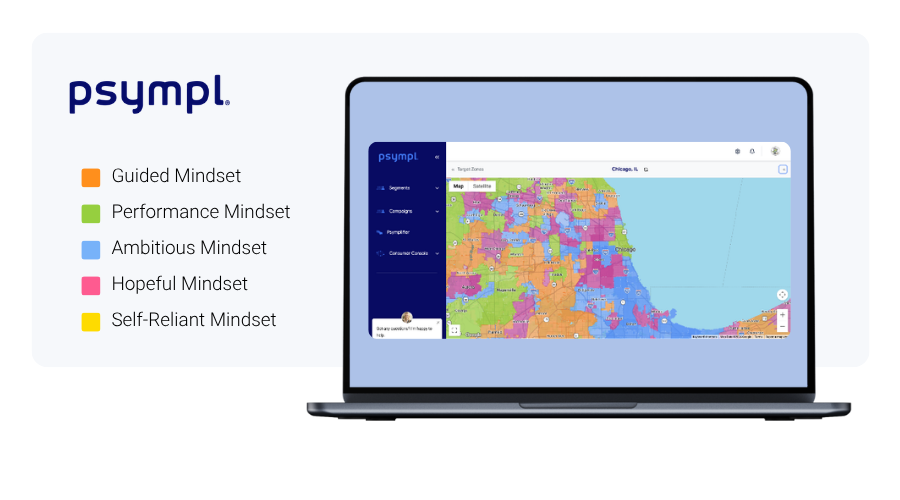
Psympl’s platform also includes the PsymplifierTM, which uses Psychographic AITM to create, analyze, and rewrite marketing content tailored to specific segments or generate new content from simple prompts.
How do Psympl and Experian aid targeting strategies?
Psympl and Experian support targeting strategies by connecting psychographic insight with consumer data, geography, and channel preferences. That combination gives financial institutions a more actionable view of who to target, where to reach them, and what message is likely to resonate.
By connecting psychographic insights with consumer data, geography, and channel preferences, Psympl and Experian show financial institutions who to target, where to reach them, and what message will resonate, forming the foundation for effective targeting.
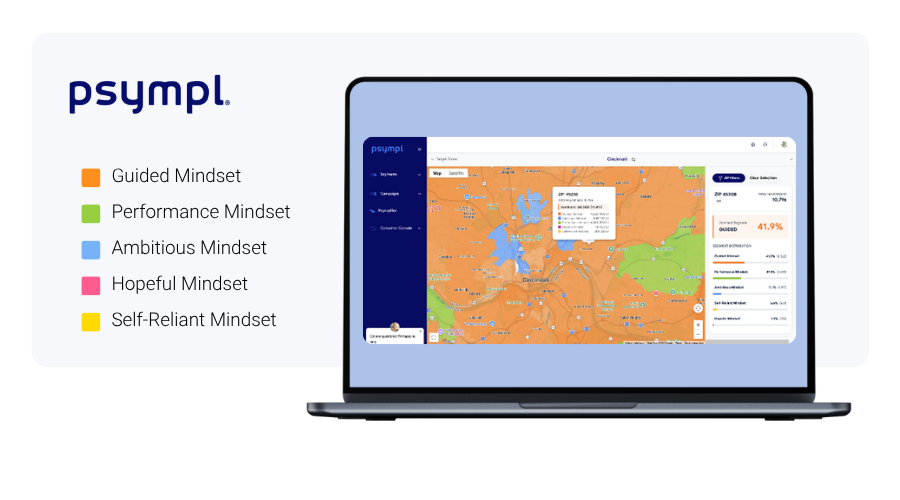
For example, a bank can pinpoint areas with consumers who prefer in-person service. Psympl’s Consumer Console™ highlights the Guided Mindset segment, those seeking expert financial help with $250,000+ in assets, as prime prospects. Psympl’s Geo-Targeting feature, powered by Experian Marketing Data, heat-maps where Guided Mindset households with $250,000+ in assets are concentrated.
In this example, one location stands out with a high representation (41.9%) and concentration (10,796 households) of the targeted Guided Mindset segment with $250,000+ in investable assets, shown in orange on the heat map. While nearby areas are dominated by Ambitious Mindset (blue) or Performance Mindset (green), the data suggests that ZIP code 45208 is an excellent candidate for a new branch, supported by targeted print, outdoor, or digital marketing.
Beyond location, Psympl’s research and Experian TrueTouch help firms choose the best channels for each segment and predict responses to direct mail, email, digital, and broadcast channels. Enriching customer databases with Psympl segments lets firms tailor messages—like notifying Guided Mindset customers about new locations, and use the Psymplifier™ to quickly generate targeted marketing content.
How are financial marketers using Psympl profiles across the customer lifecycle?
By addressing customer motivations and priorities at every stage, organizations drive consistency, align communications, and deliver on customer expectations, whether acquiring, retaining, or upselling clients.
Relationships with Baby Boomer clients often do not carry over to younger heirs, who typically have Ambitious and Hopeful Mindsets instead of the Guided, Performance, and Self-Reliant Mindsets more common among older generations. Psychographics reveal these generational differences, distinct needs, values, and engagement preferences, so firms can anticipate, address, and communicate more effectively across generations.
Tools like Psympl’s Consumer Console and Psymplifier, combined with Experian TrueTouch Engagement data, equip financial professionals to tailor interactions and marketing content to each segment’s unique preferences, maximizing impact and receptivity.
Firms that fail to adapt to the needs and preferences of younger generations will inevitably lose AUM. The Psympl platform, enhanced by Experian data, positions organizations to turn The Great Wealth Transfer into an opportunity rather than a threat.
How can financial institutions get started with Psympl Financial Segmentation?
After 20 years leading psychographic initiatives at Procter & Gamble, I wish I’d had Experian’s data and capabilities; they make planning and measurement much easier.
To start, enrich your CRM with Psympl psychographic Financial Segments from Experian. Analyze your customers to see which segments are over- or under-represented, revealing strengths and growth opportunities. Identify which segments most use specific products to target Prime Prospects. Then set a campaign goal and test psychographic messaging against a control group or with pre- and post-measures. Start small, earn, and adapt as you go.
Once you see results with relevant, psychographic-based content, expand this approach to prospecting, customer experience, and other applications.
Where can readers learn more?
I appreciate this opportunity! To learn more, readers can visit the psympl.com website, and more specifically, the Resources Page on the website, which includes videos, whitepapers, and guides for utilizing the Psympl psychographic Financial Segments for customer acquisition, retention, and enhanced engagement.
Contact us
Click here to view Experian’s U.S. Consumer Data Privacy Notice.
This site is protected by reCAPTCHA and the Google Privacy Policy and Terms of Service apply.
About our expert

Brent Walker, Co-Founder and Chief Strategy Officer, Psympl
Brent Walker is Co-Founder and Chief Strategy Officer for Psympl, helping wealth management firms, banks, credit unions, and financial services enhance customer acquisition, retention, and cross-sell initiatives. Brent started his career in Brand Management at Procter & Gamble, and over 20 years he led teams in product management, customer marketing, and psychographic segmentation initiatives. In 2012, he cofounded his first company focused on psychographics in healthcare, which saw a series of multiple acquisitions. Brent has delivered a variety of publications covering critical marketing topics, featured in Forbes, The Ohio Bankers League, The Commonwealth Fund, and Healthcare Finance.
Latest posts
Discover the top challenges and solutions discussed at Experian’s supply-side think tank to prepare for a cookieless future.

Learn how Experian’s support of UID2 in our Graph enhances consumer insights for effective cookieless media strategies.
Discover 2024 data collaboration strategies for better business intelligence. Learn to use data sharing, APIs, and secure frameworks.