Loading...

Announcing Experian’s Digital Graph and Marketing Attributes joint solution

Published: September 23, 2024 by Dylan Rothenberg, Product Marketing Manager

Introducing Experian's Digital Graph and Marketing Attributes joint solution

Experian, the leader in powering data-driven advertising through connectivity, is thrilled to unveil our latest solution, Digital Graph and Marketing Attributes. This joint solution supplies marketers and platforms with the insights and connectivity needed to understand who their customers are and reach them across digital channels.

The uncertainty around third-party cookies in Chrome and the overall decline in signal complicates the industry’s ability to reach the right consumer. Omnichannel media consumption results in scattered data, making it harder for marketers and platforms to understand consumer behavior and reach them across channels. These challenges call for a comprehensive solution.

Our Digital Graph and Marketing Attributes solution addresses these challenges by providing identifiers for seamless cross-channel engagement. By adding Marketing Attributes, like demographic and behavioral data, marketers and platforms also gain a better understanding of their customers. This solution uses Experian’s Living Unit ID (LUID) to combine offline and digital data, giving customers deeper insights into consumer behavior, greater audience reach, and improved cross-channel visibility.
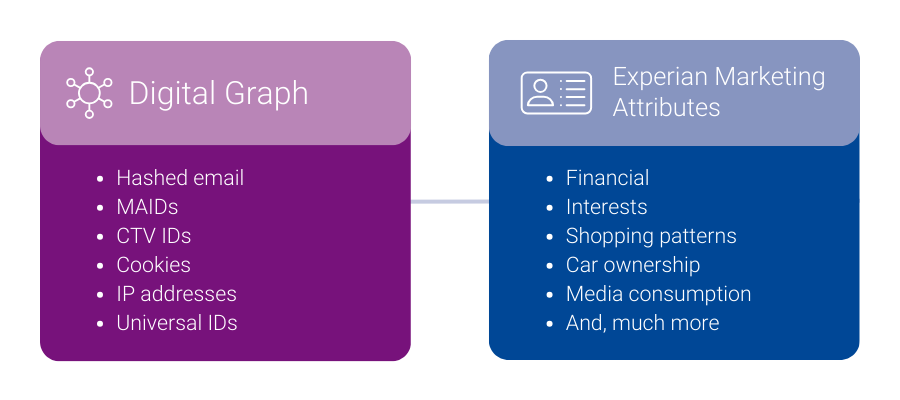
Digital Graph: Hased email, MAIDs, CTV IDs, Cookies, IP addresses, Universal IDs Experian Marketing Attributes: financial, interests, shopping patterns, car ownership, media consumption, and, much more

Benefits of Digital Graph and Marketing Attributes

Both our Digital Graph and Marketing Attributes provide value to clients as standalone products. When clients license our Digital Graph and Marketing Attributes joint solution, they have more data at their fingertips, unlocking:

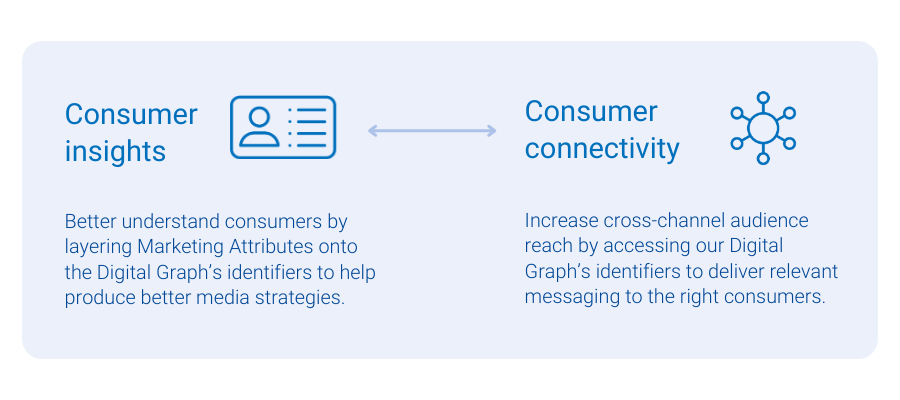
  • Consumer connectivity: When clients license Experian’s Digital Graph, they get access to digital identifiers like mobile ad IDs (MAIDs), connected TV (CTV) IDs, hashed emails (HEMs), and universal IDs so they can target the right consumers with the relevant messages across all digital media channels.
  • Consumer insights: Experian’s 5,000 Marketing Attributes provide our clients with detailed consumer information and insights, such as age, gender, purchase behaviors, and content consumption habits. Marketing Attributes help clients create more relevant messaging and informed audience segmentation.
Consumer connectivity to consumer insights

Client examples

How OpenX offers richer targeting and more connectivity with Experian

OpenX is an independent omni-channel supply-side platform (SSP) and a global leader in audience, data, and identity-targeting. With industry-leading technology, exceptional client service, and extensive scalability across all formats, including CTV, app, mobile web, and desktop, OpenX has a legacy of innovating products that enhance buyer outcomes and publisher revenue while addressing complex challenges in programmatic.

In recent years, OpenX has licensed Experian’s Digital Graph with identifiers, contributing to the SSP’s largest independent supply-side identity graph, which offers advanced audiences to buyers and improved data resolution to content owners.

More recently, OpenX licensed Experian’s Marketing Attributes to enrich its supply-side identity graph, which includes IPs, MAIDs, and client IDs, with a variety of attributes. This strategic move has helped OpenX’s clients benefit from enhanced consumer insights and addressability, in turn delivering greater reach to the demand side and higher revenue for publishers, despite industry signal loss.

“We built on our long-term partnership with Experian to enrich our digital IDs with Experian’s Marketing Attributes, which help provide buyers better insights to audiences, thereby helping our publishers monetize their inventory. With partners like Experian, OpenX effectively facilitates the value exchange between demand and supply, ensuring our partners are able to drive results for their business in the era of signal loss”

Craig Golaszewski, Sr. Director of Strategic Partnerships, OpenX

How StackAdapt licenses our product bundle to address three different use cases

StackAdapt is the multi-channel programmatic advertising platform trusted by marketers to deliver exceptional campaigns. They drive superior results through a variety of solutions, like contextual and first-party targeting, brand lift measurement, and optimization through insights.

StackAdapt licensed a similar yet unique product combination, our Digital Graph and our Audiences. StackAdapt uses the Digital Graph to allow clients to onboard their first-party data in a seamless, self-serve manner that allows them to further segment their data using Experian Audiences.

“StackAdapt has been recognized as the most trusted programmatic platform by marketers, and with the integration of Experian’s Digital Graph and Audiences, we are strengthening our leadership in the space. This partnership improves our ability to deliver precise cross-channel segmentation, reach, and measurement, helping advertisers run more successful campaigns. Our collaboration with Experian allows us to offer a differentiated solution in the market and ensure our clients can deliver the most precise and impactful ads to their audiences.”

Denis Loboda, Senior Director of Data, StackAdapt

We recently announced a new partnership with StackAdapt. This collaboration brings the power of Experian’s identity graph, syndicated and custom audiences directly to the StackAdapt platform. Read the full details in our press release here.

Four ways to use Digital Graph and Marketing Attributes

When these two products come together, our clients have a 360-degree view of their consumers, which helps them power four critical use cases:

  1. Analytics and insights: Learn more about your consumers by connecting our Marketing Attributes with our Digital Graph’s identifiers. For example, a retailer can discover that their recent customers over-index as pickleball fans and players, leading the retailer to sponsor a professional pickleball event.
  2. Inventory monetization: When supply-side partners know their audience better, they can attract advertisers in search of that audience. For example, a publisher might find out that their audience is full of pickleball fans, leading them to reach out to brands that want to reach this audience.
  3. Activation: Companies with access to more digital identifiers from our Digital Graph can reach more people, while controlling frequency across channels. A company might know that they want to reach pickleball fans. Now, they have the digital identifiers needed to reach pickleball fans across all digital channels where they consume content, leading to increased reach.
  4. Measurement and attribution: Use the Digital Graph’s support for various digital identifiers to understand all consumer touchpoints, from media impressions to conversions. Then, lean on our Marketing Attributes to determine who your messaging resonated with. For example, a company uses our Digital Graph to know if it was the same individual who was exposed to an ad on CTV and converted via e-commerce. On top of that, the company can use our Marketing Attributes data to find out that the people who purchased were overwhelmingly pickleball fans.

Connect with us to learn more about how our Digital Graph and Marketing Attributes joint solution can provide the data and insights you need to create, activate, and measure cross-channel media campaigns.


Get in touch with us

This site is protected by reCAPTCHA and the Google Privacy Policy and Terms of Service apply.


Latest posts

Loading…
A clear path to activation and measurement for brands

Brands want more from their media investments: better insights, more efficient reach, and clear proof of performance. Whether you’re starting with high-quality first-party data or need help reaching new audiences, Experian offers flexible solutions to drive reach among key audiences and to measure the impact. We’ve built two primary activation and measurement solutions tailored to how brands operate, so you can spend less time managing data and more time driving outcomes. Use case 1: First-party insights to activation and measurement Best for: Brands with first-party data looking to deepen their understanding of existing customers, activate intelligently, and measure what matters – all through a single trusted partner. Solution: Audience Engine + Outcomes Audience Engine Audience Engine is our self-service platform designed to help you onboard first-party data, gain key insights into your customers, build custom audiences using our powerful data assets, and activate them across 200+ platforms — all within a single workflow. Outcomes Experian Outcomes closes the loop by measuring real-world results of your campaigns (such as visits, purchases, and website actions) and tying them back to specific media exposures across digital and TV channels. Together, these tools offer a full-funnel audience and measurement solution, from planning and activation to proving performance. Let’s bring this to life A leading athletic retailer partnered with Experian and Yieldmo to drive in-store foot traffic, targeting shoppers likely to buy from their competitors during key sales windows. Using Experian’s Audience Engine, which includes our proprietary and third-party data marketplace, Yieldmo built a high-performing, self-serve targeting strategy for the retailer. By combining Experian Audiences with Partner Audiences from Alliant, Circana, Webbula, and Sports Innovation Lab, Yieldmo was able to build apparel and footwear audiences from the data marketplace including: In-store shopper segments Athleisure purchasers Competitive purchasers Audience Engine also enabled Yieldmo to tap into Experian’s identity graph, expanding cross-channel reach and maximizing campaign scale and precision. And while not used for this campaign, our Outcomes solution allows advertisers to tie media spend to in-store activity, so retailers can measure true business impact. Benefits Understand your customers more deeply To reveal behavioral, demographic, and lifestyle trends. Reach your first-party audiences at scale Across top activation platforms, using Audience Engine’s onboarding capabilities. Increase your brand awareness By reaching prospective audiences, using Experian Audiences, Partner Audiences, and lookalike audiences. Measure campaign effectiveness With Outcomes, which correlates media exposures (digital and/or TV) with offline and online conversions, visits, or sales. Optimize future media buys By using attribution insights to refine targeting, creative, and channel mix based on what’s actually driving results. Use case 2: Activation and measurement Best for: Brands that already know who they want to reach and are looking to activate high-quality, data-driven audiences across their preferred media platforms and want to clearly understand what’s driving performance. Solution: Audiences + Partner Audiences + Outcomes Audiences Experian Audiences are pre-built audience segments grouped by shared attributes from Experian Marketing Data built for activation on-the-shelf of top programmatic, TV, and social destinations like FreeWheel, Magnite, and Madhive, in addition to Audience Engine. Partner Audiences Experian's Partner Audiences are high-quality audience segments sourced directly from 30+ leading third-party data providers like Affinity, Circana, and Dun & Bradstreet. These segments are curated across verticals like Business, CPG, Health, Retail, and Travel, and are available through on top media destinations, in addition to our data marketplace for easy selection and deployment. Outcomes Experian Outcomes helps close the loop by tying real-world results back to media exposures across digital and TV channels. Together, these products empower marketers to activate smarter and prove success with confidence. Let's bring this to life A leading fashion brand set out to grow their customer base by reaching high-intent shoppers where they spend their time: online. Their goal: drive e-commerce conversions through a programmatic campaign powered by The Trade Desk. To do it, they needed more than just reach, they needed accuracy. That’s where Experian came in. On The Trade Desk, the brand quickly discovered Experian’s prebuilt audience segments, readily available and easy to activate. They selected: Age Range: 25–44 Women’s Fashion Frequent Spenders: Households identified as frequent purchasers of women’s apparel, cosmetics, jewelry, and accessories—based on verified, consumer-reported transactions from the past 24 months. These segments gave the brand confidence that it was putting its message in front of the right consumers, those most likely to engage and buy. To understand whether their campaign was driving results beyond impressions, the brand implemented a site pixel to capture both top-of-funnel visitation and bottom-of-funnel conversions. Using Experian’s Outcomes solution, they were able to close the loop—tying ad exposure directly to e-commerce sales. The Outcomes report showed clear campaign lift, highlighting which channels and audience segments performed best. Armed with these insights, the brand refined their targeting and messaging for future media buys—boosting ROI with each iteration. Benefits Reach your ideal audience at scale By activating Experian Audiences and Partner Audiences off the shelf at digital and TV platforms. Access privacy-conscious, diverse data Curated by 30+trusted data providers in verticals like Business, CPG, Health, Retail, and Travel without needing to manage multiple data contracts. Understand what’s working Through Outcomes reporting, which connects media exposure to offline and online outcomes like conversions, purchases, or visits. Continuously improve performance By using attribution insights to inform audience selection, creative strategy, and media channel mix for future campaigns. Bring this to your brand Experian’s activation and measurement solutions for brands gives you the tools to act with clarity: from onboarding your first-party data to reaching new customers and tying media back to real results. Whether you’re starting with deep customer insights or building campaigns from scratch, here’s how our solution helps: Audience Engine Onboard your first-party data, gain insights into audience composition, build custom audiences using Experian and Partner Audiences, and activate them across 200+ leading platforms — all through a centralized, self-service platform. Audiences and Partner Audiences Reach high-intent prospects using Experian’s syndicated audiences or custom-built segments from partners like Circana, Dun & Bradstreet, and more. Outcomes Understand what worked. See how media exposure correlates with actions like store visits, quote requests, site activity, or purchases. Every element is built to help you scale campaigns, improve addressability, and tie media spend to results that matter—without the overhead of multiple vendors or disjointed systems. Ready to see it in action? Get in touch with our team. Latest posts

Aug 19,2025 by Experian Marketing Services

Audigent, a part of Experian, brings its premium first-party audiences to Nexxen

1,000+ ready-made segments, available for activation within Nexxen Audigent, a part of Experian, has officially launched its audiences in the Nexxen demand-side platform (DSP), pairing premium publisher audiences with Nexxen’s streamlined connected television (CTV) and omnichannel buying workflow. Audigent transforms real engagement from premium publishers into over 1,000 ready-to-activate segments—spanning beauty, finance, travel, and more. Three key benefits Signal quality Verified publisher data drives higher match rates and wider look-alike reach. Media impact Reach up to 92 million entertainment fans, 78 million retail shoppers, or 71 million finance intenders across CTV, online video (OLV), and display without guesswork. Privacy and compliance Every segment is built from opt-in, first-party data and delivered through Audigent’s privacy-by-design framework. How Audigent and Nexxen boost your campaigns Now live in the Nexxen DSP, Audigent’s premium audiences plug directly into your existing buying workflow—making it easier than ever to plan, activate, and optimize at scale. Audigent utilizes cookieless, first-party IDs sourced directly from its premium publisher network, allowing advertisers to future-proof campaigns and continue to reach real people across browsers, devices, and CTV. Vertical use cases Auto Target auto intenders as they research new models, then retarget them on CTV during primetime motorsports broadcasts. Retail and CPG Engage retail shoppers with dynamic product ads ahead of peak sales weekends, bridging display and CTV for sequential storytelling. Travel and Hospitality Reach travel planners with destination-specific offers the moment they begin searching for flights. Finance Serve relevant credit card or fintech messaging to finance enthusiasts researching personal finance content. Premium audiences, measurable performance As a part of Experian, Audigent’s audience solution complements our broader identity resolution and activation capabilities, ensuring consistency across every channel. Together with Nexxen’s unified tech stack, advertisers can launch ads faster while respecting consumer privacy. Audience data, targeting, and media all sit in one workflow, making results easy to see and optimize. Contact us Latest posts

Aug 18,2025 by Experian Marketing Services

Four segmentation methods and when to use them in marketing

Marketing without segmentation is a lot like shouting into a crowded room and hoping the right person hears you. Without a clear way to communicate in a noisy marketing environment, your message gets lost in the mix. With segmentation, you can identify your target audience, speak to their needs, and deliver the right message at the right moment. Companies that use segmentation are 130% more likely to understand customer motivations, resulting in more effective campaigns and deeper audience relationships. In this article, we’ll break down four of the most effective customer segmentation methods, when to use each, and how Experian’s audience solutions can help. What is segmentation in marketing? Segmentation is the process of splitting a large audience into smaller groups that share similar traits, like demographics, location, behavior, or firmographic characteristics. As a marketer, these segments enable you to choose channels, messaging, and offers that resonate with each group. Whether you’re targeting new homeowners in Texas, loyalty shoppers in retail, or small business decision-makers in finance, segmentation helps you stand out to them and get results. Why should marketers segment their audiences? Effective audience segmentation fuels accuracy, performance, and personalization at scale. Here's why you should invest your time and marketing budget in honing your audience segments. Maximize your marketing ROI Nobody wants to waste money talking to the wrong crowd. Using various methods of segmentation, you can focus on those who want to hear from you — and the payoff can be huge. For marketing channels like email, segmentation can drive up to 760% more revenue than non-segmented campaigns. The more targeted your message, the better the return. Create a unified omnichannel strategy Segmentation helps ensure that every channel, from email and social media to display, SMS, and direct mail, operates from the same playbook. Once you define your target audience segments, you also need a trusted identity partner to sync them across platforms and environments. This ensures you can deliver consistent, personalized experiences at every touchpoint and your audience receives the same message in the proper context, regardless of where they engage. Strengthen customer loyalty Roughly 75% of consumers are loyal to brands that “get” them. When you strive to understand your customers, they’re more likely to stay. Segmentation enables you to personalize communications based on your target segment’s values, behaviors, or preferences, encouraging repeat business. Expand into new markets With segmentation, you can analyze existing customers to identify common traits and use that data to pinpoint similar groups in new regions or markets. For example, if your top customers are middle-class parents in suburban areas, you can target lookalike segments in other cities with tailored messaging. This makes it easier to expand with confidence, knowing you're reaching people who are more likely to convert. Lower customer acquisition costs Rather than forcing you to cast a wide net, segmentation enables you to focus your budget on high-potential audiences across channels, reduce acquisition costs, and minimize wasted spend on low-intent audiences. Four segmentation methods and examples Let’s look at four different methods of market segmentation. We’ll define each, share when to use them, and give real-world examples to help you apply them. 1. Demographic segmentation Demographic segmentation breaks your audience into groups based on gender, income, age, education, marital status, occupation, and household size. It’s one of the most foundational segmentation methods because it’s easy to implement and often tied directly to buying behavior. Demographic data makes it easier to get the tone, offer, and channel right from the start. And when you combine demographic segmentation with other segmentation methods, such as behavior or location, the impact multiplies. When to use it Use demographic segmentation when your product or service is clearly more relevant to people in a specific life stage, income bracket, or household type. Among all methods of market segmentation, demographic data is often the easiest starting point. It’s especially effective for industries such as financial services, healthcare, education, retail, and others, where consumer needs change based on demographics. Examples As a real-world example, a health supplement company used Experian data to segment its ambassador program audience into four demographic groups based on lifestyle and household makeup. These included younger singles, value-seeking families, high-income spenders, and older empty nesters. Applying these insights at registration allowed the brand to deliver personalized, channel-specific communications that boosted acquisition and retention. The approach led to stronger engagement and more meaningful customer connections. 2. Geographic segmentation This method of market segmentation categorizes people by location, including country, region, state, city, zip code, or even climate. It’s a simple yet effective way to tailor your marketing, as location often influences everything from lifestyle and language to shopping habits and product needs. It’s most often used among brands with physical locations or region-specific campaigns. Whether you're promoting snow boots in Colorado or sunscreen in California, geographic segmentation helps you stay relevant to the local context. When to use it Geographic segmentation is ideal when your offer or message changes depending on climate, culture, availability, or local regulations. It’s also helpful for planning market expansion or testing the performance of different methods of market segmentation across regions. Examples One home furnishings retailer partnered with Experian to understand how customer needs varied across store locations. Using a mix of client data and Experian demographics, we segmented stores based on their surrounding customer base, like urban, white-collar shoppers in metro centers versus lower-income households in more remote cities. These insights enabled the retailer to tailor inventory, marketing strategies, and ad copy for each store type, resulting in more relevant customer experiences. 3. Behavioral segmentation Behavioral segmentation centers on how people live their lives — their interests, habits, and decision-making patterns. It includes factors like past purchases, engagement frequency, brand loyalty, product usage, browsing patterns, and responsiveness to offers or promotions. Among all of the segmentation methods, this one provides insight into intent, helping you go beyond who your audience is to understand what they do. You can use behavioral insights to re-engage former customers with relevant offers, reward loyal buyers with personalized perks, or guide high-intent shoppers toward conversion with timely nudges. When to use it Behavioral segmentation is best when you want to personalize based on intent, habits, or engagement stage. It's particularly useful for retention, reactivation, or cross-selling strategies. Examples In practice, a national big-box retailer partnered with Experian to better understand customer behavior during grocery store visits. The goal was to identify distinct “trip missions” that could drive category trial and increase basket size. We analyzed everything from basket contents to customer composition and segmented visits into 11 unique missions. For example, the “All Aisles Online” segment represented large households (often homeowners with families) stocking up on household staples through online orders. In contrast, the “Marketable Mission” segment captured smaller, likely renter households making quick trips for non-essentials. These behavioral insights empowered the retailer to adjust promotions based on the intent behind each visit, strengthen customer relationships, and drive growth. 4. Firmographic segmentation (B2B) Firmographic segmentation is like demographic segmentation for businesses. It groups B2B audiences based on attributes such as annual revenue, location, company size, industry, and organizational structure. You can also segment by job title or decision-maker role to better target key stakeholders. This method is great for aligning your messaging, sales strategy, or product offerings with the unique needs of various business types. A startup in the tech sector will likely respond to a very different pitch than an enterprise manufacturer, and firmographic data helps you speak to both with precision. When to use it Use firmographic segmentation when marketing to other businesses, especially when your product or service has different benefits depending on business size or sector. Examples Recently, a B2B client partnered with Experian to gain a deeper understanding of the revenue potential of their existing business customers. Using firmographic data, we segmented the client’s customers into distinct groups based on the characteristics most strongly tied to spending behavior. For each segment, we calculated potential spend, defined as the 80th percentile of annual spend within that segment. This allowed the client to identify high-value accounts with untapped growth potential. For example, one customer, ABC Construction, had spent $4,750. But based on their segment’s profile, their annual potential was $9,000. That insight revealed a $4,250 opportunity to deepen the relationship through more targeted marketing and sales efforts. Best practices for market segmentation Regardless of the segmentation method you use, the following best practices will help you maximize the benefits of your efforts. Start with clean, reliable data Segments are only as good as the data behind them. If your data is outdated, inaccurate, or incomplete, your segments will result in ineffective targeting and a wasted budget. Utilize accurate, compliant, up-to-date sources like Experian Marketing Data, ranked #1 in accuracy by Truthset, to ensure your targeting is on point. Test and refine segments continuously Business goals, market conditions, and behaviors are constantly changing. What worked last month or even last week might not work today. By adjusting your segments over time, you make sure your marketing stays relevant, focused, and effective. Use A/B testing, performance metrics, and audience analytics to iterate on your segments and improve results over time. Align segments with personalized messaging and offers Each segment has distinct needs, preferences, and motivations, which means generic messaging won’t resonate effectively. Once you’ve built your segments, personalize your creative, copy, and offers to appeal to each group and increase the likelihood of engagement and conversions. Integrate segmentation across all platforms If someone sees one message in an email and a completely different one in an ad or on your website, it creates confusion and weakens trust. From CRMs and email platforms to ad tech and analytics tools, make sure your segmentation method is applied consistently across every channel to improve performance and build a cohesive brand experience. Segment your audiences with Experian Effective audience segmentation is at the heart of every successful marketing strategy, but in this fragmented, privacy-conscious landscape, grouping your audience into meaningful, actionable subgroups is more challenging than ever. That’s where we come in. With coverage of the entire U.S. population, Experian helps marketers define and categorize broad audiences into precise segments using rich data on demographics, behaviors, financial profiles, and lifestyle traits. These insights make it easier to personalize messaging, optimize media spend, and drive better outcomes. From ready-to-use syndicated audiences to custom segments and even Contextually-Indexed Audiences that align targeting with content, Experian offers flexible segmentation solutions that perform across digital, TV, programmatic, and social channels. In our most recent release, we introduced over 750 new and updated audience segments across key categories, including a brand-new category for Experian, giving marketers more accurate, behavior-based targeting options than ever before. 135+ new CPG audiences, a brand-new category for Experian, built from opt-in loyalty card and receipt scan data 240+ new automotive audiences covering ownership and in-market shoppers 100+ new high-spending behavior audiences focused on specific merchant categories 24 new wealth and income segments with refined household net worth tiers 13 new lifestyle-based housing audiences for family- and household-focused targeting 250+ refreshed financial segments with improved naming conventions for better discoverability and clarity Together, these segments give marketers more accuracy  to reach high-intent consumers based on real-world behaviors, spending patterns, and financial capacity. Audience solutions powered by consumer insights Experian Marketing Data, one of the most comprehensive and accurate consumer databases in the U.S., is the core of our segmentation capabilities. Backed by over 5,000 demographic and behavioral attributes, it helps you understand not just who your customers are but how they live, shop, spend, and engage, too. Each audience segment is built with privacy and precision in mind, using a blend of demographic data, financial behaviors, lifestyle signals, and media habits. With these consumer insights, we’ll help you uncover meaningful patterns that lead to smarter strategy. Experian’s pre-built audiences Our syndicated audiences are pre-built, ready-to-activate segments based on shared characteristics from age and income to purchase behavior and lifestyle indicators. When speed and scale are a priority, these segments offer a fast, effective way to reach your target audience. Experian’s 2,400+ syndicated audiences are available directly on over 30 leading television, social, and programmatic advertising platforms, as well as within Audigent for activation within private marketplaces (PMPs). Here’s what’s new from our August 2025 release: CPG shoppers by category (e.g., Frozen Food Shoppers, Multi-Vitamin Shoppers) Luxury EV owners and auto brand shoppers (e.g., Rivian, Polestar, Cadillac) High spenders in specific categories (e.g., men's grooming and women's accessories) Ultra high-net-worth households (e.g., Net Worth $50M+) and likely home sellers Young Family Homeowners and Growing Family Apartment Renters Custom audiences for specialized targeting Need a custom audience? Reach out to our audience team, and we can help you build and activate an Experian audience on your preferred platform. Additionally, work with Experian’s network of data providers to build audiences and send to an Audigent PMP for activation. Contextually-Indexed Audiences Experian’s Contextually-Indexed Audiences offer a privacy-safe way to reach relevant consumers in the moments that matter without relying on identity signals or third-party cookies. These segments combine Experian’s consumer insights with page-level content signals, enabling you to align targeting with intent and mindset, even in cookieless or ID-constrained environments. Want to take your segmentation strategy to the next level? Let’s talk. We’ll help you define your audience in ways that drive real results. Talk to our team about your segmentation methods today Latest posts

Aug 14,2025 by Experian Marketing Services

Subscribe to our newsletter

Enter your name and email for the latest updates

This site is protected by reCAPTCHA and the Google Privacy Policy and Terms of Service apply.

About Experian Marketing Services

At Experian Marketing Services, we use data and insights to help brands have more meaningful interactions with people. As leaders in the evolution of the advertising landscape, Experian Marketing Services can help you identify your customers and the right potential customers, uncover the most appropriate communication channels, develop messages that resonate, and measure the effectiveness of marketing activities and campaigns.

Visit our website

Subscribe to our newsletter

Stay up to date on the latest industry news and receive expert tips from our marketing experts.
Subscribe now!