Loading...

An interview with Ampersand’s Rachel Herbstman and Anastasia Dukes-Asuen

Published: September 5, 2024 by Experian Marketing Services

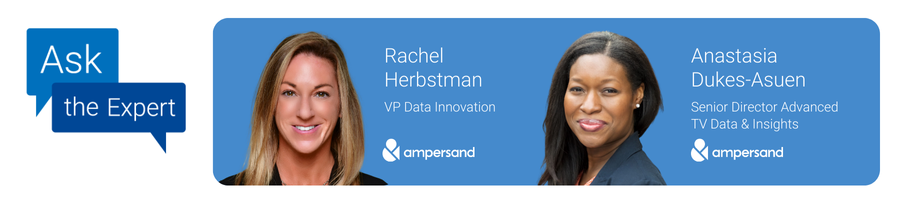
Ask the Expert Q&A with Ampersand's Rachel Herbstman, VP of Data Innovation, and Anastasia Dukes-Asuen, Senior Director Advanced TV Data & Insights

In our Ask the Expert Series, we interview leaders from our partner organizations who are helping lead their brands to new heights in AdTech. Today’s interview is with Rachel Herbstman, VP of Data Innovation, and Anastasia Dukes-Asuen, Senior Director of Advanced TV Data & Insights at Ampersand.

Could you introduce us to Ampersand and discuss your approach to TV advertising?

Ampersand, a joint venture between Comcast, Charter, and Cox, is a media sales organization that offers a unified footprint, unlocking unparalleled scale and unique data/insights for local and national advertisers. Ampersand gives advertisers true audience first planning, scale in execution, and advanced measurement of their TV investments, representing 117 million multiscreen households and over 75% of addressable households in the U.S. (64 million households). We help clients reach their unique target audience and deliver their stories – anytime, anywhere, and on whatever device.

How does adding streaming to a linear campaign, or vice versa, enhance overall campaign performance for marketers?

Herbstman: Marketers have recognized that multiscreen media strategies are the strongest as viewership continues to fragment. Unique audiences exist in traditional TV and streaming, and failure to include either media channel will reduce the total reach opportunity. These channels have proven to validate unduplicated audiences.

In our local business, adding streaming to a historically traditional linear-only media strategy increased campaign reach by 33%. Conversely, adding linear TV to a historically streaming-only media strategy increased reach by 209%. These metrics are validated by matching media exposures to an authenticated households subscriber ID and represent mass opportunities to reach new audiences with a multiscreen media strategy.

When considering reallocating media investments, how does Ampersand help clients determine the most effective channels for specific campaigns?

Herbstman: For a brand that historically invested in traditional TV, either national or local broadcast, we can provide insights to analyze the performance of any media campaign. The insights can include high-level metrics like reach and frequency and more granular metrics like unique reach per network. By seeing both the high-level results and more detailed granularity, we can provide optimization recommendations for funding other activation opportunities.

Our database of past campaigns consistently demonstrates that gaining new eyeballs with a national TV campaign usually plateaus after a few weeks. In other words, if most of your intended audience is reached after about three or four weeks of national television, reaching any new viewers can be exponentially more expensive.

We’ve built an Addressable Simulator tool for national advertisers that shows the potential impact of shifting a portion of the national media weight, specifically from the latter part of a flight, into addressable TV. Using our licensed Experian data set, we can measure any standard age/gender target or any advanced target to understand the complementary impact that addressable audience has on national media.This tool has dynamic inputs of CPMs and incidence rates, flight lengths, and budgets to simulate different scenarios and give marketers some intelligence on what holistic reach against that Experian segment they could expect with one given budget using brand-safe, traditional, and streaming inventory with an addressable activation.

Additionally, we’ve developed an interactive eCPM calculator that helps national advertisers assess the cost efficiency of adding addressable TV to their traditional campaigns. By dynamically inputting CPMs, marketers can evaluate tradeoffs between media types for upcoming campaigns.

Are there audience demographics that benefit from these combined media strategies, and what indicators or data points guide your recommendations to add cable to a local broadcast campaign versus other reallocations?

Herbstman: By including cable or streaming in a local effort, a client can use a data-driven approach to find more intended viewers in other premium content. Utilizing the vast library of Experian audience segments paired with our robust sample of 64 million data-enabled homes enables Ampersand to provide insights into the most valuable networks and dayparts that the intended viewer will likely watch on either platform.

With identity and viewing insights at scale, we can understand how consumers watch TV, even for inventory we have yet to sell. Our goal is to help marketers understand what’s happening as a result of their investments at a holistic level.

We can analyze a campaign running across hundreds of designated market areas to quickly and simply understand the holistic delivery of their broadcast and cable weight by pulling back set-top-box exposures on broadcast and Ampersand-purchased cable on our measurable footprint. Then, we can determine the share of measurable reach that each portion’s media weight contributes to.

We recommend optimizing towards a more balanced approach, where the reach levels for broadcast and cable mirror each other, creating a more effective market media mix.

Once we confirm cable’s potential in a market, we analyze network and daypart metrics to adjust key areas to optimize the campaign. We invite marketers to use these insights to measure their local or national TV campaign performance and garner unique perspectives to re-balance investments to drive reach and optimal frequencies.

Are there common missteps to avoid?

Dukes-Asuen: Ampersand’s decades of experience with media and data insights have allowed us to create an extensive database complete with targeting and measurement benchmarks. We use this database to curate best practices for brands and help set them up for success, keeping their goals and objectives for reach and frequency in mind.

Some clients spread their investment levels too thin, whether through short flight windows, low weekly frequencies, or targeting overly niche audiences that don’t fully support KPI goals.

One way to avoid these missteps is to set up a test-and-learn plan to validate a hypothesis and refine media strategies, ensuring campaigns are structured to garner meaningful insights. Ampersand can help ensure the test itself is constructed and supported to yield statistically relevant results, and the learnings can then be applied to the next campaign.

How does Experian’s data enhance your campaigns at Ampersand?

Dukes-Asuen: Within our Experian license, we can map the Experian Consumer View databases against our multichannel video programming distributors subscriber base in a privacy-compliant way to plan and activate them seamlessly. Experian has a rich set of audience targets and segmentation that we utilize to identify households that can be used for audience-based media execution with Ampersand. By defining the right audience—whether consumers are likely to purchase a product, exhibit certain behaviors, or demonstrate specific values—we enhance campaign performance and improve media spending efficiency for our advertisers.

Additionally, how do you believe AI and other new technologies will impact your media buying approaches in the future, and how might these innovations improve campaign effectiveness and provide value to your clients?

Herbstman: We have a strong use case on the measurement and analytics end. Using AI, we can aggregate a massive amount of historical data—viewership and exposure data. AI helps us understand overarching market trends and media performance to analyze campaign results and inform future campaign optimizations. The value of AI is in its role as an additional technology layer, enriching our insights portfolio and providing faster intelligence that enhances campaign effectiveness and delivers greater value to our clients.

Can you share an example of how precise audience targeting and segmentation, powered by Experian, have led to significantly better media spend reallocations and campaign performance for marketers?

One great example is how a national cruise brand dramatically improved its media spend and campaign performance by utilizing precise audience targeting and segmentation through Experian. By combining Ampersand’s addressable TV with Experian’s data-driven insights, they achieved a 14% incremental reach, a 3.1x higher frequency, and a 24% lower effective CPM. This strategic approach allowed them to reallocate their media spending more effectively, ensuring every impression reached their custom target audience.

Thanks for the interview.

For those interested in learning more about Ampersand, reach out for a personalized consultation.


Contact us

This site is protected by reCAPTCHA and the Google Privacy Policy and Terms of Service apply.


Latest posts

Loading…
It’s beginning to look a lot like 2022 holiday campaign planning season

While the weather outside is frightfully hot this summer, it’s never too soon to start thinking about the holidays – and consumers are more likely to start their holiday shopping early this year. To get you ready for the 2022 holiday shopping season, we looked back at consumer shopping trends from 2019-2021. What did we learn and what trends do we expect to see this year? Let’s look back. A look back Over the last three years, average consumer spending has increased. Record 2021 holiday sales came amidst a wave of COVID-19 cases, rising inflation, labor shortages, and supply chain problems. Despite these challenges, consumers continued to let it snow when it came to spending during the holiday season.  2022 has been a year with its own economic roadblocks – the war in Ukraine, rising gas prices, and recession concerns. Yet 2021 was a banner year for holiday sales despite its obstacles, and we predict similar trends in the 2022 holiday shopping season. What trends do we expect to see for the most wonderful time of the year?  2022 predictions While consumer spending remains strong, changing economic conditions continue to shape shopper behavior. To develop our predictions for 2022 holiday shopper behavior, we focused on four key areas: When consumers shop Where consumers shop What consumers purchase Consumer media preferences Now, let's make our holiday campaign planning checklist and check it twice. When consumers shop Chestnuts roasting on an open fire. Jack Frost nipping at your nose. Those aren’t the only ways to know when the holiday season has begun. Shoppers tend to spread out their holiday purchases across multiple months and were more likely to start shopping earlier. To understand holiday retail sales trends from 2019-2021, we identified four shopper segments:  Early Shoppers Traditional Shoppers Late Shoppers Random Shoppers What differences did we see between our four shopper segments? Early shoppers made almost half of their holiday purchases in October Random shoppers spread out their holiday purchases evenly across multiple months Late shoppers made almost half of their holiday purchases in December Traditional shoppers made almost half of their holiday purchases in November While December continues to dominate holiday sales, October has started to gain traction over the last three years, and November remains a core shopping month. Everybody knows a turkey and a mistletoe help to make the season bright but knowing when your consumers are most likely to shop will help deck your campaign planning halls. Jingle bell rock your way to holiday sales that shine bright with our tips to prepare for earlier shoppers:  Offer targeted promotions earlier in the shopping season Target your ads based on the shopping habits of your customers throughout the season Where consumers shop There’s no place like home for the holidays but most consumers aren’t shopping from home. Despite the rise in online shopping, brick and mortar locations continue to dominate holiday sales. October is the most popular month to take a one-horse open sleigh to a store, and consumers gather around the fire to online shop in November and December.     With most shoppers preferring to shop in-store, and e-commerce popularity growing, it’s critical to think about bridging the gap between your online and offline presence for the consumer. Are you offering multiple paths to purchase with solutions such as BOPIS (Buy Online, Pickup In-Store)?  Go down in history like Rudolph with our tips to prepare for more in-store shopping:  Focus on in-store shopping experience technology (self-checkout, VR, QR codes, scan to pay, etc.) Offer multiple paths to purchase to connect your online and physical presence through methods such as BOPIS (Buy Online, Pickup In-Store), BORIS (Buy Online, Return In-Store), and ROPO (Research Online, Purchase Offline), etc. What consumers purchase When it comes to holiday gifts, for some, only a hippopotamus will do. Compared to pre-pandemic, shoppers are spending more at apparel stores and mass retailers. Spending at specialty retailers, warehouse clubs, and on office, electronic, and games is almost the same across holiday and non-holiday shopping months. Time for toys and time for cheer may be year-round, but are there any correlations between where consumers shop (online vs. in-store) and what they purchase? Our data found that shoppers who bought from mass retailers were more likely to shop online, while shopping for apparel and warehouse clubs was done at a physical store location.     Put this insight to the test by thinking through how you can target your consumer based on where they shop in-store and online. You just might find that hippopotamus at a brick and mortar mass retailer location!  Consumer media preferences Do you see what I see? While we are seeing a shift to digital media channel preference, consumers still engage with traditional media channels like direct mail and the traditional newspaper. Successfully connecting with your customers involves capturing their attention through the right channel. We found that our four shopping groups prefer a mix of traditional and digital media channels. What does your media channel mix look like?  Hark! The herald angels sing of ways to adapt to the change in holiday spend and media preferences:  Align your activation efforts to digital, but don't forget about traditional channels Expand your targeting and activation focus beyond in-store vs. online Download our new 2025 report For a deeper dive into our predictions and actionable insights you can use to take your holiday campaign planning home for the holidays, download our new 2025 report, in collaboration with GroundTruth. Experian data can help you refine your content and creative strategy to achieve maximum ROI for each campaign across all your channels. Download now Get in touch

Aug 23,2022 by Experian Marketing Services

How to Adjust to the New World of Advertising

Fluctuation in consumers' behaviors and preferences during the pandemic has prompted a shift in the practices and patterns that we are accustomed to. Powerful market forces are emerging as society builds a new normal, forcing marketers to rethink their strategy, activation, and measurement.   It is important for marketers to understand the forces that influence the industry, and to learn about alternative approaches that can be applied to help reach their goals.   In our recent webinar, ‘How to Adjust to the New World of Advertising,’ Experian’s Chris Feo and guest speaker Tina Moffett, Principal Analyst at Forrester Research, lead an in-depth discussion of the market dynamics and developments guiding us to this new era of advertising. They talked about:  The pandemic changing consumer behavior  Emerging media channels   Data deprecation    The pandemic and increased media consumption The pandemic caused seismic shifts in consumer behaviors and business operations. Work from home became the norm, consumers made drastic changes in their routines, and businesses had to adjust to new operating models as local economies shrank and supply chains strained. As stay-at-home orders were put into effect, consumers increased their media consumption drastically as more time was spent at home in front of their devices. According to Forrester, by June 2020, 48% of US online adults subscribed to at least one streaming service, while 34% had signed up for multiple.  Forrester contends that:  Social and online video/OTT will grow fastest among other categories of ad spend   Connected TV outpaces other video advertising channels  55% of consumers plan to continue watching movies at home rather than in theatres after the pandemic    Data deprecation   The ways that marketers can personalize content and measure the effectiveness of campaigns is changing with data deprecation. Consumer preferences, regulations, and technology providers are evolving the way advertisers understand consumers, causing changes to existing identity-based marketing strategies. According to Forrester, 66% of marketers are investing in first-party data collection strategies to adapt to these market forces.    Marketers need to adjust   Demand for a new advertising approach    Changes in consumer behavior, evolving media consumption patterns, and data deprecation have marketers looking at new approaches to targeting and measurement. However, with the future uncertain in many of these areas, marketers need to test and experiment to determine which approach is best for them in particular use cases.     Shifting to a new world of experimentation   Advertisers need to start by assessing their current environment to determine where they have exposure today, which methods of identification they are using, and how those channels may be impacted by the market forces outlined earlier. From there, they need to start asking themselves how they can assess identity in the future or if there is another way to approach advertising in that specific channel.   There are specific areas where marketers can look to make investments in terms of experimentation:  Adoption of cleanrooms to support analytics and audience targeting Investment in first-party data to overcome the issue of data deprecation Shifting to a value-based, omni-channel advertising mindset to address customers’ needs Investment in data-savvy resources to manage media insights Adoption of consistent cross-platform advertising metrics and currencies to inform better planning If you missed our recent webinar ‘How to Adjust to the New World of Advertising,’ you can listen to the full discussion here.  Get in touch

May 04,2022 by Experian Marketing Services

Leveraging hashed email for the holiday season

Hashed Email is a privacy-safe digital identifier that can further enrich and expand the functionality and utility of The Tapad Graph with access to Tapad + Experian’s universe of email data. This provides maximum coverage for targeting and measurement when combined with household and individual IDs such as Cookies, MAIDs, CTV IDs, and IP Addresses. Gain back a clearer view Recent data from DMA shows that 51% of people have held the same email address for over 10 years. Email address data by its nature is authenticated and reliable due to its longevity. When leveraging Hashed Email as an extended functionality of The Tapad Graph, we are able to link on average 5 email addresses to each individual, reaching up to 90% of households across the US. Hashed Email expands the customer view by adding new email address identifiers into The Tapad Graph that associate with traditional digital IDs and cookie-less IDs emerging in the marketplace. Reduce fragmentation; and instead of viewing the emails as multiple customers, with Hashed Email they can be viewed as one user profile. When enabled, clients who wouldn’t traditionally have access to first-party customer emails are able to associate and link privacy-safe emails to individuals and their households. Brands and retailers can use Hashed Email to extend these linkages across offline purchases associated with each email; connecting traditional digital identifiers between walled gardens, activation in programmatic media buys, and addressable TV. With the holiday season quickly approaching, access to Hashed Emails will instantly increase scale, connectivity and improve measurement when efficiency, personalization and holistic attribution are pivotal to marketing strategies. Let’s visualize how quickly the customer journey can become fragmented when email addresses that belong to the same person are not associated. Mary has 3 email addresses that she frequently uses. One for social media accounts Email ID 1, one for shopping accounts Email ID 2, and another for work Email ID 3.  Mary is a brand loyalist to a top national retailer and whenever there is a new season, there is a high likelihood that she will purchase the latest seasonal decor from that store. She recently did some holiday shopping in-store where she purchased nearly the whole holiday line. Email ID 2 was used to send her a receipt. However, Mary annoyingly receives the store's ads on Facebook for holiday decor that she had already purchased. This is because the retailer has not yet identified that Email ID 1 and Email ID 2 belong to the same consumer. If the retailer were to leverage Hashed Email, they would be able to identify that both email addresses used belong to Mary. This association connects her multiple email addresses together, enables her offline purchases to sync with her online activity, and helps to determine the most accurate ROAS. Hashed Email is a cookie-free added view into consumer behavior for control over messaging and for measurement. When leveraging it’s possible to report back across all channels and devices in a universal format to know when and how conversions are taking place. Don't leave valuable data on the table Hashed Email has use cases beyond reducing wasted media impressions. Hashed Email’s full capabilities extend to campaign measurement and attribution modeling. When utilizing The Tapad Graph combined with Hashed Email, know from the first touchpoint to the last where your customers are engaging. But more importantly, know where households and the individuals inside of those households are converting across all of their digital devices, by using traditional digital IDs, cookie-less IDs, and Hashed Email to associate, measure, and correlate online and offline purchases. Imagine what your campaigns could look like this holiday season if you expanded your graph with up to 5 additional IDs per household. This impact could be a game-changer to scale this holiday season. Hashed Email is a reliable cookie-less digital identifier that expands your customer universe that connects online and offline activity while improving the customer experience and reducing wasted media spend. Enabling Hashed Email for the holiday season is not an opportunity that should be passed on. Where do you sign up, you ask? Get in touch

Nov 10,2021 by Experian Marketing Services

Subscribe to our newsletter

Enter your name and email for the latest updates

This site is protected by reCAPTCHA and the Google Privacy Policy and Terms of Service apply.

About Experian Marketing Services

At Experian Marketing Services, we use data and insights to help brands have more meaningful interactions with people. As leaders in the evolution of the advertising landscape, Experian Marketing Services can help you identify your customers and the right potential customers, uncover the most appropriate communication channels, develop messages that resonate, and measure the effectiveness of marketing activities and campaigns.

Visit our website

Subscribe to our newsletter

Stay up to date on the latest industry news and receive expert tips from our marketing experts.
Subscribe now!