
Buyers can now put Experian’s audience and contextual intelligence to work in Google Ad Manager Curation in two ways: through off-the-shelf solutions available directly in Google Ad Manager, or through Custom Curation packages that Experian builds using Google Ad Manager’s inventory supply. Together, these options bring Experian’s consumer data foundation closer to the Google supply agencies already buy, with the flexibility to choose between a ready-to-use solution and an Experian package tailored to specific campaign goals.
Why targeting at the source matters
Many audience strategies still apply targeting on the buy side, which means signals pass through multiple systems before an impression is evaluated. Each step can shrink the pool of requests where the audience is still recognizable, so a carefully built strategy can reach the auction at a fraction of the scale it started with.
Google Ad Manager Curation moves segment evaluation closer to the ad request. When a request matches the selected Experian segment, Ad Manager sends the bid request with the associated Deal ID to the buyer’s DSP. This more direct path can support stronger match and deal-transaction rates, more accurate forecasting, and better access to the audience defined in the strategy.
As AI shapes more media decisions, the quality and provenance of the data feeding those systems matter more. Evaluating audience or contextual criteria closer to the source helps preserve the connection between the strategy and the impression being considered.
Two ways to get started
The right entry point depends on how much customization the campaign requires. Buyers can access Experian solutions off-the-shelf directly in Google Ad Manager or work with Experian to build a Custom Curation package using Google Ad Manager inventory supply.
Start off-the-shelf
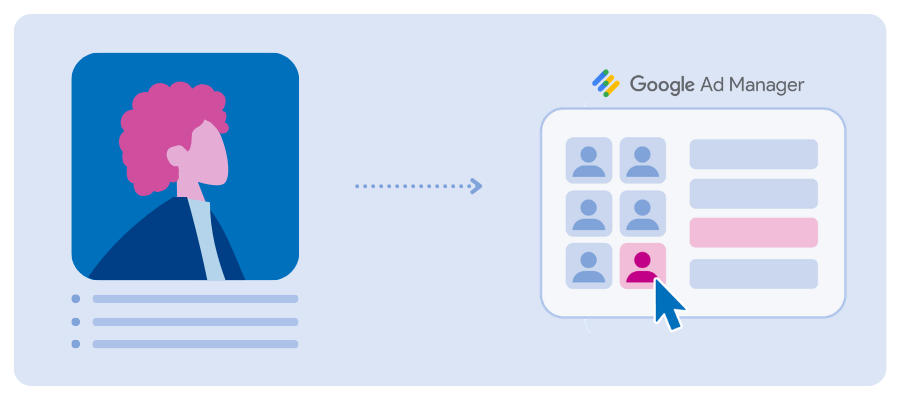
For buyers who want direct, self-service access to Experian audience and contextual solutions. Experian solutions are available off-the-shelf in Google Ad Manager, giving buyers a straightforward way to select the data or contextual strategy that fits their campaign and create packages through Google Ad Manager’s Curation capabilities.
Experian also offers Predictive Indexed, which uses Experian audiences to predict the contextual categories and pages to target based on the likelihood that consumers visiting those environments fall within the selected audience. This gives buyers an audience-informed way to approach contextual activation without requiring identity at the point of activation.
Build a Custom Curation package

For buyers who need a strategy tailored to specific audience, contextual, and inventory requirements.
Experian can build Custom Curation packages using Google Ad Manager’s inventory supply based on the targeting criteria that matter for a campaign. Where off-the-shelf solutions draw on Experian data, custom packages can also incorporate partner audiences and a brand’s own first-party audiences. Packages can combine Experian audiences, partner audiences, a brand’s own first-party audiences, contextual signals, and inventory or site criteria.
Experian applies those criteria against Google Ad Manager inventory supply and brings the data, targeting, and inventory together into a single curated deal. This gives buyers a way to combine audience and supply decisions rather than managing each component separately.
The approach can be tailored to the campaign. A buyer might start with a defined audience and add contextual or inventory criteria, bring a brand’s established first-party audience into the strategy, or build around specific supply and audience-quality requirements.
Choose the path that fits the campaign
Both paths do the same underlying thing: they move the audience or contextual decision closer to the ad request, before signal loss builds across the path. Whether a campaign calls for something ready to use or a package built to spec, the result is a more direct line from strategy to impression.
Ready to get started? Explore Experian solutions available off-the-shelf in Google Ad Manager or contact your Experian representative to request a Custom Curation package.
Latest posts

OpenAudience™ will provide marketers the ability to easily plan and buy advertising for every digitally addressable consumer across the open web LOS ANGELES, May 2, 2019 /PRNewswire/ — For the past decade, the most effective way to advertise in digital media has been on Facebook and Google. Marketers in the U.S. now spend two-thirds of all digital ad spend on the “walled gardens”, despite the fact that they receive less than 36 percent of total consumer time spent online. According to eMarketer, addressing this massive asymmetry in advertising – where tens of billions of dollars are over allocated to the walled gardens – is the top concern of marketers in 2019. While programmatic technology has become the primary monetization system for the open web, it has lacked the simplicity and efficacy of walled gardens. Today, OpenX is changing that paradigm by bringing true people-based marketing to the open web for the first time with the introduction of OpenAudience. OpenAudience will provide marketers and publishers with an unprecedented, unified level of knowledge about consumer audiences – through a platform built on privacy by design principles that brings the efficiency and efficacy of walled garden advertising to the open web. OpenAudience is powered by a comprehensive proprietary data asset and supplemented by integrated partnerships with recognized leaders in data and identity like LiveRamp, Tapad, a part of Experian, and more. For marketers, OpenAudience will provide the ability to plan and buy people-based marketing campaigns that combine the impact and ease of use of Facebook advertising with the scale of the open web. OpenAudience is currently in active partner testing with multiple marketers in the U.S., including Fortune 500 financial service and consumer personal care companies, along with one of America’s largest online entertainment outlets, and will be generally available to the broader market in Q3 of 2019. For publishers, OpenAudience will deliver user-based knowledge that empowers them to value and sell advertising with unparalleled precision. With the ability to automatically place consumers into high-value audience segments drawn from the more than 240M U.S. Monthly Active Users OpenX reaches across the open web, OpenAudience allows publishers to maximize revenue like never before. “OpenAudience is a natural evolution of programmatic advertising, combining the unified knowledge of people-based audiences with the transactional power of programmatic to create a planning, buying and advertising experience that is unlike anything else in the market today,” said Todd Parsons, chief product officer at OpenX. “No exchange in the market today has enabled a unified view of publisher audiences,” said Travis Clinger, vice president of strategic initiatives, LiveRamp. “Now, OpenX is democratizing identity across all publishers on the open web, helping marketers to plan and buy audiences the way they do inside walled gardens. We are thrilled to be a key component of OpenAudience.” For more information, or to request a place in the private testing phase of OpenAudience, visit: http://www.openx.com, or contact your OpenX account representative today. About OpenX Nobody understands the open web better than OpenX. As the world’s largest independent advertising exchange, OpenX makes the efficient people-based marketing buying experience of the walled gardens available to all marketers across the open web. OpenX works with more than 30,000 advertisers across every screen and device, reaching nearly one billion consumers – including a quarter billion unique consumers in the US – and processing more than one trillion transactions globally each day. To date, OpenX has helped deliver more than $3 billion in total monetization to publishers. That’s the Power of Open™. Contact us today

Tom Rolph, VP EMEA at Tapad, part of Experian, says that ad-sponsored streaming services can be successful if they can deliver a higher quality viewer experience than other streaming services. Last week, Hulu, the streaming service acquired by Fox and now owned 60 per cent by Disney, announced it will be regularising its ad loads. The streaming service will be bringing ad breaks down to 90 seconds in an effort to deliver a better viewer experience. This is a positive move from Hulu and one which other ad-supported streaming services should follow in order to be successful in a competitive market. Previously ad breaks on Hulu could vary wildly, from 180 seconds to 240 seconds, due to existing deals with its three owners: Disney, Comcast and AT&T. Over in the UK, we haven’t suffered from quite as inconsistent an approach as in the US, but there is still viewer frustration with the ad experience on ITV Hub and All4, where the problem tends to be over exposure of the same ad. Therefore, this move to standardise ad break lengths for streaming platforms is one that should be embraced on both sides of the pond. An important shift in this space will be to limit the number of ads during each show, but have better ad targeting to minimise repetitive advertising and increase the ROI of ad spend. All of which can be accomplished by investing in identity resolution products that can support CTV devices. Last year Ofcom found that in the UK subscriptions to Netflix, Amazon and NOW TV have risen above those to traditional pay TV services. With Netflix and Amazon both ad-free and NOW TV only a limited ad funded model, it’s clear that there is a growing appetite for ad-free viewing models. A fact that is only further supported when you consider the role of the BBC and BBC iPlayer. But the picture isn’t entirely negative for ad-funded models. There is demand for great content on ad-funded services in the UK, with ITV Hub boasting over 1bn requests and 540m hours of TV watched. The ITV Hub mobile app has also been downloaded on over 27m devices across the country – with over 22m people now registered to ITV Hub database, including more than half of Britain’s 16-24 year olds. However, to continue to attract and retain younger viewers, the experience will have to improve. There are several areas where ad-supported streaming providers need to improve in order to remain top players in this space: Ad experienceAs explored above, both volume and repetition of ads can be a turn off for viewers, but with Brits already spending a total of £303.16m every month on TV streaming services, according to Finder.com, there is potential for free, ad-funded models to flourish as people hit a limit on what they are willing to spend. There are already signs of improvement with the ad experience, with ITV just signing a deal with Amobee to allow for addressable ads on ITV Hub, while Sky’s AdSmart technology remains best in class and has now crossed over the pond to be used by Comcast stablemate NBC. Server reliabilityA cursory search finds little evidence of ongoing reliability problems with Netflix, but much evidence of problems with ITV Hub and All4, which are both prone to crashing. To compete with bigger players with massive server farms, server capacity needs to be tackled. This is especially true when it comes to live events, where many people will recall ITV Hub’s famous fails during the World Cup. While even some of the larger players have had similar streaming issues (for example, Amazon’s move into live sports streaming when they had to pull UK streaming of the US Open Tennis due to user complaints), viewing experience should be prioritised as the space gets increasingly competitive. Getting the content rightAmazon and Netflix have huge content budgets, but UK broadcasters remain strong in this regard, Channel 4 has enjoyed viewing figures of 7.5m for the Great British Bake Off, while ITV pulled in 13.7m for I’m A Celebrity. By building on UK-specific content that speaks to UK audiences, ad-supported streaming services can continue to pull in more viewers. Mobile accessMore and more Brits are choosing to watch TV content on their smartphone or tablet, according to UKOM-approved comScore data. In fact, 6.5m adults visited the BBC iPlayer app to watch video on either a smartphone or tablet, edging out Netflix which attracted 5.8m Getting the experience right on mobile, with the option to download content so it can be viewed in areas of low or no signal, is key.If UK ad-supported TV stations can crack these key areas for their Connected TV offering then they will be set up to succeed and offer a true home-grown alternative to the US streaming giants. Full article here. Contact us today
Tapad’s, part of Experian, SVP of Identity shows us how marketers might communicate seamlessly through emerging channels like voice, the smart home, and, yes, podcasts.In his relatively new role as senior vice president of identity at Tapad, a part of Experian, Ajit Thupil keeps a close eye on the evolution of marketing as it becomes more intent on using data and identity technology to track ROI. Here he sits with Chris Wood at Tapad’s New York offices to discuss the future of identity. (To capture the inventive atmosphere at this location, the room they chatted in was named after Leonardo da Vinci.) For Thupil, it all comes back to the customer, whether it’s a brand client or a consumer. Brands want measurability and customers demand a seamless experience across the many devices they use in a day. While consumers are understandably reticent about giving up personally identifiable information (PII), current identity solutions use anonymous data profiles to connect the dots at the individual or household level. Given the frequency that users switch devices, along with their tendency to share bigger screens like TVs, there’s no dearth of challenges for this “head of problem solving” to solve. Contact us today