At A Glance
The Advertising Research Foundation’s DASH TV Universe Study provides a projectable view of how Americans connect to and consume TV across households, devices, and services. In this Q&A, Jim Meyer, General Manager, DASH, and Samantha Zhang, Senior Data Scientist, at the ARF explain what DASH measures, who uses it, why MRC accreditation matters, and how Experian combines DASH with its data to build audience segments for advertisers and agencies.In our Ask the Expert series, we interview leaders from our partner organizations who are helping lead their brands to new heights in AdTech. Today’s interview is with Samantha Zhang, Senior Data Scientist, and Jim Meyer, General Manager of the DASH TV Universe Study at the Advertising Research Foundation (ARF). DASH is an annual tracking study conducted by the ARF to define and better understand TV audience behavior and household dynamics.
What does DASH measure, and how does it help the industry understand TV consumption today?
By capturing hundreds of individual- and household-level data points from each respondent in a rigorous and nationally projectable sample, DASH creates a comprehensive picture of U.S. consumer TV “infrastructure” – how America watches.
| Core elements in DASH | Elements that create context in DASH |
| TV sets Location | brand | smartness | service modes | sources | Demographics |
| Connected devices Game consoles |video players | streaming devices | Yesterday viewing Daypart | TV/device genre | Out-of-home viewing |
| Mobile devices Owners | sharing users | Shopping Online and in-store | Exposure to major RMNs |
| Internet service Modes | ISPs | connectivity by device | Streaming audio |
| Streaming TV SVOD/AVOD tiers and sharing | FAST | Email accounts and apps |
| Live TV Modes of access | including casting from devices | Social media |
For example, DASH gathers:
- Data on every TV set, including brand, room location, age, “smartness,” and connection devices and modes
- Household connectivity and video service data, even in homes with no TV set
- Internet Service Providers (ISP) and TV service usage, including Multichannel Video Programming Distributors (MVPDs), virtual vMVPDs, streamers (ad-supported and premium), and Free Ad-Supported Television (FAST) channels
- Person-level ownership and usage of video-capable mobile devices, including smartphones, tablets, and laptops
- Measures of viewing and co-viewing across dayparts, devices, and services
- Additional modules covering shopping and retail media networks, streaming audio, social media, email, and apps
Broad coverage and granularity make DASH a uniquely robust source of truth for practitioners across the industry, including measurement experts and ad programming strategists. DASH also reports regularly (and publicly) on key industry dynamics. DASH identified a growing segment of device-only viewers – now nearly 9 million households that watch TV, but do not own a TV set – and highlighted the implications of that trend for traditional ratings systems based only on households with TV sets.
| Households (HHs – million) | 2025 HHs (M) | U.S. penetration | Change vs. 2024 (M) |
| Total US | 134.8 | 100% | +2.7 |
| Connected TV (CTV) | 114.6 | 85% | +2.1 |
| TV (Set) | 124.2 | 92.2% | +1.1 |
| Device-only | 8.8 | 6.6% | +1.6 |
| TV-Accessible | 133.1 | 98.7% | +2.7 |
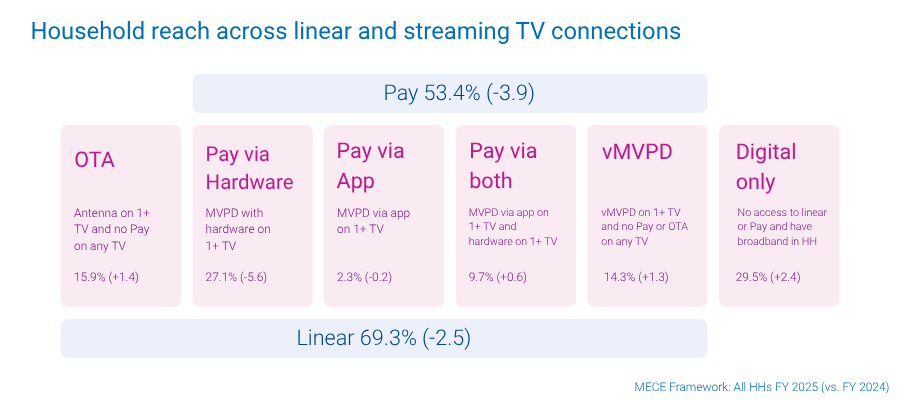
DASH called out the rise in app-based pay TV and proposed a new connection framework that better represents the modern TV world, in which linear and streaming overlap.
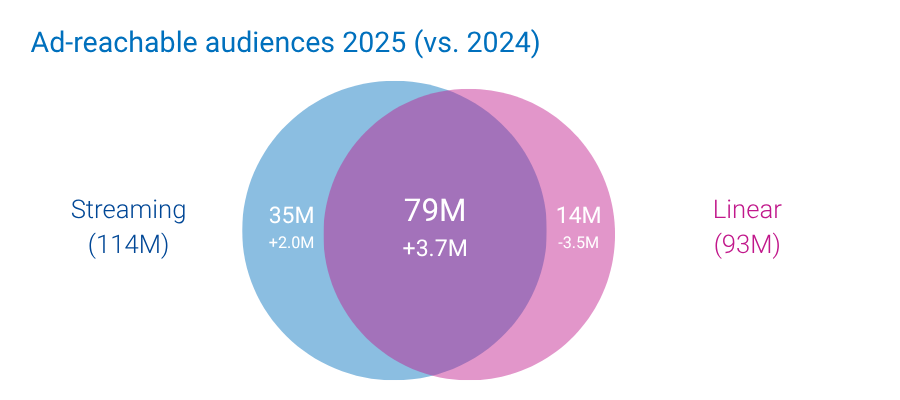
DASH also defines the universes of households reachable with advertising. This graphic, for example, shows how all ad-supported linear and streaming properties in aggregate define the true scale of TV advertising. While 35 million households (and growing) are reachable only with streaming ads and 13 million (and falling) only with linear ads, most households are reachable with both, underscoring the importance of understanding the “overlap.”
Who uses DASH data, and what decisions does it help inform?
There are three primary users of DASH, each with its own use cases:
The recent accreditation of DASH by the Media Rating Council (MRC) and adoption by Nielsen as an input to its TV ratings have generated interest from a broad range of companies. We are actively pursuing new licensees and partners to make DASH more useful within, and even outside, the TV ecosystem.
What does MRC accreditation signify, and why is it meaningful for DASH?
MRC accreditation means DASH passed a rigorous audit conducted by Ernst & Young over many months, which validated our methodology, controls, and data quality. MRC accreditation establishes that DASH is an industry-standard dataset.
While the service provider normally announces its own accreditation, the MRC took the unusual step of issuing its own release on DASH, announcing the accreditation of DASH for TV universe estimation and endorsing the study for broader, cross-media use.
How does Experian use DASH data to build audiences?
The segments combine specific TV usage habits and behaviors from DASH with Experian data on demographics, spending, and other contextual inputs to create a fuller view of consumer viewing behavior. They are designed to be valuable to advertisers in many categories and planning contexts – and to be customizable to fit advertisers’ media targets. The segments can be used to:
- Apply or suppress audiences to improve target coverage across a campaign
- Better align media and creative
- Reach elusive but high-value viewers, such as Ad Avoiders
- Drive valuable consumer behavior
- Achieve specific advertising objectives
What are some practical use cases for DASH-based audiences?
Here are some practical use cases for four different kinds of DASH segments in five different advertiser categories.
Thanks for the interview. Where can readers learn more about DASH?
We started work on DASH seven years ago, and it’s been fun to watch it “grow up.” Our partnership with Experian is a big step toward putting DASH to work for advertisers and agencies. To learn more, visit our site at https://theARF.org/DASH or contact us at DASH@theARF.org.
Contact us
About our experts

Samantha Zhang, Senior Data Scientist at ARF
Samantha Zhang is a Senior Data Scientist at the Advertising Research Foundation working on the DASH TV Universe Study, with additional research spanning areas including attention measurement, digital privacy, and artificial intelligence.

Jim Meyer, General Manager, DASH, at ARF
JimMeyer is general manager and co-founder of the ARF DASH TV Universe Study and managing partner of Golden Square, LLC, which advises media and research technology companies on growth strategy and development.
Latest posts

Tom Rolph, VP EMEA at Tapad, part of Experian, says that ad-sponsored streaming services can be successful if they can deliver a higher quality viewer experience than other streaming services. Last week, Hulu, the streaming service acquired by Fox and now owned 60 per cent by Disney, announced it will be regularising its ad loads. The streaming service will be bringing ad breaks down to 90 seconds in an effort to deliver a better viewer experience. This is a positive move from Hulu and one which other ad-supported streaming services should follow in order to be successful in a competitive market. Previously ad breaks on Hulu could vary wildly, from 180 seconds to 240 seconds, due to existing deals with its three owners: Disney, Comcast and AT&T. Over in the UK, we haven’t suffered from quite as inconsistent an approach as in the US, but there is still viewer frustration with the ad experience on ITV Hub and All4, where the problem tends to be over exposure of the same ad. Therefore, this move to standardise ad break lengths for streaming platforms is one that should be embraced on both sides of the pond. An important shift in this space will be to limit the number of ads during each show, but have better ad targeting to minimise repetitive advertising and increase the ROI of ad spend. All of which can be accomplished by investing in identity resolution products that can support CTV devices. Last year Ofcom found that in the UK subscriptions to Netflix, Amazon and NOW TV have risen above those to traditional pay TV services. With Netflix and Amazon both ad-free and NOW TV only a limited ad funded model, it’s clear that there is a growing appetite for ad-free viewing models. A fact that is only further supported when you consider the role of the BBC and BBC iPlayer. But the picture isn’t entirely negative for ad-funded models. There is demand for great content on ad-funded services in the UK, with ITV Hub boasting over 1bn requests and 540m hours of TV watched. The ITV Hub mobile app has also been downloaded on over 27m devices across the country – with over 22m people now registered to ITV Hub database, including more than half of Britain’s 16-24 year olds. However, to continue to attract and retain younger viewers, the experience will have to improve. There are several areas where ad-supported streaming providers need to improve in order to remain top players in this space: Ad experienceAs explored above, both volume and repetition of ads can be a turn off for viewers, but with Brits already spending a total of £303.16m every month on TV streaming services, according to Finder.com, there is potential for free, ad-funded models to flourish as people hit a limit on what they are willing to spend. There are already signs of improvement with the ad experience, with ITV just signing a deal with Amobee to allow for addressable ads on ITV Hub, while Sky’s AdSmart technology remains best in class and has now crossed over the pond to be used by Comcast stablemate NBC. Server reliabilityA cursory search finds little evidence of ongoing reliability problems with Netflix, but much evidence of problems with ITV Hub and All4, which are both prone to crashing. To compete with bigger players with massive server farms, server capacity needs to be tackled. This is especially true when it comes to live events, where many people will recall ITV Hub’s famous fails during the World Cup. While even some of the larger players have had similar streaming issues (for example, Amazon’s move into live sports streaming when they had to pull UK streaming of the US Open Tennis due to user complaints), viewing experience should be prioritised as the space gets increasingly competitive. Getting the content rightAmazon and Netflix have huge content budgets, but UK broadcasters remain strong in this regard, Channel 4 has enjoyed viewing figures of 7.5m for the Great British Bake Off, while ITV pulled in 13.7m for I’m A Celebrity. By building on UK-specific content that speaks to UK audiences, ad-supported streaming services can continue to pull in more viewers. Mobile accessMore and more Brits are choosing to watch TV content on their smartphone or tablet, according to UKOM-approved comScore data. In fact, 6.5m adults visited the BBC iPlayer app to watch video on either a smartphone or tablet, edging out Netflix which attracted 5.8m Getting the experience right on mobile, with the option to download content so it can be viewed in areas of low or no signal, is key.If UK ad-supported TV stations can crack these key areas for their Connected TV offering then they will be set up to succeed and offer a true home-grown alternative to the US streaming giants. Full article here. Contact us today

Tapad’s, part of Experian, SVP of Identity shows us how marketers might communicate seamlessly through emerging channels like voice, the smart home, and, yes, podcasts.In his relatively new role as senior vice president of identity at Tapad, a part of Experian, Ajit Thupil keeps a close eye on the evolution of marketing as it becomes more intent on using data and identity technology to track ROI. Here he sits with Chris Wood at Tapad’s New York offices to discuss the future of identity. (To capture the inventive atmosphere at this location, the room they chatted in was named after Leonardo da Vinci.) For Thupil, it all comes back to the customer, whether it’s a brand client or a consumer. Brands want measurability and customers demand a seamless experience across the many devices they use in a day. While consumers are understandably reticent about giving up personally identifiable information (PII), current identity solutions use anonymous data profiles to connect the dots at the individual or household level. Given the frequency that users switch devices, along with their tendency to share bigger screens like TVs, there’s no dearth of challenges for this “head of problem solving” to solve. Contact us today
Joint solution will enhance accuracy and reach across North America, EMEA and APAC NEW YORK, April 17, 2019 /PRNewswire/ — Tapad, a global marketing technology company and leader in digital identity resolution solutions, today announced a new joint capability with Arm®Treasure DataTM , a leader in enterprise customer data management. The partnership combines The Tapad GraphTM technology with Arm Treasure Data’s robust enterprise Customer Data Platform (CDP), enabling advertisers in the Arm Treasure Data marketplace to access Tapad’s datasets. With the integration of Tapad’s Graph and Arm Treasure Data’s existing first party data, marketers will be able to deliver scalable, cross-device messaging with precision. In addition, marketers can benefit from anonymous customer journey analysis, audience expansion and online and offline attribution. Arm Treasure Data’s APAC market customers will have access to expanded audience reach by leveraging Tapad’s global, proprietary datasets. While Tapad will be able to extend its presence into the APAC region, tapping into Arm Treasure Data’s existing footprint. “The Tapad GraphTM is a trusted and established platform with a history of innovation,” said Stephen Lee, Senior Director, Business Development, Arm Treasure Data. “Integrating Tapad’s technology into the Arm Treasure Data CDP will allow for streamlined experiences across markets, achieving global scalable reach.” For more information about The Tapad GraphTM, or to request a demo, visit our identity page. About Tapad Tapad, Inc. is a global marketing technology company and leader in digital identity resolution solutions. The Tapad GraphTM, and related solutions, provide a privacy-safe approach to connecting device identifiers to brand and marketer data, thereby allowing for enhanced measurement, attribution, reach and ROI of marketing campaigns. The Tapad GraphTM enables marketers around the world to maximize campaign effectiveness and drive business results. Tapad is recognized across the industry for its innovation, growth and workplace culture, and has earned numerous awards, including the TMCnet Tech Culture Award. Based in New York, Tapad also has offices in Chicago, London, Oslo, Singapore and Tokyo, and is a wholly owned subsidiary of Telenor Group. About Treasure Data Arm Treasure Data enterprise Customer Data Platform (CDP) unifies data from multiple sources – online, offline, IoT and device generated data – and empowers enterprises to disrupt their markets with superior customer experiences. Our customers are creating transformational customer relationships by connecting the data dots with our CDP. Arm Treasure Data is fully owned by Arm Holdings and has a global customer base of over 300 enterprises including Fortune 500 and Global 2000 companies. Our clients manage over 130 trillion records, resulting in more predictable and profitable business results. Contact us today