At A Glance
The Advertising Research Foundation’s DASH TV Universe Study provides a projectable view of how Americans connect to and consume TV across households, devices, and services. In this Q&A, Jim Meyer, General Manager, DASH, and Samantha Zhang, Senior Data Scientist, at the ARF explain what DASH measures, who uses it, why MRC accreditation matters, and how Experian combines DASH with its data to build audience segments for advertisers and agencies.In our Ask the Expert series, we interview leaders from our partner organizations who are helping lead their brands to new heights in AdTech. Today’s interview is with Samantha Zhang, Senior Data Scientist, and Jim Meyer, General Manager of the DASH TV Universe Study at the Advertising Research Foundation (ARF). DASH is an annual tracking study conducted by the ARF to define and better understand TV audience behavior and household dynamics.
What does DASH measure, and how does it help the industry understand TV consumption today?
By capturing hundreds of individual- and household-level data points from each respondent in a rigorous and nationally projectable sample, DASH creates a comprehensive picture of U.S. consumer TV “infrastructure” – how America watches.
| Core elements in DASH | Elements that create context in DASH |
| TV sets Location | brand | smartness | service modes | sources | Demographics |
| Connected devices Game consoles |video players | streaming devices | Yesterday viewing Daypart | TV/device genre | Out-of-home viewing |
| Mobile devices Owners | sharing users | Shopping Online and in-store | Exposure to major RMNs |
| Internet service Modes | ISPs | connectivity by device | Streaming audio |
| Streaming TV SVOD/AVOD tiers and sharing | FAST | Email accounts and apps |
| Live TV Modes of access | including casting from devices | Social media |
For example, DASH gathers:
- Data on every TV set, including brand, room location, age, “smartness,” and connection devices and modes
- Household connectivity and video service data, even in homes with no TV set
- Internet Service Providers (ISP) and TV service usage, including Multichannel Video Programming Distributors (MVPDs), virtual vMVPDs, streamers (ad-supported and premium), and Free Ad-Supported Television (FAST) channels
- Person-level ownership and usage of video-capable mobile devices, including smartphones, tablets, and laptops
- Measures of viewing and co-viewing across dayparts, devices, and services
- Additional modules covering shopping and retail media networks, streaming audio, social media, email, and apps
Broad coverage and granularity make DASH a uniquely robust source of truth for practitioners across the industry, including measurement experts and ad programming strategists. DASH also reports regularly (and publicly) on key industry dynamics. DASH identified a growing segment of device-only viewers – now nearly 9 million households that watch TV, but do not own a TV set – and highlighted the implications of that trend for traditional ratings systems based only on households with TV sets.
| Households (HHs – million) | 2025 HHs (M) | U.S. penetration | Change vs. 2024 (M) |
| Total US | 134.8 | 100% | +2.7 |
| Connected TV (CTV) | 114.6 | 85% | +2.1 |
| TV (Set) | 124.2 | 92.2% | +1.1 |
| Device-only | 8.8 | 6.6% | +1.6 |
| TV-Accessible | 133.1 | 98.7% | +2.7 |
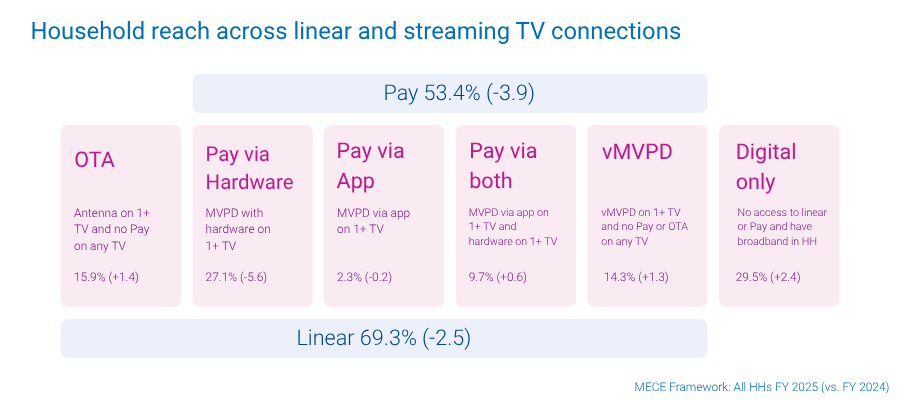
DASH called out the rise in app-based pay TV and proposed a new connection framework that better represents the modern TV world, in which linear and streaming overlap.
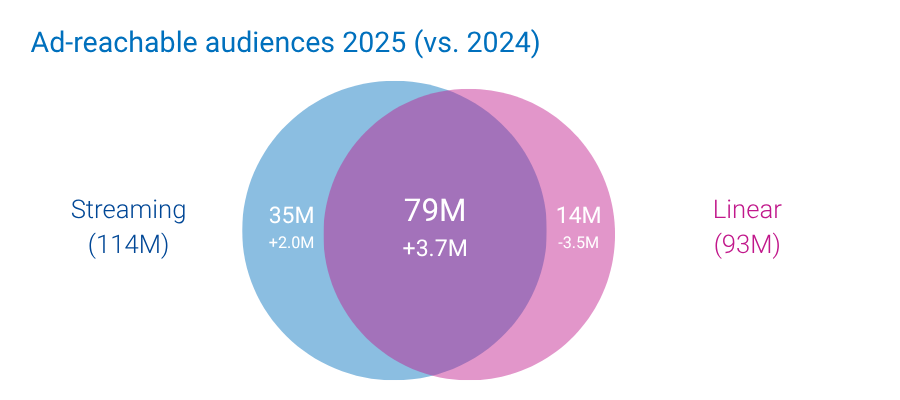
DASH also defines the universes of households reachable with advertising. This graphic, for example, shows how all ad-supported linear and streaming properties in aggregate define the true scale of TV advertising. While 35 million households (and growing) are reachable only with streaming ads and 13 million (and falling) only with linear ads, most households are reachable with both, underscoring the importance of understanding the “overlap.”
Who uses DASH data, and what decisions does it help inform?
There are three primary users of DASH, each with its own use cases:
The recent accreditation of DASH by the Media Rating Council (MRC) and adoption by Nielsen as an input to its TV ratings have generated interest from a broad range of companies. We are actively pursuing new licensees and partners to make DASH more useful within, and even outside, the TV ecosystem.
What does MRC accreditation signify, and why is it meaningful for DASH?
MRC accreditation means DASH passed a rigorous audit conducted by Ernst & Young over many months, which validated our methodology, controls, and data quality. MRC accreditation establishes that DASH is an industry-standard dataset.
While the service provider normally announces its own accreditation, the MRC took the unusual step of issuing its own release on DASH, announcing the accreditation of DASH for TV universe estimation and endorsing the study for broader, cross-media use.
How does Experian use DASH data to build audiences?
The segments combine specific TV usage habits and behaviors from DASH with Experian data on demographics, spending, and other contextual inputs to create a fuller view of consumer viewing behavior. They are designed to be valuable to advertisers in many categories and planning contexts – and to be customizable to fit advertisers’ media targets. The segments can be used to:
- Apply or suppress audiences to improve target coverage across a campaign
- Better align media and creative
- Reach elusive but high-value viewers, such as Ad Avoiders
- Drive valuable consumer behavior
- Achieve specific advertising objectives
What are some practical use cases for DASH-based audiences?
Here are some practical use cases for four different kinds of DASH segments in five different advertiser categories.
Thanks for the interview. Where can readers learn more about DASH?
We started work on DASH seven years ago, and it’s been fun to watch it “grow up.” Our partnership with Experian is a big step toward putting DASH to work for advertisers and agencies. To learn more, visit our site at https://theARF.org/DASH or contact us at DASH@theARF.org.
Contact us
About our experts

Samantha Zhang, Senior Data Scientist at ARF
Samantha Zhang is a Senior Data Scientist at the Advertising Research Foundation working on the DASH TV Universe Study, with additional research spanning areas including attention measurement, digital privacy, and artificial intelligence.

Jim Meyer, General Manager, DASH, at ARF
JimMeyer is general manager and co-founder of the ARF DASH TV Universe Study and managing partner of Golden Square, LLC, which advises media and research technology companies on growth strategy and development.
Latest posts

To our valued customers and partners, it’s been an exciting week here at Tapad! As announced in a press release this morning, Tapad is now a member of the Experian family. We’re thrilled to continue to grow as a leader in identity resolution under the umbrella of a global expert in data, analytics and technology. Tapad and Experian are deeply connected by our commitment to serving the needs of our customers; and with a focus on quality of the data we provide, we have a common goal for the future of identity in the advertising ecosystem. As part of this announcement, we wanted to assure you, our valued customer, that we remain deeply committed to serving you today just as we always have. Nothing will change in your daily operations with Tapad. Experian immediately recognized that the success and growth of Tapad was directly tied to the strength and depth of its team members. As such, the acquisition will not result in any changes to day-to-day contacts at Tapad, or processes with weekly graph deliveries and other product support. Experian’s faith and investment in Tapad’s future and the future of identity resolution underscores what we’ve always believed our products could achieve and that we will be able to continue serving brands, advertisers, publishers, and the advertising and marketing ecosystem for years to come. On a personal note, I am excited to be transitioning my role as Chief Operating Officer of Tapad to the General Manager position of a global business that’s achieved exponential growth over the past several years; culminating in this strategic acquisition that will no doubt bring even more value to our customers in the future. We remain committed to open communication and welcome any questions you may have. Thank you,Mark Connon | General Manager, Tapad Contact us today
Addressable TV has been through a transformation in the past year. Streaming content has become the most coveted space for creators and advertisers with the rise of new apps and platforms; but the influx of stay-at-home orders around the country have shifted television viewership as we know it, and streaming apps are popping up in droves to take advantage. So, how can you? With no shortage of opportunities to advertise on addressable TV and CTV, how does it fit into the media mix? And furthermore, how can you attribute this household-level device into your overall strategy? Tying it all together Layering addressable TV within digital ad campaigns couldn’t be easier today — but applying the right targeting and cadence between all of your digital efforts; and tying them together in attribution takes the right kind of data. Marketers can use CTV identifiers coupled with other device identifiers available in The Tapad Graph to not only target impressions but also map addressable TVs within the consumer journey; and unify strategies between household decision makers to better personalize messaging. 1 The Trade Desk Q2 2020 Earnings Call Transcript, August 2020; 2 iSpot Report, via Deadline, July 2020; 3 Flixed.io, January 2020 Contact us today
For the past several years ad-tech defined the value of identity at the individual level; made possible by the evolution of data, technology and machine-learning. But, earlier this year COVID-19 set in motion many shifts in consumer digital behavior. The more we’ve been working and learning from home, using devices that are shared amongst an entire household, the more apparent it is that marketers need to shift their strategies to align with these changes. Did you know the average household owns eleven or more connected devices? And the longer we’ve been at home, the more these devices are shared by multiple individuals. If you’re looking for a few simple ways to evolve from an individual focused strategy to a household strategy, here’s a good place to start: Audience segmentation Traditionally, audiences are built with a narrow focus on a single user, and what known attributes about that individual or their brand engagement can be leveraged for a targeting strategy. Now that screens are being shared between multiple users in a home, how can you be sure you’re identifying them correctly, and thus, segmenting them in the right buckets for targeting? The key lies in the ability to connect those points through identity resolution. Using ad exposure from household level devices, followed by a second engagement from an individual within that household can indicate a user is a better candidate for purchase or conversion than others. So before you build audiences for targeting, you can qualify them at the household level for segmentation with more confidence. Example: An auto advertiser uses audience segments from a third party provider such as ‘auto intenders’ to target individuals with new pricing offers. They would continue retargeting these users, unaware that some are connected in the same household, and thus are probably not all in the market to actually get a new car. By bucketing users that share a common household device within this third party segment, they can hone in on which individuals are actually in-market for a car and evolve their strategy to be more effective. Targeting Retargeting, frequency capping and sequential messaging have always been meant for an individual user — the more they’re exposed to your brand in a personalized way, the more likely they are to take the desired action. But, have you considered that multiple users could have a shared initial exposure to your brand? Today, you can target a household of potential consumers on a shared device like a CTV, and employ those retargeting strategies based on that common initial exposure. Starting at the household level, means you can compare movement through the funnel between different individuals in that household, and tailor your targeting accordingly. Perhaps you realize only one person in that household will convert and you tailor messaging to them more frequently, while confidently suppressing the other individuals. Example: a CPG brand uses OTT advertising, but doesn’t incorporate it within their sequential strategy, because they consider it just a ‘brand awareness’ opportunity. By using OTT more strategically as a household level engagement, it can reveal which individuals within a household are more favorable towards a brand further down the funnel. So, you can spend impressions targeting those users, rather than wasting impressions on multiple individuals within the household. Measurement Measurement and attribution are imperative to understanding the path to purchase and making strategies more efficient over time. Often that efficiency involves adding or removing devices and channels from a targeting strategy based on their contribution to an action or conversion by an individual. This year we’re seeing addressable TV devices explode in use, which are shared at the household level. Even desktop computers are being used by more people in the home due to COVID-19. So, assuming a linear path of attribution by an individual is missing the full picture. Identity resolution can help you understand where messaging was more effective for some users in the household than others, and leverage that insight to continue more effective strategies in the future. Example: Without a household view, a direct-to-consumer brand would assume all interactions from one device would be coming from a single individual, and that could create a higher cost-per analysis. By incorporating the household level devices into attribution models, they can find efficiencies between touch points of multiple users, and learn how those split off into individual paths to conversion. Not only can this DTC create a more effective model, but they can use that model to create cost efficiencies in the future. Contact us today