At A Glance
The Advertising Research Foundation’s DASH TV Universe Study provides a projectable view of how Americans connect to and consume TV across households, devices, and services. In this Q&A, Jim Meyer, General Manager, DASH, and Samantha Zhang, Senior Data Scientist, at the ARF explain what DASH measures, who uses it, why MRC accreditation matters, and how Experian combines DASH with its data to build audience segments for advertisers and agencies.In our Ask the Expert series, we interview leaders from our partner organizations who are helping lead their brands to new heights in AdTech. Today’s interview is with Samantha Zhang, Senior Data Scientist, and Jim Meyer, General Manager of the DASH TV Universe Study at the Advertising Research Foundation (ARF). DASH is an annual tracking study conducted by the ARF to define and better understand TV audience behavior and household dynamics.
What does DASH measure, and how does it help the industry understand TV consumption today?
By capturing hundreds of individual- and household-level data points from each respondent in a rigorous and nationally projectable sample, DASH creates a comprehensive picture of U.S. consumer TV “infrastructure” – how America watches.
| Core elements in DASH | Elements that create context in DASH |
| TV sets Location | brand | smartness | service modes | sources | Demographics |
| Connected devices Game consoles |video players | streaming devices | Yesterday viewing Daypart | TV/device genre | Out-of-home viewing |
| Mobile devices Owners | sharing users | Shopping Online and in-store | Exposure to major RMNs |
| Internet service Modes | ISPs | connectivity by device | Streaming audio |
| Streaming TV SVOD/AVOD tiers and sharing | FAST | Email accounts and apps |
| Live TV Modes of access | including casting from devices | Social media |
For example, DASH gathers:
- Data on every TV set, including brand, room location, age, “smartness,” and connection devices and modes
- Household connectivity and video service data, even in homes with no TV set
- Internet Service Providers (ISP) and TV service usage, including Multichannel Video Programming Distributors (MVPDs), virtual vMVPDs, streamers (ad-supported and premium), and Free Ad-Supported Television (FAST) channels
- Person-level ownership and usage of video-capable mobile devices, including smartphones, tablets, and laptops
- Measures of viewing and co-viewing across dayparts, devices, and services
- Additional modules covering shopping and retail media networks, streaming audio, social media, email, and apps
Broad coverage and granularity make DASH a uniquely robust source of truth for practitioners across the industry, including measurement experts and ad programming strategists. DASH also reports regularly (and publicly) on key industry dynamics. DASH identified a growing segment of device-only viewers – now nearly 9 million households that watch TV, but do not own a TV set – and highlighted the implications of that trend for traditional ratings systems based only on households with TV sets.
| Households (HHs – million) | 2025 HHs (M) | U.S. penetration | Change vs. 2024 (M) |
| Total US | 134.8 | 100% | +2.7 |
| Connected TV (CTV) | 114.6 | 85% | +2.1 |
| TV (Set) | 124.2 | 92.2% | +1.1 |
| Device-only | 8.8 | 6.6% | +1.6 |
| TV-Accessible | 133.1 | 98.7% | +2.7 |
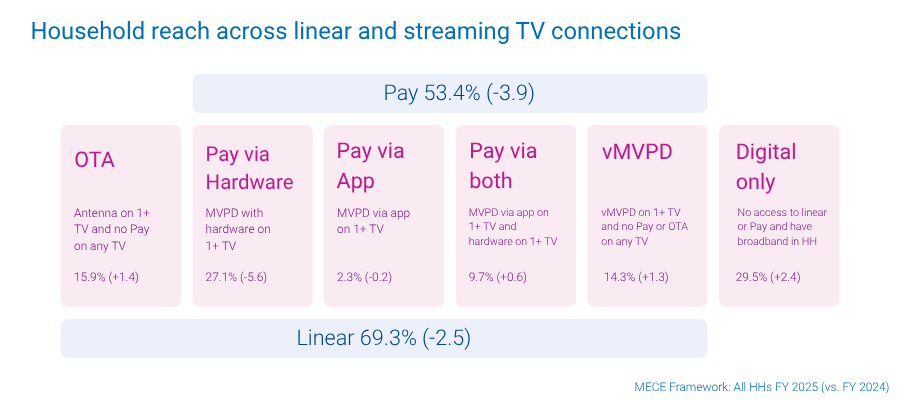
DASH called out the rise in app-based pay TV and proposed a new connection framework that better represents the modern TV world, in which linear and streaming overlap.
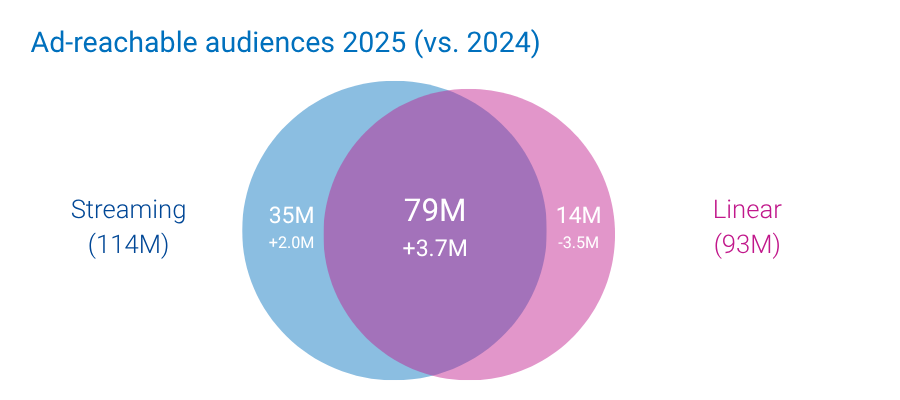
DASH also defines the universes of households reachable with advertising. This graphic, for example, shows how all ad-supported linear and streaming properties in aggregate define the true scale of TV advertising. While 35 million households (and growing) are reachable only with streaming ads and 13 million (and falling) only with linear ads, most households are reachable with both, underscoring the importance of understanding the “overlap.”
Who uses DASH data, and what decisions does it help inform?
There are three primary users of DASH, each with its own use cases:
The recent accreditation of DASH by the Media Rating Council (MRC) and adoption by Nielsen as an input to its TV ratings have generated interest from a broad range of companies. We are actively pursuing new licensees and partners to make DASH more useful within, and even outside, the TV ecosystem.
What does MRC accreditation signify, and why is it meaningful for DASH?
MRC accreditation means DASH passed a rigorous audit conducted by Ernst & Young over many months, which validated our methodology, controls, and data quality. MRC accreditation establishes that DASH is an industry-standard dataset.
While the service provider normally announces its own accreditation, the MRC took the unusual step of issuing its own release on DASH, announcing the accreditation of DASH for TV universe estimation and endorsing the study for broader, cross-media use.
How does Experian use DASH data to build audiences?
The segments combine specific TV usage habits and behaviors from DASH with Experian data on demographics, spending, and other contextual inputs to create a fuller view of consumer viewing behavior. They are designed to be valuable to advertisers in many categories and planning contexts – and to be customizable to fit advertisers’ media targets. The segments can be used to:
- Apply or suppress audiences to improve target coverage across a campaign
- Better align media and creative
- Reach elusive but high-value viewers, such as Ad Avoiders
- Drive valuable consumer behavior
- Achieve specific advertising objectives
What are some practical use cases for DASH-based audiences?
Here are some practical use cases for four different kinds of DASH segments in five different advertiser categories.
Thanks for the interview. Where can readers learn more about DASH?
We started work on DASH seven years ago, and it’s been fun to watch it “grow up.” Our partnership with Experian is a big step toward putting DASH to work for advertisers and agencies. To learn more, visit our site at https://theARF.org/DASH or contact us at DASH@theARF.org.
Contact us
About our experts

Samantha Zhang, Senior Data Scientist at ARF
Samantha Zhang is a Senior Data Scientist at the Advertising Research Foundation working on the DASH TV Universe Study, with additional research spanning areas including attention measurement, digital privacy, and artificial intelligence.

Jim Meyer, General Manager, DASH, at ARF
JimMeyer is general manager and co-founder of the ARF DASH TV Universe Study and managing partner of Golden Square, LLC, which advises media and research technology companies on growth strategy and development.
Latest posts

CPG companies often base marketing decisions on custom market positioning studies, surveys and generic consumer personas. There’s a better way…

Study reveals that brands with more mature identity programs were significantly more likely to be successful in achieving their key objectives Tapad, a part of Experian, a global leader in cross-device digital identity resolution and a part of Experian, has commissioned Forrester Consulting, part of a leading research and advisory firm, to conduct a new study that evaluates the current state of customer data-driven marketing and explores how marketers can use identity solutions to deliver privacy safe and engaging experiences, in an evolving data landscape. The study highlights the changing ground rules for digital marketing and the threat that poses to marketers’ ability to deliver against long standing KPIs and campaign goals. Nearly two-thirds (62%) of respondents said that the forces of data deprecation will have a significant (40%) or critical (21%) impact on their marketing strategies over the next two years. Among those surveyed, identity resolution strategies have surfaced as an opportunity to create more powerful customer experiences, with 66% aiming to have it help improve customer trust and implement more ethical data collection and use practices, while nearly 60% believe it will point the way to more effective personalization and data management practices. Although organizations are eager to implement identity resolution strategies, a complex web of solutions and partners makes execution a challenge. For example, respondents report using at least eight identity solutions on average, across nearly six vendor partners, and they expect that fragmentation to persist in the ‘cookieless’ future. Additionally, brands’ identity resolution technologies typically represent a patchwork of homegrown and commercial solutions. Eighty-one percent of respondents use both in-house and commercial identity resolution tools today, and 47% use a near-equal blend of the two. Despite the challenges, many brands have the foundation for a strong identity resolution strategy in place, and they are thriving as a result. Specifically, more mature brands were 79% more successful at improving privacy safeguards to reduce regulatory and compliance risk, 247% more successful at improving marketing ROI, and over four times more effective at improving customer trust compared to their low-maturity peers. Additional insights include: Marketers Are Increasingly Playing a Key Strategic Role Within the Organization, But There is a Mandate to Demonstrate Value. Nearly three-quarters of respondents in our study agree the marketing function is more strategically important to their organization than it used to be, while almost two-thirds agree there’s more pressure than ever to prove the ROI or business performance of their activities. Consumers Expect Brands to Deliver Engaging Experiences Across Highly Fragmented Journeys: Tapad, a part of Experian found that 72% of respondents agree that customers demand more relevant, personalized experiences at the time and place of their choosing. At the same time, 67% of respondents recognize that customer purchase journeys take place over more touchpoints and channels than ever, and 59% of respondents agree that those journeys are less predictable and linear than they once were. Marketing Runs on Data, But the Rules Governing Customer Data Usage are Ever-Evolving: According to the study, 70% of decision-makers agree that consumer data is the lifeblood of their marketing strategies – fueling the personalized, omnichannel experiences customers demand. At the same time, 69% of respondents recognize that customers are increasingly aware of how their data is being used. At least two-thirds agree that data deprecation, including tighter restrictions on data use (66%), as well as operating system and browser changes impacting third-party cookies (68%) means that legacy marketing strategies are unlikely to remain viable in the long-term.“ Our latest survey findings give us a better understanding of how our customers and other companies around the world are trying to master the relationship between people, their data and their devices,” said Mark Connon, General Manager at Tapad, a part of Experian. “This research shows why it’s fundamental for the industry to continuously work to develop solutions that are agnostic. Tapad, a part of Experian has worked tirelessly to deliver on this with our Tapad Graph, and by introducing solutions like Switchboard to help the evolving ecosystem and in turn helping customers reap the benefits of better identity in both short and long-term.” The study is founded on an online survey of over 300 decision-makers at global brands and agencies, which was fielded from March to April, 2021. Data deprecation and identity are fast-developing, moving targets, so this study delivers targeted insights and recommendations for how to prepare for coming shifts in customer data strategies – whether they manifest tomorrow or a year from now. Get in touch

With the recent announcement of delaying third-party cookie deprecation to 2024, the industry has more time to rethink how to identify and communicate with consumers.