At A Glance
The Advertising Research Foundation’s DASH TV Universe Study provides a projectable view of how Americans connect to and consume TV across households, devices, and services. In this Q&A, Jim Meyer, General Manager, DASH, and Samantha Zhang, Senior Data Scientist, at the ARF explain what DASH measures, who uses it, why MRC accreditation matters, and how Experian combines DASH with its data to build audience segments for advertisers and agencies.In our Ask the Expert series, we interview leaders from our partner organizations who are helping lead their brands to new heights in AdTech. Today’s interview is with Samantha Zhang, Senior Data Scientist, and Jim Meyer, General Manager of the DASH TV Universe Study at the Advertising Research Foundation (ARF). DASH is an annual tracking study conducted by the ARF to define and better understand TV audience behavior and household dynamics.
What does DASH measure, and how does it help the industry understand TV consumption today?
By capturing hundreds of individual- and household-level data points from each respondent in a rigorous and nationally projectable sample, DASH creates a comprehensive picture of U.S. consumer TV “infrastructure” – how America watches.
| Core elements in DASH | Elements that create context in DASH |
| TV sets Location | brand | smartness | service modes | sources | Demographics |
| Connected devices Game consoles |video players | streaming devices | Yesterday viewing Daypart | TV/device genre | Out-of-home viewing |
| Mobile devices Owners | sharing users | Shopping Online and in-store | Exposure to major RMNs |
| Internet service Modes | ISPs | connectivity by device | Streaming audio |
| Streaming TV SVOD/AVOD tiers and sharing | FAST | Email accounts and apps |
| Live TV Modes of access | including casting from devices | Social media |
For example, DASH gathers:
- Data on every TV set, including brand, room location, age, “smartness,” and connection devices and modes
- Household connectivity and video service data, even in homes with no TV set
- Internet Service Providers (ISP) and TV service usage, including Multichannel Video Programming Distributors (MVPDs), virtual vMVPDs, streamers (ad-supported and premium), and Free Ad-Supported Television (FAST) channels
- Person-level ownership and usage of video-capable mobile devices, including smartphones, tablets, and laptops
- Measures of viewing and co-viewing across dayparts, devices, and services
- Additional modules covering shopping and retail media networks, streaming audio, social media, email, and apps
Broad coverage and granularity make DASH a uniquely robust source of truth for practitioners across the industry, including measurement experts and ad programming strategists. DASH also reports regularly (and publicly) on key industry dynamics. DASH identified a growing segment of device-only viewers – now nearly 9 million households that watch TV, but do not own a TV set – and highlighted the implications of that trend for traditional ratings systems based only on households with TV sets.
| Households (HHs – million) | 2025 HHs (M) | U.S. penetration | Change vs. 2024 (M) |
| Total US | 134.8 | 100% | +2.7 |
| Connected TV (CTV) | 114.6 | 85% | +2.1 |
| TV (Set) | 124.2 | 92.2% | +1.1 |
| Device-only | 8.8 | 6.6% | +1.6 |
| TV-Accessible | 133.1 | 98.7% | +2.7 |
DASH called out the rise in app-based pay TV and proposed a new connection framework that better represents the modern TV world, in which linear and streaming overlap.
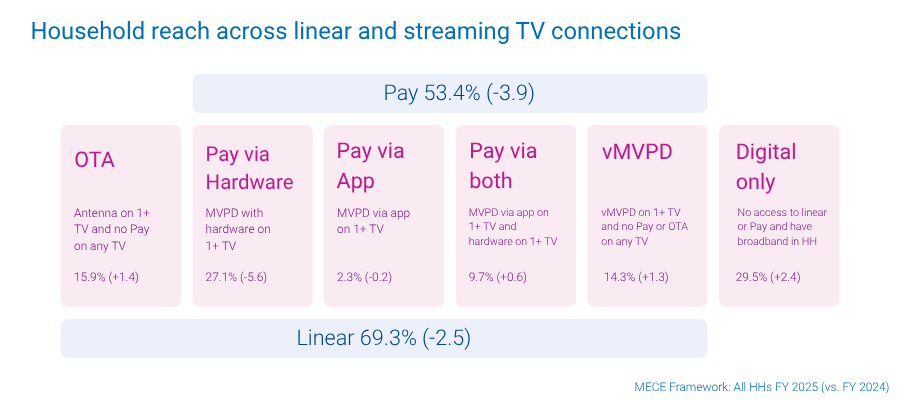
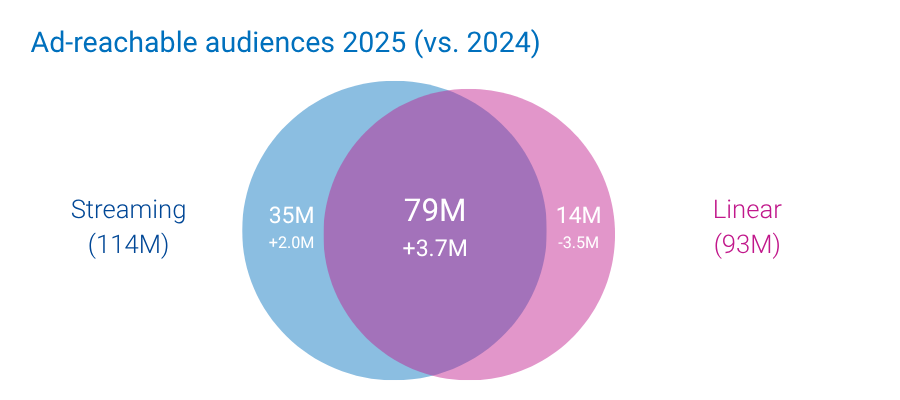
DASH also defines the universes of households reachable with advertising. This graphic, for example, shows how all ad-supported linear and streaming properties in aggregate define the true scale of TV advertising. While 35 million households (and growing) are reachable only with streaming ads and 13 million (and falling) only with linear ads, most households are reachable with both, underscoring the importance of understanding the “overlap.”
Who uses DASH data, and what decisions does it help inform?
There are three primary users of DASH, each with its own use cases:
The recent accreditation of DASH by the Media Rating Council (MRC) and adoption by Nielsen as an input to its TV ratings have generated interest from a broad range of companies. We are actively pursuing new licensees and partners to make DASH more useful within, and even outside, the TV ecosystem.
What does MRC accreditation signify, and why is it meaningful for DASH?
MRC accreditation means DASH passed a rigorous audit conducted by Ernst & Young over many months, which validated our methodology, controls, and data quality. MRC accreditation establishes that DASH is an industry-standard dataset.
While the service provider normally announces its own accreditation, the MRC took the unusual step of issuing its own release on DASH, announcing the accreditation of DASH for TV universe estimation and endorsing the study for broader, cross-media use.
How does Experian use DASH data to build audiences?
The segments combine specific TV usage habits and behaviors from DASH with Experian data on demographics, spending, and other contextual inputs to create a fuller view of consumer viewing behavior. They are designed to be valuable to advertisers in many categories and planning contexts – and to be customizable to fit advertisers’ media targets. The segments can be used to:
- Apply or suppress audiences to improve target coverage across a campaign
- Better align media and creative
- Reach elusive but high-value viewers, such as Ad Avoiders
- Drive valuable consumer behavior
- Achieve specific advertising objectives
What are some practical use cases for DASH-based audiences?
Here are some practical use cases for four different kinds of DASH segments in five different advertiser categories.
Thanks for the interview. Where can readers learn more about DASH?
We started work on DASH seven years ago, and it’s been fun to watch it “grow up.” Our partnership with Experian is a big step toward putting DASH to work for advertisers and agencies. To learn more, visit our site at https://theARF.org/DASH or contact us at DASH@theARF.org.
Contact us
About our experts

Samantha Zhang, Senior Data Scientist at ARF
Samantha Zhang is a Senior Data Scientist at the Advertising Research Foundation working on the DASH TV Universe Study, with additional research spanning areas including attention measurement, digital privacy, and artificial intelligence.

Jim Meyer, General Manager, DASH, at ARF
JimMeyer is general manager and co-founder of the ARF DASH TV Universe Study and managing partner of Golden Square, LLC, which advises media and research technology companies on growth strategy and development.
Latest posts
Commerce media networks each define new-to-brand differently. See why a shared identity layer is what makes cross-network results comparable.
Every brand wants to be part of the culture. Few know how to show up without crashing the party. The brands that get it right stay true to who they are, and the moments they create tend to stick long after the attention moves on. At Cannes Lions 2026, leaders from Alaska Airlines, Fetch, FreeWheel, Goodway Group, Grupo Bimbo, OAAA, PMG, Quan Media Group, Significant, The Weather Company, and Wpromote talked through what real cultural relevance looks like, from finding the right moments to keeping them alive long after the attention fades. Watch the conversation below to hear what it takes for brands to earn their place in culture. Watch the conversation How brands earn their way into cultural moments Build the strategy behind the creative A clear rationale helps bold ideas earn internal support and achieve the intended outcome. Make cultural relevance feel genuine A cultural connection lands when it reflects something people already care about, not when a brand forces it. Move quickly and stay true to the brand Teams create strong brand moments when they act on an opportunity without compromising the brand’s identity. Plan the second act Once attention drops, give people new ways to relive the experience and remain part of it. Read the early audience response Comments, shares, and other reactions can show whether an idea connects before campaign data offers a more complete view. Add value to the experience Brands earn attention when they give people something worthwhile, not when they simply place a logo in the moment. Featured partners Alaska Airlines – Eric Edge, Chief Marketing Officer Fetch – Emily Starer-Wallace, General Manager of Data Partnerships FreeWheel – Larry Allen, Vice President of Global Strategy, Data, Measurement and Addressable Goodway Group – Mike Wolk, Senior Vice President of Partnerships Grupo Bimbo – Catherine Berger, Vice President of Marketing Transformation and Services OAAA – Anna Bager, President and Chief Executive Officer PMG – Chad Stoller, Global Head of Media Quan Media Group – Brian Rappaport, Chief Executive Officer Significant – Jesse Unger, Co-Founder The Weather Company – AnneMette Bontaites, Vice President of Sales Wpromote – Deanna Cullen, Vice President of Media Investment Want more conversations like this one? Connect with us to learn more about how streaming media helps brands reach real people across every screen. This is one of several conversations from Cannes Lions 2026 on how brands can show up in culture with relevance that feels real. Subscribe to our newsletter to receive our next Cannes conversation, fresh takes on cultural relevance, and honest advice from industry leaders on how brands earn a real place in culture. Subscribe to our newsletter For more from Cannes Lions 2026, continue with another conversation in the series What it takes to move patients from awareness to care What commerce media can see beyond a single retailer What streaming media reveals about cross-screen viewing What creators earn that reach can’t buy What agencies are rebuilding around AI and data Contact us Latest posts
Watch leaders from Adobe DSP, FreeWheel, Madhive, Minerva, OpenX, and Pinterest at Cannes Lions 2026 discuss how streaming media connects viewers across screens.