In this blog post…
In the American political landscape, understanding the intricacies of voters’ attitudes and behaviors has never been more crucial. With the 2024 election season on the horizon, the challenge lies in moving beyond broad categorizations like “Democrat,” “Republican,” or “Independent.” Voters seek candidates who resonate with their beliefs and values.
To meet this challenge, Experian has created political personas that offer a nuanced understanding of American voters. In this blog post, we’ll explore how these Experian audiences can help you tailor your engagement strategies for the upcoming election cycle.
Before we dive into our political personas, let’s break down what political campaign marketing is and six benefits of using digital marketing in political campaigns.
What is political campaign marketing?
Political campaign marketing is the strategic engine that drives candidates toward electoral success. It involves crafting and sending out tailored messages to effectively reach constituents to inform them about candidates’ stances on key issues. Think of it as the art of narrative construction, using various communication channels—from traditional media to digital platforms—to engage and mobilize supporters. In an era marked by information saturation, effective campaign marketing serves to cut through the noise to deliver compelling messages that inform, inspire, and spur action.
Benefits of digital marketing in political campaigns
As the 2024 election approaches, using digital marketing in political campaigns becomes paramount to effectively reach and influence voters where they spend a significant portion of their time—online.
Kamala Harris’s entry into the race has shifted spending priorities, particularly in critical states such as Ohio, where the Senate race has already attracted $300 million in ad spending. Political ad spend on connected TV (CTV) is expected to rise significantly, from 2.7% in 2020 to 12.8% this year. The Harris campaign is spearheading this trend, dedicating $200 million to digital ads, with a substantial portion directed toward streaming platforms.
Embracing digital marketing can help campaigns effectively shape opinions and mobilize support. Here are five key benefits of integrating digital marketing strategies into political campaigns:
- Unparalleled reach with targeted advertising: A well-connected digital platform partner can help you reach your target audiences across the ecosystem – from social to the open web.
- Optimization flexibility: Digital marketing allows for quick adjustments in response to real-time data and evolving circumstances.
- Interactive engagement: The interactive nature of digital channels creates meaningful engagement and dialogue between candidates and voters, building connections and community.
- Insights: Robust analytics provide valuable insights into audience behavior and preferences, facilitating continuous optimization and refinement of outreach efforts.
- Amplified messaging: Through digital marketing, political campaigns can amplify their message, mobilize support, and forge deeper connections with voters.
Data serves as the foundation for these benefits. Interactivity hinges on data to deliver the right message and creative for engagement. Insights are gained through pre-campaign research, analyzing audience attributes to grasp their interests and behaviors. Flexibility relies on real-time campaign data, a unique advantage in digital marketing.
In an era where audiences are available readily on most major activation platforms, advertisers need to understand how audiences are built to be privacy conscious and consistent in a cookieless environment.
Experian’s political personas
Digital marketing in political campaigns is crucial to reach and influence voters online. Integrating Experian’s political personas into your political campaign strategy can help you grasp the complexities of today’s American voter landscape and craft tailored engagement strategies. These personas offer invaluable insights into voter viewpoints on key political issues, enriching digital marketing efforts and empowering campaigns to connect with constituents more effectively.
Experian has created 10 political personas to help you better understand today’s American voter so you can reach consumers based on their viewpoints into key political issues.
Our political personas group voters along the political spectrum from most “committed” on the ends of the spectrum.
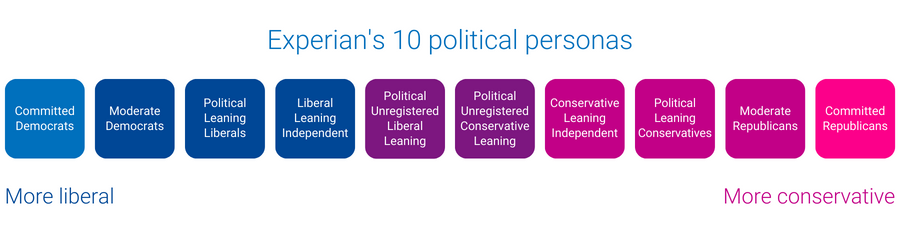
Let’s walk through how we define each persona starting from the most “committed” personas on the ends of the spectrum.
Committed Democrats
This audience contains consumers who are likely to have a “very liberal” outlook on political issues. They have strong liberal opinions on various topics including key issues and the economy and are very involved in their communities.
Committed Republicans
This audience contains consumers who are likely to have a “very conservative” outlook on political issues. They are well-informed, community-minded individuals with strong opinions that reflect their conservatism. They have very conservative attitudes regarding key social issues.
Moderate Democrats
This audience contains consumers who are likely to have a “somewhat liberal” outlook on political issues.
Moderate Republicans
This audience contains consumers who are likely to have a “somewhat conservative” outlook on political issues.
Political Leaning Liberals
This audience contains consumers who are likely to have strong opinions on key issues that may not align with the traditional Democrat point of view.
Political Leaning Conservatives
This audience contains consumers who are likely on-the-fence on traditional Republican points of view on key issues.
Liberal Leaning Independents
This audience contains consumers who are registered independents and who are likely to have a “middle of the road” outlook on political issues while tending to lean more liberal.
Conservative Leaning Independents
This audience contains consumers who are likely registered independents and likely have a “middle-of-the-road” outlook on political issues while tending to lean more conservative.
Political Unregistered Liberal Leaning
This audience contains consumers who are not likely to have aligned with a specific party, but have a more liberal attitude. They are well-informed and are aware of important political issues. They frequently align with but are not necessarily completely aligned with liberal points of view.
Political Unregistered Conservative Leaning
This audience contains consumers who are not likely to have aligned with a specific party, but have a more conservative attitude. They are well-informed and are aware of important political issues. They frequently align with but are not necessarily completely aligned with conservative points of view.
These 10 personas can help you better understand who the American voter is, but when combined with our 200 politically relevant audiences, such as watches political TV, donations to charitable causes, engagement channel preferences, hobbies, and more, the ability to study and improve engagement for each persona is considerably magnified.
How to combine our political personas with other audiences
If you’re a political candidate looking to reach an important population, Experian audiences are available on-the-shelf of major platforms. For example, if you want to reach unregistered voters and independent voters to influence green initiatives within your community, you can focus on unregistered and moderate personas in the area and combine that with audiences interested in green initiatives, like our GreenAware segments – which predict a consumer’s attitude and point of view on environmental issues.
You can use our “Political Unregistered Liberal Leaning”, “Liberal Leaning Independents,” and GreenAware “Think Greens” audience segments to reach constituents who are likely to be most interested in your message.
To reach voters based on their regional voting patterns, you can use our new battleground counties and district audiences:
- Affiliation Switcher Counties
- Battleground Counties
- House Battleground Districts
- Democrat Counties
- Republican Counties
- Independent Counties
Add Experian’s audiences to your 2024 election strategy
Political advertising spend is projected to surpass $12 billlion in the 2024 election cycle, generating the largest amount of voter outreach in the history of American elections. Experian’s audiences are available on major activation platforms allowing you to strategically reach constituents who would be most impacted and interested in your initiatives.
As we approach a cookieless future, Experian’s political personas are cookie resilient. Our data is rooted in both offline and online data that doesn’t rely on third-party cookies. The personas do not rely on an individual’s browsing behavior. Experian can help our partners understand and engage with these political audiences.
Over 200 politically relevant Experian audiences are available for activation on-the-shelf of the leading TV, demand, and supply platforms. Here are the platforms where you can find our political audiences:
- ArcSpan
- Audigent
- Cadent
- Eyeota
- Magnite
- Microsoft
- Nexxen
- Pandora
- Permutive
- Samsung Ads
- The Trade Desk
- Verizon Media
- Viant
- Videoamp
- Yieldmo
Can’t find the audience you’re looking for or need a custom audience? Connect with our audience team for more information.
Contact us
Latest posts

Hashed Email is a privacy-safe digital identifier that can further enrich and expand the functionality and utility of The Tapad Graph with access to Tapad + Experian’s universe of email data. This provides maximum coverage for targeting and measurement when combined with household and individual IDs such as Cookies, MAIDs, CTV IDs, and IP Addresses. Gain back a clearer view Recent data from DMA shows that 51% of people have held the same email address for over 10 years. Email address data by its nature is authenticated and reliable due to its longevity. When leveraging Hashed Email as an extended functionality of The Tapad Graph, we are able to link on average 5 email addresses to each individual, reaching up to 90% of households across the US. Hashed Email expands the customer view by adding new email address identifiers into The Tapad Graph that associate with traditional digital IDs and cookie-less IDs emerging in the marketplace. Reduce fragmentation; and instead of viewing the emails as multiple customers, with Hashed Email they can be viewed as one user profile. When enabled, clients who wouldn’t traditionally have access to first-party customer emails are able to associate and link privacy-safe emails to individuals and their households. Brands and retailers can use Hashed Email to extend these linkages across offline purchases associated with each email; connecting traditional digital identifiers between walled gardens, activation in programmatic media buys, and addressable TV. With the holiday season quickly approaching, access to Hashed Emails will instantly increase scale, connectivity and improve measurement when efficiency, personalization and holistic attribution are pivotal to marketing strategies. Let’s visualize how quickly the customer journey can become fragmented when email addresses that belong to the same person are not associated. Mary has 3 email addresses that she frequently uses. One for social media accounts Email ID 1, one for shopping accounts Email ID 2, and another for work Email ID 3. Mary is a brand loyalist to a top national retailer and whenever there is a new season, there is a high likelihood that she will purchase the latest seasonal decor from that store. She recently did some holiday shopping in-store where she purchased nearly the whole holiday line. Email ID 2 was used to send her a receipt. However, Mary annoyingly receives the store's ads on Facebook for holiday decor that she had already purchased. This is because the retailer has not yet identified that Email ID 1 and Email ID 2 belong to the same consumer. If the retailer were to leverage Hashed Email, they would be able to identify that both email addresses used belong to Mary. This association connects her multiple email addresses together, enables her offline purchases to sync with her online activity, and helps to determine the most accurate ROAS. Hashed Email is a cookie-free added view into consumer behavior for control over messaging and for measurement. When leveraging it’s possible to report back across all channels and devices in a universal format to know when and how conversions are taking place. Don't leave valuable data on the table Hashed Email has use cases beyond reducing wasted media impressions. Hashed Email’s full capabilities extend to campaign measurement and attribution modeling. When utilizing The Tapad Graph combined with Hashed Email, know from the first touchpoint to the last where your customers are engaging. But more importantly, know where households and the individuals inside of those households are converting across all of their digital devices, by using traditional digital IDs, cookie-less IDs, and Hashed Email to associate, measure, and correlate online and offline purchases. Imagine what your campaigns could look like this holiday season if you expanded your graph with up to 5 additional IDs per household. This impact could be a game-changer to scale this holiday season. Hashed Email is a reliable cookie-less digital identifier that expands your customer universe that connects online and offline activity while improving the customer experience and reducing wasted media spend. Enabling Hashed Email for the holiday season is not an opportunity that should be passed on. Where do you sign up, you ask? Get in touch
Identified in The 2021 Digital Advertising Trends Report published by Postclick, marketers are striving to improve and enhance their segmentation and targeting strategies in their digital ad campaigns. Carlos Lopez, SVP of Brand Planning at Digitas Health predicted that in 2021, the challenge will be to overcome the death of third-party cookies and still deliver a personalized advertising experience. It’s fair to say that his prediction will still be impacting marketers past 2021 with the delay of cookie deprecation. These goals along with the constantly changing digital landscape paint a challenging picture for even the most advanced marketers. Marketers can be prepared for the next era of digital marketing by finding the right mix of partners that offer privacy-safe, cookie-free solutions. Smart marketers will employ these solutions and compare these results with data from cookies. The Tapad + Experian Take The Tapad Graph enables brands, agencies, and ad tech platforms to identify and target individuals and households across their digital touchpoints. With this data, they can personalize messages across devices, measure and optimize throughout the customer journey, and then report back on conversions at the individual and household levels. Tapad, now part of Experian, leverages a machine learning algorithm that determines these connections at scale by using probabilistic models with authenticated, privacy-safe, real-time data. There are a myriad of cookieless IDs emerging in the marketplace, and it’s not likely going to be a one size fits all situation. In order to be prepared for the next era of digital marketing, marketers should diversify ID partners and be proactive with testing while the cookie is still around to benchmark against. With Switchboard, a module within The Tapad Graph, we’ve been able to develop connections between traditional digital identifiers (IP Addresses, MAIDs, CTV IDs) and the new wave of cookieless IDs (UID2.0, Panorama ID, ID5 ID) that will be utilized in the future. Here’s an example of what The Tapad Graph and Switchboard looks like at the Household level with various traditional digital identifiers and cookieless IDs. Get in touch
Marketers are under more pressure than ever before to prove ROI and efficiency of marketing activities in relation to business performance. On top of that, there are new privacy regulations and uncertainty around what new technologies will have to be implemented in order to replace the granular level targeting and measurement the industry historically has used third-party cookies for. It’s clear marketers are going to need the right tech stack and partners to continue to prove their team’s efficacy. We recently partnered with Forrester Consulting to evaluate the current state of customer data-driven marketing and surveyed over 300 global marketing decision makers at the brand and agency levels. We found that marketing is facing increased demands today, insights from the study include:Consumers expect brands to deliver engaging experiences across highly fragmented journeys. Seventy-two percent of decision-makers reported that customers demand more relevant, personalized experiences at the time and place of their choosing. Marketing runs on data, but the rules governing customer data usage are changing quickly. More than 70% of study participants stated that consumer data is the lifeblood of their marketing strategies, fueling the personalized, omnichannel experiences customers demand. These demands paint a challenging picture. Just as marketers are poised (and tasked) with delivering greater value to their organizations and customers, the ground rules are changing and threatening their ability to deliver. Indeed, 62% of respondents said that the forces of data deprecation will have either a “Significant” (40%) or “Critical” (21%) impact on their marketing strategies over the next two years. Effective identity resolution can help brands prepare for data deprecation challenges Marketers face a daunting landscape, but they can leverage the data, technology, and processes that comprise identity resolution to address business objectives, combat ecosystem complexity, and future-proof customer engagement efforts. By utilizing identity resolution, marketers will be able to match and connect multiple identifiers across devices and touchpoints. This allows for a cohesive, omnichannel view that enables brands to continue to deliver personalized and contextually relevant messages throughout the customer journey and without the use of cookies. The identity graph is the underlying infrastructure that defines connections between the numerous, fluid, and disparate identifiers created during moments of consumer engagement, turning disparate signals into addressable and actionable steps. These connections enable brands to bolster their ability to gain deeper customer insights and power audience building, attribution, and connected measurement. Identity resolution encompasses a wide range of capabilities that support an equally diverse set of marketing use cases. These include the targeting, personalization, and measurement of both known and pseudonymous audiences in the offline and digital worlds, which enables marketers to improve customer data management, drive more effective personalization, and gain insights and efficiencies through measurement across touchpoints. By taking the time to vet the privacy procedures and data collection processes of identity solutions you can reduce your regulatory risk and maintain customer trust. In an open-ended survey response, a marketer shared, “We’ve found that users are willing to volunteer data when they understand what it’s being used for and are asked for clear consent.” Finding the right partners to help navigate the changes The scramble to find an alternative to third-party cookies has slowed down since Google announced they will be delaying their cookie removal until late 2023. However, this gives marketers a unique opportunity to take advantage of the additional time and feel more prepared and confident in their solutions. With the delay, marketers can now test ID solutions and compare apples to apples with data from the third-party cookie while it’s still active and addressable. Test and find a solution that works now, so there are no surprises once cookies have finally made their way out the door in 2023. At Tapad, a part of Experian, we’ve developed a solution that provides agnostic interoperability for the myriad of cookieless identifiers emerging in the market. As a new module in the Tapad Graph, Switchboard will connect traditional digital identifiers to cookieless IDs to support the entire ad ecosystem with privacy-safe future-proof identity resolution. Get in touch