From decision management to decision intelligence: what 250 lenders in the US, UK and Brazil told Celent, a global research and advisory firm for the financial services industry, about the future of decisioning
For the last thirty years, the technology behind lending decisions has evolved steadily. In its new report, Celent traces that progress through four eras: business rules engines in the 1990s, business rules management systems in the 2000s, decision management systems in the 2010s and now, in the 2020s, decision intelligence platforms.
Each stage has expanded what lenders can do with data and decisioning. Decision intelligence represents the latest evolution, bringing a broader set of capabilities together as lenders look to increase automation, make greater use of multiple types of data and expand the use of AI capabilities in decisioning.
This new independent research from Celent examines how lenders are approaching that latest shift. Celent surveyed 250 lenders across the United States, the United Kingdom and Brazil in May 2026, speaking with executives across lending, credit, fraud, IT and risk.
Opportunity to automate exists across loan types
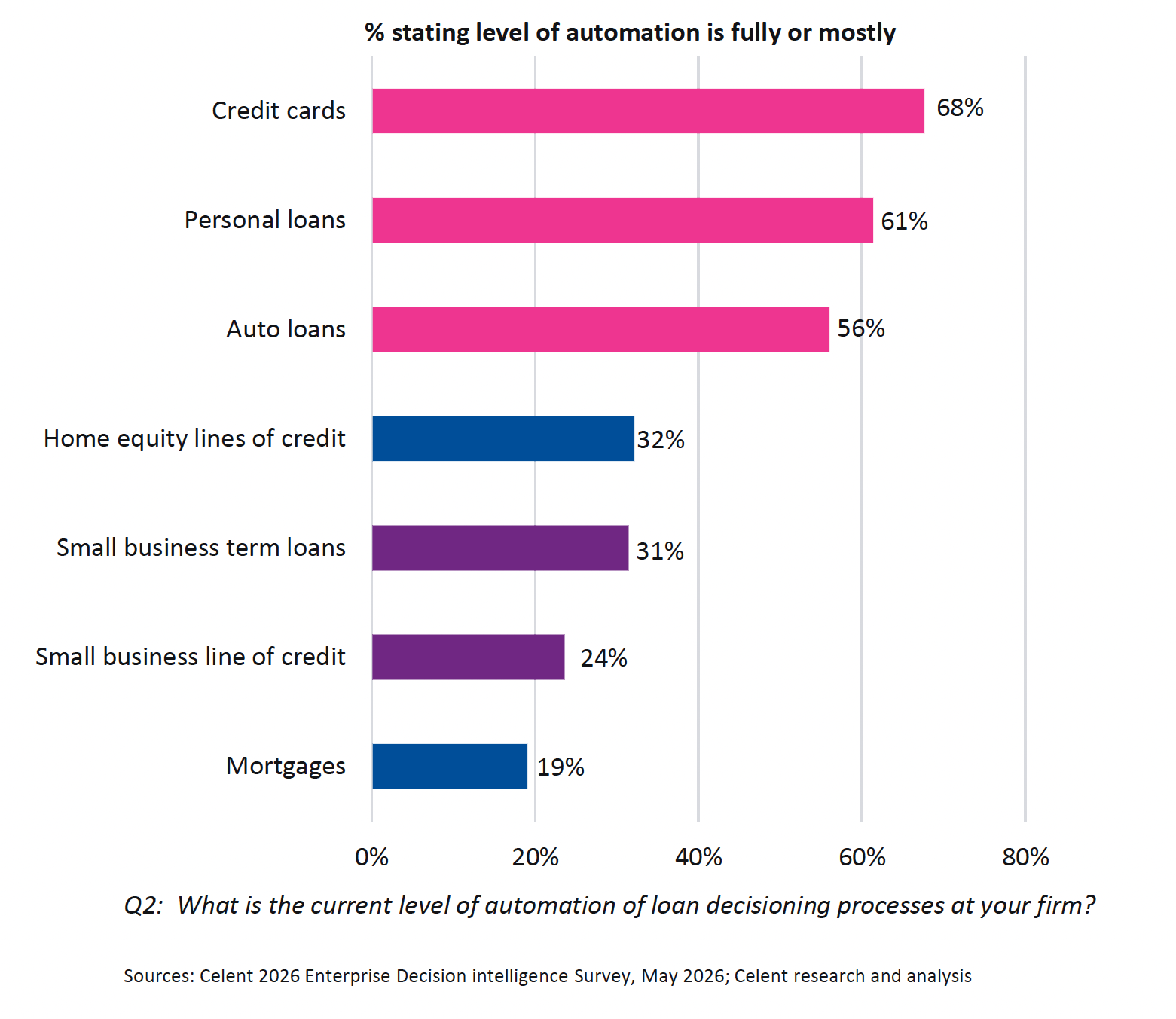
Lending is one of the most data-rich industries in the world, yet large parts of the credit lifecycle still run on manual or semi-manual decisions. Celent found that decisioning automation is more common in lower-value products. Credit cards and personal loans have the highest levels of automation, while automation declines markedly for higher-value, more complex products.
Only 19% of mortgage lenders describe their decisioning as fully or mostly automated. For small business term loans, the figure is 31%. Even for credit cards, the most automated loan type, the figure reaches only 68%, leaving significant opportunities to increase automation across all loan types.
Across almost every loan type, most lenders surveyed also rate their own decisioning capability as in line with the market. Very few consider themselves leaders. Credit cards are the clear exception, but across all other loan types, the field remains largely undifferentiated.
Lenders are set to invest in decision intelligence
The research suggests that lenders intend to change this. Celent found that 82% of lenders are increasing their decision intelligence IT spending, and 25% are planning double-digit increases. The investment priorities also point towards more connected risk decisioning, including greater integration of credit and fraud risk assessment.
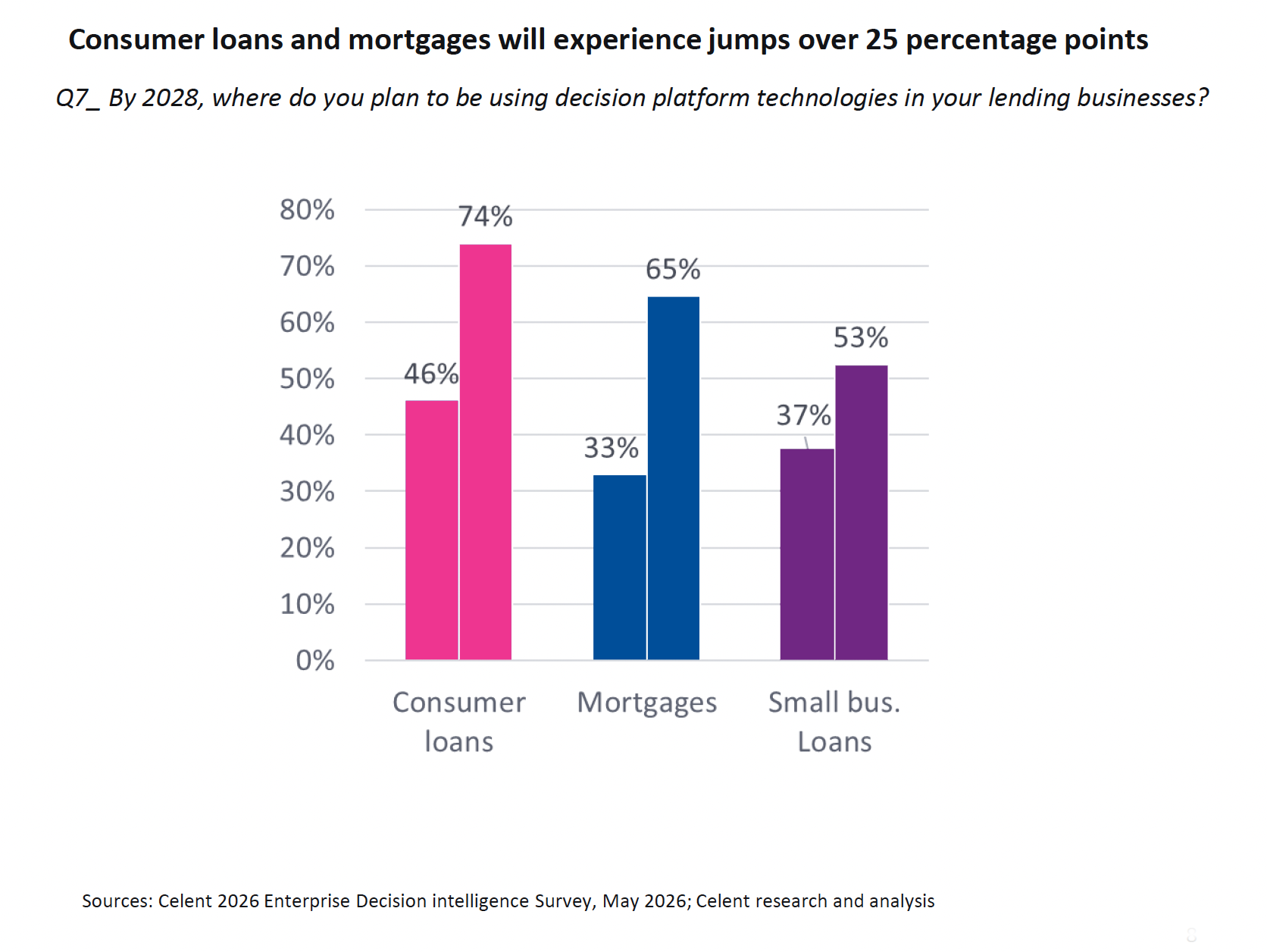
That investment is expected to translate into adoption. By 2028, the survey findings indicate that decision intelligence platform adoption will exceed 50% across originations, decisioning, collections and account management. The steepest increases are in the higher-value products that are under-automated today. From 2026 to 2028, mortgage lending shows the largest projected increase, rising 32 percentage points, followed by consumer lending at 28 percentage points.
Celent describes decision intelligence platform adoption as having entered the pragmatist, or mainstream, phase of the technology adoption cycle. The early experiments are giving way to broader adoption.
Trust in AI starts with data
When Celent asked which AI trust capabilities matter most, data came first. Fifty-one percent of respondents ranked data integrity, lineage, privacy and control among their top three priorities, and 18% ranked it first.
That priority is reflected in where lenders plan to invest. Improving data management is the single highest investment priority in the study, ranked first by 25% of lenders and placed in the top three by 58%.
Trusted AI starts with trusted data. Without it, decisions can’t be explained, and in a regulated market, unexplainable decisions don’t scale. When the underlying data is incomplete or inconsistent, AI does not fix the problem. It amplifies it. Getting the data foundation right is critical.
Why this matters for lenders
Real opportunity to automate remains across loan types, particularly in complex, higher-value products where decisioning is still largely manual. At the same time, investment in decision intelligence is set to increase. The research also provides a clearer picture of what lenders value as decision intelligence evolves: trusted data, integration with existing systems, and the governance needed to support more advanced decisioning and AI.
This direction is consistent with Experian’s Connected Intelligence research with more than 800 senior decision-makers across 12 countries, which found that AI adoption alone does not create value. Greater value comes from connecting data, analytics, decisioning and governance across the organisation. Celent’s findings bring that challenge into sharper focus for lenders , highlighting the importance of integration, access to internal and external data, and trust in AI.
For lenders, this has practical implications for technology strategy. Decisioning environments need to work with existing systems and data while allowing new sources, models and AI capabilities to be introduced over time. As those capabilities develop, governance, explainability and control need to remain part of the same operating environment.
This is the context in which platforms such as Experian Ascend Platform™ are evolving. The Ascend Platform brings data, analytics, fraud, decisioning and AI capabilities into a connected environment that can work with existing technology and data. The Agent Operating System™ extends this to agentic AI, providing a governed environment for AI agents to work across data and decisioning processes with controls and human oversight.
The opportunity for lenders is increasingly practical: where greater automation can improve decisioning, how existing technology and data can support change, and how new AI capabilities can be introduced with the appropriate trust and control.