Experian’s latest global research uncovers why trust in data, governance and operating models is critical to deliver AI at scale
Experian and Phronesis conducted global research in 2026 with over 800 senior decision-makers across 12 countries, and over 80 expert interviews to explore the key challenges and opportunities facing financial institutions in credit and fraud risk.
AI is reshaping how decisions are made across credit and fraud risk. But for FIs, adoption alone will not deliver value
According to our research, 73% of financial institutions (FIs) are prioritising real-time decisioning, with a focus on faster decision-making, regulatory compliance and governance, higher approval rates and reduced fraud risk. And while many FIs are investing in AI to meet these needs, few have been able to scale it consistently across the decisioning lifecycle.
Data quality and integration, governance, and fragmentation across systems are emerging as the key challenges for FIs when scaling AI. The focus now is on whether data, governance, and operating models can support trusted decision authority driven by AI.
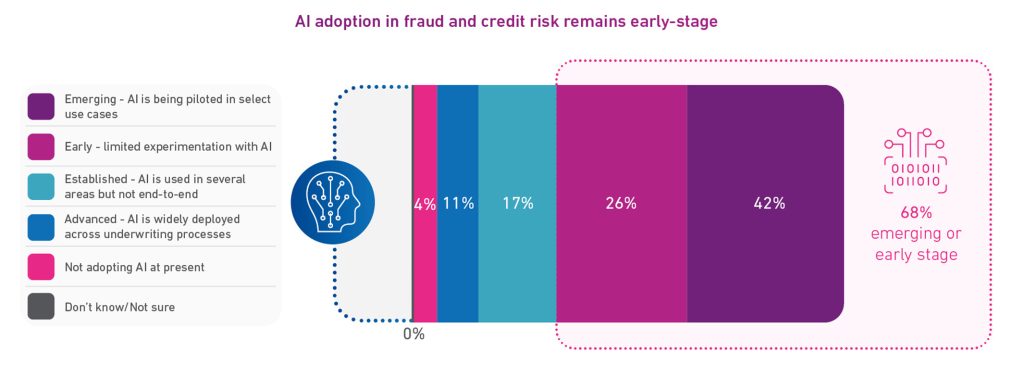
Applying AI within a trusted and controlled decisioning context requires confidence in the data underpinning decisions, clarity of policy, and a deep understanding of the domain in which those decisions are made. Without this, AI remains difficult to scale beyond isolated use cases.
Decision authority defines where and how decisions are made: who (or what) can act, what they can act on, and the limits within which those decisions remain acceptable. More critically, it defines how responsibility is shared between human judgement and automated systems.
AI does not change this, but it makes it more visible: without clear authority, and the ability to trace, explain and validate how decisions are made, even accurate AI outputs are difficult to trust or act on, making them ineligible for compliance-related business uses.
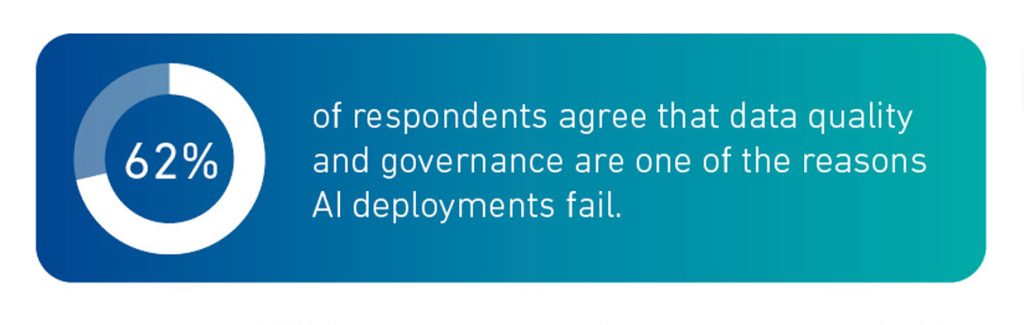
At the same time, the pace of change is accelerating. New capabilities are emerging rapidly, but the fundamentals are not changing. For leaders, the priority is shifting from experimentation to execution; applying an integrated approach to data, governance and AI, within the right context, to deliver consistent and reliable outcomes at scale.
Around 60% of organisations are moving towards architectures where AI systems can interact across tools and data sources, with similar levels of interest in unified data, software and AI solutions.
Experian & Phronesis 2026
Our latest report sets out what that looks like in practice, and the capabilities required to move from fragmented approaches to connected intelligence.