The Experian Small Business Index™ declined month-over-month by almost 12 points.
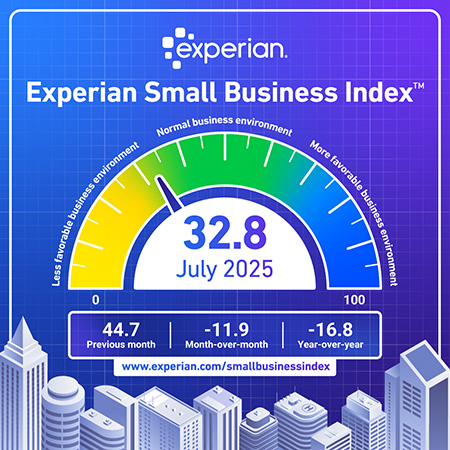
July 2025
- Index Value (Jul):32.8
- Previous Month:44.7
- MoM:-11.9
- YoY:-16.8 (Jul 2024 = 49.6)
The Experian Small Business Index™ declined in July to 32.8, down 11.9 points. Small businesses still look healthy, but business owners are starting to show some stress in their consumer credit profiles. The primary driver was tighter lending conditions, which reduced approval rates and increased delinquencies for consumers. Pressure has built on the small business owner due to rising student loan defaults and a softer labor market, which is beginning to erode consumer credit health.
Inflation has remained even, with slight upticks in some sectors and slight decreases in others. Rent inflation continues a downward trend; it was 3.8% in June, down from 3.9% in May. Producer price inflation was also down 0.4 points to 2.3%, reaching its lowest level since September 2024. Some sectors had inflation rise, with food inflation up slightly from May to 3.0% from 2.9%, overall inflation was up 2.7% in June from 2.4% in May, and core inflation increased from 2.8% in May to 2.9% in June. The savings rate decreased to 4.5% in May, down from 4.9% in April, as consumers continue to spend.
Related Posts
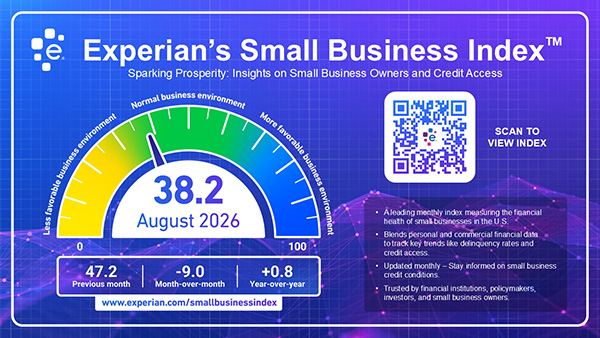
The Experian Small Business Index™ declined 9 points to 38.2 in August, which is nearly level with last year at this time.
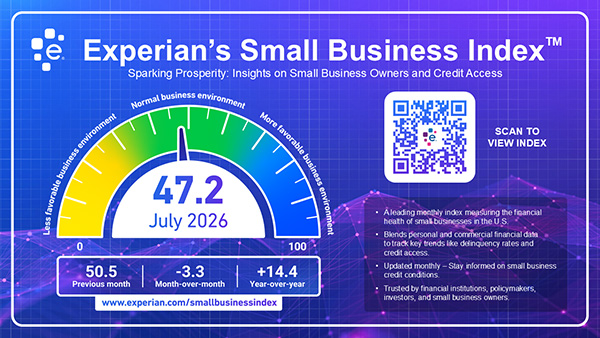
Experian Small Business Index saw rising utilization and 91+ day past-due rates, which contributed to the monthly decline.
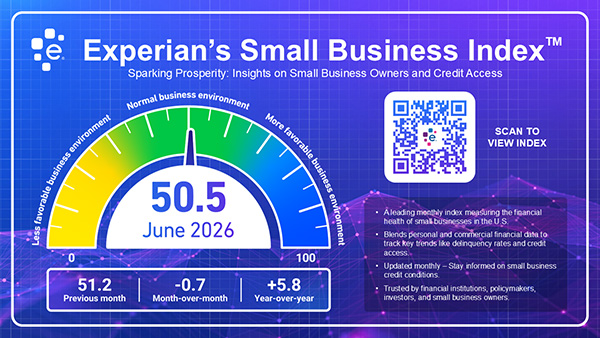
The Experian Small Business Index declined by 0.7 in June, but remains well above last years level on strong small business sentiment.