
What makes an ad impression valuable to an advertiser? The inventory where an ad appears, the audience it reaches, or its potential to contribute to a business outcome?
The answer often involves all three. Yet curation is frequently discussed in terms of site lists, audience segments, and deal IDs. These play an important role, but they don’t tell the full story of the intelligence and decisioning required to evaluate supply and media opportunities.
Advertisers want to reach relevant audiences across quality inventory, make efficient use of their media investments, and achieve measurable business outcomes. Meeting those goals requires connecting the right identity, consumer intelligence, technology, and optimization closer to the source of each impression. Making decisions too late in the transaction can mean missing more effective, direct, or cost-efficient paths to an advertiser’s target audience.
The four pillars of effective curation
Curation works best when four capabilities come together to connect advertiser objectives with relevant media opportunities.
1. Identity makes data useful across environments
Advertisers know their customers, publishers know their audiences, supply-side platforms (SSPs) understand their inventory and traffic, and demand-side platforms (DSPs) bring knowledge of campaign goals. Data partners add behavioral insights. Each may use different identifiers, making it harder to recognize the same person or household consistently across the ecosystem.
Identity provides a shared foundation for connecting these signals. A trusted, widely adopted identity graph can link permitted identifiers to a consistent view of people and households across participating ecosystem partners. This allows advertiser, publisher, and audience data to work together under appropriate privacy controls to inform media decisions.

When that identity foundation is available through real-time integrations, audience signals can be interpreted more effectively as media opportunities arise. Decisioning can apply a consistent understanding of the audience across participating supply environments, keeping audience context connected as opportunities move through the ecosystem.
2. Consumer intelligence adds context to each opportunity
Effective consumer intelligence starts with trusted data and understanding who consumers are, what they do, and what they care about, collected and used with appropriate consent, privacy protections, and permissions.
To achieve that, it’s critical to identify which data providers, audience segments, and types of data are best suited to a specific campaign and deal. Different sources offer different insights, and selecting the right combination helps advertisers identify relevant audiences and make more informed media decisions.

The right signals depend on the campaign. Retail campaigns may draw on purchase history and other behaviors that help predict future spending. Automotive campaigns may rely more on in-market signals, given longer buying cycles, to inform audience, messaging, and channel strategies. First party audiences play a crucial role in many use cases, and the ability to apply these audiences through an independent decisioning system maximizes match rates while minimizing data sharing across platforms.
Rather than relying on a predefined mix of audience segments, an advanced decisioning system can use campaign goals, brand context, and other available signals to shape the audience for each opportunity.
It can help identify which data providers, segments, and data types are most relevant, and then adjust the audience mix as performance and outcomes provide new information. This supports more tailored media decisions throughout a campaign.
3. Technology integrations connect intelligence to supply
Real-time connections with SSPs let decisioning systems consider signals such as context, device information, and format alongside advertiser audience and campaign criteria as opportunities arise. But each SSP integration can expose different signals and data structures, making it difficult to apply a strategy consistently across supply. A neutral intelligence layer connected through the right technology framework can normalize those inputs across participating SSPs and return qualifying deal and audience signals through the SSP, helping DSPs prioritize relevant opportunities in their existing workflows.
4. Optimization turns insights into better decisions
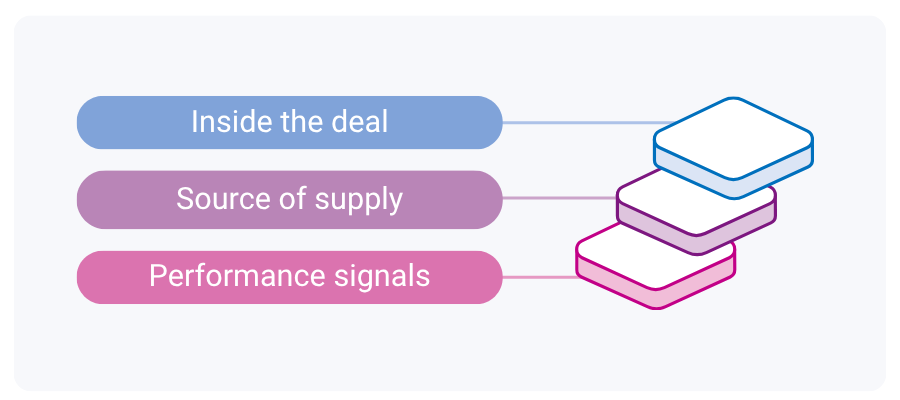
Optimization becomes more informed as demand-side performance data, signals from real-time supply integrations, and online and offline conversion data come together. Connected through a consistent audience view, these signals can help categorize inventory and identify supply paths associated with stronger performance.

Real-time decisioning and optimization help apply those insights quickly during a campaign, while accumulated learnings can inform future campaign setup and delivery. Decisioning systems can evaluate impressions quickly. The quality, relevance, and connectivity of the information behind them determine how useful those decisions are.
Bringing intelligence closer to the impression
Advances in real-time technology are creating new opportunities to apply this intelligence earlier in the media transaction.
Traditionally, much of the intelligence informing programmatic buying has been applied through DSPs. Curation was developed and widely adopted in part because it improved decisioning and performance by layering supply side signals into the ad buying workflow. Containerization is how SSPs are extending that shift, allowing decisioning capabilities to operate within or alongside their infrastructure, closer to the source of supply.
While containers are powerful tools, containerization alone doesn’t create interoperability across supply. Each container operates within its SSP environment, therefore utilizing native features and signals available there.
Real-time integrations are needed to pass signals from participating SSP environments into a neutral decisioning layer. That layer can connect varying signals and identifiers across supply sources, helping apply decisioning more consistently across different sources and types of supply. Imagine an automotive campaign focused on test-drive bookings. Identity and audience signals help recognize likely buyers. SSP signals such as context and format describe the available placements. Campaign and conversion feedback can show which audience, context and placement combinations are performing better. Real-time integrations help apply those learnings across participating SSPs during the campaign, so the DSP can prioritize stronger opportunities while retaining control of bidding.
Advertisers, publishers, data providers, DSPs, and SSPs each contribute different signals that can inform media selection. Connecting those signals through trusted identity and interoperable technology can make decisioning more relevant to individual campaign objectives.

AI can take this a step further by analyzing connected signals and executing media decisions faster and more dynamically. As more relevant data becomes available in real time, AI-driven models could tailor how opportunities are evaluated based on an advertiser’s campaign objectives, audience priorities, and the specific requirements of a DSP. With access to appropriate performance feedback, these systems could refine their decisions over time, making curation increasingly responsive to individual campaigns.
What’s next for curation?
Curation will continue evolving into a real-time decisioning engine for the advertising ecosystem, connecting identity, consumer intelligence, technology, and optimization closer to where media opportunities become available. Neutrality and interoperability will be central to making that intelligence work across platforms and creating value for everyone involved.
Site lists and deal IDs remain useful components of programmatic activation. Relying on site lists and contextual signals alone, though, means overlooking much of what curation can offer. The broader value comes from connecting identity, consumer intelligence, technology, and optimization through real-time supply integrations to inform media decisions. As these capabilities become more connected, curation can play a greater role in how the industry evaluates and acts on media opportunities, helping advertisers and their partners make faster, more customized decisions across the open web.
That’s where the value of modern curation comes into focus, and where its future in media lies.
About the author

Budi Tanzi
SVP, Product, Experian
Budi Tanzi is the Senior Vice President of Product at Experian Marketing Services, overseeing all identity products. Prior to joining Experian, Budi worked at various stakeholders of the ad-tech ecosystem, such as Tapad, Sizmek, and StrikeAd. During his career, he held leadership roles in both Product Management and Solution Engineering. Budi has been living in New York for almost 11 years and enjoys being outdoors as well as sailing around NYC whenever possible.
Latest posts

With the recent announcement of delaying third-party cookie deprecation to 2024, the industry has more time to rethink how to identify and communicate with consumers.
As today’s digital landscape gets more and more complicated there are more ways for brands to connect with users and drive purchases and more ways for ad tech to target and measure those touch points. As in-person shopping picks up steam due to the re-normalization of society post-COVID 19; the connection between digital ads and in-person purchases needs to be made once again. With the rise of Connected TV throughout the pandemic there are even more digital opportunities to target a user. But how do you make sure that those brand engagements are captured and correctly attributed to offline purchases and conversions? The answer lies in a holistic identity resolution strategy. Cross-device identity resolution with The Tapad Graph connects the identifiers and devices of individuals within a household to each other; enabling targeting, frequency capping, extension, segmentation and measurement or attribution between devices; including Connected TV and hashed (privacy-protected) email addresses along with Cookies, Mobile Ad Ids and IP Address. Brands can join their first-party data to The Tapad Graph to execute strategies that connect online and offline data for pre, mid and post-campaign efficiencies. Let’s imagine a scenario in which an outdoor retail brand is targeting users watching specific content on a Connected TV device. Powered by identity resolution, they start with a general ad on CTV and continue targeting down individual paths with each user. When one of them converts in store and makes a purchase; the outdoor retailer can connect that action through location and in-store traffic data with the cross-device identity resolution used to execute the digital campaign. Now the actions of the user online and offline are resolved for more accurate measurement and attribution after the campaign ends. But it doesn’t stop there– the brand’s CRM data can be reactivated for the next digital campaign and leveraged to capitalize on the most effective media mix for the user who made the purchase previously. These combined insights can be invaluable in shaping up future campaign strategies with geo-contextual ads, recommended additional products and personalization to help drive more conversions and purchases in-store or online. As in-person shopping picks back up and marketers are tasked once again with balancing online and in-store KPIs, the right identity resolution strategy can unlock necessary efficiencies for retailers, ad tech vendors and agencies tasked with supporting these initiatives. Get in touch

Experian Marketing Services and Data Quality President Genevieve Juillard recently sat down with Zach Rodgers, host of the AdExchanger Talks podcast to discuss the future of identity, the importance of data transparency and privacy, and our recent acquisition of Tapad. Genevieve focused on the opportunity for our industry to reimagine an advertising ecosystem that is resilient and adaptable; one that takes advantage of emerging data and prioritizes data transparency and consumer privacy. She also discussed the importance of advertising strategies that put consumers at the heart of every decision and give them more control over their data. Genevieve shared with AdExchanger that Experian’s acquisition of Tapad, a global leader in digital identity resolution, was a natural fit for our company. Tapad’s approach and role in the ecosystem is very much aligned with Experian’s, which is to develop solutions that are resilient to industry and consumer changes. The combination of our capabilities supports interoperability across all types of identifiers, both online and offline, and will position us to help our clients navigate the post-third-party cookie world. To learn more about Experian’s plans to support an effective advertising ecosystem that will evolve with our dynamic industry, listen to the full podcast Embracing ‘Healthy Fragmentation’ In Ad Tech, With Genevieve Juillard. Get in touch