2024 marked a significant year. AI became integral to our workflows, commerce and retail media networks soared, and Google did not deprecate cookies. Amidst these changes, ID bridging emerged as a hot topic, raising questions around identity reliability and transparency, which necessitated industry-wide standards. We believe the latest IAB OpenRTB specifications, produced in conjunction with supply and demand-side partners, set up the advertising industry for more transparent and effective practices.
So, what exactly is ID bridging?
As signals, like third-party cookies, fade, ID bridging emerged as a way for the supply-side to offer addressability to the demand-side. ID bridging is the supply-side practice of connecting the dots between available signals, that were generated in a way that is not the expected default behavior, to understand a user’s identity and communicate it to prospective buyers. It enables the supply-side to extend user identification beyond the scope of one browser or device.
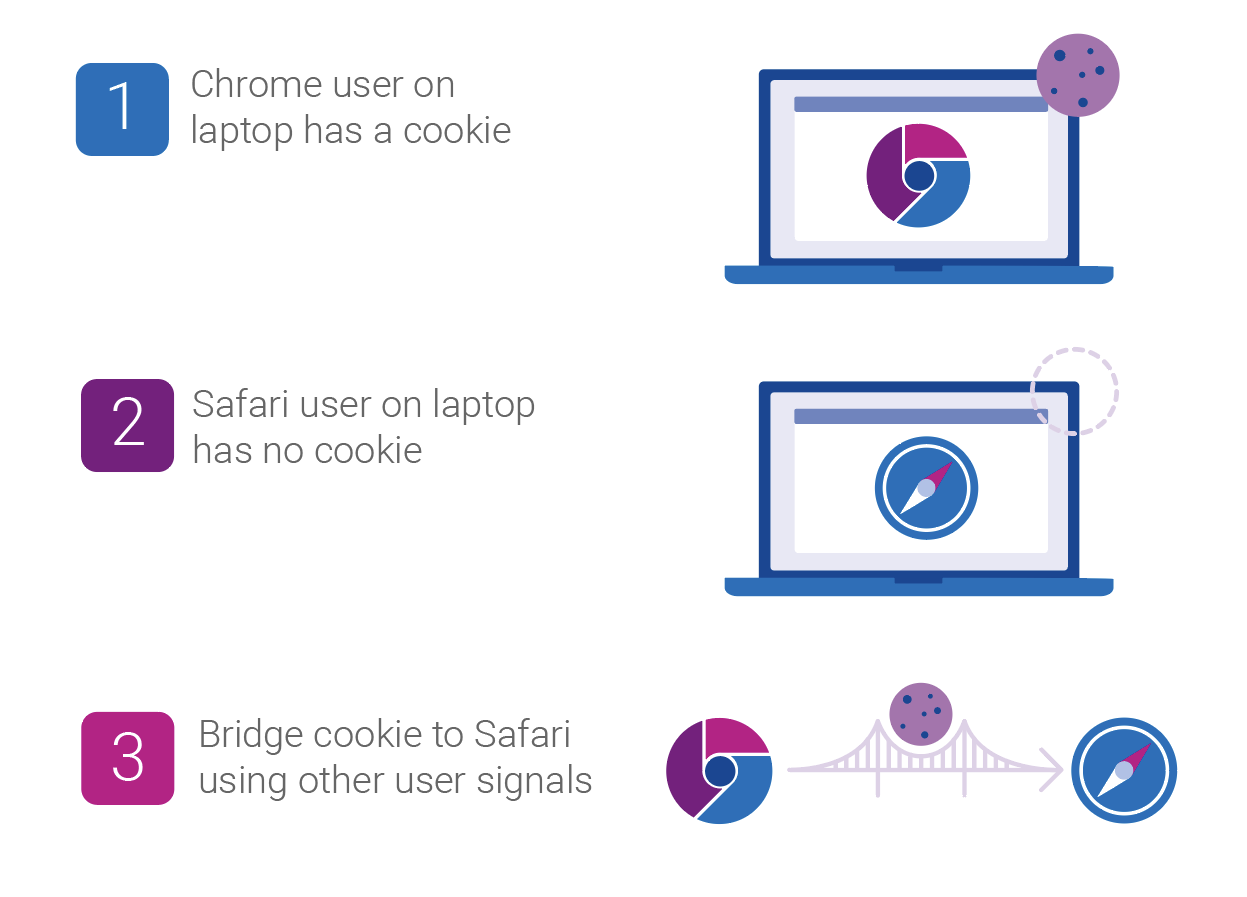
Imagine you visit a popular sports website on your laptop using Chrome. Later, you use the same device to visit the same sports website, but this time, on Safari. By using identity resolution tools, a supply-side partner can infer that both visits are likely from the same user and communicate with them as such.
ID bridging is not inherently a bad thing. However, the practice has sparked debate, as buyers want full transparency into the use of a deterministic identifier versus an inferred one. This complicates measurement and frequency capping for the demand-side. Before OpenRTB 2.6, ID bridging led to misattribution as the demand-side could not attribute ad exposures, which had been served to a bridged ID, to a conversion, which had an ID different from the ad exposure.
OpenRTB 2.6 sets us up for a more transparent future
In 2010, the IAB, along with supply and demand-side partners, formed a consortium known as the Real-Time Bidding Project for companies interested in an open protocol for the automated trading of digital media. The OpenRTB specifications they produced became that protocol, adapting with the evolution of the industry.
The latest evolution, OpenRTB 2.6, sets out standards that strive to ensure transparency in real-time bidding, mandating how the supply-side should use certain fields to more transparently provide data when inferring users’ identities.
What’s new in OpenRTB 2.6?
Here are the technical specifications for the industry to be more transparent when inferring users’ identities:
- Primary ID field: This existing field now can only contain the “buyeruid,” an identifier mutually recognized and agreed upon by both buyer and seller for a given environment. For web environments, the default is a cookie ID, while for app activity, it is a mobile advertising ID (MAID), passed directly from an application downloaded on a device. This approach ensures demand-side partners understand the ID’s source.
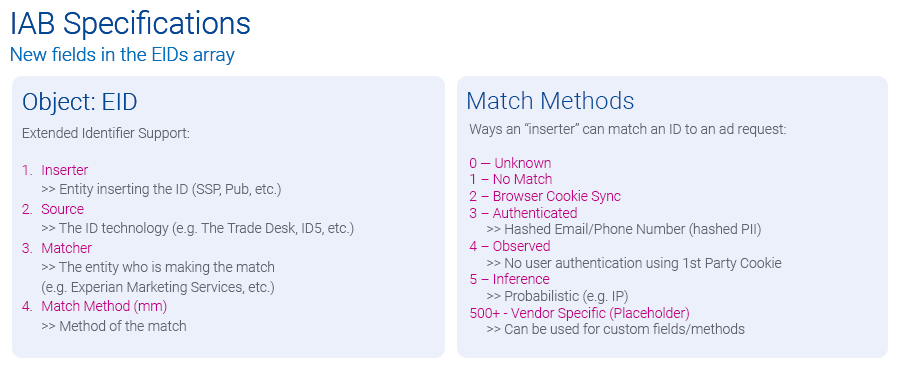
- Enhanced identifier (EID) field: The EID field, designated for alternative IDs, now accommodates all other IDs. The EID field now has additional parameters that provide buyers transparency into how the ID was created and sourced, which you can see in the visual below:
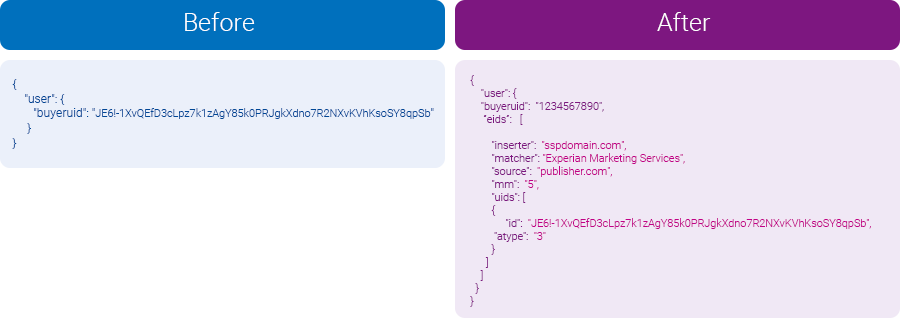
Using the above framework, a publisher who wants to send a cross-environment identifier that likely belongs to the same user would declare the ID as “mm=5,” while listing the potential third-party identity resolution partner under the “matcher” field, which the visual below depicts. This additional metadata gives the demand-side the insights they need to evaluate the reliability of each ID.
“These updates to OpenRTB add essential clarity about where user and device IDs come from, helping buyers see exactly how an ID was created and who put it into the bidstream. It’s a big step toward greater transparency and trust in the ecosystem. We’re excited to see companies already adopting these updates and can’t wait to see the industry fully embrace them by 2025.”
Hillary Slattery, Sr. Director, Programmatic, Product Management, IAB Tech Lab
Experian will continue supporting transparency
As authenticated signals decrease due to cookie deprecation and other consumer privacy measures, we will continue to see a rise in inferred identifiers. Experian’s industry-leading Digital Graph has long supported both authenticated and inferred identifiers, providing the ecosystem with connections that are accurate, scalable, and addressable. Experian will continue to support the industry with its identity resolution products and is supportive of the IAB’s efforts to bring transparency to the industry around the usage of identity signals.
Supply and demand-side benefits of adopting the new parameters in OpenRTB 2.6
- Partner collaboration: Clarity between what can be in the Primary ID field versus the EID field provides clear standards and transparency between buyers and sellers.
- Identity resolution: The supply side has an industry-approved way to bring in inferred IDs while the demand side can evaluate these IDs, expanding addressability.
- Reducing risk: With accurate metadata available in the EID field, demand-side partners can evaluate who is doing the match and make informed decisions on whether they want to act on that ID.
Next steps for the supply and demand-sides to consider
For supply-side and demand-side partners looking to utilize OpenRTB 2.6 to its full potential, here are some recommended steps:
For the supply-side:
- Follow IAB Specs and provide feedback: Ensure you understand and are following transparent practices. Ask questions on how to correctly implement the specifications.
- Vet identity partners: Choose partners who deliver the most trusted and accurate identifiers in the market.
- Be proactive: Have conversations with your partners to discuss how you plan to follow the latest specs, which identity partners you work with, and explain how you plan to provide additional signals to help buyers make better decisions.
We are beginning to see SSPs adopt this new protocol, including Sonobi and Yieldmo.
“The OpenRTB 2.6 specifications are a critical step forward in ensuring transparency and trust in programmatic advertising. By aligning with these standards, we empower our partners with the tools needed to navigate a cookieless future and drive measurable results.”
Michael Connolly, CEO, Sonobi
These additions to the OpenRTB protocol further imbue bidding transactions with transparency which will foster greater trust between partners. Moreover, the data now available is not only actionable, but auditable should a problem arise. Buyers can choose, or not, to trust an identifier based on the inserter, the provider and the method used to derive the ID. While debates within the IAB Tech Lab were spirited at times, they ultimately drove a collaborative process that shaped a solution designed to work effectively across the ecosystem.”
Mark McEachran, SVP of Product Management, Yieldmo
For the demand side:
- Evaluation: Use the EID metadata to assess all the IDs in the EID field, looking closely at the identity vendors’ reliability. Select partners who meet high standards of data clarity and accuracy.
- Collaboration: Establish open communication with supply-side partners and tech partners to ensure they follow the best practices in line with OpenRTB 2.6 guidelines and that there’s a shared understanding of the mutually agreed upon identifiers.
- Provide feedback: As OpenRTB 2.6 adoption grows, consistent feedback from demand-side partners will help the IAB refine these standards.
Moving forward with reliable data and data transparency
As the AdTech industry moves toward a cookieless reality, OpenRTB 2.6 signifies a substantial step toward a sustainable, transparent programmatic ecosystem. With proactive adoption by supply- and demand-side partners, the future of programmatic advertising will be driven by trust and transparency.
Experian, our partners, and our clients know the benefits of our Digital Graph and its support of both authenticated and inferred signals. We believe that if the supply-side abides by the OpenRTB 2.6 specifications and the demand-side uses and analyzes this data, the programmatic exchange will operate more fairly and deliver more reach.
Contact us
Latest posts
When we launched our data marketplace earlier this year, we set out to transform how the industry discovers and activates privacy-safe audiences and maintains addressability across display, mobile, and connected TV (CTV). Yieldmo was one of the first adopters and their story speaks volumes about what’s possible when flexible tech meets premium data. Large retail brand boosts in-store traffic with Yieldmo and Experian Yieldmo, an advertising platform known for its inventive, AI-powered creative formats and privacy-first inventory, partnered with Experian to support a leading athletic retailer’s campaign focused on driving in-store traffic. The goal? Attract in-store shoppers likely to purchase from competitors, particularly during key sales windows. Using Experian’s Audience Engine platform, which includes our proprietary and third-party data marketplace, Yieldmo built a high-performing, self-serve targeting strategy that included both conquesting and in-store shopper segments. With the ability to easily combine Experian Audiences and Partner Audiences, like those from Alliant, Circana, Webbula, and Sports Innovation Lab, Yieldmo quickly built precise apparel and footwear audiences. Using Experian’s identity graphs in Audience Engine, Yieldmo increased cross-channel addressability to maximize campaign scale and impact. “Experian’s data marketplace in Audience Engine fills a critical gap, letting us quickly search by brand, build smarter conquest segments, and activate custom audiences fast. The platform is flexible and the support is hands-on and reliable.”Abby Littlejohn, Director of Sales Planning at Yieldmo With self-serve setup that cut down manual work, the ability to build highly tailored audiences, and expected lift in store visits, Experian helped the team achieve standout results. "We selected Experian as our primary third-party data partner based on contract ease, audience quality, and speed. Through Experian, we can find high-performing audiences from multiple providers that meet our client’s targeting objectives. We include Experian audience segments in 80% of formal RFP proposals and are in active discussions on how to optimize for future campaigns—making Experian a go-to partner for third-party targeting.”Nelson Montouchet, AVP, Strategic Partnerships, Yieldmo More data, more reach: Experian’s data marketplace fuels smarter targeting across ad platforms Today, just months after launch, Experian’s data marketplace is gaining traction across the ecosystem. Over 10 platforms, including leading supply-side platforms (SSPs) and TV platforms such as Madhive, OpenAP, and Optimum, are now actively utilizing our data marketplace to enhance their activation capabilities. As privacy rules tighten and many identity signals start to fade, a lot of activation platforms are finding it tougher to reach their audiences. This is where our data marketplace shines, with one of the most comprehensive identity graphs out there, 126 million households, 250 million individuals, and over four billion active digital IDs, we make it easy to activate audiences while keeping addressability high across channels. We preserve accuracy when scaling to digital IDs via our identity graphs since Experian is rooted in offline data, which provides better connections and smarter targeting. “Our long-standing partnership with Experian and breadth of Experian's data marketplace, combined with the interoperable, direct matching methodology of our Open Identity solution, make it possible for OpenAP to enable advertisers and agencies to use best-in-class data partners to build audiences with the highest fidelity and consistently reach audiences at scale wherever they are consuming content across premium video.”Chris LoRusso, Chief Business Officer at OpenAP Experian’s data marketplace has grown to include over 20 premium data providers, such as: “We’re thrilled to bring PlaceIQ’s privacy-first, visit-based audiences to Experian’s marketplace, giving brands quick and easy access to high-intent shoppers. From recent big-box customers to yoga-studio regulars, advertisers can add real-world relevance to campaigns across every channel.”Brian Bradtke, Head of Partner Development, Precisely PlaceIQ These partnerships bring unique value to platforms looking to understand and engage audiences more effectively, whether through physical location intelligence, sports and fandom insights, or behavioral intent signals. What’s next We're focused on expanding our data ecosystem and helping platforms and marketers turn fragmented data strategies into a unified competitive advantage. If Yieldmo’s story is any indication, this is just the beginning. Let’s connect and explore how Experian’s data marketplace can help you drive more revenue, scale your audience reach, and stay ahead of privacy shifts. Connect with us Latest posts

Gaming companies sit at a unique crossroads: they’re part entertainment powerhouse, part tech platform, part media company. Whether you’re publishing blockbuster titles, running a mobile game network, or building immersive in-game ad experiences, you have access to vast amounts of player data—and massive potential for growth. What's standing in the way of growth and loyalty Video game publishers and platforms are increasingly turning to data to understand, engage, and retain their players. But that’s easier said than done. Here are the top challenges they face: Data lives in silos. Gaming companies often collect data across multiple platforms—console, PC, mobile—but can’t stitch together a full view of the player across devices and titles. Identity is hard to resolve. Players interact across games, apps, websites, and platforms. It’s tough to connect all those signals and create a consistent, personalized experience. Privacy is non-negotiable. Regulations are tightening. Any solution must not only be powerful—it must be privacy-safe. Ad performance is difficult to measure. It’s often unclear which campaigns are driving engagement, conversions, or purchases—especially across fragmented digital touchpoints. How Experian can help you win with data and identity Experian helps gaming companies stop leaving value on the table. We turn scattered player data into a single, unified view—giving you the foundation to better understand and engage your players. Our approach: Organize, enrich, activate 1. We clean and unify your data We help you build a solid identity foundation by resolving messy, duplicate, or outdated records across systems. That means your player data from mobile, console, PC, and web all connects—giving you a clear view of how your users engage across games and platforms. 💡 How it’s working: A global interactive gaming company is partnering with Experian to unify and enrich player profiles across systems—boosting the performance of both player engagement campaigns and in-game monetization strategies. 2. We deliver deep customer insights With Experian, you go beyond surface-level data. We help you understand player behaviors, financial attributes, interests, and lifestyle factors—fueling more personalized experiences, smarter segmentation, and better monetization strategies. 💡 How it’s working: A major game developer used Experian’s data enrichment tools to gain deeper insights into player behavior and financial attributes—enabling more personalized in-game offers, smarter audience segmentation, and stronger player retention. 3. We enrich profiles and help you activate across channels We enhance your player records with hundreds of attributes—so you can create custom segments that work. Then, we help you activate those audiences in real-time across digital, social, and programmatic platforms. 💡 How it’s working: A global gaming publisher used Experian to build custom audiences and activate across programmatic channels, driving higher in-game engagement and ad ROI. Turning audiences into ad revenue In addition to improving their own player marketing, gaming companies are unlocking a second growth engine: ad revenue from non-endemic brands. Much like retail media networks, game publishers and platforms are realizing the value of their audience data. From airlines and automakers to QSR and CPG brands, advertisers are taking notice of the high-value, high-intent audiences inside game environments. But to attract that ad spend, publishers need to offer more than impressions—they need precise audience targeting, cross-device identity, and reliable measurement. How Experian helps drive better ad performance To appear authentically to a gamer, you need to know who they are and what they care about. Experian helps marketers understand a person’s behaviors and preferences to enable relevant, personalized advertising. And since nobody wants to see the same ad ten times during a session, we help manage ad frequency across devices and placements to protect the player experience. Our approach: Extend reach, measure results 1. We expand your digital reach Experian makes it easier to find and connect with your players wherever they are—across devices, platforms, and publishers. We help you build scalable audiences you can reach programmatically and with precision. 💡 How it’s working: Unity, a leading gaming platform, is redefining the way marketers reach their audiences across major and emerging channels. They’ve tapped into Experian’s syndicated audiences to gain player insights and help advertisers connect with gaming audiences across mobile, web, and connected TV (CTV) based on behaviors and preferences. 2. We help you measure what matters Whether your goal is app installs, in-game purchases, ad engagement, or player retention, we help connect the dots. You’ll know which campaigns are driving action—and where to double down. 💡 How it’s working: A leading global game publisher is working with Experian to enrich player profiles, build and activate audience segments, and measure how campaigns drive in-game engagement and purchases—giving them a clearer view of ROI across digital channels. Why choose Experian Whether you’re trying to build stronger player relationships or turn your audience into a high-performing advertising engine, Experian gives you the data and identity foundation to make it happen. We help you: Organize and clean your player data Resolve identities across digital touchpoints Enrich your data with deep, actionable insights Build and activate target audiences Measure impact across the player journey Let's power up together We’re already supporting leading brands across the gaming ecosystem—from global game publishers and mobile app developers to in-game ad networks and gaming platforms. And we’re ready to help more companies harness the full power of their data. Get in the game with us 🎮 Latest posts

As a programmatic media partner for marketers and agencies, MiQ’s mission is to ensure their clients’ media investments are spent on the right audiences in the right environments. MiQ needed a stronger way to unify audience insights, increase scale, and improve efficiency amidst signal loss. To meet this challenge, MiQ integrated Experian’s Digital Graph into their Identity Spine, creating a more comprehensive view of their clients’ target audiences and ensuring their data-driven solutions remain effective, regardless of the signal source or identifier in use. What is Experian's Digital Graph? Experian’s Digital Graph is like a puzzle, connecting billions of digital identifiers to create a complete view of consumers. As signal loss makes targeting harder, our Digital Graph helps marketers stay connected by linking cookies, mobile ad IDs (MAIDs), hashed emails (HEMs), IP addresses, connected TV (CTV) IDs, and universal IDs, like Unified ID 2.0 (UID2) and ID5. We put the pieces together, matching first-party data to a variety of digital IDs for better targeting, measurement, and cross-device insights—so you don’t have to. Challenge: Strengthen targeting capabilities amidst signal loss MiQ needed to stay agile in its strategy and partnerships to ensure digital connectivity amidst ongoing signal loss. To maintain campaign performance and scale, MiQ sought privacy-first partners they could integrate into their Identity Spine. MiQ’s primary objectives included: Strengthen audience targeting across all digital environments, with or without cookies. Reach target audiences in privacy-compliant ways. Maintain or increase the scale — even as reliance on cookie-based targeting declines. The solution: Integrating Experian's Digital Graph into MiQ's Identity Spine MiQ incorporated Experian’s Digital Graph, licensing HEMs, UID2s, and third-party partner cookies, into their proprietary Identity Spine. MiQ’s Identity Spine seamlessly connects over 60 cookieless data feeds and 25 ID solutions. “Experian’s Graph has bolstered our already comprehensive, multi-ID Identity Spine with incredible data on cross-device ownership and cross-channel behavior.”Georgiana Haig, Strategy and Partnerships Director, MiQ Results: MiQ expanded the reach and scale of their Identity Spine The integration of Experian’s Digital Graph with MIQ’s Identity Spine enabled marketers to find, grow, and measure customers across screens even as signal loss evolves and traditional identifiers fluctuate. The integration allowed MiQ to: Create a unified view: MiQ now has a unified view of its clients’ target audiences, enhancing their audience understanding with the addition of 6.5 devices to each matched IP address, enhancing scale and targeting capabilities. Increase scale: By matching first-party data to multiple universal IDs, MiQ expanded its reach across devices, contributing to a 51% increase in seed audience reach and and a 64% increase in reaching using universal IDs. Improve efficiency: The combination of Experian’s data with MiQ’s Identity Spine improved cross-device ID resolution, leading to more accurate measurement and reporting with a 70% match rate in associating MiQ-provided IP addresses with universal IDs. Stay connected to your audience despite signal loss with Experian MiQ’s Identity Spine stays strong through their partnership with Experian, keeping audience targeting effective even as signal loss changes the landscape. Download the full case study to learn more about how Experian’s Digital Graph enabled MiQ to strengthen audience targeting despite ongoing signal loss. Download the full case study Contact us About MiQ MiQ is a global programmatic media partner for marketers and agencies, with 19 offices across Europe, North America, and the Asia-Pacific region. They specialize in connecting data from multiple sources to solve business problems for their clients. They are award-winning experts in data science, analytics, and programmatic trading, focused on ensuring clients’ media investments are spent on the right audiences in the right environments. To learn more, please visit www.wearemiq.com. Latest posts