
Originally published in Adweek
Key takeaways
- 56% of U.S. media buyers plan to increase commerce media spend this year, but 55% cite missing cross-network measurement standards.
- New-to-brand definitions, lookback windows, and attribution rules differ by network, so results across networks can’t be compared directly.
- Off-site commerce media is growing twice as fast as on-site, carrying purchase signal away from the retail environment that created it.
- A shared identity layer lets brands recognize the same consumer across every network, and Experian’s independence from demand-side platforms (DSPs) and supply paths keeps that layer neutral.
Commerce media keeps expanding, and brands are running campaigns across more networks than ever. Most still can’t say which network performed better.
More media networks haven’t produced a more complete view
Investment keeps climbing, and 56% of U.S. media buyers plan to increase commerce media network spending this year, often by reallocating from social, display, and search budgets. Nearly half of advertisers, 47.5%, now fund those campaigns from two or three separate budgets.
Every network in that mix brings its own identity system, audience definitions, and measurement approach. Brands add the fourth or fifth network expecting a fuller picture of performance. Instead, they get more numbers that no one designed to sit next to each other.
I don’t think commerce media has a data problem. Every network has audience data and purchase data. Consistency across them is what nobody has built yet.
The inconsistency lives in the definitions
Take new-to-brand, the metric meant to separate new customers from repeat buyers. It means different things at different networks. Lookback windows differ. Some definitions apply at the brand level, others at the product line. Some count in-store purchases, others count only digital. View-through credit varies across display, video, and connected TV (CTV). Attribution windows vary by partner and by format. Audience portability compounds it. Retailer audiences often can’t move across platforms, so teams rebuild the same strategy in several systems and hope the definitions roughly align.
Over half of advertisers, 55%, name the lack of cross-network measurement standards as a top challenge. A campaign can look stronger on one network than another for no reason other than a different reporting rule. You can’t move budget on numbers that don’t compare or show incremental lift, and yet most teams are trying to.
Off-site growth makes this harder to ignore
On-site inventory is approaching its ceiling. Sponsored results now appear on 99% of product search pages at Amazon and Walmart, and ad density has reached as high as 50% on key retail search pages. Off-site spending is growing at twice the rate of on-site.

Off-site carries commerce signal away from the environment that created it. Every handoff is a point where the audience definition, the match rate, and the measurement logic have to hold. These are solvable problems, and they show up in the same form at every handoff, which makes them worth solving once instead of campaign by campaign. Fragmentation that stayed manageable inside a retailer’s own properties becomes something to design for the moment the signal travels.
Interoperability starts with a shared identity layer
Brands and networks need a common way to recognize the same consumer wherever a campaign runs. That layer has to draw on retailer, brand, and campaign signals together, and it needs consistent definitions from one network to the next. Get that right and performance sits on common ground, even with every network’s particular reporting rules.
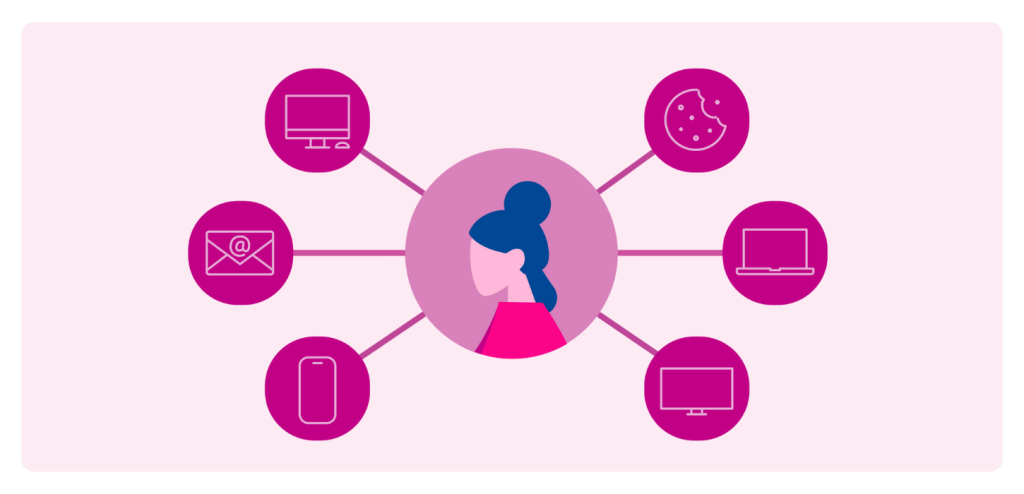
That layer matters more as AI takes over more of the optimization. Models inherit whatever inconsistency sits in the data beneath them, so audience definitions that shift from one network to the next degrade every decision that follows. Better models won’t fix a fragmented identity layer, but they will scale its errors faster. Networks can get ahead of this by settling the identity layer first, standardizing audience definitions so they hold on-site and off-site and give the models downstream something dependable to learn from.
Signal expansion belongs in the same conversation. First-party data reflects the customers who logged in, joined the loyalty program, or completed a transaction. Irregular buyers, emerging segments, and high-value prospects who are actively in-market show up faintly or not at all in that view, even though signal about them exists elsewhere in the ecosystem. A shared identity layer that connects to a marketplace of data providers closes part of that gap, and it does so without asking any network to hand over raw records.
This is also what opens commerce media to brands that will never own a media network. Most companies sitting on valuable first-party data don’t have the traffic or the assortment to build what Amazon and Walmart built, and they don’t need to. Combining signal with trusted partners produces audiences larger and more valuable than any one of those brands holds alone. That’s how a brand participates in commerce media without becoming a media company.
Networks need infrastructure, and neutrality decides whose
A mid-sized commerce media network runs into the same ceiling from the other direction. Owned inventory has a limit, and so does owned data. Growing past both means off-site reach, enriched audiences, and measurement that holds up next to the largest players, and building all of that in-house isn’t realistic for most networks. What they need is infrastructure that supports expansion without giving up control of the customer relationship.
That makes the choice of whose infrastructure a consequential one. Brands and networks should look hard at the commercial position of any partner they put at the center of identity and measurement. A partner with interests in a specific demand-side platform (DSP), supply path, or set of agency relationships gains visibility into every deal that moves through it, and that visibility shapes incentives over time. Networks are right to weigh it carefully.
Experian competes in none of those layers. Our position strengthens when the ecosystem stays open and brands keep the freedom to work across partners, platforms, and evolving technologies. Independence is what makes shared infrastructure possible.
Consistency is the constraint on the next round of growth
Commerce media maturity trails its ambition. 42% of teams believe they have operationalized commerce media, while only 13% qualify as advanced against leadership, technology, measurement, and operations.
Closing that gap depends on identity discipline more than network count. A brand that recognizes the same consumer across every network it buys can compare results, move budget with confidence, and hold every partner to one standard. Without that, each new network adds spend and subtracts clarity.
Consistency is what turns commerce media from a set of separate programs into something a brand can actually manage.
About the author

Kevin Dunn
Chief Revenue Officer, Experian
Kevin Dunn joins Experian Marketing Services with more than 20 years of leadership experience across marketing and advertising technology, most recently serving as Senior Vice President of Brands and Agencies at LiveRamp. In that role, he led growth across retail, CPG, travel, hospitality, financial services, and healthcare, overseeing new business, account expansion, and channel partnerships.
Kevin is known for building cohesive, accountable teams and leading with optimism, clarity, and a strong sense of shared purpose. His leadership philosophy centers on empowering people, driving positive outcomes for clients and fostering a culture where teams can grow, take smart risks, and succeed together.
Latest posts

Leading global marketing technology company, Tapad, a part of Experian, adopts The Trade Desk’s streamlined cookie ID into its identity resolution solutions to increase global cookie coverage across the internet April 03, 2019 09:00 AM Eastern Daylight Time LOS ANGELES & NEW YORK–(BUSINESS WIRE)–Global marketing technology company, Tapad, a part of Experian, has partnered with The Trade Desk to onboard The Trade Desk’s unified ID solution into its digital identity driven solutions. The Trade Desk’s unified ID solution is free for all parties spanning the digital advertising supply chain, including SSPs, DSPs, DMPs and data providers. With leading players onboarding the unified ID solution, such as Tapad, streamlined cookie syncs make ad viewing experiences better for consumers, increase match rates for all parties, and expand cookie coverage on a global-scale. Adoption of The Trade Desk’s global cookie footprint enables Tapad customers to benefit from greater precision and potentially higher performing digital marketing campaigns. “Identity is critical in the ecosystem and as a long-standing leader in the space, Tapad has shown a strong commitment to building digital identity resolution solutions that help marketers launch more effective campaigns on a global scale,” said Ed Chater, VP of Data Partnerships, The Trade Desk. “We are thrilled for their participation and look forward to solving the digital identity narrative across the industry through this partnership. The continued widespread adoption of the unified ID solution validates our collective mission to improve the effectiveness of digital advertising.” About Tapad Tapad, Inc. is a global marketing technology company and leader in digital identity resolution solutions. The Tapad Graph™, and related solutions, provide a privacy-safe approach to connecting device identifiers to brand and marketer data, thereby allowing for enhanced measurement, attribution, reach and ROI of marketing campaigns. The Tapad Graph™ enables marketers around the world to maximize campaign effectiveness and drive business results. Tapad is recognized across the industry for its innovation, growth and workplace culture, and has earned numerous awards, including the TMCnet Tech Culture Award. Based in New York, Tapad also has offices in Chicago, London, Oslo, Singapore and Tokyo, and is a wholly owned subsidiary of Telenor. About The Trade Desk, Inc. The Trade Desk™ is a technology company that empowers buyers of advertising. Through its self-service, cloud-based platform, ad buyers can create, manage, and optimize more expressive data-driven digital advertising campaigns across ad formats, including display, video, audio, native and, social, on a multitude of devices, such as computers, mobile devices, and connected TV. Integrations with major data, inventory, and publisher partners ensure maximum reach and decisioning capabilities, and enterprise APIs enable custom development on top of the platform. Headquartered in Ventura, CA, The Trade Desk has offices across North America, Europe, and Asia Pacific. To learn more, visit thetradedesk.com or follow us on Facebook, Twitter, and LinkedIn. Contact us today
by AdExchanger // Friday, March 15th, 2019 – 12:06 am “Data-Driven Thinking” is written by members of the media community and contains fresh ideas on the digital revolution in media. Today’s column is written by Preethy Vaidyanathan, chief product officer at Tapad, a part of Experian For years marketers asked, “How do we get more data?” Now that they’ve mastered data mining, marketers want to know what’s next. The time has come for organizations to make their abundance of digital data actionable, increase ROI and reach consumers with consistent, personalized experiences across all touchpoints. A seamless consumer experience can only be achieved by consolidating digital data. Organizations, however, are finding that consolidating data silos is more time-consuming and complicated than initially expected. The challenges One of the most pervasive obstacles companies face in when consolidating data is adopting inefficient and costly tactics that quickly become outdated. For instance, over the last couple of years, many companies turned to enterprise data warehouses to consolidate data silos, but some were too expensive or poorly suited for raw, unstructured and semi-structured data. This led companies to adopt data management initiatives, which bogged down many enterprises. Perception among senior level executives is another challenge. Many still question the need for digital transformation – achieving greater efficiencies through updating business and organizational processes with new technologies. Gartner found that more than half (54%) of senior executives say their digital business objective is transformational, while 46% say their objective is optimization. Digital transformation and data consolidation require time and effort. So, many large organizations work to overcome data silos as part of a multiyear digital transformation versus an immediate action item, delaying the benefits the company sees from taking on this project. All of these challenges make delaying progress in data consolidation easy, but companies should remember the impetus for doing so: creating a seamless customer experience that, in turn, drives business results. Brands with higher quality customer experience grow revenue faster than direct competitors with lower quality customer experience. The approach Many brands go into the digital transformation process assuming they have massive amounts of customer data, and that much of it is valuable or will be in the future. They might spend months aggregating that data in data stores or data lakes – at great expense. The trouble is that their data was scattered across multiple databases, which means it’s highly fragmented. As a result of this fragmentation, marketers can’t activate their data in ways that enhance the customer experience. To do so, companies must ensure their digital data is highly flexible so it can provide a holistic view of the consumer journey across every digital, in-store, in-venue and offline channel. I’d recommend that organizations taking on data centralization initiatives prioritize use cases that offer the company the greatest benefit. This is where organizations should establish a “crawl, walk, run” approach to data centralization to ensure key executives buy into the process. Starting with a subset of use cases, such as customer retention or upsell, or with a campaign, which is an even smaller starting point, allows executives to see the benefits of data consolidation projects relatively quickly. Once they validate these initial benefits, they can expand the range of use cases or campaigns, as well as the marketing ROI for their business. While data centralization is a long-term project that may take several years to complete, it doesn’t mean a business can’t get started now and see measurable results quickly. Break down data consolidation into stages so the organization can experience wins along the way. At the end of the day, data consolidation will help organizations deliver more effective marketing campaigns that drive business growth. Contact us today

Tapad’s technology enhances Bidtellect clients frequency capping and audience extension capabilities cross device. NEW YORK, Feb. 28, 2019 /PRNewswire/ — Tapad, part of Experian, is a global marketing technology company and leader in digital identity resolution solutions, today announced a new partnership with Bidtellect (now Simpli.fi), a leading native Demand-Side Platform (DSP). Bidtellect’s paid content distribution platform will leverage The Tapad Graph™ as its first cross-device partner. The integration will offer Bidtellect’s clients in the U.S. and Canada cross-device frequency capping and enhanced audience extension capabilities. The combination of Tapad’s leading cross-device technology, with Bidtellect’s unparalleled scale and optimization capabilities, will allow content marketers within brands and agencies to develop even more strategic, effective content marketing campaigns. The Tapad Graph™ will allow content marketers to gain greater reach and create more relevant, unified messaging with targeted delivery, when used in conjunction with Bidtellect’s technology. Marketers can expect to benefit from amplified reach, and enhanced, privacy-safe engagement with desired audiences as a result of this partnership. “Partnering with Tapad, the leaders in cross-device data, provides Bidtellect with a complete solution that leverages both probabilistic and deterministic mapping strategies,” said Mike Conway, Chief Technology Officer at Bidtellect. “The Tapad relationship expands our audience size by providing the opportunity to reach the same user across multiple devices and, when used in conjunction with our frequency capping functionality, ensures increased reach, reduced ad saturation, and elimination of wasted ad spend.” As the partnership progresses, Tapad will also work with Bidtellect to provide advanced attribution for conversions and engagement metrics including connectivity and amplification. These advanced insights will help brands and agencies develop a more holistic approach to content marketing, so they can build audiences and influence bidding algorithms that directly impact their business. Contact us today