In 2022, Google began changing the availability of the information available in User-Agent strings across their Chromium browsers. The change is to use the set of HTTP request header fields called Client Hints. Through this process, a server can request, and if approved by the client, receive information that would have been previously freely available in the User-Agent string. This change is likely to have an impact on publishers across the open web that may use User-Agent information today.
To explain what this change means, how it will impact the AdTech industry, and what you can do to prepare, we spoke with Nate West, our Director of Product.
What is the difference between User-Agents and Client Hints?
A User-Agent (UA) is a string, or line of text, that identifies information about a web server’s browser and operating system. For example, it can indicate if a device is on Safari on a Mac or Chrome on Windows.
Here is an example UA string from a Mac laptop running Chrome:

To limit the passive fingerprinting of users, Google is reducing components of the UA strings in their Chromium browsers and introducing Client Hints. When there is a trusted relationship between first-party domain owners and third-party servers, Client Hints can be used to share the same data.
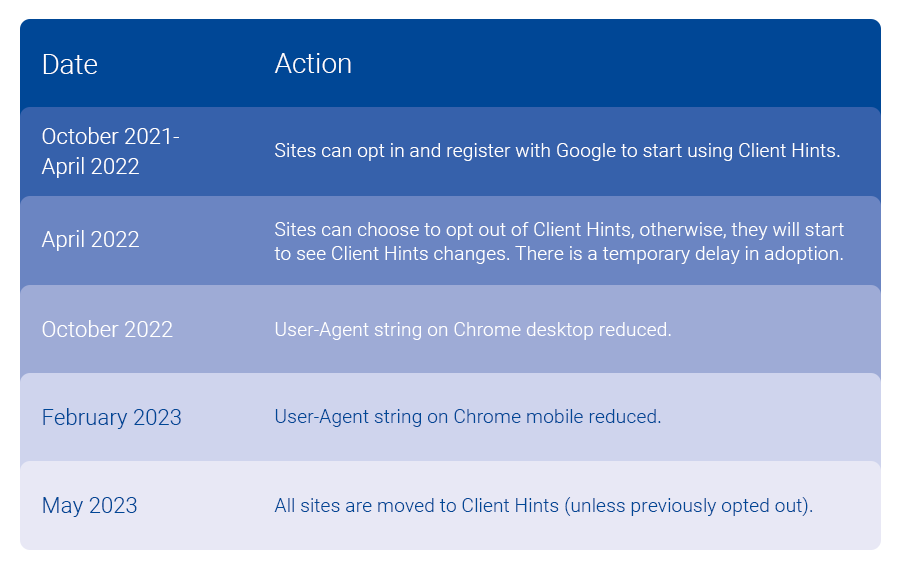
This transition began in early 2022 with bigger expected changes beginning in February 2023. You can see in the above example, Chrome/109.0.0.0, where browser version information is already no longer available from the UA string on this desktop Chrome browser.
How can you use User-Agent device attributes today?
UA string information can be used for a variety of reasons. It is a component in web servers that has been available for decades. In the AdTech space, it can be used in various ad targeting use cases. It can be used by publishers to better understand their audience. The shift to limit access and information shared is to prevent nefarious usage of the data.
What are the benefits of Client Hints?
By using Client Hints, a domain owner, or publisher, can manage access to data activity that occurs on their web properties. Having that control may be advantageous. The format of the information shared is also cleaner than parsing a string from User-Agents. Although, given that Client Hints are not the norm across all browsers, a long-term solution may be needed to manage UA strings and Client Hints.
An advantage of capturing and sharing Client Hint information is to be prepared and understand if there is any impact to your systems and processes. This will help with the currently planned transition by Google, but also should the full UA string become further restricted.
Who will be impacted by this change?
Publishers across the open web should lean in to understand this change and any potential impact to them. The programmatic ecosystem supporting real-time bidding (RTB) needs to continue pushing for adoption of OpenRTB 2.6, which supports the passing of client hint information in place of data from UA strings.
What is Google’s timeline for implementing Client Hints?
Do businesses have to implement Client Hints? What happens if they don’t?
Not capturing and sharing with trusted partners can impact capabilities in place today. Given Chromium browsers account for a sizable portion of web traffic, the impact will vary for each publisher and tech company in the ecosystem. I would assess how UA strings are in use today, where you may have security concerns or not, and look to get more information on how to maintain data sharing with trusted partners.
We can help you adopt Client Hints
Reach out to our Customer Success team at tapadcustomersuccess@experian.com to explore the best options to handle the User-Agent changes and implement Client Hints. As leaders in the AdTech space, we’re here to help you successfully make this transition. Together we can review the options available to put you and your team on the best path forward.
Get in touch
About our expert

Nate West, Director of Product
Nate West joined Experian in 2022 as the Director of Product for our identity graph. Nate focuses on making sure our partners maintain and grow identity resolution solutions today in an ever-changing future state. He has over a decade of experience working for media organizations and AdTech platforms.
Latest posts

It’s been one week since the highly anticipated Cannes Lions 2024—the event of the year for advertising and creativity. We are excited to present our top five takeaways from the event, revealing the industry's priorities for the year ahead. Navigating the post-cookie era One of the pivotal discussions at Cannes Lions 2024 centered around signal loss and identity resolution. The industry is grappling with the impact of third-party cookie deprecation, driving a move toward alternative identifiers such as Unified I.D. 2.0 (UID2) and ID5, and contextual targeting. This shift aims to uphold accurate audience targeting while addressing privacy concerns through authenticated forms of identity. Brands and agencies are actively exploring these new strategies to replace traditional cookie-based methods with stable, privacy-compliant solutions. First-party data providers are also seeking data onboarding solutions to navigate this transition. They need streamlined integration processes, comprehensive ID-matching capabilities, and transparent pricing structures. Fortified by our roots in offline data and significant investments in our Graph, and our newest offering, Third-Party Onboarding, you can count on Experian's solutions to maintain strong signal coverage in a cookieless world so you can have uninterrupted, effective marketing. Unifying targeting across TV platforms Another focal point at Cannes Lions 2024 was the challenge of navigating TV fragmentation. Advertisers strive for unified targeting across diverse TV platforms, including connected TV (CTV) and traditional linear TV. They emphasize integrating data sources and ad servers to reach audiences across these platforms. CTV continues to stand out in conversations as a crucial and expanding area for advertising, offering new opportunities for targeted campaigns and broader audience engagement. We're fueling the expansion of CTV advertising through our signal-agnostic Graph, which seamlessly integrates CTV IDs, universal identifiers such as UID2, IP addresses, and mobile ad IDs (MAIDs) for targeted campaigns. Our newest offering, Third-Party Onboarding, also provides connectivity to more than 10 TV destinations. Transforming marketing with AI We would be remiss not to mention the hottest topic at Cannes Lions 2024, the transformative power of AI within data and identity. Discussions highlighted AI's pivotal role in revolutionizing marketing strategies by enhancing campaign planning, dynamic optimization, measurement, and analytics. AI is not just a tool; it enables marketers to work smarter and faster. With real-time data enrichment, AI will empower marketers to manage large-scale campaigns with unprecedented efficiency and precision. Marketers envision a future where AI seamlessly integrates into every aspect of their strategy, from understanding and predicting consumer behavior to automating personalized engagement. They see AI as the key to unlocking new levels of precision and efficiency, allowing them to adjust real-time campaigns based on consumer interactions and preferences. This vision includes using AI for deeper audience insights, ensuring that every marketing touchpoint is relevant and impactful. Striving for strategies for proven ROI Discussions on measurement at Cannes Lions 2024 focused on how measurement metrics are evolving to keep pace with industry changes. Cross-device, multi-touch attribution, and outcome-based metrics like consumer lifetime value and conversion rates are becoming more important. Accurate measurement is critical for demonstrating campaign impact and optimizing future marketing efforts. These developments reflect a shift toward more sophisticated measurement practices to optimize marketing strategies and prove tangible ROI. Through our Consumer Sync solutions, you can improve your attribution quality to understand the true path to conversion by linking all digital touchpoints to a single person. Creating integrated consumer experiences with retail media networks Retail media networks (RMNs) are becoming more integrated and connected. Their goal is to provide consumers with a unified online and physical store experience and create a comprehensive marketplace where retailers can work together and use shared data to better reach and engage with their audiences. "Throughout the conversations, it's been clear that there's a lot of demand and interest in building and growing retail media networks. What strikes me is that Experian products, both across identity and data, can be a big support to help grow and fill in these gaps."budi tanzi, vp, product Discussions at Cannes Lions 2024 emphasized how collaborations with technology providers and industry groups can help set measurement standards and ensure transparency. These partnerships can enable RMNs to expand their reach and compete with larger advertising platforms, driving industry growth and innovation. Experian offers comprehensive solutions for RMNs. Our Profile Insights and Enrichment tools offer valuable customer behavior insights, driving smarter inventory management. We enhance ad targeting beyond item-level purchases with accurate data and syndicated audiences, aligning with broader media strategies. Third-Party Onboarding enables expansion beyond owned and operated inventory, supported by our Graph for enhanced connectivity. "Data providers are excited to eliminate digital hops in their data flow using Experian Third-Party Onboarding. Third-Party Onboarding is uniquely set up to reduce friction for third-party data and the ecosystem in general."adam kobus, director of data partnerships Experian events at Cannes Lions 2024 This year, we hosted a kick-off happy hour, content studio, and members of our team joined various panels across the Croisette. Here’s a recap of our week at Cannes. Experian's kick-off event with Audigent and LG Ad Solutions To kick off the week, we co-hosted a happy hour with Audigent and LG Ad Solutions. At our sold-out event, attendees enjoyed a live performance from St. Lucia. Content studio We interviewed 27 thought leaders across the industry in our content studio. Our interviews covered topics like:• Signal loss• Connected and linear TV• Data collaboration• Future of addressability and personalization• Retail media networks• And more We'll be sharing more from our content studio over the coming months. Follow us on LinkedIn or sign up for our email newsletter for the latest updates. Panel participation The Experian team participated in four panels throughout the week across the Croisette: Scott Kozub, VP, Product Management, joined the Brand Innovators panel, "Future of media,” where he discussed how media companies can adapt their content and distribution strategies to cater to changing consumption habits as media becomes more fragmented across devices and platforms. Kimberly Gilberti, Chief Product Officer, joined OpenX's panel, "Unlocking addressability: Navigating the post-cookie era,” to discuss the prevailing strategies for achieving addressability in a cookieless world. Budi Tanzi, VP, Product, participated in Audigent's panel, "Curation in regulated industries,” where they talked about why curation is effective in regulated markets like finance and health. Rachael Donnelly, Chief Marketing Officer, joined The Female Quotient in the Equality Lounge for their panel "Emotional agility: Leading beyond the double standard," where they explored the power of diverse storytelling and its impact on audience engagement, brand building, and the bottom line. Let's keep the momentum going As we wrap up another exciting week at Cannes Lions, the discussions have shown us the potential for innovation in signal loss, TV fragmentation, AI, measurement, and retail media networks. These topics pave the way for a more connected future in advertising. Which trends are you most excited about? Let’s continue the conversation! Reach out to us, and let's dive deeper into these topics together. Stay connected We understand that customers may be experiencing uncertainty with their marketing strategies with Oracle’s exit from advertising. Experian is one of Oracle’s primary data providers powering their audiences. We can help marketers easily make the switch from Oracle audiences to Experian audiences without changes in advertising effectiveness or efficiency. We have mapped Oracle audiences to Experian audiences to make it easy for you to switch your campaign targeting to Experian. Reach out to your account representative or our audiences team for information about audience mapping and finding the most relevant Experian audience for your campaigns. Connect with our audiences team Latest posts

Cuebiq’s mission, as an offline intelligence and measurement company, is to quantify how digital marketing impacts offline consumer behavior. This case study shows how Cuebiq partnered with Experian to continue delivering in-store lift analyses despite signal loss. To achieve this, Cuebiq used Experian’s Activity Feed to resolve digital ad exposures to mobile ad IDs, so that marketers could know the effectiveness of their media campaigns on in-store visits and purchases. Even as Google backs away from third-party cookie deprecation, the need for flexible, future-proof identity solutions remains. By working with Experian, Cuebiq could help their clients more accurately measure their campaigns and optimize their media. Challenge: Increasing match rates across digital platforms Cuebiq wanted to enhance how well they connect digital ad exposures, across web, mobile, and connected TV (CTV), to mobile ad IDs (MAIDs), of consumers who visited their clients’ stores. They needed a single technology partner who could collect data across these environments and improve these connections. With the ability to resolve exposures to households, individuals, and MAIDs to then facilitate attribution of digital exposures to offline store visitation, Cuebiq could continue to provide accurate reports on how digital ads impact offline consumer behavior. This clarity in data enables their clients to fine-tune their marketing strategies. Cuebiq’s key objectives included: Resolving digital exposures to MAIDs Increase overlap of offline and online data Improving the effectiveness of offline measurement offerings Activity Feed: The solution to increase match rates Experian’s Activity Feed pulls together fragmented digital event data from all digital channels, including browsers like Safari and Firefox that restrict traditional tracking methods. Activity Feed ingests and ties digital ad exposure and website activity data to household or individual profiles hourly, helping client's associate ad exposures to impact by a household or individual. Activity Feed plays a crucial role in overcoming fragmented data and helping marketers accurately measure their cross-channel marketing efforts. Cuebiq used Activity Feed to resolve exposure data from all environments, even cookieless ones, to a single household or individual and saw significantly higher match rates. Cuebiq received their clients’ ad exposure data resolved to mobile ad IDs (MAIDs) and correlated it to their clients’ in-store visitation and sales. To do so, Cuebiq implemented the Experian pixel, which they placed to track all their marketers’ impressions (mobile, CTV, web traffic, etc.). The Experian pixel collects information in real-time, such as: Timestamp Cookies Device ID (MAID/CTV) when available IP address User-Agent Impression ID “Before we started working with Experian, we couldn’t fully maximize ad views across the complex digital landscape. In just a few weeks, they were able to maximize the match rate across the fragmented digital inventory, solving a huge problem when it comes to cross-channel attribution.” Luca Bocchiardi, Director of Product, Cuebiq Results Activity Feed combines separate data streams and matches them back to a household. This enables Cuebiq to expand household IDs and accurately identify MAIDs that are seen in-store for cross-channel measurement. Over a 21-day period, Cuebiq passed ~1 billion events to Experian. Activity Feed resolved 85% of total events to a household, 91% of which were tied to MAIDs. By implementing Activity Feed, Cuebiq was successfully able to: Gain clearer insights into the success of their client‘s campaigns Match consumer engagements in a privacy-compliant manner Tell the story of the key performance indicators (KPIs) related to their marketing efforts A solution for measurement across cookied and cookieless environments Activity Feed is prepared for whatever the future of signal loss holds in store, capable of using third-party cookies and alternative IDs, like UID2.0s, ID5 IDs, hashed emails, and IPs for identity resolution. Experian remains fully committed to exploring a suite of next-generation solutions and prioritizing continued testing of different industry solutions to help customers maintain consumer visibility amidst signal loss. We’ve identified six viable alternatives to third-party cookies, how these alternatives fall short, and how Experian can help you navigate these alternatives. “Experian’s customer service is extremely efficient and collaborative. We trust them to keep putting our business first long-term.”Luca Bocchiardi, Director of Product, Cuebiq Download the full case study to discover how Cuebiq used Activity Feed to overcome their challenges. Your path to maximizing match rates and resolving data from cookieless environments starts here. Download the full case study Contact us About Cuebiq Cuebiq is transforming the way businesses interact with mobility data to providing a high-quality and transparent currency to map and measure offline behavior. They are at the forefront of all industry privacy standards, establishing an industry-leading data collection framework, and making it safe and easy for businesses to use location data for innovation and growth. To learn more, visit their website at www.cuebiq.com Latest posts

Experian offers a suite of next-generation tools built on the Experian Digital Graph to help marketers adapt to ongoing signal fragmentation and privacy regulation. These solutions enable brands to maintain behavioral targeting and campaign performance even as traditional signals decrease. Through Experian's integration with Audigent, we now offer early access to Curated Deals, contextually-indexed audiences, and Geo-Indexed Audiences that help advertisers test privacy-first audience activation in a period of accelerating signal fragmentation. Experian and Audigent offer a data management platform (DMP) that enables publishers to collect, manage, and understand their first-party data, while also accessing third-party data, to better monetize their data assets. At the same time, Experian continues to advance its signal-agnostic Digital Graph, which already covers industry-standard universal IDs, like Unified ID 2.0 (UID2) and ID5, as well as both IPv4 and IPv6, which are becoming more and more prevalent. Together, these updates give marketers a reliable, privacy-forward foundation for audience reach, cross-device targeting, and measurement as signal fragmentation continues to reshape digital advertising. How is Experian's Digital Graph evolving in a multi-signal world? Signal fragmentation is reshaping how marketers reach and measure audiences, so we continue to strengthen the Experian Digital Graph to keep performance steady across channels. Recent updates focus on improving connectivity, accuracy, and durability: More signals to keep reach strong: We added IPv6 and phone-based UID2s to our Digital Graph, building on the hashed email (HEM)-based UID2s we already support. Better AI models for cleaner identity data: We improved our AI clustering and device classification models to sharpen ID resolution. More stable customer profiles: We enhanced stability in our Digital Graph by tying it more closely to our Offline Graph, ensuring more complete customer profiles that last over time. Together, these updates give marketers a more resilient identity foundation and help maintain performance in a market defined by rising signal fragmentation. How is Experian advancing contextual targeting and geo-based targeting with our partners? AWith more signals in market and traditional identifiers becoming less reliable advertisers are returning to tactics that don’t rely on cookies. Contextual targeting and geo-based targeting have both delivered results for years, and are becoming even more important as marketers look for consistent ways to reach audiences without relying on ID-level data. Experian is modernizing these approaches by pairing Experian Marketing Data with contextual and geographic signals to create privacy-first activation paths that hold up as identifiers fade. With our acquisition of Audigent, we’re expanding the ways marketers can activate privacy-forward audiences at scale. Together, these capabilities strengthen how brands reach people with relevant experiences, even as traditional IDs fade: Contextually- Indexed Audiences: We index Experian’s syndicated audiences against contextual signals inside private marketplace (PMP) deals using Experian’s Digital Graph and Audigent’s Hadron ID. In a 15-day test with a national advertiser, this ID-less approach exceeded click-through rate goals by 25% while matching the scale and delivery of ID-based campaigns. Geo-Indexed Audiences: We also offer Geo-Indexed Audiences that use location-based signals to reach consumers in the right places and moments, providing another durable option when IDs are unavailable or restricted. Evolving toward more intent-rich signals: Looking ahead, we are developing ways to incorporate additional intent indicators, such as content consumption patterns and repeated contextual behaviors, to give marketers stronger cues about where their audiences are in their decision process, all without relying on user-level identifiers. Together, these tactics make contextual and geo-based targeting more measurable, scalable, and privacy-safe, helping marketers keep performance steady as signal fragmentation accelerates. Which alternative IDs does Experian's Digital Graph support? Experian’s signal-agnostic Digital Graph is designed to interoperate across identity frameworks and connect digital identifiers into a single, privacy-compliant system. It now supports alternative IDs such as: UID2s ID5 IDs HEMs Connected TV (CTV) IDs Our Digital Graph is rebuilt weekly to maintain high accuracy and addressability across campaigns. These capabilities ensure marketers can continue cross-device activation and measurement as legacy signals decline. “Experian is a valued partner in Nexxen’s unified identity graph powering the Nexxen data platforms, which bring us the ability to seamlessly onboard client data, activate campaigns, and measure performance while maximizing biddable opportunities for our advertisers. They help ensure our clients can continue reaching audiences at scale and successfully execute campaigns.”Chance Johnson, Chief Commercial Officer What's next for Experian's identity and connectivity roadmap? As digital signals change and CTV viewership grows, we continue to expand the identifiers supported within the Experian Digital Graph. Recent additions such as IPv6 and phone-based UID2s, alongside existing IPv4 and email-based IDs, help marketers and platforms understand the full customer journey across screens and households within a privacy-first framework. We are committed to maintaining and increasing connectivity in the digital world, ensuring that clients can reach their audiences even as familiar signals decline. A core part of that commitment is strengthening the overlap between our Offline and Digital Graphs. This work improves cross-channel consistency and gives marketers more reliable links between individuals, households, and devices. As we keep investing in identity resilience, clients can expect ongoing innovation that supports addressability and performance despite evolving privacy constraints. Start exploring privacy-first audience targeting through Experian's data marketplace How can marketers maintain addressability at scale today? Experian’s connected toolkit of signal-agnostic advertising solutions empowers brands to continue reaching audiences with confidence: Identity resolution through Experian’s Digital Graph Curation via Audigent Cross-device measurement built for privacy compliance Universal ID interoperability across platforms As the industry adjusts to signal fragmentation, Experian provides the scale, trust, and connectivity required to sustain effective targeting. A resilient path forward for addressable advertising As the AdTech industry continues to evolve, Experian’s Digital Graph continues to power interoperability, scale, and privacy-safe measurement. With data ranked #1 in accuracy by Truthset, collaborations across the AdTech ecosystem, and ongoing support for universal IDs, Experian gives marketers a reliable path to addressable, measurable, and privacy-first advertising. Connect with our team About the author Budi Tanzi, VP of Product and Solution Engineering, Experian Marketing Services Budi Tanzi is the Vice President of Product at Experian Marketing Services, overseeing all Identity Products. Prior to joining Experian, Budi worked at various stakeholders of the ad-tech ecosystem, such as Tapad, Sizmek and StrikeAd. During his career, he held leadership roles in both Product Management and Solution Engineering. Budi has been living in New York for almost 11 years and enjoys being outdoors as well as sailing around NYC whenever possible. FAQs How does Experian's Digital Graph help marketers prepare amidst signal fragmentation? Experian’s Digital Graph enables consistent audience targeting and measurement across browsers and devices using privacy-compliant identifiers. It connects verified digital data, giving advertisers continuity as traditional IDs become less reliable.Experian’s Digital Graph supports consistent audience targeting and measurement across browsers and devices using privacy-compliant identifiers. By connecting verified digital data, the Digital Graph gives marketers continuity as signals such as cookies, device IDs, and IP-based identifiers become less reliable. Recent updates, including IPv6, phone-based UID2s, and improved AI clustering, help you maintain reach and accuracy even as digital signals shift. What partners support Experian’s signal fragmentation strategy? Experian works with a variety of partners to source digital IDs. We work with The Trade Desk and ID5 to incorporate their universal IDs into our Digital Graph. Additionally, Audigent, now a part of Experian, offers Curated Deals, which are a non-cookie dependent way to provide reach and relevance. Does Experian’s Digital Graph comply with privacy standards? Yes. Experian’s identity and data solutions align with IAB Data Privacy Standards and regulations such as the California Consumer Privacy Act (CCPA), ensuring transparent and compliant data use. What future plans does Experian have for the Digital Graph? Our current focus is to increase the overlap between our Offline and Digital Graphs, enabling more cross-channel addressability for our clients. We also continue expanding supported identifiers and improving our AI models to maintain performance as signal fragmentation grows. How can I get started testing Experian’s signal-agnostic solutions? You can reach out directly to explore privacy-first activation options, including contextual, geo-indexed, curated deals, and ID-based strategies supported by the Experian Digital Graph. Latest posts