In 2022, Google began changing the availability of the information available in User-Agent strings across their Chromium browsers. The change is to use the set of HTTP request header fields called Client Hints. Through this process, a server can request, and if approved by the client, receive information that would have been previously freely available in the User-Agent string. This change is likely to have an impact on publishers across the open web that may use User-Agent information today.
To explain what this change means, how it will impact the AdTech industry, and what you can do to prepare, we spoke with Nate West, our Director of Product.
What is the difference between User-Agents and Client Hints?
A User-Agent (UA) is a string, or line of text, that identifies information about a web server’s browser and operating system. For example, it can indicate if a device is on Safari on a Mac or Chrome on Windows.
Here is an example UA string from a Mac laptop running Chrome:

To limit the passive fingerprinting of users, Google is reducing components of the UA strings in their Chromium browsers and introducing Client Hints. When there is a trusted relationship between first-party domain owners and third-party servers, Client Hints can be used to share the same data.
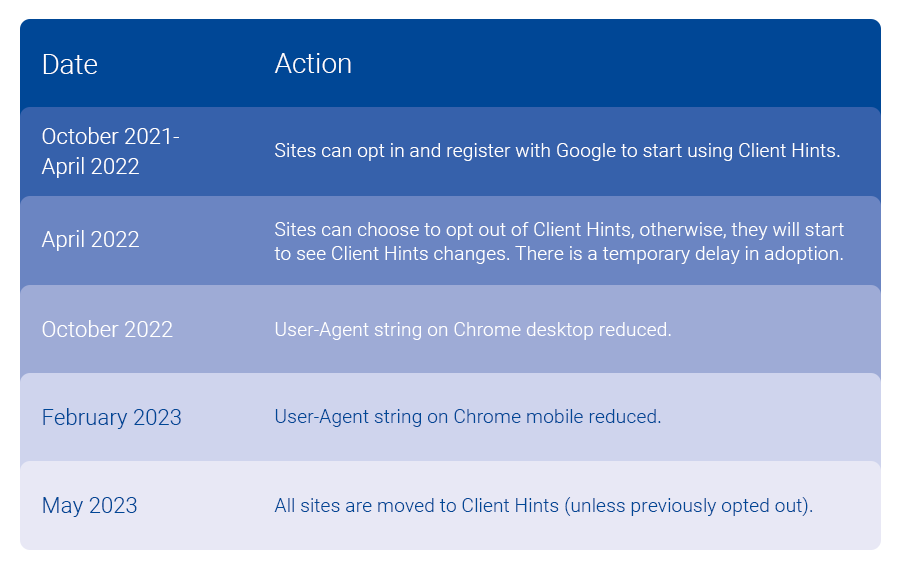
This transition began in early 2022 with bigger expected changes beginning in February 2023. You can see in the above example, Chrome/109.0.0.0, where browser version information is already no longer available from the UA string on this desktop Chrome browser.
How can you use User-Agent device attributes today?
UA string information can be used for a variety of reasons. It is a component in web servers that has been available for decades. In the AdTech space, it can be used in various ad targeting use cases. It can be used by publishers to better understand their audience. The shift to limit access and information shared is to prevent nefarious usage of the data.
What are the benefits of Client Hints?
By using Client Hints, a domain owner, or publisher, can manage access to data activity that occurs on their web properties. Having that control may be advantageous. The format of the information shared is also cleaner than parsing a string from User-Agents. Although, given that Client Hints are not the norm across all browsers, a long-term solution may be needed to manage UA strings and Client Hints.
An advantage of capturing and sharing Client Hint information is to be prepared and understand if there is any impact to your systems and processes. This will help with the currently planned transition by Google, but also should the full UA string become further restricted.
Who will be impacted by this change?
Publishers across the open web should lean in to understand this change and any potential impact to them. The programmatic ecosystem supporting real-time bidding (RTB) needs to continue pushing for adoption of OpenRTB 2.6, which supports the passing of client hint information in place of data from UA strings.
What is Google’s timeline for implementing Client Hints?
Do businesses have to implement Client Hints? What happens if they don’t?
Not capturing and sharing with trusted partners can impact capabilities in place today. Given Chromium browsers account for a sizable portion of web traffic, the impact will vary for each publisher and tech company in the ecosystem. I would assess how UA strings are in use today, where you may have security concerns or not, and look to get more information on how to maintain data sharing with trusted partners.
We can help you adopt Client Hints
Reach out to our Customer Success team at tapadcustomersuccess@experian.com to explore the best options to handle the User-Agent changes and implement Client Hints. As leaders in the AdTech space, we’re here to help you successfully make this transition. Together we can review the options available to put you and your team on the best path forward.
Get in touch
About our expert

Nate West, Director of Product
Nate West joined Experian in 2022 as the Director of Product for our identity graph. Nate focuses on making sure our partners maintain and grow identity resolution solutions today in an ever-changing future state. He has over a decade of experience working for media organizations and AdTech platforms.
Latest posts

Healthcare and Life Sciences teams map the patient journey to spot care gaps and guide interventions. However, clinical records cover only what happens inside clinics, not the forces driving patient decisions. Enriching these records with lifestyle, socioeconomic, and consumer-behavior insights reveals the “why” behind health outcomes. That’s where non-clinical insights step in – revealing the real-world forces that shape patient results. To address these blind spots, Experian and Komodo Health have teamed to integrate de-identified insights from millions of patient journeys with Experian’s socioeconomic and lifestyle data. This enriched view lets enterprises see each journey in full, identify care disparities, and craft smarter strategies – while rigorously protecting privacy. Driving tangible outcomes and better patient care This collaboration focuses on turning insights into action. With Experian and Komodo's integrated clinical, socioeconomic, and lifestyle data, Healthcare and Life Sciences teams can move from insight to accuracy, building adherence programs, finding hard-to-reach patients, and demonstrating treatment success. They can: Layer Komodo’s de-identified patient-level medical and pharmacy insights and analytics with Experian lifestyle and socioeconomic attributes Segment patient populations by condition, treatment history, and socioeconomic status Prioritize outreach – reducing waste and focusing resources where care is needed most For instance: Neighborhood-level gaps Identify opportunities to capture untreated patients and improve clinical trial inclusion. Income-related support Flag populations most likely to benefit from cost-saving programs, ensuring communications highlight co-pay assistance or financial relief options. Inside the data stack At the core of Komodo Health's AI-enabled healthcare analytics platform is its Healthcare Map®. This innovative tool integrates de-identified patient-level medical and pharmacy claims data from the patient journeys of over 330 million unique individuals – providing insights on diagnoses, treatments, outcomes, and care patterns across the United States. Experian enhances this data by adding socioeconomic and lifestyle characteristics that influence up to 80% of health outcomes. Together, this combined data effectively addresses essential questions such as: Which neighborhoods face the highest diabetes risk? Where is therapy abandonment spiking? When should co-pay assistance messages drop? How can we accelerate HCP outreach or clinical-trial recruitment? Experian's socioeconomic and lifestyle insights: Fueling data-driven care decisions In this context, Experian provides valuable insights into socioeconomic factors and lifestyle patterns, covering everything from household composition and income ranges to psychographics and other attributes that help build a broader understanding of an individual's circumstances. Where deep patient understanding, health engagement, and real-world evidence converge As healthcare marketing, patient engagement, and real-world data converge, the Experian and Komodo collaboration is empowering Healthcare and Life Sciences teams with fast, actionable insights. Fusing de-identified patient-level clinical data with socioeconomic and lifestyle attributes helps teams engage the right patients, and fuels research from product launches to community programs. It elevates experiences while proving impact with real-world evidence. Ready to utilize these insights? Latest posts

Brand and tech leaders share insights to guide marketers forward Cannes Lions 2025 brought its usual charm, rosé, and lively discussions, but what stood out was a shift in tone: brand and tech leaders aren’t talking in theories anymore – they’re rebuilding how advertising works. From identity to outcomes, the consensus was clear: marketers need bold, structural changes to thrive. At Experian, we spoke with leaders from Ampersand, Butler/Till, Comcast Advertising, Fox, OpenX, Optable, Snowflake, VideoAmp, and Yieldmo. Their message? Foundational change, not incremental tweaks, is the way forward. Here are five moves marketers and CMOs should be making right now. 1. Make identity the foundation, not an add-on Identity must be the core of your marketing strategy, not an afterthought. Building a strong identity framework from the outset ensures that your data and tech stack work seamlessly across channels. This means investing in first-party data assets and identity resolution tools that inform every campaign and tactic. Identity isn’t just a feature; it’s the base layer of everything successful marketers do today. "There’s no AI strategy without a data and identity strategy. Marketers who want to stretch every media dollar and personalize each touchpoint need a unified, deeper view of the consumer – insight they can carry straight into downstream ad platforms.”David Wells, Snowflake Next step: Treat identity resolution as a prerequisite to every campaign, not a task to address later. Align your data management platform (DMP), customer data platform (CDP), and collaboration partners around a unified identity spine (Experian’s or your own) to ensure data flows uninterrupted from planning to reporting. 2. Curate, don't automate. Programmatic is getting personal Programmatic advertising remains relevant, but its purpose is evolving from mere automation to intelligent, data-driven curation. This shift requires moving beyond static site lists to dynamic, page-level contextual engines that determine, in real-time, which impressions to display. Today, it’s about carefully selecting and curating inventory to ensure transparency, quality, and relevance for your audience. Marketers are increasingly turning to private marketplaces (PMPs) that offer curated, brand safe inventory and clear supply paths to deliver meaningful results. Expect continued growth in curated PMPs, AI-assisted forecasting, and supply-side innovations that combine premium connected TV (CTV) inventory with deterministic data. The goal is to reach the right viewer and understand exactly how and why they got there. “What we’re talking about right now is almost like curation 2.0, which is bringing more of the capabilities that historically sat with the demand-side platform (DSP) into the hands of the supply-side platform (SSP) – that is, supply-side targeting, or what we call data-driven curation."Matt Sattel, OpenX Next step: Audit your supply chain. If you can’t clearly explain every step from bid request to delivery, explore curated deals or direct SSP partnerships that align with your quality and transparency standards. 3. Connect teams like you connect data Fragmented results often stem from fragmented teams. Persistent silos (like TV buys on one floor, digital on another, and data science somewhere else) slow down budgets and create inconsistent messaging. Forward thinking organizations are restructuring teams around unified KPIs and shared data. When planners, buyers, and analysts work together (or at least share dashboards), campaigns move faster and creative stays consistent. “We restructured our teams to focus on all forms of video – linear, streaming, and online. This allowed us to embrace partners who cross over these verticals and technical approaches.”Gina Whelehan, Butler/Till Next step: Map your current workflow end-to-end. Where does a brief stall or data stop flowing? Restructure teams or create shared success metrics to eliminate bottlenecks. 4. Turn disconnected data into unified insights Marketers have spent years gathering massive amounts of data, but hoarding data isn’t a winning strategy. The future belongs to those who can collaborate with partners to connect and utilize data effectively, all while respecting privacy and security. Rather than chasing the next data source, leading marketers are finding ways to safely connect data already available in-house or via partners. This might involve data clean rooms, secure data sharing agreements, or joint analytics initiatives – but the common thread is working together on data, not operating in isolation. “We've been encouraging marketers to tie in first-party data and to really utilize that data and to work with trusted sources and deterministic sources in order to overcome a lot of the challenges around signal loss with cookies, in particular. The other way is also clean rooms. Clean rooms really enable the opportunity to collaborate in a private, safe way, and connecting to those more deterministic sources in order to deliver the results that advertisers are looking for.”Carmela Fournier, Comcast Advertising Next step: Identify gaps in your first-party data. Then, collaborate with a provider like Experian to safely match data sets and unlock insights without exposing sensitive info. 5. Focus on outcomes, not clicks Impressions, clicks, and other output metrics have been the currency of marketing for decades. But the consensus at Cannes is that those proxies aren’t enough – business outcomes are what matter now. Marketers must shift their focus to measuring real results, such as sales lift, new customer acquisition, lifetime value, or brand impact, rather than getting bogged down in intermediate metrics. This move to outcome-based measurement changes how campaigns are planned and judged: success is defined by the value created, not just the volume delivered. Unified, identity-based analytics are finally making it possible to see who saw an ad and what they did next, across TV, CTV, and digital. That intel drives smarter budget shifts and tighter creative feedback loops. “Outcome-based measurement is table stakes in today’s media ecosystem, and Ampersand has woven it into almost everything we do. Thanks to Experian’s strength in identity, audience insights, and outcome measurement, we can give advertisers the attribution they need at every stage of the funnel.”Justin Rosen, Ampersand Next step: Identify metrics that matter to your bottom line, then find a partner who can measure them accurately. If measurement stacks don’t talk to each other, they’re holding you back. Preparing for the challenges ahead The common thread across these five moves is connection – connecting data, teams, and outcomes. Marketers who act on these imperatives will be ready for whatever new screen, format, or privacy rule comes next. Experian can help you: Establish an identity spine Enable secure data collaboration in or out of clean room environments Curate premium CTV inventory with deterministic audiences Measure business outcomes across every channel Ready to make your next bold move? Let's start a conversation Latest posts

Marketers are searching for better ways to connect with their audiences across screens and prove results. Optimum Media is at the forefront of this development, helping brands plan, activate, and measure campaigns across linear TV, addressable TV, connected TV (CTV), digital, and social platforms. To support this approach, Optimum Media partners with Experian, combining their subscriber data with Experian’s trusted audience and identity solutions. Together, we help brands not only find the right consumers but also understand their behaviors and measure real outcomes. Here’s how Optimum Media and Experian are working together. Build a complete customer view with rich data from Experian Optimum Media starts with strong first-party data, including viewership and exposure information from millions of households. However, reaching a deeper understanding of these audiences requires more than what subscriber records alone can offer. Through Experian’s Marketing Attributes, Optimum Media gains access to thousands of demographic and behavioral attributes to its data sets. These attributes—such as income ranges, lifestyle interests, and retail purchasing behaviors—help advertisers build a more complete view of the consumer. "We work with trusted partners like Experian to deliver the additional audience insights—like demographics and lifestyle—that are critical for our clients' success."Natalia Irmin, Sr. Director, Strategic Partnerships, Optimum Media Combining Experian’s Marketing Attributes with Optimum Media’s subscriber footprint helps brands segment audiences more precisely, develop refined media plans, and tailor messaging based on the real behaviors and interests of consumers. Move beyond basic targeting with Audience Engine To support more personalized and scalable targeting, Optimum Media uses Audience Engine—Experian’s self-service platform for audience management and activation. Through Audience Engine, Optimum Media can: Access Experian’s syndicated audiences Not just what’s available directly on their platform. Build custom segments Using Experian’s demographic and behavioral insights. Tap into our data marketplace To explore additional segments from Experian and our Partner Audiences through trusted third-party providers. These tools give Optimum Media and its clients the ability to move beyond basic targeting. Whether a brand wants to reach families preparing for back-to-school shopping, in-market car buyers, or upscale consumers planning home renovations, Audience Engine makes it possible to identify and activate those audiences with greater accuracy—based on real data, not guesswork. Extend campaign reach with Experian’s Digital Graph While Optimum Media has a substantial owned footprint, they often work with advertisers who need to extend reach beyond traditional subscriber bases. To support this, they rely on Experian’s Digital Graph. Our Digital Graph connects mobile ad IDs (MAIDs), IP addresses, CTV IDs, and hashed emails into unified household and individual profiles. This enables Optimum Media to identify and reach audiences outside of their network with the same level of accuracy as inside it. For even deeper audience insights, Digital Graph can be bundled with Marketing Attributes. This combination helps advertisers go beyond basic targeting to include real-world behaviors like shopping habits, travel preferences, and lifestyle characteristics. The result: campaigns that do more than deliver impressions—they connect with the right households across any channel. Turn viewership into measurable business outcomes One of the biggest challenges in multiscreen advertising is connecting exposure to real business results. With Experian’s solutions, Optimum Media can: Plan based on audience behaviors across screens, not just age and gender demographics. Activate household-level audiences across linear, CTV, digital, and social. Measure campaign performance using unduplicated reach, frequency, and attribution across devices. By offering advertisers access to a more complete consumer profile and maintaining consistent measurement across channels, Optimum Media and Experian help clients make better decisions about where to spend and how to adjust strategies over time. Why the Optimum Media and Experian partnership delivers Deeper audience understanding: By combining first-party viewership with Experian’s demographic and behavioral data, advertisers gain a fuller picture of who they are reaching. Seamless cross-platform execution: Identity solutions like Digital Graph allow brands to reach audiences across multiple devices and channels without losing precision. "Optimum Media has been instrumental in helping Experian strengthen the precision, quality, and real-world applications of our data. Their ongoing feedback is invaluable in making sure our solutions continue to meet client needs and perform at the highest level."Chris Feo, Chief Business Officer, Experian With a single, trusted partner offering both identity and audience solutions, Optimum Media avoids the complexity many advertisers still face when piecing together different data sets and vendors. “Having Experian’s identity and audience solutions under one roof makes it easier for us to plan, reach, and measure across every channel. It’s a complete solution that simplifies advertising and improves performance.”Natalia Irmin, Sr. Director, Strategic Partnerships, Optimum Media Start building better campaigns with Experian Ready to improve your audience targeting and measurement strategies like Optimum Media? Connect with our team today to learn how Marketing Attributes, Audience Engine, Digital Graph, and our other solutions can help you build stronger, more measurable advertising campaigns. Connect with us About Optimum Media Optimum Media is a multiscreen advertising business that partners with small and medium businesses, as well as national, political, media and entertainment, and agency clients across the United States. They work with advertisers to develop custom multiscreen advertising solutions powered by proprietary technology and a massive aggregated database of audience data points and TV viewership data. Latest posts