As Earth Day approaches, it’s the perfect opportunity for marketers to explore innovative ways to engage with eco-conscious customers. With a strong and growing interest in sustainable business practices worldwide, green audiences are becoming increasingly influential. In addition to being good for the planet, engaging these customers is great for any brand or organization striving to become more eco-friendly and socially responsible. By taking advantage of this timely event and using appropriate tools, you can create personalized campaigns that will both promote your brand and increase customer loyalty.
Eco-conscious audiences
In this blog post, we’ll cover three eco-conscious audiences to target this Earth Day:
- Solar energy
- GreenAwareTM
- Electric vehicles
Solar energy
Our first eco-conscious audience is Solar energy. Consumers in this audience show an inclination toward harnessing the power of the sun as a clean, renewable energy source. Our audience data can provide valuable insights into the Solar energy consumer base, including their age, education level, occupation, household income, and communication preferences. Let’s explore these metrics to better understand how to reach this group effectively.
Age and living situation
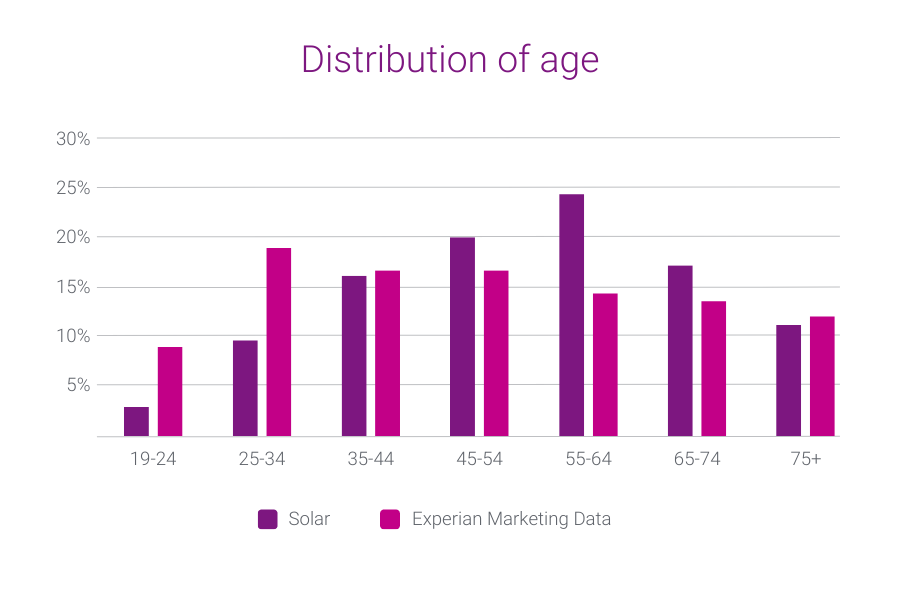
Consumers in our Solar energy audience are more likely to live in a home with two or more adults and are between the ages of 45-74.
Education level and occupation
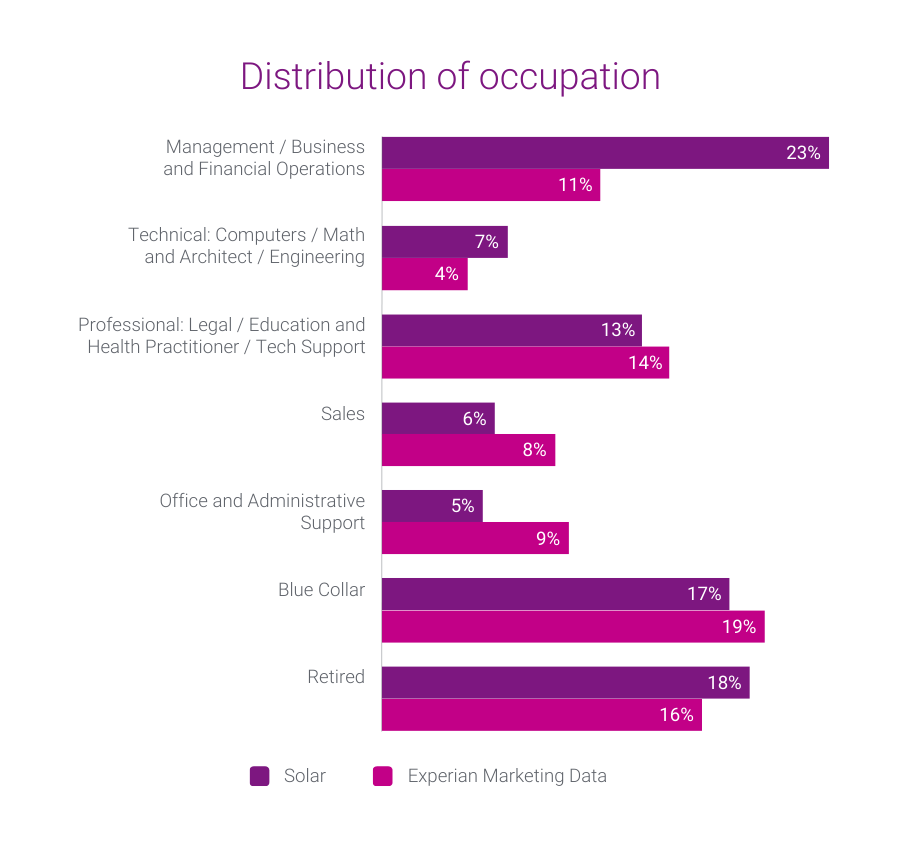
Consumers in our Solar energy audience are more likely to have graduated from college or graduate school and work in management-level occupations.
Household income
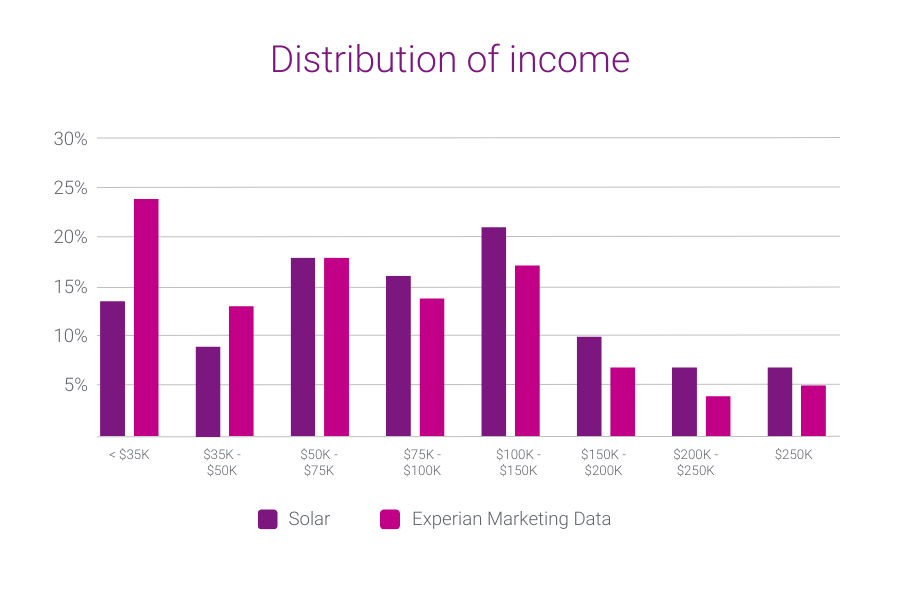
Consumers in our Solar energy audience have household incomes of more than $75,000 and their homes are valued at over $550,000.
Preferred engagement channels
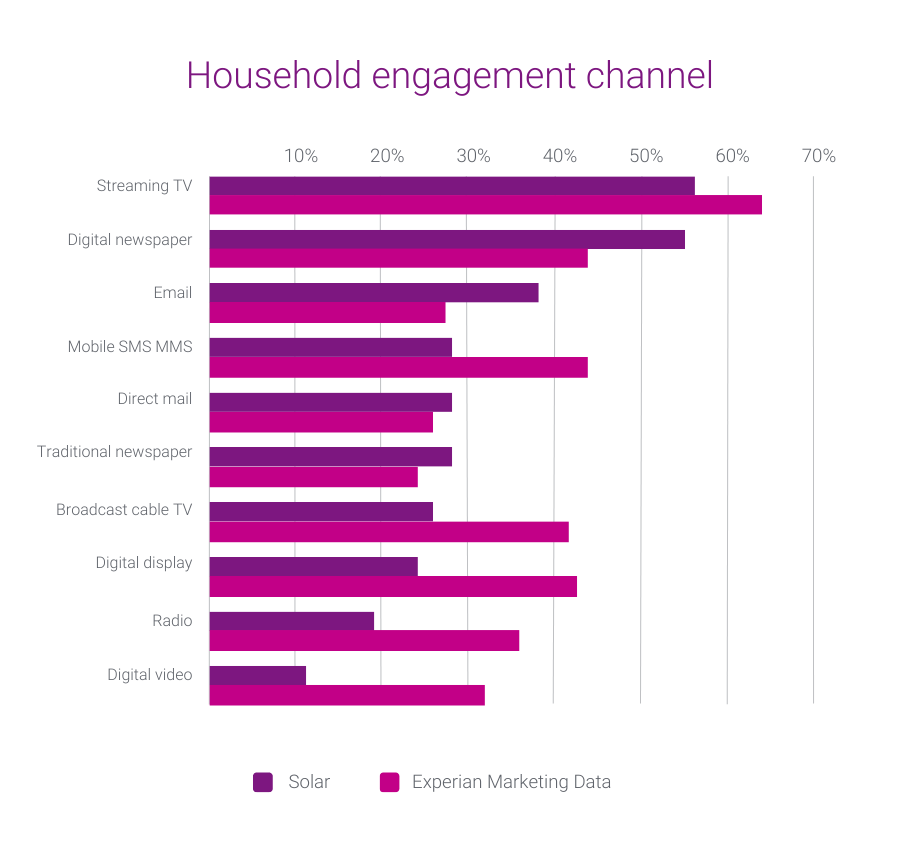
Consumers in our Solar energy audience are most receptive to ads served through digital channels like digital newspapers and email.
Solar energy audience pairings
Consumers in our Solar energy audience also belong to three of our Mosaic® USA groups:
- Power Elite
- Flourishing Families
- Booming with Confidence
Our consumer segmentation portal of 126 million households and 650 lifestyle and interest attributes empowers marketers like you to precisely target your ideal audience and communicate with them on a personal level. Mosaic’s data segments the U.S. into 19 overarching groups and 71 underlying types, giving you the insights needed to anticipate the behavior, attitudes, and preferences of your most profitable customers and communicate with them on their preferred channels, with messaging that resonates.
GreenAware
Our second eco-conscious audience is GreenAware.
GreenAware segments the 126 million U.S. households within Experian Marketing Data into four distinct groups. Each group differs in their attitudes and behaviors toward purchasing products that are environmentally safe and working with companies that are eco-conscious. We created these groups using an enhanced application of traditional statistical clustering techniques based on environmentally relevant measurements in Simmons’ National Consumer Study.
Based on the distinctive mindset of consumers toward the environment, you can learn how environmental concerns fit into their lives through four major consumer segments:
- Eco-Friendly Enthusiasts
- Sustainable Spectators
- Passive Greenies
- Eco Critics
Let’s dive deeper into each group to understand their unique perspective on the environment and how this impacts their attitudes and behaviors.
Eco-Friendly Enthusiasts
This eco-conscious segment prioritizes a green lifestyle and takes pride in avoiding products that harm the planet. With traditional and liberal values, they embrace optimism and prioritize family. With their children out of the house, they take the time for some well-deserved rejuvenation and are committed to a healthy lifestyle. Some members of this group are transitioning into retirement and welcoming a new chapter in their life.
- Mature adults and retirees
- College graduate or more
- Above average income
- May be married or single
- Typically own their homes
Sustainable Spectators
This segment aspires to be more sustainable, but they struggle with translating their green ideas into action. They have a soft spot for a cozy home. While their love for interior design and taking care of their own space is evident, they’re always looking for new experiences and opportunities to learn. Staying healthy and active is a top priority for this group, so it’s no surprise that they’re always looking for ways to stay fit and feel their best.
- Established and mid-life adults
- College graduate or more
- High income
- Typically married
- Likely to own their homes
Passive Greenies
This is the largest and one of the most youthful groups. Known for their love of exploration and self-discovery, they may not have fully embraced eco-conscious behaviors yet, but they are eager to stay current with the latest technology and trends. With their incredible ability to multitask, they’re always on-the-go, and constantly seek the next best thing.
- Mainly young adults and diverse
- Education ranges from high school through some college
- Below average income
- More likely to be single or divorced
- Typically rent
Eco Critics
This group is not likely to be eco-conscious and may have negative attitudes about the environment. They are confident, driven, and focused on their personal growth. They crave instant gratification, seeking out quick and easy solutions to their everyday decisions. They place a high value on entertainment, their social life, and carefully curate their image.
- Young and established adults
- Education ranges from high school through post-graduate studies
- High income
- Married or single
- Typically own their homes
Let’s take a look at how the GreenAware segments stack up against each other in terms of age, household income, education level, and media preference. How do they compare? Let’s find out.
Age
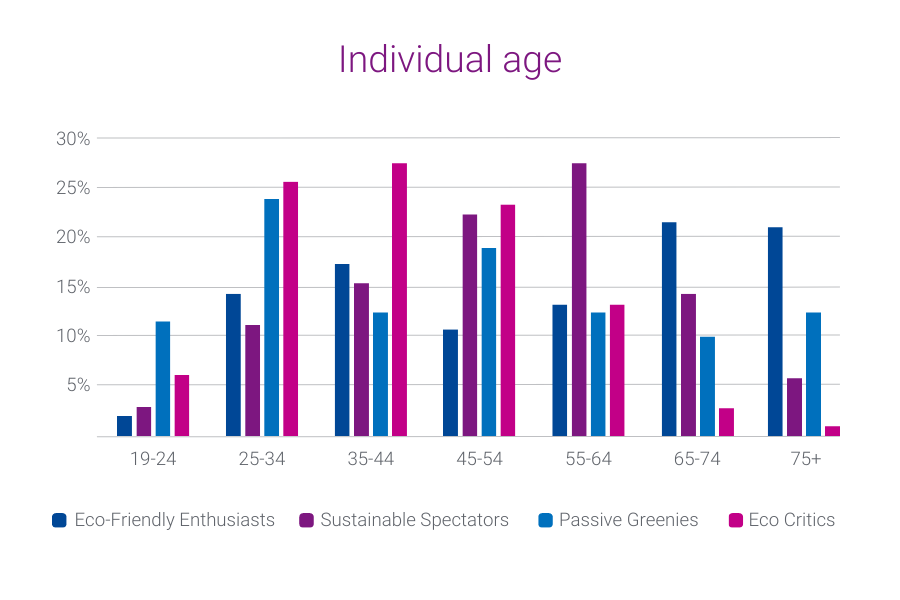
Consumers in the Eco-Friendly Enthusiasts segment are the oldest of the four GreenAware segments – about half of the consumers are 65 or older. Eco Critics are the youngest segment, with over half of consumers in this group between ages 25-44.
Household income
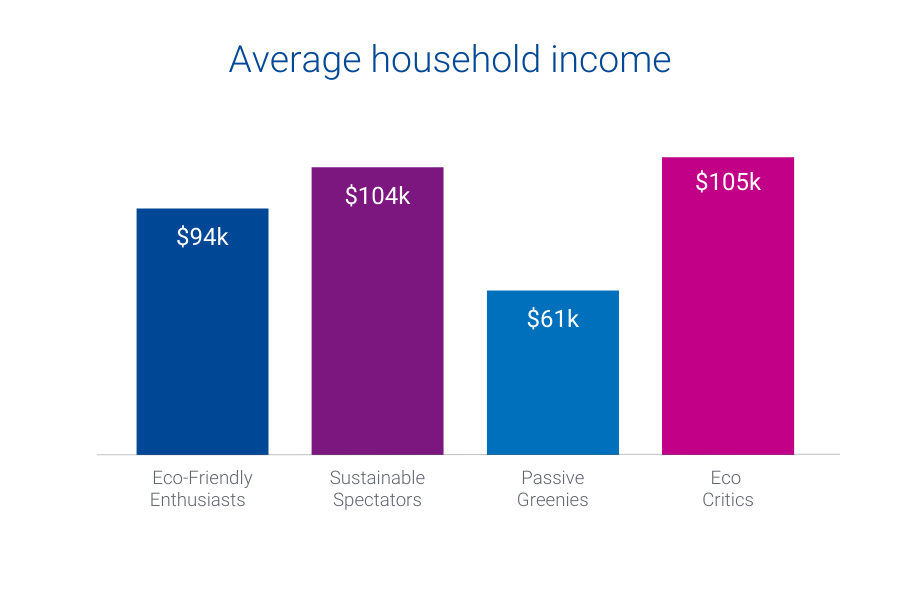
Sustainable Spectators and Eco Critics are the wealthiest GreenAware segments. The average household income of consumers in these segments is above $100,000. Passive Greenies have the lowest household income, with a majority below $50,000.
Education level and occupation
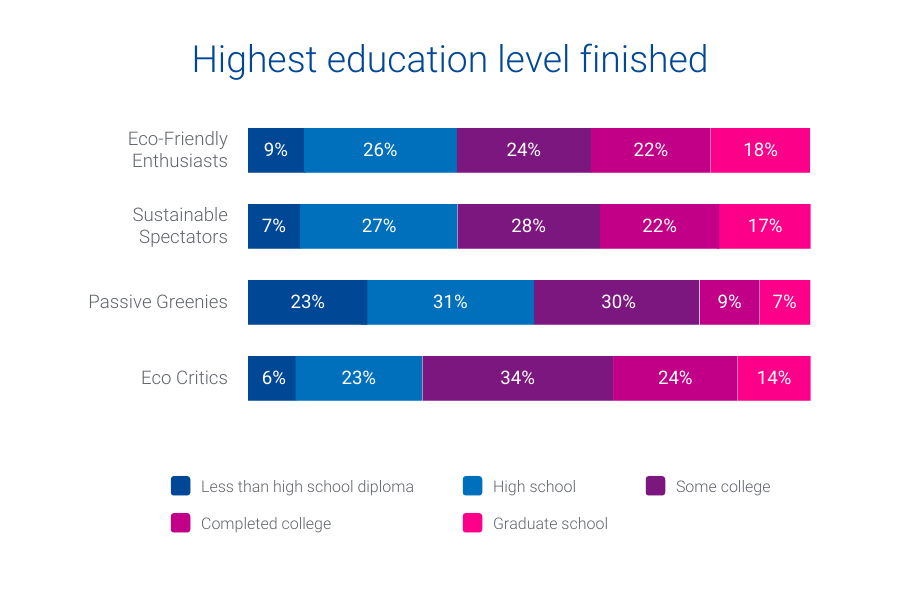
Passive Greenies are more likely to work Blue Collar jobs and have the lowest level of education. As the wealthiest segments, Sustainable Spectators and Eco Critics have the highest levels of college degrees and work in management, business, and financial operations. Eco-Friendly Enthusiasts are the most likely to be retired and out of the workforce.
Preferred engagement channels
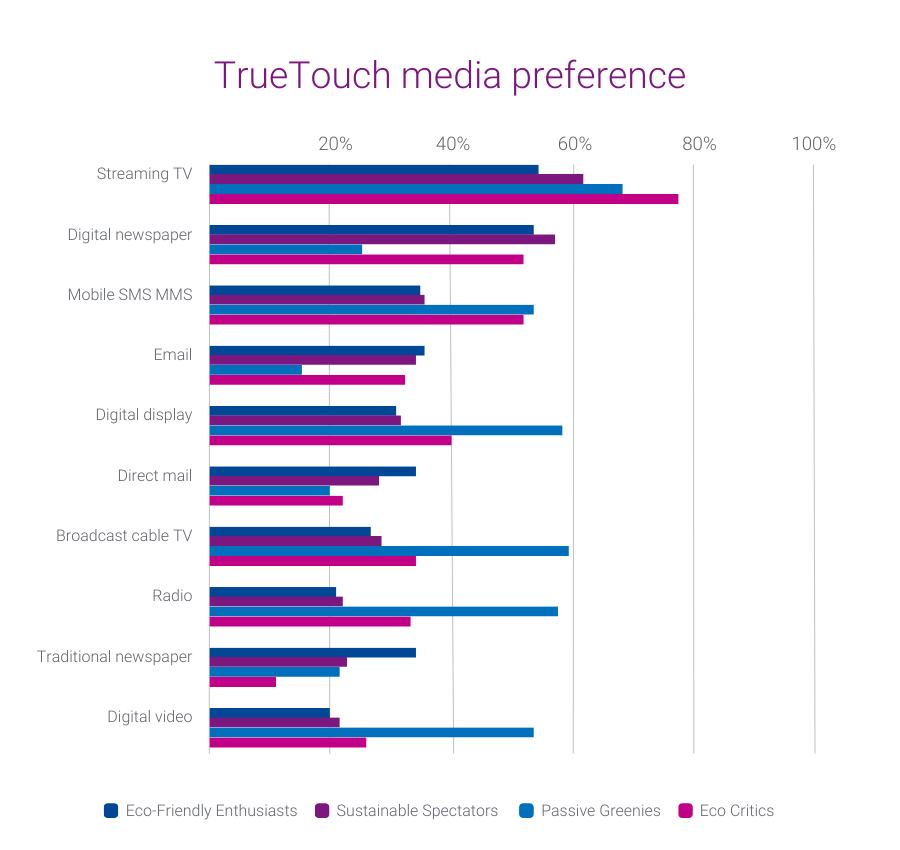
- Streaming TV is the preferred engagement channel for all GreenAware segments.
- Eco-Friendly Enthusiasts prefer digital channels like digital newspapers, mobile SMS, and email. They also engage with traditional channels like direct mail and newspaper.
- Passive Greenies have a high preference for digital display, mobile SMS, digital video, broadcast cable TV, and radio.
- Eco Critics have a high preference for digital channels like digital newspapers, mobile SMS, and digital display.
- Sustainable Spectators strongly prefer digital newspapers. They don’t show as strong of a preference for mobile SMS and digital display as Eco Critics and Passive Greenies.
GreenAware audience pairings
Six of our Mosaic groups have at least one GreenAware segment with 10% or more of the population. For more precise targeting, below are suggested Mosaic audiences you can pair with each GreenAware segment:
| Eco-Friendly Enthusiasts | Sustainable Spectators | Passive Greenies | Eco Critics |
| Booming with Confidence | Power Elite | Singles and Starters | Power Elite |
| Autumn Years | Booming with Confidence | Golden Year Guardians | Suburban Style |
| Golden Year Guardians | Singles and Starters |
Electric vehicles
Our third eco-conscious audience is electric vehicles.
Electric vehicles (EVs) are having a major moment in the automotive industry. This is no surprise given that new EV models are being released and an increasing number of charging stations are popping up around the country. As EVs become more prominent, it’s essential to stay up to date on relevant trends to make informed decisions about what lies ahead.
The demand for electric vehicles (EVs) is on the rise
Consumers are embracing the EV revolution, showing their desire for a cleaner, greener future. Automotive marketers are increasingly looking to reach in-market EV shoppers and current alternative fuel vehicle owners due to the growing availability of electric vehicles, improved infrastructure, and rising popularity. In 2022, EVs charged up the market and accounted for a remarkable 6% of new retail registrations.
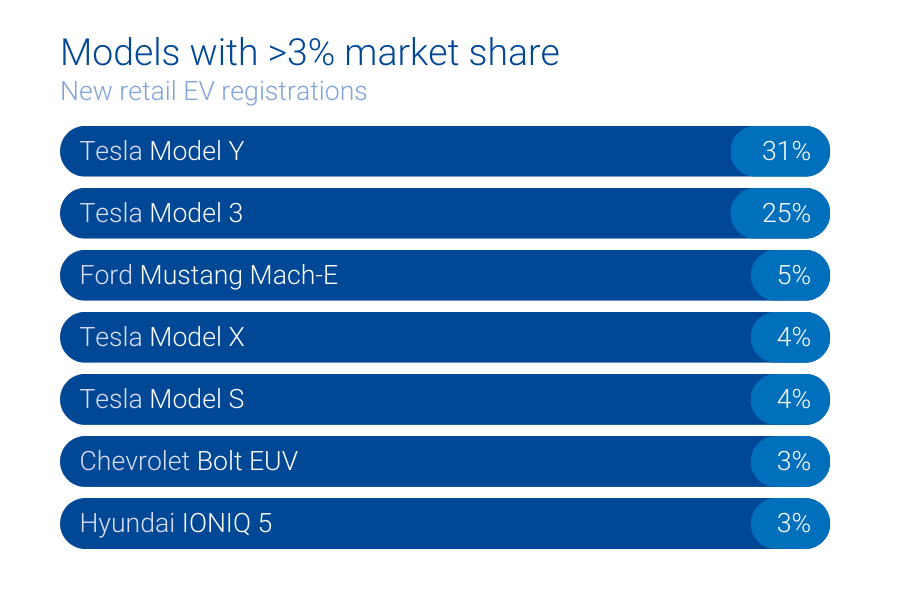
While Tesla continues to dominate the EV market, Ford, Chevrolet, and Hyundai are starting to compete, each holding more than 3% of the market share of new retail EV registrations.
Geography
Where are we seeing the most new retail EV registrations? The top designated market areas (DMAs) for new retail EV registrations are mostly located in heavily populated, coastal cities like Los Angeles, CA and New York, NY.
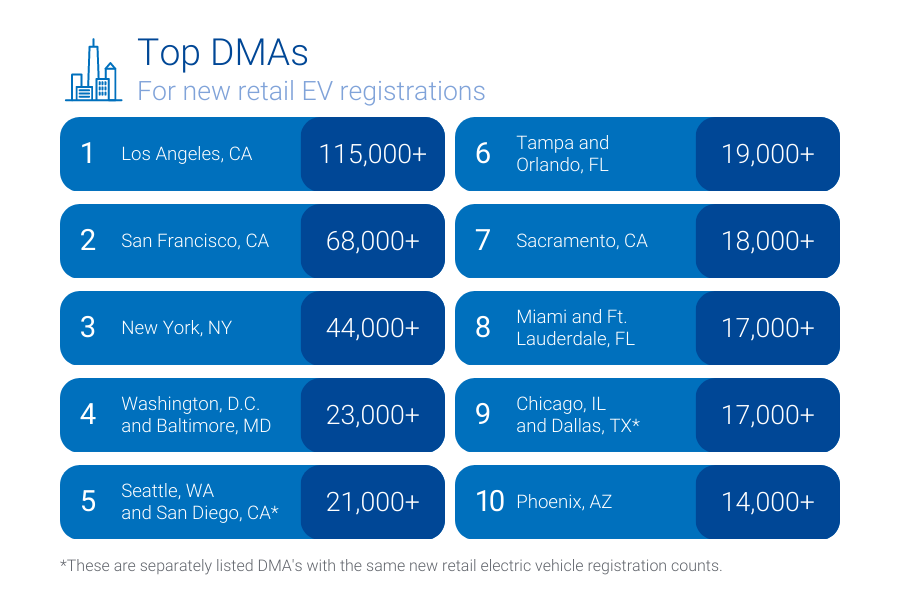
The fastest growing DMAs, however, are in smaller cities like Tucson, AZ and Oklahoma City, OK.
Generational demographics
Gen X and Millennials make up the largest percentage of new retail EV buyers at 37.5% and 34.4%. Gen Z and the Silent generation represent the smallest shares at 5% and 2.1%. Boomers hover between Gen X and Millennials’ share and account for 20.6% of new EV retail purchases.
EV audience pairings
Our top five Mosaic groups for new EV buyers include:
- American Royalty
- Cosmopolitan Achievers
- Philanthropic Sophisticates
- Couples with Clout
- Fast Track Couples
How to target consumers in-market for electric vehicles
We offer 70+ audiences that are focused on likely buyers and owners of EV and plug-in hybrid (PHEV) vehicles. We also offer a subset of 28 audiences focused on individual EV/PHEV vehicle models.
Below is how you can find a few of these audiences on-the-shelf of most trusted advertising platforms:
- Autos, Cars, and Trucks > In Market-Fuel Type > Electric
- Autos, Cars, and Trucks > In Market-Fuel Type > Used Electric
- Autos, Cars, and Trucks > In-Market Make and Models > Tesla
- Autos, Cars, and Trucks > In-Market Make and Models > Chevrolet Bolt EV
We can help you reach eco-conscious consumers
Earth Day is a great opportunity to get creative with your marketing efforts with our three eco-conscious audiences: Solar energy, GreenAware, and electric vehicles. To find out how you can add eco-conscious audiences to your marketing plan, contact us.
Get in touch
Latest posts

Note: This Ask the Expert was recorded prior to Experian’s acquisition of Audigent and discusses industry trends and how we’ve worked together in the past. Adopting new strategies based on trust due to evolving privacy regulations and the gradual loss of traditional signals, like third-party cookies, is essential to successfully navigating the future of digital advertising. Advertisers and marketers are at a crossroads, facing the challenge of maintaining personalization and precision while respecting consumer expectations around privacy. To stay competitive, brands must adopt future-ready strategies that focus on trust, privacy-forward technologies, and scalable solutions. In our latest Ask the Expert segment, recorded before Experian acquired Audigent, we explore how first-party data and advanced contextual audience targeting are two critical approaches for successfully navigating these changes. With insights from Greg Williams, President of Audigent, now part of Experian, and Crystal Jacques, VP of Sales at Experian, we discuss how these tools can empower your brand for long-term success. First-party data as a cornerstone strategy First-party data, a powerful tool for building meaningful connections with your audience, has emerged as a fundamental pillar of future-ready strategies. When collected and used effectively, it provides brands with a detailed understanding of consumer preferences and behaviors, enabling real-time campaign adjustments for maximum impact. “Data has become part of every step of the digital advertising supply chain, and should be part of everybody’s buys… the more you can include data in your digital marketing, the better off and the more power you have."Greg Williams, President, Audigent With the continual loss of signal, including third-party cookies, first-party data has proven to be key for brands to stay both competitive and privacy-compliant. Brands using first-party data are better positioned to overcome the challenges of signal loss. This data facilitates improved media targeting and personalized messaging, driving greater engagement and return on investment. Contextually-Indexed Audiences build relevance Experian’s Contextually-Indexed Audiences enable advertisers to target users based on their interests in real-time, without relying on cookies or mobile ad IDs. Machine learning analyzes and maps traffic from over two million websites, linking to Experian’s 2,400 audience segments. With added benefits like audience customization and flexible activation through Audigent’s private marketplaces (PMPs) or demand-side platforms, Experian is setting a new standard for scalable audience targeting. For automotive advertisers, this could mean reaching consumers actively researching luxury electric vehicles on relevant sites. Unlike outdated methods, contextual targeting aligns the message with consumer intent, balancing high precision with consumer privacy. Automotive success story Audigent’s innovative solutions have delivered tangible results. Williams mentions how they helped an automotive brand achieve double the scale and triple their goal of driving test drives. This stands as a testament to the real-world effectiveness of contextual audience strategies and Experian's role in executing them. How to stay ahead of change Here are five strategies to help your brand remain future-ready amid privacy challenges and signal loss: Prioritize first-party data: Build trust and improve targeting accuracy by relying on data that you own directly from your consumers. Test privacy-forward tools: Experiment with solutions like contextual targeting and Google’s Privacy Sandbox to future-proof your advertising. Strengthen identity framework: Create systems to securely manage and use data for cross-channel decision making. Use scalable tools: Partner with trusted providers to deploy solutions that adapt to changing industry standards. Stay proactive and flexible: Continuously evaluate trends and refine approaches to align with emerging consumer and regulatory expectations. A deeper conversation For additional insights, watch our full Q&A. Greg Williams and Crystal Jacques discuss the future of audience targeting, how first-party data reshapes marketing strategies, and how Experian and Audigent have collaborated in the past. Watch now Contact us About our experts Greg Williams, President, Audigent Greg Williams is Audigent's President, responsible for managing Audigent’s vast portfolio of ecosystem partners, enterprise sales, marketing, and client success. An innovator in programmatic ad buying, Williams co-founded MediaMath and was instrumental in building and scaling that company in the US and internationally. He led MediaMath's international expansion in 2011 and grew that business from zero to a top revenue driver for the company in three years. During his 14 years at the company, Williams held global roles and built teams across every function of the organization — most notably leading business and market development, product development, and partnerships. Prior to co-founding MediaMath, Williams held senior positions at [X+1] (which was later acquired by RocketFuel), Nielsen, and Accenture. Crystal Jacques, Head of Enterprise Sales, Experian Head of Enterprise Partnerships, leading Experian's go-to-market team across all verticals. With over ten years of experience in the Identity space, Crystal brings a wealth of expertise to her role. She joined Experian in 2020 through the Tapad acquisition, following her successful stint as the head of Global Channel Partnerships for Adbrain, which The Trade Desk later acquired. Latest posts

CES 2025 will be an exciting opportunity to explore how we can work together to shape the year ahead. Here are four themes we expect to take center stage at the event. “There is no better way to kick off the calendar year than with clients and industry peers that are excited to collaborate on new business opportunities. People come straight off the holidays energized by CES and with a pipeline of deals to work on for the coming month. In-person meetings always trump virtual calls and everyone in the industry comes together to make it a fruitful week.”Crystal Jacques, Head of Enterprise Partnerships 1. Addressability in a signal-loss world Addressability has become a cornerstone in AdTech as brands aim to deliver personalized experiences while navigating evolving privacy regulations and signal loss. This shift has prompted advertisers to rethink how they reach and engage audiences. In this environment, alternative identifiers such as UID2 and ID5 have gained traction, offering brands new avenues to target consumers across platforms while respecting privacy. Addressability has shifted from a straightforward tracking mechanism to a multifaceted strategy that combines identity solutions, contextual insights, and collaboration across the ecosystem. ID Bridging and the new OpenRTB 2.6 specs As the industry loses identity signals, it becomes increasingly difficult to identify audiences on the supply-side and make them reachable for the demand-side. The supply-side has used the practice of ID bridging to do just that. ID bridging is the supply-side practice of connecting the dots between available signals to infer a user’s identity and communicate it to prospective buyers. This practice sparked debate, as buyers want full transparency into the use of a deterministic identifier versus an inferred one. "The OpenRTB 2.6 specifications are a critical step forward in ensuring transparency and trust in programmatic advertising. By aligning with these standards, we empower our partners with the tools needed to navigate a cookieless future and drive measurable results.”Michael Connolly, CEO, Sonobi The industry needs widely accepted standards, and that's what we believe the industry has with the IAB Tech Lab's OpenRTB 2.6. The specifications dictate the data the supply-side needs to include in the Primary ID and Enhanced Identifier (EID) fields. In doing so, the demand-side receives more transparent information on when bids have inferred IDs and where they came from. As authenticated signals decrease due to cookie deprecation and other consumer privacy measures, we will continue to see a rise in inferred identifiers. Experian’s industry-leading Digital Graph has long supported both authenticated and inferred identifiers, providing the ecosystem with connections that are accurate, scalable, and addressable. Experian will continue to support the industry with its identity resolution products and is very supportive of IAB’s efforts to bring transparency to the industry around the usage of identity signals. 2. Commerce media consolidation As the world of commerce media expands beyond traditional retail media, we’re seeing a surge of networks across various verticals—financial, travel, and beyond—all competing to capture shoppers’ attention. With each company independently building its own media network, the need for strategic partnerships has never been more evident. Key players face challenges in scaling these networks and meeting growth targets due to infrastructure and funding limitations. In response, the industry is shifting toward partnerships – and potentially consolidation – to create networks that allow advertisers to reach customers across the entire shopping journey – from digital to in-store. To succeed, commerce media networks must form strategic partnerships to enhance their data and identity capabilities and provide advertisers with a complete view of their customer. “With annual growth in billions of dollars, the revenue potential for RMNs is massive. Organizing customer data, segmenting customers, generating insights, creating addressable audiences, and activating campaigns are all critical steps for a RMN to realize that revenue potential. RMNs should select a partner that provides the data, identity and analytical resources to create the winning formula for marketers, customers and retailers.”Steve Zimmerman, Director of Analytics With Experian’s expertise in data and identity solutions, commerce media networks can overcome data fragmentation, create high-quality audiences, and maximize addressability across their entire customer base. This collaborative, partner-led approach empowers retailers to utilize their first-party customer data but not be limited by in-house resources. As the commerce media space matures, those who embrace these partnerships and data-driven solutions will be well-positioned to capture the full potential of this expanding market. 3. Navigating complex privacy regulations With privacy concerns intensifying, consumers are more conscious about data usage, and a series of state-level privacy laws are poised to take effect across the U.S. Multiple state-level laws makes compliance more challenging for marketers since no two laws are the same. While a federal privacy law remains unlikely for 2025, discussions around data ethics, compliance, and transparency will be prominent at CES, especially as a new administration assumes office. Our privacy-forward audience solutions Our Geo-Indexed and Contextually-Indexed Audiences help marketers reach the right consumers while prioritizing data privacy. Created without sensitive personal information, these audiences utilize geographic and contextual signals – not personal identifiers — to offer relevant targeting. These new tools provide both privacy and accuracy, giving advertisers and publishers a competitive edge. “By embracing innovations in geo-based targeting and adhering to responsible data strategies, you can not only comply with these laws but continue to reach your intended audiences effectively.”Jeremy Meade, VP, Marketing Data & Operations As privacy regulations evolve, marketers need trusted allies who can provide transparent, compliant solutions. With deep roots in data protection and security, you can confidently partner with Experian as we proactively stay ahead of regulations and strictly follow all consumer privacy laws. 4. Rise of curation As privacy regulations and signal loss reshape the AdTech ecosystem, curation can optimize programmatic campaigns by connecting advertisers with valuable audiences. This emerging trend utilizes audience, contextual, and supply chain signals to curate high-quality inventory packages for advertisers. By blending insights with inventory, curation ensures greater addressability, efficiency, and performance for both advertisers and publishers. Supply-side platforms (SSPs) are taking a more active role in curating audiences and inventory. SSPs now collaborate with data providers to match buyer and publisher first-party data in real-time, creating curated private marketplaces (PMPs) that deliver transparency, efficiency, and improved match rates. SSPs can send deal IDs to multiple DSPs, which allows advertisers to deploy audience-based campaigns without restrictions on which DSPs or identifiers can be used. However, curation isn’t without challenges. It can add complexity, lead to redundant buys, and even reduce publisher control over inventory. Transparency, quality benchmarks, and strategic partnerships will be critical for maximizing the benefits of curation in 2025. Experian, in partnership with Audigent and others, is at the forefront of enabling privacy-forward curation strategies. Experian and Audigent’s combined capabilities bring together first-party publisher data, contextual signals, and advanced identity resolution to create curated PMPs that empower marketers to deliver precise, impactful campaigns. Follow us on LinkedIn or sign up for our email newsletter for more informative content on the latest industry insights and data-driven marketing. What were the top themes at CES 2025? Read our CES recap to find out. Read now Contact us Latest posts

At Experian, we understand the importance of audience targeting when it comes to crafting a successful marketing campaign. We are excited to share a curated list of audience recommendations to support your campaign planning so you can confidently connect with your audience. What separates Experian’s syndicated audiences Experian’s 2,400+ syndicated audiences are available directly on over 30 leading television, social, programmatic advertising platforms, and directly within Audigent for activation within private marketplaces (PMPs). Reach consumers based on who they are, where they live, and their household makeup. Experian ranked #1 in accuracy by Truthset for key demographic attributes. Access to unique audiences through Experian’s Partner Audiences available on Experian’s data marketplace, within Audigent for activation in PMPs and directly on platforms like DirectTV, Dish, Magnite, OpenAP, and The Trade Desk. New and improved audience segments we recommend for Q1 campaigns Q1 is the ultimate season for TV, with the NFL playoffs, Super Bowl, College Football playoffs, award shows and so much more capturing viewers’ attention. That’s why we're excited to introduce 14 new and 8 updated television audiences. Recently released on major platforms, these new television audiences offer unique opportunities to align your campaign planning with the latest viewer behavior trends. Cable Satellite or Streaming Network Subscribers Satellite Service Subscribers Mutli Brand TV Owners Seasonal audiences for Q1 New Year’s audiences As the new year approaches, it’s the ideal moment to connect with consumers inspired by their New Year’s resolutions. In 2024, one-third of U.S. adults set goals for the year, focusing on key areas like healthier living, getting organized, exploring new experiences, and improving financial wellness. Experian’s New Year’s resolution audiences provide valuable insights into these aspirations, allowing you to tailor your messaging and engage with consumers determined to make positive changes in 2025. From promoting healthy lifestyles and travel to supporting organization and financial goals, Experian’s data-driven solutions help you capture these motivated audiences with precisely targeted messaging. Learn more here Football audiences Football season presents an unmatched opportunity for brands to connect with one of the most engaged audiences in the U.S. As in-game ad costs continue to rise and slots fill up quickly, brands are seeking innovative ways to reach passionate football viewers beyond the game. Experian’s specialized football audience segments allow advertisers to engage with fans across categories like NFL stadium visitors, college football enthusiasts, beer drinkers, and dedicated TV viewers, ensuring your brand connects meaningfully with consumers throughout the season. Read more here Financial audiences With tax season just around the corner, brands have the opportunity to connect with financially engaged audiences in the U.S. Whether your goal is to reach self-starters managing their own returns or high-net-worth individuals seeking advanced tax solutions, Experian can ensure your brand connects meaningfully with the right financial audience at the right time. Experian’s specialized financial audience segments empower brands to engage with key groups, such as: Tax Return – Self prepare user Tax Return – Online tax software user Tax Return – Professional Service Preparer user Savvy Sounding-Board Seeking Investor Price Sensitive, Self-Directed Investor Top recommendations for Q1 Based on the top Experian audiences activated in Q1 of 2024, our top 10 list is designed to assist agencies and media buyers plan data-driven advertising campaigns. Occupation 1) Small Business Owners: This segment contains consumers who are likely to be small business owners. 2) Military – Inactive: This segment contains consumers who are likely to be inactive in the military. 3) Legal/Education and Health Practitioners: This segment contains consumers who are likely to have an occupation in Legal/Education and Health Practitioner. 4) Technical: Computers/Math and Architect/Engineering: This segment contains consumers who are likely to have an occupation in Computers/Math and Architect/Engineering. Consumer Lifestyles 5) Vacation/Leisure Travelers: Weekend Getaways: This segment contains consumers who are likely high spenders or frequent purchasers of weekend getaway travel. 6) Women's Sleepwear and Lingerie: High Spenders: This segment contains consumers who are likely high spenders at women's sleepwear and lingerie stores (e.g., Soma, Victoria's Secret). 7) Smart Investors: This segment contains consumers who are likely actively seeking out as much information about an investment as possible before committing, shopping around for the best investment deal, and aversion to financial debt. 8) Computers/Software Frequent Spenders: This segment contains consumers who are likely frequent spenders of computer software. Life Events 9) New Movers: High Spenders: This segment contains consumers who are likely new mover high spenders. 10) New Parents: Child Aged 0-36 Months: This segment contains consumers who are likely to be new parents for children aged 0-36 months. You can find the complete audience segment name in the appendix. Activate the right audiences with Experian For a full list of Experian’s syndicated audiences and activation destinations, download our syndicated audiences guide. Need a custom audience? Reach out to our audience team and we can help you build and activate an Experian audience on the platform of your choice. Connect with our audience team Contact us Appendix Here are the complete audience segment names (taxonomy paths) for all audience segments discussed in this blog post. TV Audiences Television (TV) > Household/Family Viewing > Cable Satellite or Streaming Network Subscribers Retail Shoppers: Purchase Based > Seasonal > Discount Holiday Shoppers Television (TV) > Brand Owners > Multi Brand TV Owners Financial Audiences Lifestyle and Interests (Affinity) > Financial Behavior > Tax Return – Self prepare user Lifestyle and Interests (Affinity) > Financial Behavior > Online Tax Software user Lifestyle and Interests (Affinity) > Financial Behavior > Tax Return –Professional Service Prepare user Financial Personalities > Investments Financial Personality > Savvy Sounding-Board Seeking Investor, Average Investable Assets Financial Personalities > Investments Financial Personality > Price Sensitive, Self-Directed Investor, Very High Investable Assets Occupation Consumer Behaviors > Occupation: Small Business Owners Lifestyle and Interests (Affinity) > Occupation > Military – Inactive Demographics > Occupation > Professional: Legal/Education and Health Practitioners Demographics > Occupation > Technical: Computers/Math and Architect/Engineering Consumer Lifestyles Retail Shoppers: Purchase Based > Travel > Vacation/Leisure Travelers: Weekend Getaways Retail Shoppers: Purchase Based > Apparel > Women's Apparel (Clothing): Women's Sleepwear and Lingerie: High Spenders Financial Behavior > Smart Investors Retail Shoppers: Purchase Based > Technology/Telecom > Computers/Software Frequent Spenders Life Events Retail Shoppers: Purchase Based > Shopping Behavior > New Movers: High Spenders Life Events > New Parents > Child Age 0-36 Months Latest posts