Loading...

Three eco-conscious audiences for Earth Day

Published: April 18, 2023 by Experian Marketing Services

As Earth Day approaches, it’s the perfect opportunity for marketers to explore innovative ways to engage with eco-conscious customers. With a strong and growing interest in sustainable business practices worldwide, green audiences are becoming increasingly influential. In addition to being good for the planet, engaging these customers is great for any brand or organization striving to become more eco-friendly and socially responsible. By taking advantage of this timely event and using appropriate tools, you can create personalized campaigns that will both promote your brand and increase customer loyalty.

Eco-conscious audiences

In this blog post, we’ll cover three eco-conscious audiences to target this Earth Day:

  1. Solar energy
  2. GreenAwareTM
  3. Electric vehicles

Solar energy

Our first eco-conscious audience is Solar energy. Consumers in this audience show an inclination toward harnessing the power of the sun as a clean, renewable energy source. Our audience data can provide valuable insights into the Solar energy consumer base, including their age, education level, occupation, household income, and communication preferences. Let’s explore these metrics to better understand how to reach this group effectively.

Age and living situation

Consumers in our Solar energy audience are more likely to live in a home with two or more adults and are between the ages of 45-74.
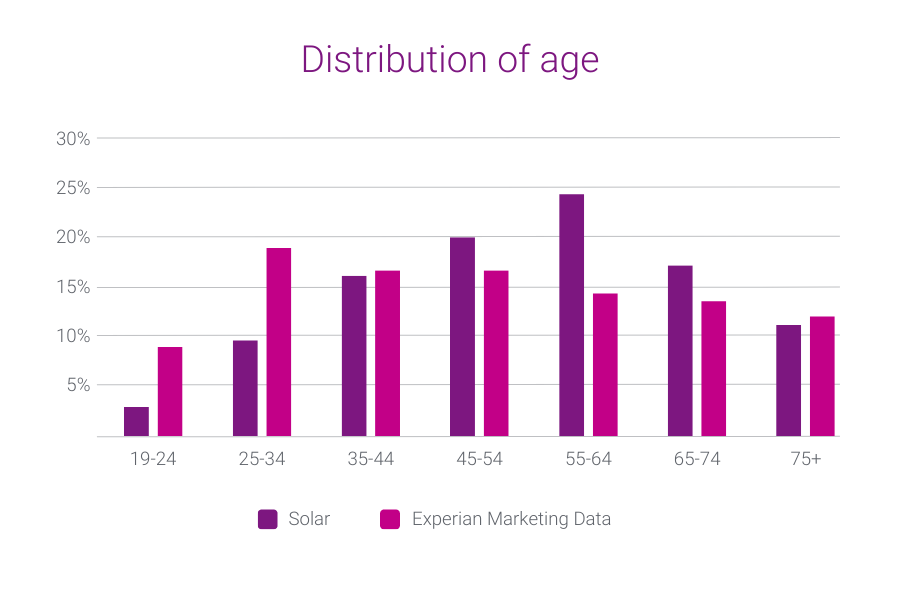
consumers in the eco-conscious solar energy audience are more likely to be between ages 45-74

Education level and occupation

Consumers in our Solar energy audience are more likely to have graduated from college or graduate school and work in management-level occupations.
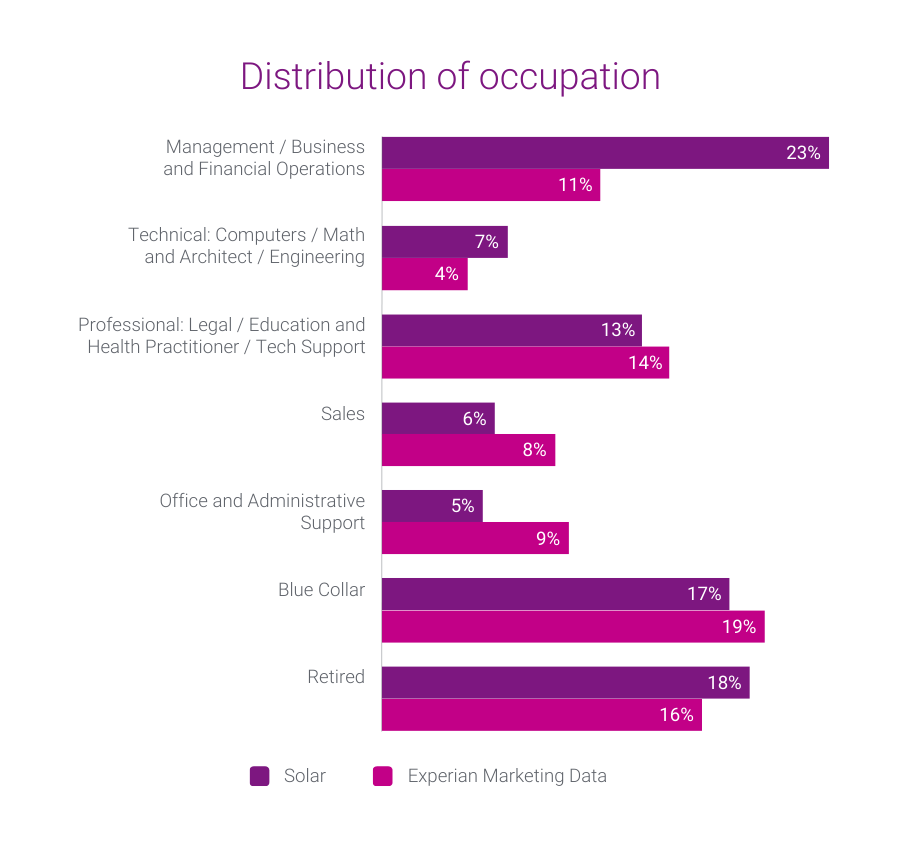
consumers in the eco-conscious solar energy audience are more likely to work in management-level occupations

Household income

Consumers in our Solar energy audience have household incomes of more than $75,000 and their homes are valued at over $550,000.
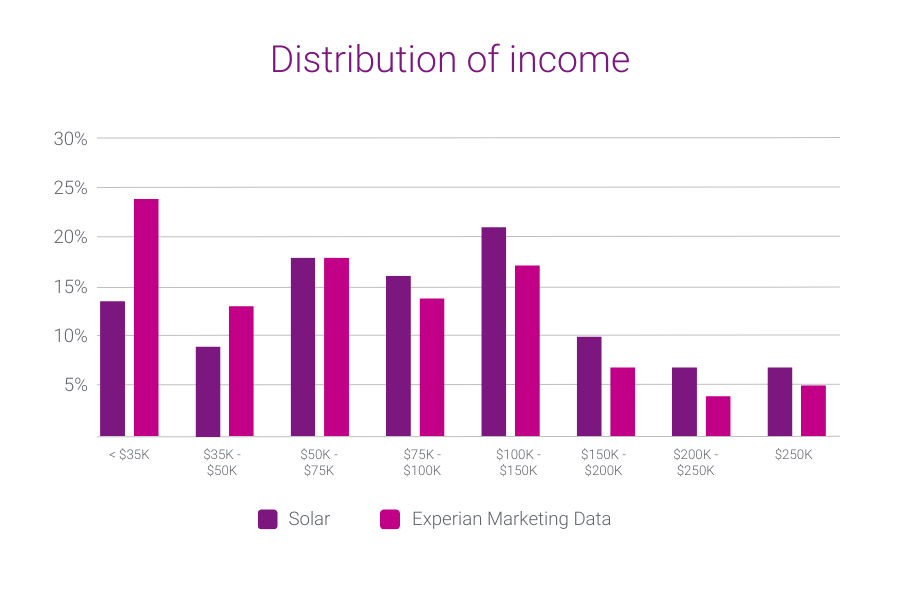
consumers in the eco-conscious solar energy audience have household incomes of more than $75,000

Preferred engagement channels

Consumers in our Solar energy audience are most receptive to ads served through digital channels like digital newspapers and email.
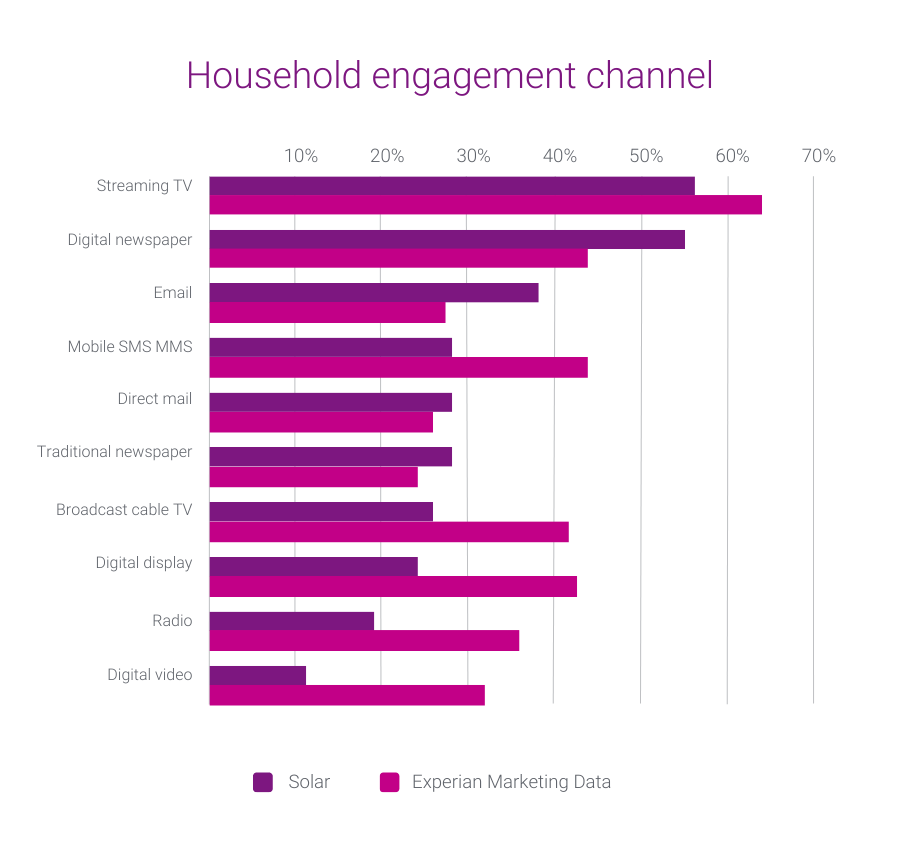
consumers in the eco-conscious solar energy audience are most receptive to ads through streaming tv and digital newspaper

Solar energy audience pairings

Consumers in our Solar energy audience also belong to three of our Mosaic® USA groups:

  1. Power Elite
  2. Flourishing Families
  3. Booming with Confidence

Our consumer segmentation portal of 126 million households and 650 lifestyle and interest attributes empowers marketers like you to precisely target your ideal audience and communicate with them on a personal level. Mosaic’s data segments the U.S. into 19 overarching groups and 71 underlying types, giving you the insights needed to anticipate the behavior, attitudes, and preferences of your most profitable customers and communicate with them on their preferred channels, with messaging that resonates.

GreenAware

Our second eco-conscious audience is GreenAware.

GreenAware segments the 126 million U.S. households within Experian Marketing Data into four distinct groups. Each group differs in their attitudes and behaviors toward purchasing products that are environmentally safe and working with companies that are eco-conscious. We created these groups using an enhanced application of traditional statistical clustering techniques based on environmentally relevant measurements in Simmons’ National Consumer Study.

Based on the distinctive mindset of consumers toward the environment, you can learn how environmental concerns fit into their lives through four major consumer segments:

  1. Eco-Friendly Enthusiasts
  2. Sustainable Spectators
  3. Passive Greenies
  4. Eco Critics

Let’s dive deeper into each group to understand their unique perspective on the environment and how this impacts their attitudes and behaviors.

Eco-Friendly Enthusiasts

This eco-conscious segment prioritizes a green lifestyle and takes pride in avoiding products that harm the planet. With traditional and liberal values, they embrace optimism and prioritize family. With their children out of the house, they take the time for some well-deserved rejuvenation and are committed to a healthy lifestyle. Some members of this group are transitioning into retirement and welcoming a new chapter in their life.

  • Mature adults and retirees
  • College graduate or more
  • Above average income
  • May be married or single
  • Typically own their homes

Sustainable Spectators

This segment aspires to be more sustainable, but they struggle with translating their green ideas into action. They have a soft spot for a cozy home. While their love for interior design and taking care of their own space is evident, they’re always looking for new experiences and opportunities to learn. Staying healthy and active is a top priority for this group, so it’s no surprise that they’re always looking for ways to stay fit and feel their best.

  • Established and mid-life adults
  • College graduate or more
  • High income
  • Typically married
  • Likely to own their homes

Passive Greenies

This is the largest and one of the most youthful groups. Known for their love of exploration and self-discovery, they may not have fully embraced eco-conscious behaviors yet, but they are eager to stay current with the latest technology and trends. With their incredible ability to multitask, they’re always on-the-go, and constantly seek the next best thing.

  • Mainly young adults and diverse
  • Education ranges from high school through some college
  • Below average income
  • More likely to be single or divorced
  • Typically rent

Eco Critics

This group is not likely to be eco-conscious and may have negative attitudes about the environment. They are confident, driven, and focused on their personal growth. They crave instant gratification, seeking out quick and easy solutions to their everyday decisions. They place a high value on entertainment, their social life, and carefully curate their image.

  • Young and established adults
  • Education ranges from high school through post-graduate studies
  • High income
  • Married or single
  • Typically own their homes

Let’s take a look at how the GreenAware segments stack up against each other in terms of age, household income, education level, and media preference. How do they compare? Let’s find out.

Age

Consumers in the Eco-Friendly Enthusiasts segment are the oldest of the four GreenAware segments – about half of the consumers are 65 or older. Eco Critics are the youngest segment, with over half of consumers in this group between ages 25-44.
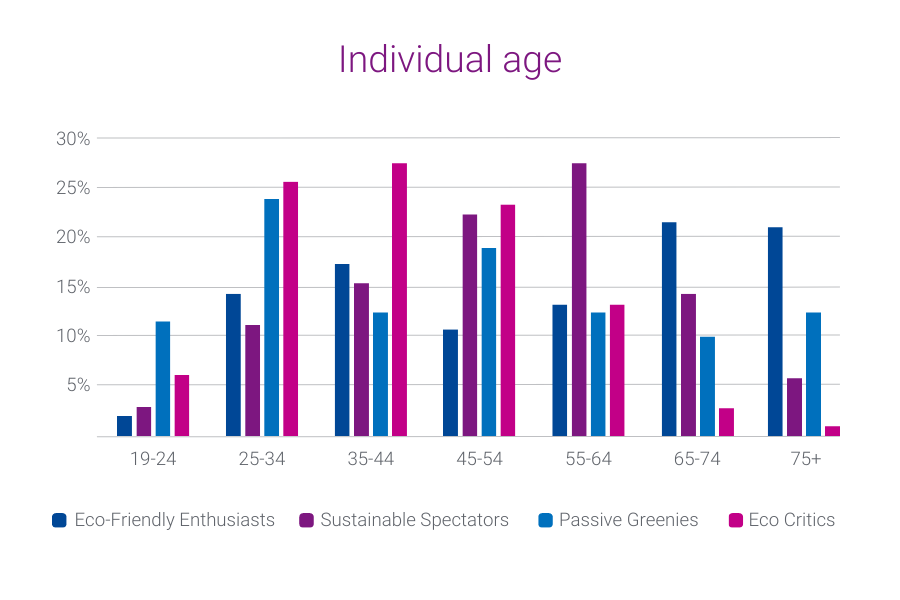
consumers in the "eco-friendly enthusiasts" audience are the oldest of the eco-conscious audience segments

Household income

Sustainable Spectators and Eco Critics are the wealthiest GreenAware segments. The average household income of consumers in these segments is above $100,000. Passive Greenies have the lowest household income, with a majority below $50,000.
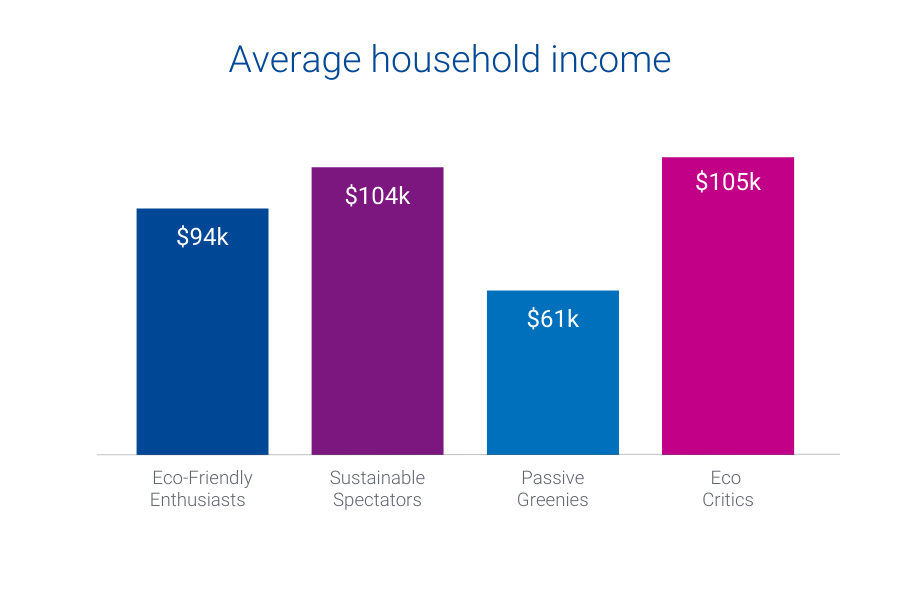
sustainable spectators and eco critic consumers are the wealthiest of the eco-conscious audiences

Education level and occupation

Passive Greenies are more likely to work Blue Collar jobs and have the lowest level of education. As the wealthiest segments, Sustainable Spectators and Eco Critics have the highest levels of college degrees and work in management, business, and financial operations. Eco-Friendly Enthusiasts are the most likely to be retired and out of the workforce.
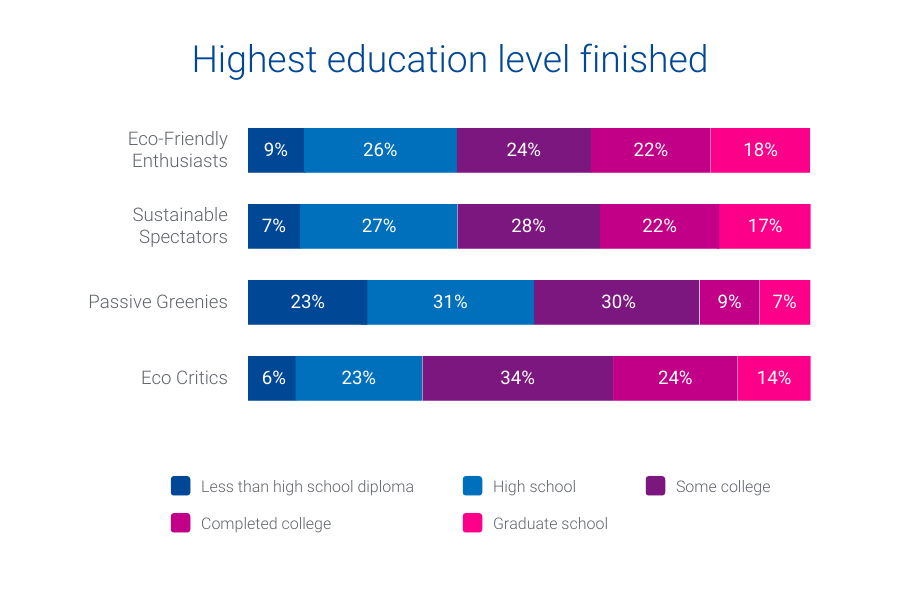
graph of eco-conscious audiences and the highest education level they have finished

Preferred engagement channels

  • Streaming TV is the preferred engagement channel for all GreenAware segments.
  • Eco-Friendly Enthusiasts prefer digital channels like digital newspapers, mobile SMS, and email. They also engage with traditional channels like direct mail and newspaper.
  • Passive Greenies have a high preference for digital display, mobile SMS, digital video, broadcast cable TV, and radio.
  • Eco Critics have a high preference for digital channels like digital newspapers, mobile SMS, and digital display.
  • Sustainable Spectators strongly prefer digital newspapers. They don’t show as strong of a preference for mobile SMS and digital display as Eco Critics and Passive Greenies.
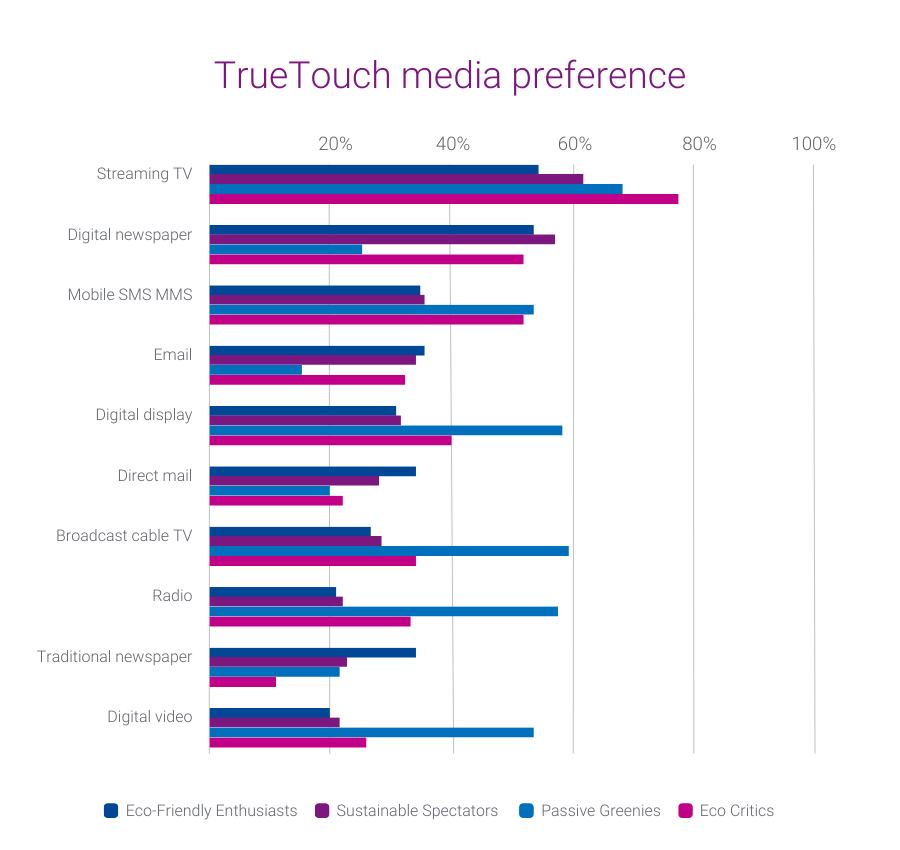
graph of the eco-conscious audiences' preferred engagement channels

GreenAware audience pairings

Six of our Mosaic groups have at least one GreenAware segment with 10% or more of the population. For more precise targeting, below are suggested Mosaic audiences you can pair with each GreenAware segment:

Eco-Friendly EnthusiastsSustainable SpectatorsPassive GreeniesEco Critics
Booming with ConfidencePower EliteSingles and StartersPower Elite
Autumn YearsBooming with ConfidenceGolden Year GuardiansSuburban Style
Golden Year GuardiansSingles and Starters

Electric vehicles

Our third eco-conscious audience is electric vehicles.

Electric vehicles (EVs) are having a major moment in the automotive industry. This is no surprise given that new EV models are being released and an increasing number of charging stations are popping up around the country. As EVs become more prominent, it’s essential to stay up to date on relevant trends to make informed decisions about what lies ahead.

The demand for electric vehicles (EVs) is on the rise

Consumers are embracing the EV revolution, showing their desire for a cleaner, greener future. Automotive marketers are increasingly looking to reach in-market EV shoppers and current alternative fuel vehicle owners due to the growing availability of electric vehicles, improved infrastructure, and rising popularity. In 2022, EVs charged up the market and accounted for a remarkable 6% of new retail registrations.

While Tesla continues to dominate the EV market, Ford, Chevrolet, and Hyundai are starting to compete, each holding more than 3% of the market share of new retail EV registrations.
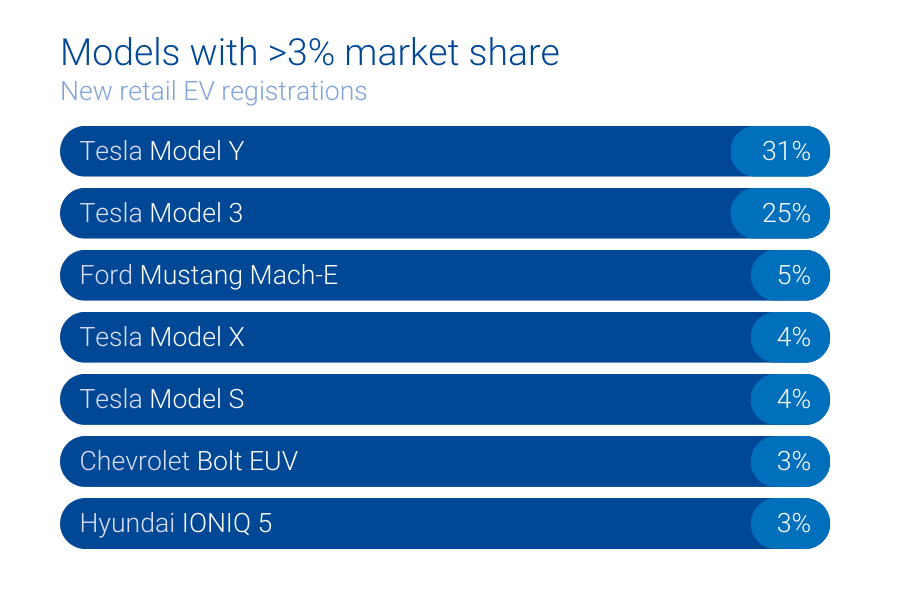
graph showing the demand for electric vehicles by model

Geography

Where are we seeing the most new retail EV registrations? The top designated market areas (DMAs) for new retail EV registrations are mostly located in heavily populated, coastal cities like Los Angeles, CA and New York, NY.
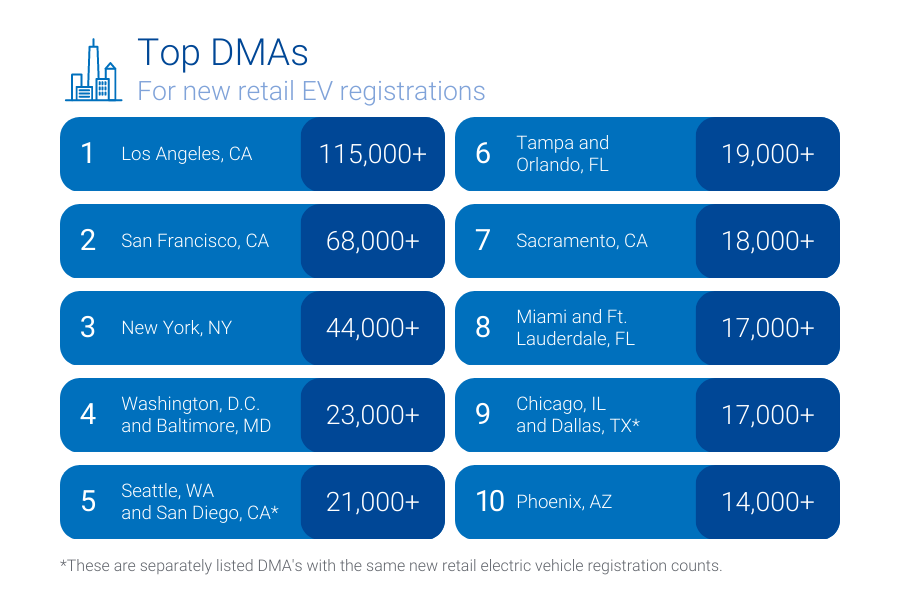
graphic showing the top designated market areas for new retail EV registrations

The fastest growing DMAs, however, are in smaller cities like Tucson, AZ and Oklahoma City, OK.

Generational demographics

Gen X and Millennials make up the largest percentage of new retail EV buyers at 37.5% and 34.4%. Gen Z and the Silent generation represent the smallest shares at 5% and 2.1%. Boomers hover between Gen X and Millennials’ share and account for 20.6% of new EV retail purchases.

EV audience pairings

Our top five Mosaic groups for new EV buyers include:

  1. American Royalty
  2. Cosmopolitan Achievers
  3. Philanthropic Sophisticates
  4. Couples with Clout
  5. Fast Track Couples

How to target consumers in-market for electric vehicles

We offer 70+ audiences that are focused on likely buyers and owners of EV and plug-in hybrid (PHEV) vehicles. We also offer a subset of 28 audiences focused on individual EV/PHEV vehicle models.

Below is how you can find a few of these audiences on-the-shelf of most trusted advertising platforms:

  • Autos, Cars, and Trucks > In Market-Fuel Type > Electric
  • Autos, Cars, and Trucks > In Market-Fuel Type > Used Electric
  • Autos, Cars, and Trucks > In-Market Make and Models > Tesla
  • Autos, Cars, and Trucks > In-Market Make and Models > Chevrolet Bolt EV

We can help you reach eco-conscious consumers

Earth Day is a great opportunity to get creative with your marketing efforts with our three eco-conscious audiences: Solar energy, GreenAware, and electric vehicles. To find out how you can add eco-conscious audiences to your marketing plan, contact us.

Get in touch

This site is protected by reCAPTCHA and the Google Privacy Policy and Terms of Service apply.


Latest posts

Loading…
Case study: How Swiss Sense developed a data-driven international growth strategy using Experian’s Mosaic® data

Swiss Sense’s mission is to provide exceptional sleep comfort for all. The European retailer analyzed their customer data in one market to better understand their ideal customer profile and scale these learnings to other markets. To achieve this, Swiss Sense used Experian’s Mosaic® data, a profiling tool that segments households into categories based on their lifestyle, interests, and demographics. Using Mosaic data, Swiss Sense identified key customer personas and tailored their communications to match. Partnering with Experian, they created personalized product recommendations and delivered targeted messaging through direct mail, out-of-home (OOH) advertising, and leafleting campaigns. What is Mosiac? Experian’s Mosaic data helps businesses understand their customers better by grouping households into segments based on their lifestyles, interests, and financial situations. It gives marketers a clear picture of who their customers are, so they can create more targeted campaigns. Challenge: Utilize data-driven insights to drive market-specific growth strategies Swiss Sense wanted to expand its presence across all of its markets. To achieve this, they analyzed customer data in the Netherlands to identify their ideal customer profiles and replicate their success in other regions. Their objectives included: Develop regional strategies Integrate data-driven insights into their local and international marketing strategy The solution to achieve data-driven marketing Swiss Sense saw that Experian could provide a data-driven view of customers in other countries using both Global and local Mosaic profiles. They chose Experian as their partner to ensure a persona-based segmentation across multiple countries. This partnership allowed Swiss Sense to: Gain consistent customer insights across all operational markets.  Equip marketing and operational teams with precise data for targeting and personalization. Drive adoption of the segmentation strategy by giving end users access to a bespoke dashboard with the data. Results: Driving targeted marketing and personalized experiences with Mosiac By partnering with Experian, Swiss Sense was able to seamlessly implement a solution tailored to their unique needs. Swiss Sense gained an overview of its customer base while using the more granular Mosaic data in each country to gain the optimal understanding of each region’s customers.  These insights helped Swiss Sense’s marketing team, allowing them to craft targeted customer content, suggest relevant imagery, and adopt the right tone of voice. Identifying key Mosaic growth segments further enabled Swiss Sense to focus marketing efforts on regions and cities over-indexing for their ideal customer types. This led to the execution of highly targeted offline campaigns, including: Direct mail flyers delivered to target audiences’ homes OOH advertising in cities where key segments over-index Distributing leaflets in public places such as target town centers Download our case study for the full details of Swiss Sense’s journey to international growth.  Download the full case study now Contact us About Swiss Sense Founded by the Diks family in 2006, Swiss Sense is a Dutch family-owned retailer specializing in high-quality beds, mattresses, and bedroom accessories. With over 2,000 employees and stores across multiple European countries, Swiss Sense is dedicated to providing exceptional sleep comfort for all. To learn more, please visit www.SwissSense.nl. Latest posts

Jan 23,2025 by Lucy Simmonds, Content Marketing Specialist

Four themes we saw at CES 2025

Every year, the Experian team attends the Consumer Electronics Show (CES) in Las Vegas to study the latest technological advancements and innovations that shape the AdTech industry. The energy at CES 2025 was palpable, with a whirlwind of conversations around artificial intelligence (AI), connected TV (CTV), privacy-first solutions, and sustainability in advertising. Here are four standout themes from this year’s event. 1. The AI evolution: More buzzwords, but growing potential AI dominated discussions this year, but the gap between hype and practical application was still evident. While some vendors showcased innovative tools for campaign optimization and audience creation, much of the buzz felt aspirational.  The use of AI to generate audiences based on new types of data is a promising sign of things to come. Data providers, including those collaborating with Experian, are beginning to test AI tools to enhance audience accuracy and scale. The AI space still feels frenetic, but the potential for transformative change is undeniable. "AI was a hot topic, with discussions ranging from campaign optimization tools to audience selection. While many leaned on buzzwords, there were glimpses of legitimate use cases."Brooke Logan, VP of Data Strategy and Partnerships 2. CTV: A race for quality and curation CTV remained a popular topic at CES, particularly around the challenges of fragmentation and scale. Sellers are grappling with an oversupply of inventory, leading to a renewed focus on curation. Conversations highlighted the importance of premium audiences, brand safety, and identity resolution. In the fragmented CTV landscape, advertisers want to be able to define an audience once, have that audience be highly addressable, and then activate everywhere. One standout theme was the shift in CTV monetization strategies. With linear TV revenues declining, major publishers are exploring ways to maximize yields on streaming platforms. Direct-sold premium inventory still reigns, but programmatic is gaining traction—a trend we’re seeing driven by publishers seeking scalable solutions. "CTV remains fragmented. While premium inventory is largely direct-sold, big publishers are exploring ways to boost yield on streaming as linear revenue declines."Lauren Portell, Sr. Account Executive, Advanced TV 3. Privacy-first solutions The regulatory landscape continues to evolve, and advertisers are responding with innovative, privacy-centric methodologies. For industries like healthcare, privacy-first solutions are being developed from the ground up to comply with current and future regulations. The emphasis on cookieless and contextual advertising remains strong, with data providers utilizing first-party data to enrich audience targeting strategies. "Providers across verticals that are typically more sensitive are developing methodologies from the ground up based on current and future potential privacy regulations."Adam Kobus, Director of Data Partnerships 4. Eco-conscious advertising: Building a sustainable future Sustainability emerged as a growing focus, as indicated by initiatives like Scope3 and Experian’s own carbon reduction goals. Companies are exploring ways to reduce the environmental impact of ad serving and data management. For example, platforms like AdGood are transforming unused CTV inventory into opportunities for non-profit initiatives. While not strictly eco-focused, these efforts signal a shift toward more conscientious advertising practices. "Sustainability is gaining attention, with efforts to reduce the carbon footprint through eco-conscious advertising, data management practices, and ad serving."Erin Wolf, Sr. Account Executive, Demand Partnerships The buzz around Experian The launch of the Experian marketplace and the Audigent acquisition were major talking points, underscoring Experian’s commitment to innovation in AdTech. Together, Experian and Audigent will be an end-to-end solution where publishers big and small can empower marketers to better understand their customers, create precise audience segments, and activate those audiences across the best inventory. Likewise, Experian’s new data marketplace connects TV operators, programmers, supply partners, and demand platforms with top-tier third-party audiences across retail, CPG, health, B2B, and location intelligence. All audiences delivered from our marketplace benefit from our best-in-class offline and digital identity graphs, which ensure addressability across all channels like display, mobile, and CTV.  An exciting year ahead CES 2025 underscored the rapid evolution of the advertising ecosystem. From AI to CTV and privacy-first solutions, the industry is adapting to new challenges and opportunities. As Experian continues to lean into these trends, our role in powering data-driven advertising through connectivity remains more focused than ever. We’re excited to see how these themes will evolve throughout the year and look forward to collaborating with our partners to shape the future of digital advertising. Follow us on LinkedIn or sign up for our email newsletter for more informative content on the latest industry insights and data-driven marketing. Contact us Latest posts

Jan 15,2025 by Experian Marketing Services

What is direct response TV (DRTV)?

Suppose you're watching your favorite TV show, and an ad suddenly catches your attention. It urges you to take immediate action, whether to call a number, visit a website, or text a keyword like ‘DETAILS’ to a specific number for more information. This is direct response television (DRTV), a powerful form of advertising available on all TV types — including live, cable, and streaming — that directly connects brands with consumers to drive immediate engagement and measurable results. The goal of DRTV marketing is simple: convert viewers into customers quickly and measurably by asking them to do something in real time. Every DRTV ad is carefully designed to drive quick conversions with a clear, direct path from interest to action. This makes it an essential tool for marketers who need to measure their return on investment (ROI) for TV and see instantaneous results. Key benefits of DRTV marketing Unlike traditional TV ads that build long-term brand awareness, DRTV campaigns are focused on driving instant results and are surprisingly effective at doing it. Here are a few benefits of DRTV and why it’s a powerful tool for marketers in a digitized world. Immediate customer engagement One of the biggest advantages of DRTV is its ability to engage customers right off the bat. DRTV grabs attention and motivates people to act now, whether with a phone number on the screen, a QR code to scan, or a limited-time offer, often with compelling incentives. Measurable ROI DRTV is designed to deliver precise, trackable results. Because the ads encourage specific actions — like visiting a website or calling a phone number — it’s easy to see what’s working and what’s not. Marketers can measure everything from sales to lead generation, which guides them in refining their strategies for even better results. Pairing DRTV with digital tools, like web analytics or CRM systems, can provide even deeper campaign performance insights. Broad reach Even in the streaming age, live TV and cable still attract millions of viewers, which makes DRTV excellent for brands needing to expand their reach. Marketers can even tailor DRTV ads to specific audiences by choosing the best time slots on the proper channels. Whether you’re targeting parents watching morning news or sports fans tuning into big games, you’ll know you’re connecting with the right people at optimal times. Types of DRTV ads DRTV advertising offers several formats, each suited to different audiences, budgets, and goals, whether you’re introducing a new product or driving traffic to your website. Infomercials Infomercials are the classic, long-form DRTV ads that most people associate with the term. These ads typically run for 15-30 minutes and go into detail on product benefits and features. They often include demonstrations and special offers to educate and engage viewers with urgent, limited-time deals. Think of the iconic “But wait, there’s more!” ads used to sell everyday items ranging from household cleaners to exercise equipment. Short-form ads Short-form DRTV ads are 30-second to 2-minute ads that get straight to the point with a single message or offer and a clear call-to-action (CTA) to encourage immediate engagement. Short-form ads are ideal for quick bursts of information, like promoting a flash sale or highlighting a new product. A 60-second ad showcasing a new mobile app might feature a quick walkthrough of its features, followed by a QR code or website URL to download it instantly. Product demos Some DRTV ads focus exclusively on demonstrating how a product works in real-life scenarios. These ads are great for showing off unique features or solving familiar pain points that make the product feel essential. A cookware brand might show how its nonstick pans make cooking and cleanup a breeze while including a CTA to “order now and get a free bonus spatula!” Testimonials Testimonials from real customers or experts are a great way to build trust and credibility.  Hearing someone’s success story or endorsement of a product or service can help viewers feel confident about their purchase decision. A skincare brand, for example, might air a two-minute ad of a dermatologist explaining the science behind the product, along with five-star reviews from satisfied users. Call-in contests or limited-time offers This type of DRTV ad creates urgency by promoting a special offer or giveaway. Viewers might have to call a number or visit a website within a specific timeframe to claim the deal. For example, travel agencies sometimes air ads offering free vacations or planning kits to the first 100 callers, which helps them generate immediate leads. Hybrid ads with digital integration Many modern DRTV campaigns blend traditional TV with digital tools, like QR codes, social media hashtags, or links to custom landing pages. These hybrid ads meet viewers wherever they are. A fitness program might air a short-form ad with a QR code linking to their free app trial, making it easy for viewers to instantly engage. Success tips for DRTV advertising Creating a successful direct response TV campaign centers on messaging that resonates with the right audience, inspires action, and delivers measurable results. Here are some essential tips for a winning DRTV strategy. Strong CTA Every DRTV ad should include a compelling, straightforward CTA that motivates viewers to act immediately. Whatever it is, your CTA should be easy to understand and time-sensitive to create urgency, such as, “Claim this limited-time offer in the next 30 minutes!” Multi-channel integration Direct response TV works best when part of a broad multi-channel strategy, so you should make sure your campaign integrates well with digital channels. This can reinforce your message, help consumers engage across platforms, and drive better results. Audience targeting Precise audience targeting is critical to DRTV campaign success. Experian’s advanced TV audiences, developed with the Advertising Research Foundation (ARF), help you connect with the right viewers to drive immediate action. These syndicated audiences are now available on FreeWheel, the TV advertising industry’s global tech platform. With over 2,400 ready-to-use audience segments, Experian enables you to target specific groups, such as: TV viewership audiences: Target households based on viewing habits and preferred devices. In-market car buyers: Reach consumers actively searching for their next vehicle, which is ideal for driving sales. Holiday shoppers: Engage gift-givers, deal-seekers, and travelers during peak shopping seasons. New TV audiences released in August 2024 In addition to these, our August 2024 release introduced several updates that further refine Experian’s targeting capabilities. Some of the audience updates in this release included: New retail transaction audiences: These segments offer insights into categories like children’s products, parenting, hobbies and crafts, science and nature, and sports and fitness. With high spending and frequent purchase behaviors, these audiences provide a deeper understanding of consumer preferences. Notable segments include: Sports and fitness high spenders Children’s product high spenders Science and nature high spenders Updated TV audiences: New and refreshed TV segments now reflect the viewing habits of today’s consumers for accurate insights and targeting. Examples of newly added segments include: Free and paid ad-supported streaming TV subscribers Satellite service subscribers Cable and streaming TV service subscribers With these advanced targeting capabilities, your DRTV campaigns can be more effective and resonant with viewers most likely to respond for maximum ROI and engagement. Effective planning A strong DRTV campaign starts with defining your objectives, budgeting effectively, and identifying the right media mix. Understanding where your audience spends their time — prime-time TV or niche cable channels — will get you the most value from your DRTV investment. Real-time tracking Tracking your DRTV campaign’s performance in real time is critical for success. Tools that provide immediate insights into viewer responses, website visits, or call volumes allow you to identify what’s working and pivot quickly if needed. Measuring success Measuring success against key performance indicators (KPIs) like conversion rates, ROI, or cost-per-acquisition (CPA) is an excellent way to know if your DRTV campaign is delivering results. Experian’s advanced data solutions make tracking and analyzing campaign performance easier, so you can make data-informed decisions and deliver precise results to stakeholders. Continuous optimization DRTV marketing is an ongoing effort. Use the insights from real-time tracking and performance measurement to refine your strategy. Optimization keeps your campaign relevant and effective, whether you need to tweak your CTA, adjust your audience targeting, or test new creative formats. How DRTV relates to advanced TV and connected TV While DRTV has historically focused on immediate viewer actions via traditional linear TV, it’s found new relevance within advanced TV and connected TV (CTV) ecosystems. These modern formats expand the measurable, action-driven qualities of DRTV while incorporating the precise targeting and personalized storytelling made possible by digital technologies. DRTV and advanced TV Advanced TV enhances DRTV by enabling addressable advertising, which helps marketers deliver ads to specific households based on behavioral or demographic data. For instance, using tools like Experian’s Graph, advertisers can integrate data sets across multiple sources to refine audience segmentation and tailor messages to individual households.  Advanced TV also supports cross-channel consistency to provide a unified customer experience whether the viewer engages with linear TV, streaming services, or other devices. Additionally, programmatic ad buying plays a role in automating the ad-buying process. This helps advertisers optimize their bids and placements and get DRTV campaigns in front of the right audience at the right time, which maximizes cost-efficiency across both traditional and digital channels. DRTV and CTV CTV has a high rate of logged-in, authenticated viewers and provides a lot of helpful first-party data. This allows for hyper-precise audience targeting, cross-device attribution, and an ability to link ad exposure to conversions — even when purchases occur on non-CTV devices. Universal IDs like UID2 further strengthen these capabilities by creating consistent and privacy-respecting user identities across platforms. Experian’s TV partnerships Through partnerships with leading CTV players like Madhive, Samsung, Disney/Hulu, and others, Experian’s identity solutions integrate seamlessly to support well-timed, personalized ads across major streaming platforms. These integrations, powered by our Digital and Offline Graphs, offer a complete view of audiences to enable more controlled, effective activation across mediums, including free ad-supported streaming television (FAST) channels. Using Experian’s advanced data and identity tools, advertisers can tap into the full potential of DRTV strategies within advanced TV and CTV to make campaigns more actionable, efficient, and impactful. The future of DRTV So, what is DRTV going to look like in the future? With the integration of digital and television platforms, DRTV is becoming more targeted, interactive, and personalized. This shift creates new opportunities for advertisers to drive conversions. Here are some key advancements that will continue to shape the future of DRTV: Addressable TV: Advertisers can deliver targeted ads to specific households based on demographic and behavioral data. It uses data from smart TVs, streaming devices, and third-party data providers to enable highly relevant ads based on the interests of individual viewers. Interactive TV ads: Interactive TV ads enable viewers to engage directly with the content through their remote control or mobile devices. Users can click on a product for more information or make purchases without leaving the TV screen and immediately convert. Authenticated audiences: With CTV and AI technology, advertisers can use first-party data from authenticated users to improve targeting, measurement, and campaign performance. Advertisers can create a more cohesive and personalized experience by linking viewers across multiple devices, which improves ad effectiveness and attribution. Branded apps with saved information: Branded apps that store payment and personal information streamline the direct response process. These apps reduce purchase journey friction and allow quicker conversions, as viewers can complete transactions with fewer steps. QR codes replacing URLs: QR codes are becoming a popular alternative to traditional URLs in DRTV ads. These codes provide a quick, convenient way for viewers to visit a website, access a product page, or act on a CTA simply by scanning the code with their phone. Better targeting algorithms: Advancements in targeting algorithms allow advertisers to serve more personalized and relevant ads. These algorithms help ads reach the right audience at the right time, which can increase engagement and conversion rates. These innovations offer advertisers more tools to connect with audiences in a personalized, interactive, and measurable way. Connect with Experian’s TV experts Experian can help you achieve the full potential of your direct response TV advertising efforts with our advanced tools, precise audience targeting, and strong industry partnerships. We help brands create impactful DRTV campaigns that drive real-time engagement, audience connection, and measurable results, whether for traditional, advanced, or CTV. Reach out today to work with us on your DRTV efforts and achieve better ROI, or explore how our expertise can transform your TV advertising campaigns. Connect with our TV experts Contact us Latest posts

Jan 09,2025 by Experian Marketing Services

Subscribe to our newsletter

Enter your name and email for the latest updates

This site is protected by reCAPTCHA and the Google Privacy Policy and Terms of Service apply.

About Experian Marketing Services

At Experian Marketing Services, we use data and insights to help brands have more meaningful interactions with people. As leaders in the evolution of the advertising landscape, Experian Marketing Services can help you identify your customers and the right potential customers, uncover the most appropriate communication channels, develop messages that resonate, and measure the effectiveness of marketing activities and campaigns.

Visit our website

Subscribe to our newsletter

Stay up to date on the latest industry news and receive expert tips from our marketing experts.
Subscribe now!