Healthcare marketing lacks a connected customer view. Here’s how to build one.

by Kevin Dunn, Chief Revenue Officer 9 min read August 19, 2026

At A Glance

Healthcare marketers are spending record amounts on pharma advertising, but most still can't connect campaign exposure to prescribing outcomes. This article explains why fragmented data, identity, and measurement systems break the link between patient (DTC) and healthcare professional (HCP) audiences, and the infrastructure that closes that gap.

Originally published in AdExchanger

Key takeaways

  • Pharma digital ad spend is tracking between $22 billion and $26 billion in 2026, yet most brands still can’t connect ad exposure to prescribing behavior.
  • DTC and HCP teams need to agree on a shared measurement framework before a campaign launches, not after, so performance can be judged on one standard.
  • Experian’s identity infrastructure keeps DTC and HCP data governed separately through two distinct paths while still making cross-audience measurement possible.
  • Experian’s Audience Engine connects audience building to activation, giving teams access to premium publisher inventory and a marketplace of 19+ verified health data partners.

Healthcare marketing teams are spending more than ever. Pharma digital ad spend is now tracking between $22 billion and $26 billion in 2026, with connected TV (CTV) overtaking search as the most noticed healthcare ad channel. Yet most brands still can’t draw a straight line from campaign exposure to a filled prescription.

The problem isn’t budget or creative. It’s a structural gap in how healthcare marketers connect data, identity, and measurement across patient (DTC) and healthcare professional (HCP) audiences.

That gap is widening as campaigns grow more complex. A brand running a simultaneous patient (DTC) push and healthcare professional (HCP) engagement program is running two disconnected programs with different data sources, identity schemas, agency relationships, and definitions of success. When a patient sees a CTV ad and their cardiologist receives a targeted digital engagement the same week, almost no brand can confirm that those two exposures happened, let alone measure their combined effect on prescribing behavior.

Why is data fragmentation becoming a bigger challenge for healthcare marketers?

Data fragmentation is becoming a bigger challenge for healthcare marketers because the accuracy pharma brands are paying for in digital media doesn’t match what most measurement stacks can deliver. As pharma shifts spend from linear television to digital channels, the expectation of accuracy comes with it. Brands can no longer accept “we reached the right demographic” as a measurement answer when they are paying programmatic CPMs and expecting outcomes measured in script lift.

The typical healthcare marketer is working with three or four disconnected data environments. Consumer data lives in one place. Claims and National Provider Identifier (NPI) records live in another. Media reporting from the agency is in a third. Analytics and measurement are downstream of all of them, often running on a different timeline. Each handoff introduces the potential for data loss, and those losses compound across a campaign flight.

This creates a reporting picture that tells you what happened in each channel but not what worked across them. That distinction matters enormously when the goal isn’t impressions but activation, adherence, or prescribing behavior.

The missing layer in pharma marketing. Watch our Q&A

Does fixing healthcare data fragmentation mean merging DTC and HCP data together?

No, merging DTC and HCP data together isn’t the answer to healthcare data fragmentation. Healthcare data environments have strict governance requirements, and the separation of DTC and HCP data is both a regulatory and a strategic necessity. Merging DTC and HCP data into a single undifferentiated pool is not a goal worth pursuing.

What healthcare marketers actually need is a shared infrastructure that lets disparate data environments speak a common language without eliminating the boundaries between them. Three elements make that possible:

1. A shared measurement framework

DTC and HCP teams should agree on the outcomes that matter before campaigns launch, not after. This sounds basic, but it rarely happens. When consumer media teams and medical affairs teams are optimizing different metrics, the brand can’t produce a unified view of performance, no matter how sophisticated the attribution model.

2. A common identity layer is what makes measurement possible across environments

In healthcare, this means maintaining two separate but interoperable identity workflows: a privacy-safe, tokenized identity for consumer audiences, and a deterministic NPI-based resolution for HCP audiences. These workflows need to connect to real activation surfaces, meaning the publisher and platform partners where media actually runs.

Experian’s identity infrastructure is built on this principle, acting as a neutral, interoperable workflow layer. For DTC audiences, that means high-fidelity tokenized matching that preserves accuracy from onboarding through activation and into partner-enabled measurement. For HCP audiences, it means deterministic NPI-based resolution using verified professional attributes including specialty, practice location, and professional address. These are two distinct identity paths, governed to keep DTC and HCP data separate while enabling measurement across both.

3. Feedback loops complete the flywheel

The most durable gap in healthcare campaign management is the distance between what the measurement partner reports and what changes in the next campaign plan. When script lift data from IQVIA or engagement signals from OptimizeRx can’t flow back into audience strategy and channel weighting, each campaign essentially starts from scratch. Closing that loop requires both technical integration and organizational commitment to act on what the data shows.

From onboarding to outcomes

Pharma marketing teams need identity workflows that can support accurate audience creation, governed activation, and partner-enabled measurement without combining DTC and HCP identity paths.

Download our pharma marketing playbook to help your team:

  • Plan DTC and HCP identity strategies with clearer separation
  • Prepare audiences for activation across approved channels and partners
  • Evaluate audience quality, usable reach, and governance
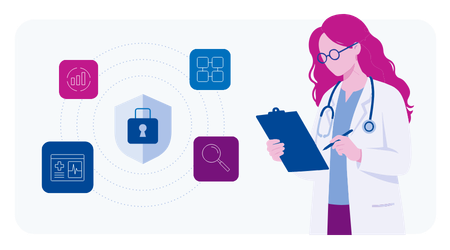
Illustration of a female doctor looking at her clipboard with icons around her that represent privacy, analytics, measurement, and connection.

What does a connected view of DTC and HCP audiences look like in healthcare marketing?

A connected view means DTC and HCP audiences in healthcare marketing runs on identity workflows matched to what each requires, deterministic resolution for HCPs and high-fidelity matching for DTC, with both feeding into shared measurement instead of siloed reporting. Building this kind of connected infrastructure isn’t a one-quarter initiative, but three questions show you where your program stands today.

1. Are your DTC and HCP identity workflows built on deterministic resolution or probabilistic matching?

Depending on pharma brands’ campaign goals, probabilistic matching can support large-scale DTC reach, while targeting HCPs always calls for certainty, typically achieved through deterministic matching. As the need for hyper-specific healthcare audiences grows, the stakes become too high for identity infrastructure that can’t be verified. Experian’s identity infrastructure uses high-fidelity tokenized matching for DTC workflows and deterministic NPI-based resolution for HCP workflows, designed to preserve accuracy from audience creation through activation. HCP resolution draws on verified professional attributes including NPI, specialty, and practice location.

2. Can your audience strategy reach the segments it builds?

A lot of healthcare audience development happens in a spreadsheet or an analytics tool, then breaks down at activation because the IDs can’t be matched to live publisher inventory. Audience strategy needs to be connected to activation from the start. Experian’s Audience Engine enables teams to build, onboard, and activate audiences in a single workflow, with access to premium publisher inventory and a marketplace of 19-plus verified health data partners.

3. Is your measurement tied to business outcomes or to proxy metrics?

Viewability and completion rates matter, but they aren’t the end goal. The measurement partners that matter in healthcare, including IQVIA Digital for script lift, PurpleLab for claims-based analytics, and OptimizeRx for point-of-care engagement, operate at the level of verified DTC and HCP behavior. If your campaign reporting can’t connect to those signals, you’re measuring the wrong things.

Why is infrastructure the foundation for durable healthcare marketing programs?

Infrastructure is the foundation for durable healthcare marketing programs because it’s what lets audience planning, activation, and measurement function as one connected system instead of three separate handoffs that break down under pressure. As healthcare marketing gets more competitive, regulated, and measurable, that connected system is what keeps campaigns from starting over each time.

A connected view of DTC and HCP audiences in healthcare, with the proper guardrails in place, is a strategic decision about how your brand wants to compete. The technology and the partner ecosystem exist to make it real. The question is whether your marketing organization is structured to take advantage of it.

Ready to build a connected healthcare identity strategy?

Our team works with pharma brands to align identity, audience, and measurement across DTC and HCP programs. If you’re ready to close the gap between data and outcomes, let’s talk.

This site is protected by reCAPTCHA and the Google Privacy Policy and Terms of Service apply.


About the author

Head-and-torso portrait of a smiling adult man with short brown hair, wearing a white collared shirt layered under a dark sweater and black jacket, posed against a plain light gray background.

Kevin Dunn

Chief Revenue Officer, Experian

Kevin Dunn joins Experian Marketing Services with more than 20 years of leadership experience across marketing and advertising technology, most recently serving as Senior Vice President of Brands and Agencies at LiveRamp. In that role, he led growth across retail, CPG, travel, hospitality, financial services, and healthcare, overseeing new business, account expansion, and channel partnerships.

Kevin is known for building cohesive, accountable teams and leading with optimism, clarity, and a strong sense of shared purpose. His leadership philosophy centers on empowering people, driving positive outcomes for clients and fostering a culture where teams can grow, take smart risks, and succeed together.


FAQs

Most pharma brands can’t connect a CTV ad exposure to a prescribing decision because their DTC and HCP data runs through three or four disconnected environments: consumer data, claims and NPI records, agency media reporting, and downstream analytics. Each handoff between those systems introduces potential data loss, and those losses add up across a campaign flight, leaving brands with channel-level reporting instead of a connected view of what actually moved prescribing behavior.

Building a connected identity strategy doesn’t mean combining DTC and HCP data into one data set. Healthcare data environments carry strict governance requirements, so DTC and HCP data need to stay separate for both regulatory and strategic reasons. A connected identity strategy links those separate environments through interoperable workflows rather than merging them into one data set.

Experian helps pharma brands connect DTC and HCP measurement without merging their data by running two distinct, governed identity paths: high-fidelity tokenized matching for DTC audiences and deterministic NPI-based resolution for HCP audiences, built on verified professional attributes like specialty and practice location. That structure lets brands measure performance across both audiences while keeping the underlying data separate.


The difference between deterministic and probabilistic matching in healthcare marketing comes down to certainty: probabilistic matching can support large-scale DTC reach where some statistical estimation is acceptable, while HCP targeting calls for certainty that only deterministic matching, typically based on verified NPI data, can provide. As healthcare audiences get more specific, the cost of an unverified match rises, which is why HCP resolution leans deterministic.


If a healthcare marketing team’s audience strategy isn’t translating into activation, the first thing to check is whether those audience segments can actually reach live publisher inventory. A lot of audience development happens in a spreadsheet or analytics tool and then stalls at activation because the IDs never connect to real media. Experian’s Audience Engine builds audience creation, onboarding, and activation into one workflow, backed by a marketplace of 19+ verified health data partners.


Latest posts

A deep dive with an Experian partner, ARF

In our Ask the Expert series, we interview leaders from our partner organizations who are helping lead their brands to new heights in AdTech. Today’s interview is with Samantha Zhang, Senior Data Scientist, and Jim Meyer, General Manager of the DASH TV Universe Study at the Advertising Research Foundation (ARF). DASH is an annual tracking study conducted by the ARF to define and better understand TV audience behavior and household dynamics. What does DASH measure, and how does it help the industry understand TV consumption today?  By capturing hundreds of individual- and household-level data points from each respondent in a rigorous and nationally projectable sample, DASH creates a comprehensive picture of U.S. consumer TV “infrastructure” – how America watches.  Core elements in DASHElements that create context in DASHTV setsLocation | brand | smartness | service modes | sources DemographicsConnected devices Game consoles |video players | streaming devicesYesterday viewing Daypart | TV/device genre | Out-of-home viewingMobile devicesOwners | sharing usersShoppingOnline and in-store | Exposure to major RMNsInternet serviceModes | ISPs | connectivity by device Streaming audio Streaming TVSVOD/AVOD tiers and sharing | FAST Email accounts and apps Live TV Modes of access | including casting from devices Social media For example, DASH gathers: Data on every TV set, including brand, room location, age, “smartness,” and connection devices and modes  Household connectivity and video service data, even in homes with no TV set Internet Service Providers (ISP) and TV service usage, including Multichannel Video Programming Distributors (MVPDs), virtual vMVPDs, streamers (ad-supported and premium), and Free Ad-Supported Television (FAST) channels  Person-level ownership and usage of video-capable mobile devices, including smartphones, tablets, and laptops  Measures of viewing and co-viewing across dayparts, devices, and services  Additional modules covering shopping and retail media networks, streaming audio, social media, email, and apps Broad coverage and granularity make DASH a uniquely robust source of truth for practitioners across the industry, including measurement experts and ad programming strategists. DASH also reports regularly (and publicly) on key industry dynamics. DASH identified a growing segment of device-only viewers – now nearly 9 million households that watch TV, but do not own a TV set – and highlighted the implications of that trend for traditional ratings systems based only on households with TV sets.  Households (HHs – million)2025 HHs (M) U.S. penetrationChange vs. 2024 (M)Total US134.8100%+2.7Connected TV (CTV)114.685%+2.1TV (Set)124.292.2%+1.1Device-only8.86.6%+1.6TV-Accessible133.198.7%+2.7 DASH called out the rise in app-based pay TV and proposed a new connection framework that better represents the modern TV world, in which linear and streaming overlap. DASH also defines the universes of households reachable with advertising. This graphic, for example, shows how all ad-supported linear and streaming properties in aggregate define the true scale of TV advertising. While 35 million households (and growing) are reachable only with streaming ads and 13 million (and falling) only with linear ads, most households are reachable with both, underscoring the importance of understanding the “overlap.” Who uses DASH data, and what decisions does it help inform? There are three primary users of DASH, each with its own use cases: Measurement providers, including Nielsen, use DASH to calibrate viewership data, turn household data into persons data (and vice versa) and estimate potential reached audiences–what the providers call media-related universe estimate (MRUEs)–for the calculation of ratings. Not surprisingly, measurement companies were the first to see the value that an independent TV universe study could provide. Media companies, including major broadcasters and streamers, use DASH to add context and color to their ad sales presentations – and to track the measurement providers, whose ratings play a major role in valuing ad inventory. AdTech companies, including Experian, use DASH to create high-value audience segments for activation. The recent accreditation of DASH by the Media Rating Council (MRC) and adoption by Nielsen as an input to its TV ratings have generated interest from a broad range of companies. We are actively pursuing new licensees and partners to make DASH more useful within, and even outside, the TV ecosystem. What does MRC accreditation signify, and why is it meaningful for DASH?  MRC accreditation means DASH passed a rigorous audit conducted by Ernst & Young over many months, which validated our methodology, controls, and data quality. MRC accreditation establishes that DASH is an industry-standard dataset.  While the service provider normally announces its own accreditation, the MRC took the unusual step of issuing its own release on DASH, announcing the accreditation of DASH for TV universe estimation and endorsing the study for broader, cross-media use. How does Experian use DASH data to build audiences?  The segments combine specific TV usage habits and behaviors from DASH with Experian data on demographics, spending, and other contextual inputs to create a fuller view of consumer viewing behavior. They are designed to be valuable to advertisers in many categories and planning contexts – and to be customizable to fit advertisers’ media targets. The segments can be used to: Apply or suppress audiences to improve target coverage across a campaign  Better align media and creative  Reach elusive but high-value viewers, such as Ad Avoiders  Drive valuable consumer behavior  Achieve specific advertising objectives What are some practical use cases for DASH-based audiences?  Here are some practical use cases for four different kinds of DASH segments in five different advertiser categories.  Travel Co-WatchersA couples-only resort uses TV Co-Watching Households without Children to strengthen target reach and ad memory recallA big theme park destination uses TV Co-Watching Households with Children to reach families in moments of togetherness Home Entertainment TV Owners and Brand LoyalistsA premium TV manufacturer uses the overlap of Multi Brand TV Owners and Single Brand TV Loyalist Households to market its newest TV model to its most loyal consumers. Fast Food Screen Size ViewersA fast food chain with a high-impact new brand campaign uses Large Screen TV Viewers to better align the media and  creativeThat same fast food chain uses Small-Screen TV Viewers to drive store traffic by increasing exposure of its retail campaign among on-the-go viewers Financial Services Cord Cutters A personal cost management app and a cash-back credit card target Streaming-First Cord Cutter Households to reach young, tech-savvy, cost-conscious consumers Thanks for the interview. Where can readers learn more about DASH? We started work on DASH seven years ago, and it’s been fun to watch it “grow up.” Our partnership with Experian is a big step toward putting DASH to work for advertisers and agencies. To learn more, visit our site at https://theARF.org/DASH or contact us at DASH@theARF.org. Contact us About our experts Samantha Zhang, Senior Data Scientist at ARF Samantha Zhang is a Senior Data Scientist at the Advertising Research Foundation working on the DASH TV Universe Study, with additional research spanning areas including attention measurement, digital privacy, and artificial intelligence.  Jim Meyer, General Manager, DASH, at ARF Jim Meyer is general manager and co-founder of the ARF DASH TV Universe Study and managing partner of Golden Square, LLC, which advises media and research technology companies on growth strategy and development. Latest posts

April 30, 2026 by Experian Marketing Services
Reach auto buyers based on how they shop in a changing market with Experian Audiences

Reach buyers based on how they shop in a changing market. Experian Audiences help target switchers, align to budgets, and match messaging to inventory.

April 28, 2026 by Experian Marketing Services
Agentic AI in programmatic advertising: Predictive, identity-driven media

Explore how Experian utilizes AI to power data-driven programmatic advertising with greater accuracy, efficiency, and consumer trust.

April 24, 2026 by Experian Marketing Services