At A Glance
AdTech can feel overwhelming with all its jargon, but we're breaking it down café-style. From first-party data and identity resolution to clean rooms and ID-free targeting, this guide breaks down the essential terms marketers need to know.In this article…
If you’ve ever sat in a meeting and heard an AdTech term you didn’t understand, you’re not alone. The industry evolves as quickly as a café turns over tables on a busy weekend. Even seasoned regulars can get tripped up by the jargon.
So instead of scratching your head over the “menu,” let’s walk through some of the most common terms: served café-style.
The ingredients: The many flavors of first-party data
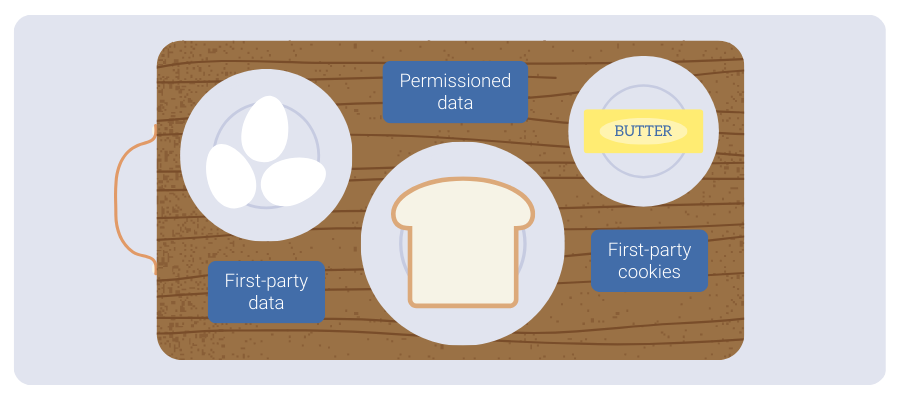
Every meal starts with ingredients, and in AdTech, those ingredients are data. First-party data is not just one thing: it’s more like everything your favorite neighborhood café knows about you.
First-party data
The café knows your coffee preferences because you’ve told them directly; whether by ordering at the counter, calling in, or placing an order online. This is information you’ve willingly provided through your interactions, and it belongs only to that café.
First-party cookies
The barista writes down your preferences in a notebook behind the counter, so next time you walk in, they don’t have to ask. First-party cookies remember details to make your experience smoother, but only for that café.
Authenticated identity
A loyalty app that connects online orders to in-person visits. By logging in, you’re saying, “Yes, it’s really me.” Authenticated identity is proof that the customer isn’t just a face in line, but someone with a verified profile.
Persistent identity
Recognizing you whether you order through the app or in person. Persistent identity enables the ability to keep track of someone across different touchpoints, consistently, without confusing them with someone else.
Permissioned data
Agreeing to join the loyalty program and get emails. Permissioned data is a connection to the customer that the customer proactively shared with the café by signing up for their loyalty program or email newsletter.
Each piece comes from direct interactions, stored and used in different ways. That’s what makes first-party data nuanced. The saga of third-party cookie deprecation and changing privacy regulations makes it important to understand which types of data you can collect and use for marketing purposes.
And once you have those ingredients, the next step is making sure you recognize how they fit together, so you can see each customer clearly. That’s where identity resolution comes in.
The recipe: Bringing the ingredients together with identity resolution
At the café, identity resolution is what helps the staff recognize you as the same customer across every interaction. Without it, they might think you’re two different people; one who always orders breakfast and another who sometimes picks up pastries to go.
Matching
The café has a loyalty program, and the pet bakery next door has one too. When they match records across their two data sets, they realize “M. Jones” from the café is the same person as “Michelle Jones” from the bakery. That connection means they can activate a joint promotion, like free coffee with a dog treat, without either business handing over their full customer lists. In marketing, matching works the same way, linking records across data sets for activation so campaigns reach the right people.

Deduplication
Collapses duplicate profiles into a single, clean record, so you don’t get two birthday coupons, even though that would be nice to get.
That’s what Experian does at scale: we connect billions of IDs in a privacy-safe way, so you can get an accurate picture of your audience.
And once you can recognize your customers across touchpoints, the next challenge is collaborating across systems and partners for deeper insights. That’s where the behind-the-counter processes come in.
Behind the counter: Crosswalks and clean rooms
At a café, these terms are like the behind-the-counter processes that keep everything running smoothly. They may sound technical, but they all serve the same purpose: helping data collaborate across different sources, while keeping sensitive information safe. The goal is a better “meal” for the customer, deeper insights, better targeting, and more personalized campaigns. Here’s how they work.
Crosswalks
The café partners with the pet bakery next door. They both serve a lot of the same people, but they track them differently. With a crosswalk, they can use a shared key to recognize the same customer across both businesses, so you get a coffee refill, and your dog gets a treat, without either one handing over their full customer list. A crosswalk is the shared system that lets both know it is really you, without swapping personal details. It’s the bridge connecting two silos of data.

Clean rooms
The café and the pet bakery want to learn more about their shared customers, like whether dog owners are more likely to stop by for brunch on weekends. Instead of swapping their full records, they bring their data into another café’s private back room, a clean room, where they can compare trends safely and privately. Both get useful insights, while customer details stay protected. That’s a clean room: secure collaboration without exposing sensitive data.
Of course, sharing and protecting data is only part of the picture. The real test comes when you need to serve customers in new ways, especially as the industry moves beyond cookies.
Serving customers in new ways: Cookie-free to ID-free
Targeting has evolved beyond cookies, just like cafés no longer rely only on notebooks to remember regulars.
ID-free targeting
The café looks at ordering patterns, like cappuccinos selling on Mondays and croissants on Fridays, without tracking who’s ordering what. Instead of focusing on who the customer is, the café tailors choices based on the context of the situation, like time of day or day of the week. This is like contextual targeting, serving ads based on the environment or behavior in the moment, rather than on personal identity.

ID-agnostic targeting
The café realizes customers show up in all sorts of ways: walk in, online ordering, delivery. Each channel has its own “ID,” a name on the app, a credit card, or a loyalty profile. ID-agnostic targeting means no matter how you order, the café can still serve you without being locked into one system.
Just like cafés no longer rely only on notebooks to keep track of regulars, marketers no longer have to depend solely on cookies. Today, there are multiple paths, cookie-free, ID-free, and ID-agnostic, that can all help deliver better, more relevant experiences.
But even with new ways to reach people, one big question remains: how do you know if it’s actually working? That’s where measurement and outcomes come into play.
Counting tables vs. counting sales
At the café, measurement and outcomes aren’t the same.
Measurement
Tables filled, cups poured, specials ordered.
Outcomes
What it all means: higher revenue, more loyalty sign-ups, or increased sales from a new promotion.
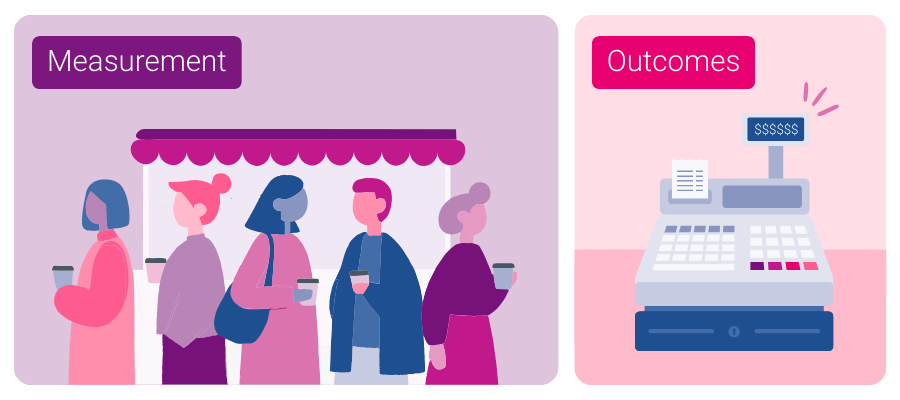
Both matter. Measurement shows whether the café is running smoothly, but outcomes prove whether the promotions and strategies are truly paying off. Together, they help connect day-to-day activity to long-term success.
All of this brings us back to the bigger picture: understanding the menu well enough to enjoy the meal.
From menu to meal
In AdTech, there will always be new terms coming onto the menu. What matters most is understanding them well enough to know how they help you reach your business goals. Just like at the café, asking a question about the specials isn’t foolish. It’s how you make sure you get exactly what you want. The more we, as an industry, understand the “ingredients” of data and identity, the better we can cook up new solutions that serve both brands and consumers. After all, the goal isn’t just to talk about the menu, it’s to enjoy the meal.
At Experian, we help brands turn that menu into action. From identity resolution to privacy-safe data collaboration, our solutions make it easier to connect with audiences, activate campaigns, and measure real outcomes.
If you’re ready to move from decoding the jargon to delivering better customer experiences, we’re here to help
About the author

Brandon Alford
Group Product Manager, Experian
Brandon Alford is a seasoned professional in the AdTech ecosystem with a focus on identity, audience, measurement, and privacy-forward solutions. He has spent his career helping advertisers and publishers navigate the complexities of digital advertising and privacy, bringing a practical and forward-looking perspective to industry challenges and innovation.
AdTech jargon FAQs
First-party data is information a customer shares directly with a brand, like purchase history, preferences, or sign-ups. It’s the most valuable and privacy-safe data marketers can use to build personalized campaigns.
Identity resolution ensures a brand can recognize the same customer across different touchpoints. Matching links records across data sets (e.g., between partners) so campaigns reach the right people without exposing full customer lists.
A crosswalk bridges two data systems with a shared key to recognize the same customer, while a clean room allows partners to analyze data together securely without exposing sensitive details.
Cookie-free and ID-free targeting shift focus away from tracking individuals, instead tailoring ads based on context (like time of day or content being viewed) or allowing flexibility across multiple IDs.
Measurement tracks activity (like clicks or visits), while outcomes prove business impact (like sales, loyalty, or revenue). Both are essential, but outcomes show whether strategies are truly effective.
Experian provides tools for identity resolution, privacy-safe data collaboration, and campaign measurement, helping marketers move from understanding the “menu” of AdTech terms to achieving real results.
Latest posts

Originally appeared in Streaming Media Magazine Navigating today’s fragmented, privacy-conscious media landscape is a bit like stepping into a dense jungle. The buy-side—marketers, agencies, and demand-side platforms (DSPs)—must find their way through signal loss, measurement challenges, and evolving consumer expectations. But this isn’t just a challenge; it’s a strategic opportunity. Let’s dive into how buy-side players can use Experian’s advanced data and identity solutions to be their guide through the jungle and emerge as winners. Marketers: Maintaining personalization and measurement across channels Marketers are navigating an increasingly fragmented media jungle, where the deprecation of signals like cookies, mobile ad IDs (MAIDs), and IP addresses makes finding and understanding audiences feel like guesswork. To chart a clear path, marketers need a reliable compass—and identity resolution provides exactly that. A strong identity provider, grounded in offline data like names, addresses, phone numbers, and emails, acts as a guide through the chaos. By connecting offline signals with digital identifiers in a privacy-first manner, marketers can uncover the relationships between households and devices, then enrich those profiles with valuable marketing data. With a complete view of your customers, you gain deeper insights and can seamlessly reach the right audience across channels—even as signals evolve. It’s a marketer’s North Star—constant, dependable, and always pointing you in the right direction. How Experian can help Imagine a financial services brand aiming to connect with high-net-worth individuals across today’s fragmented media world. They’ve excelled on social and search but now want to dive into connected TV (CTV) and other emerging channels. Enter Experian’s Digital Graph. By seamlessly connecting digital identifiers like MAIDs, CTV IDs and hashed emails (HEMs), our graph becomes the bridge that unifies their audience across every channel. Suddenly, the same audience that saw their ad on social during lunch is now watching a personalized spot on CTV that evening, all thanks to Experian. The result? A cohesive campaign that delivers hyper-relevant messages, stronger engagement, and measurable success. With Experian, fragmentation becomes connection, and personalization stays powerful across the entire media landscape. Agencies: Strategic partners in a fragmented world Agencies are the architects of the identity jungle, building bridges that guide brands through fragmentation and deliver campaign success. Thriving in this terrain requires data solutions that create actionable insights, enable personalization, and drive measurable outcomes. To meet marketers’ demands, many agencies have invested heavily—acquiring data companies or forging strategic partnerships to strengthen their foundations in data and identity solutions. These investments help them connect fragmented audience data and unlock new opportunities for their clients. But even with in-house capabilities, agencies often need more—more attributes, more integrations, and greater connectivity. In the jungle of identity, success isn’t just about building better data assets; it’s about ensuring those assets can be utilized across platforms. How Experian can help Picture a large independent agency ready to step up its game—expanding beyond its middle-market niche to attract enterprise-level clients. But to play in the big leagues, they need more than a solid strategy; they need data and identity solutions that deliver a competitive edge. Enter Experian. With our rich identity graph and deep customer insights, the agency can unlock new opportunities for its clients. Imagine offering enterprises the ability to connect fragmented audience data, create hyper-targeted campaigns, and measure success across every channel. The payoff? The agency doesn’t just win over new enterprise clients; it strengthens relationships with existing customers by proving it can navigate today’s fragmented media landscape with precision and measurable impact. With Experian, the agency becomes an indispensable strategic partner in the data-driven advertising world. DSPs: Navigating signal loss with a multi-ID strategy For DSPs, navigating the identity jungle means forging a path through the winding trails of cookieless strategies. With third-party cookies fading and no single identity solution—like Unified ID 2.0 (UID2)—able to cover all media engagement, DSPs must adapt to a multi-ID world. The challenge is twofold: finding flexible solutions to manage a multitude of identifiers while staying compliant with a growing number of state-level privacy laws. It’s not just a technical problem; it’s a call for strategic vision. And the way to thrive in this ever-changing terrain is to invest in identity solutions that connect digital and offline identifiers to a single customer profile. How Experian can help Imagine a DSP navigating a complex web of identifiers—UID2, HEMs, proprietary IDs—while juggling compliance with evolving privacy laws. Experian steps in as the ultimate connector. Our identity solutions, powered by stable offline data, are signal-agnostic and integrated across the advertising ecosystem. This ensures that DSPs can confidently manage multiple identity frameworks, keeping campaigns targeted, measurable, and compliant. With Experian, DSPs gain more than a stopgap solution; they get a future-proof identity strategy. The result? Better targeting, smoother omnichannel execution, and the strategic edge needed to thrive in a fragmented, multi-ID world. Turning identity challenges into a strategic advantage The identity jungle is a thriving ecosystem for those with the right guide. Experian helps marketers, agencies, and DSPs chart the course by unifying multiple identifiers into a single, complete customer profile. With the right tools (and a good map), buy-side stakeholders can learn more about their customer, reach audiences across channels, and deliver personalized marketing. Read our companion article to learn how the sell-side is approaching data and identity challenges. Read now Get started today Latest posts

We spoke with industry leaders from Ampersand, Basis Technologies, Captify, Cuebiq, CvE, Fetch, Madhive, MiQ, and Samsung to gather insights on how innovations in data and identity are creating stronger consumer connections. Here are five key insights to consider. 1. Build on trust with first-party data Stricter privacy regulations and growing customer expectations mean businesses must rethink how they gather and use data. A robust first-party data strategy centers on gathering high-quality data, such as behavioral and transactional data. By using behavioral, lifestyle, and purchasing data, brands can craft personalized strategies that align with their goals. This approach balances effective targeting with building trust and complying with privacy rules. Integrating identity solutions like Unified I.D. 2.0 (UID2) and ID5 into existing data strategies improves interoperability across platforms while keeping user privacy intact. These tools help create more effective campaigns. "We've been preparing and leaning into educating our clients around the value of first-party data. These are very important and primary considerations in any of our campaigns."April Weeks, Basis Technologies 2. Align metrics with business goals To demonstrate clear value, campaigns need to tie their outcomes to broader goals. Relying only on click-through rates or CPMs won’t cut it. Metrics that measure meaningful results, like driving sales or increasing customer retention, provide greater transparency than surface level data, like clicks or impressions. A continuous feedback loop between targeting and measurement ensures campaigns can be refined to better align with business objectives. This feedback helps marketers understand who they are targeting and how those audiences are driving key business results. Shifting focus to metrics that resonate with stakeholders ensures that marketing efforts are evaluated based on their true contribution to the company's objectives. "The television industry has access to more data than ever before, and at Samsung Ads, our ACR technology helps us provide valuable insights about what content and ads are being viewed. This abundance of data enables us to support clients in aligning their campaigns with business objectives effectively."Justin Evans, Samsung Ads 3. Personalize experiences to boost engagement Personalization drives stronger customer relationships by delivering tailored experiences to individual customer needs. Using data-driven insights to fine-tune offers and messaging makes interactions more relevant, strengthening brand loyalty. Combining behavioral, lifestyle, and transactional data provides a comprehensive understanding of the customer journey and ensures each touchpoint feels personal. Testing and iterating on personalization strategies also helps identify which data and approaches yield the best results. Scaling these efforts means customers receive the right messaging at the right time, and businesses see better outcomes. "Every business should be building a data strategy that thinks about the different versions of data that exist and how they bring that together. They don't necessarily need to own all of it but have a clear rationale and strategy about where you're using which data sets."Paul Frampton, CvE 4. Utilize advanced measurement tools for smarter decisions Improving the effectiveness of campaigns starts with using sophisticated measurement tools to gain actionable insights. Using analytics like brand lift studies, foot traffic analysis, app download tracking, incrementality, and share of search allows marketers to understand the full impact of their efforts. With these resources, teams can pinpoint what’s working, make real-time adjustments, and refine their approach. This adaptability ensures budgets are used as effectively as possible. Learn how Swiss Sense measured marketing outcomes using Mosaic® "We are playing a leading role in democratizing new tools for local advertisers. By mimicking the marketing funnel mentality, we've introduced solutions ranging from measuring brand lift to tracking foot traffic and app downloads."Luc Dumont, Madhive 5. Adapt quickly to stay competitive The only constant in advertising is change. Adapting quickly to new technologies and consumer behaviors keeps businesses competitive. A culture of agility fosters innovation, making it easier to respond to industry shifts and discover new opportunities. Companies that anticipate change and invest in modern data solutions position themselves for long-term growth. Whether it’s adjusting to privacy updates, exploring emerging tech, or staying flexible, businesses must continuously invest in adapting their platforms and strategies. "Falling behind is not really an option. There's always a change in advertising and in data where there's a new horizon. The people who stay close to that and innovate will always follow it."Amelia Waddington, Captify Shaping the future Building meaningful consumer connections requires advertisers to combine robust data strategies with flexibility and innovation. By focusing on these five considerations, marketers can adapt to today’s challenges while preparing for what’s ahead. Connect with our experts Latest posts

Agencies, platforms, and marketers stand at the crossroads of transformation, as privacy regulations tighten, technology accelerates, and consumer behaviors evolve. Yet these challenges also present extraordinary opportunities. Our 2025 Digital trends and predictions report highlights five trends that will shape 2025 and digs into: What’s changing in the market How to keep learning about your customers How to reach your customers in different places How to measure what’s really working along the way In this blog post, we’ll give you a sneak peek of three of these trends — from cracking the code of signal loss to tapping into the buzz around connected TV (CTV) and stepping up your omnichannel game. Think of it as a taste test before the main course. Ready for the full menu? Download our report to get the lowdown on all five trends. Download now 1. Signal loss: A rich appetizer of alternate ingredients As traditional cookies crumble, marketers need fresh ingredients to keep the flavor coming. Already, about 40% of browser traffic doesn’t support third-party cookies, and marketers are spicing things up with first-party data, alternative identifiers like Unified I.D. 2.0 (UID2) and ID5, and contextual targeting strategies. In fact, 50% more of our clients received alternative IDs (UID2, ID5, Hadron ID) in their Digital Graph in 2024 compared to 2023. The number of alternative IDs resolved to individuals in our Digital Graph increased by 30% year-over-year – as everyone looks beyond the cookie jar. There is no secret sauce to replace cookies. Instead, expect a multi-ID recipe that brings together different identifiers, unified by an identity graph. This approach turns a fragmented pantry of data into a cohesive meal, giving you a complete view of your customer on every plate. 2. The rising power of CTV: A hearty entrée of opportunities CTV is quickly becoming the main dish on the streaming menu, as viewers load up on their favorite shows. While CTV is slated to make up 20% of daily U.S. media consumption by 2026, advertisers are still holding back on pouring in the ad spend. To unlock its full flavor, marketers need to whip up solutions like frequency capping and unified audience activation. Although CTV will account for 20% of daily U.S. media consumption by 2026, it’s projected to command only 8.1% of ad spend. Frequency capping and unified audience activation solutions will be key to unlocking CTV’s full potential. By 2025, nearly half of CTV "diners" will choose free ad-supported streaming TV (FAST). Marketers need strategies to prevent ad overexposure. With 50% of U.S. consumers avoiding products due to ad overload, and 30% of marketers willing to increase their CTV spend if frequency capping improves, unified identity solutions help ensure every impression is served just right. 3. Omnichannel: A flavorful fusion plate No one likes a one-flavor meal. Marketers are moving beyond single-channel “side dishes” to omnichannel “fusion feasts” that blend direct mail, digital, CTV, and retail media networks (RMNs) into a truly cohesive culinary experience. Even though only 21% of global B2C professionals currently put omnichannel at the top of their shopping list, the growing demand for seamless, audience-first campaigns is heating up. In 2025, having an audience-first approach will be like having a perfect pairing for every course. Unified identity solutions act as your master sommelier, ensuring that each channel complements the next, and every customer enjoys a well-rounded, memorable journey. Vertical trends: A dessert sampler from four unique kitchens Different markets have their own signature flavors. In Auto, crossover utility vehicles (CUVs) claim 51% of new vehicle registrations, and consumers in the 35-54 age group and families are the primary buyers. Automotive marketers should prioritize CUV advertising with a strong focus on family-oriented and income-appropriate messaging In Financial Services, marketers need to anticipate shifts in consumer behavior tied to economic conditions, such as increasing demand for deposit products when interest rates are high. For insurance, aligning campaigns with life events, like new home purchases or marriage, can maximize engagement. In Healthcare, advertisers are prioritizing personalized, regulation-compliant campaigns that address social determinants of health (SDOH). In Retail, advertisers are increasingly activating on both CTV and social platforms, with many managing their own in-house campaigns. While larger brands often rely on media agencies, a shift toward in-house media buying is emerging among some bigger players, offering more control over audience targeting and performance metrics. Our report covers each vertical’s unique menu, helping you select the right “ingredients” for your customers. With the top Experian Audiences on hand, you can create feasts that delight, nourish, and convert. Download our new 2026 Digital trends and predictions report Marketing in 2026 will be defined by connection: between activation and measurement, data and AI, platforms and outcomes. These connections are what turn innovation into impact, and they’re where Experian helps marketers lead with confidence. What you'll learn AI is only as good as its data : Find out why the marketers who shape how AI works, with high-integrity, human-centered data, will be the ones who lead. Activation and measurement are coming together: Explore how marketers are shifting from reporting after the fact to guiding performance in the moment. First-party data activation is becoming a foundational capability: See how it’s now possible to onboard and activate privacy-compliant audiences across channels, all from a single system. Commerce media is no longer just a retail play: Understand why auto, CPG, financial services, and travel brands are now adopting retail-style models to connect data, media, and sales outcomes. Curation is the new programmatic standard: Learn how curation brings identity, quality, and control together, allowing marketers to target confidently across connected TV (CTV), audio, and the open web. Download now Experian's U.K. 2025 advertising trends This article highlights the major advertising trends set to shape the U.S. market in 2025, but significant industry changes are happening on a global scale. For a more comprehensive look at worldwide trends, check out Experian's U.K. 2025 advertising trends. Read now Contact us Latest posts