At A Glance
Pharma marketers can support more informed health journeys when patient and HCP messaging is relevant, privacy-forward, and optimized against meaningful outcomes. In this Ask the Expert conversation, Experian and DeepIntent discuss how health marketers can coordinate education, CTV, activation workflows, and measurement without entering private clinical decisions.Privacy-forward pharma media supports more informed healthcare journeys
Effective pharma marketing depends on reaching patients, caregivers, and healthcare professionals (HCPs) with useful information in appropriate, privacy-forward ways. The goal is to make relevant education easier to find, support more informed conversations, and help brands understand how media contributes across the health journey.
In this Ask the Expert session, Natalie Mancuso, SVP, Data Partnerships at DeepIntent, joins Sheila Wirick, who leads the health team at Experian, to discuss how to craft patient and HCP campaigns, privacy-safe activation workflows, connected TV (CTV), and measurement approaches built for pharma.
Why should your media plan start with understanding the patient and provider
The patient-and-provider journey should inform your media plan, as treatment decisions in pharma are increasingly informed, personal, and patient-driven. With more health information available than ever, patients are playing a more active role in understanding their options and participating in treatment conversations. As other industries become more customer-centric, pharma media planning needs to become more patient-centric.

“We’ve got patients who are more informed, more involved in their treatment decisions than ever. The accessibility of data and information and the ways we can consume it with just AI alone is so vast that if we’re not arming people with the right information in real time, we’re missing the boat.”
DeepIntentNatalie Mancuso, SVP, Data Partnerships
This means media should be aligned to where a patient or provider is in the decision journey and what they need at that moment. Early on, media may play an educational role by building awareness of a condition, symptom, or treatment category. Later, it may help support more specific questions, treatment consideration, access, affordability, or adherence.
The patient-provider conversation remains the key boundary. That exchange should stay private and clinically led. Media can play a valuable role before and after those moments by offering information that helps patients and providers feel more informed.
How can brands connect patient and HCP messaging responsibly?
It’s critical for agencies and brands to deliver relevant messaging to inform each stakeholder’s needs throughout the treatment journey, especially ahead of key clinical milestones. To execute this, brands must exercise privacy-forward activation, keeping patient and HCP identity, activation, and measurement paths separate, while using a common workflow layer to support the same brand goal.

Experian helps pharma marketers do this by acting as an independent, privacy-forward identity, data, and workflow layer. We bring together high-fidelity matching, governed onboarding, and non-clinical consumer context, so patient and HCP engagement can be activated more accurately across channels and connected to reporting.
The distinction is not only where each audience is reached. HCPs may be engaged in both professional and personal environments, but their needs are different from patients’. For example, an HCP may receive messaging about co-pay savings for eligible patients, while a patient may receive information about patient support programs. These are different messages for different audiences, but they ladder up to the same goal: informing both parties in a privacy-forward, relevant way.
Hear from Natalie Mancuso in our 2026 State of advertising report
In our 2026 State of advertising report, Natalie shares why identity serves as the connective infrastructure that links planning, activation, and measurement across connected TV (CTV), programmatic, commerce media, and walled garden environments.
What does privacy-forward activation look like in pharma?
Pharma brands often start with fragmented patient and HCP signals. Privacy-forward activation turns those inputs into usable audiences by first confirming that the data can be used, then translating identity in controlled environments that protect personally identifiable information through tokenization or other methodologies.
For DTC, that means building and matching audiences without relying on inferred health conditions from browsing behavior. For HCPs, it means connecting professional identity to verified sources in a way that supports activation and measurement. In a category shaped by HIPAA, state privacy laws, internal review, and consumer sensitivity, building privacy in from sourcing through activation is what makes responsible health media possible.
From onboarding to outcomes
Pharma marketing teams need identity workflows that can support accurate audience creation, governed activation, and partner-enabled measurement without combining DTC and HCP identity paths.
Download our pharma marketing playbook to help your team:
- Evaluate audience quality, usable reach, and governance
- Plan DTC and HCP identity strategies with clearer separation
- Prepare audiences for activation across approved channels and partners
How can CTV play a more useful role in pharma?
CTV can play a more useful role in healthcare when it’s connected to a larger, privacy-forward plan and not treated as just an awareness channel.
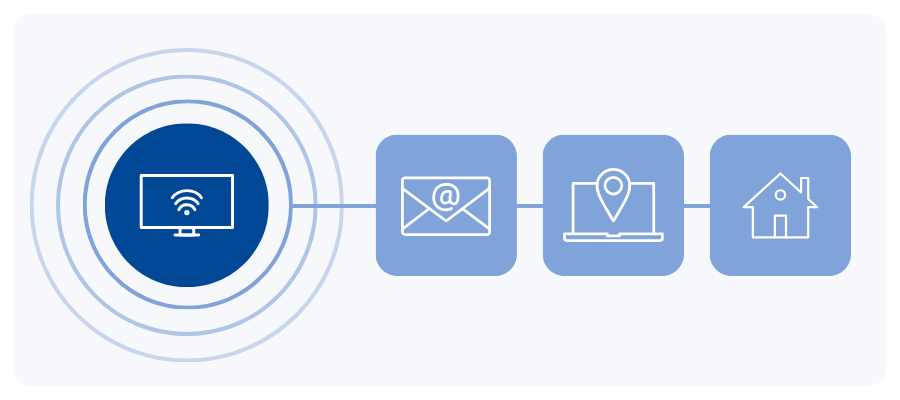
DeepIntent connects CTV and digital exposure data using identity signals, such as National Provider Identifiers (NPIs), hashed email addresses, IP addresses, device IDs, and household signals, where permitted and reviewed. That identity layer helps support sequencing and suppression across streaming, endemic, mobile, and digital settings.
In practice, CTV can introduce targeted education or broad brand awareness, and later touchpoints can provide sequential information in the right channels. Instead of repeating the same message, brands can make pivots based on engagement and context.
“For us, it starts with identity and not panels. When we’re resolving CTV and digital exposures to the same person, we’re leveraging signals so that every touchpoint across streaming, endemic, and mobile is recognized as the same individual, not model lookalikes.”
DeepIntentNatalie Mancuso, SVP, Data Partnerships
For pharma, campaign performance should not be measured by reach alone. A stronger approach looks at whether sequenced engagement contributes to meaningful downstream signals, including:
- Prescription activity
- Provider engagement
- Referral patterns
- Patient compliance
- Adherence signals, where measurement is permitted
Why should messaging and reporting change in pharma?
Pharma campaigns are journeys with changing information needs. Reporting should guide the campaign optimization.
“If I’m launching into a market with a new class of drug, I’m asking what education needs to be put into the market – from both an HCP and a consumer standpoint – to build awareness?”
DeepIntentNatalie Mancuso, SVP, Data Partnerships
Clicks and website visits still have a place, but they can’t tell the full pharma story. DeepIntent processes data in real time, giving brands an up-to-date read on how media connects to campaign engagement. Campaign signals can help teams optimize audience logic, creative, channel mix, or sequencing during a live campaign.
Explore how privacy-safe pharma activation can make an impact
Experian brings marketing data and identity expertise for health marketing and DeepIntent adds pharma-specific activation experience. Together, we help brands connect patient and HCP strategies responsibly, with privacy built in from the start.

Watch the full video with our experts to hear Sheila Wirick and Natalie Mancuso discuss patient and HCP messaging, CTV, privacy-safe activation, and outcome measurement for pharma brands.
About our experts
Natalie Mancuso
SVP, Data Partnerships, DeepIntent
Natalie Mancuso is SVP, Data Partnerships at DeepIntent and a leader in health-focused AdTech and DSP strategy. With over 20 years of experience growing billion-dollar healthcare brands, she turns complex data into scalable, performance-driven solutions that keep marketers ahead of industry change.

Sheila Wirick
Director of Health Sales, Experian
Sheila Wirick is the Director of Health Sales at Experian with more than 20 years of experience in data and analytics. As Director of Health Sales at Experian Marketing Services, she collaborates with healthcare, pharmaceutical, and nonprofit organizations to apply data and insights that enhance customer retention, brand awareness, and acquisition. She is committed to helping organizations use data to deliver measurable results and meaningful impact.
FAQs
A pharma audience is activation-ready when patient or HCP inputs can be translated into usable audiences with the right accuracy, controls, interoperability, and destination readiness. For patient engagement, that may include privacy-safe cohort construction, caregiver logic, non-clinical enrichment and appropriate exclusion rules. For HCP engagement, it may include governed identity inputs such as NPI, specialty, practice location, professional address and other verified attributes where appropriate.
Pharma brands can sequence messages responsibly by giving each channel a clear role and using audience logic to maintain continuity. CTV and out-of-home can support awareness, social can reinforce the message, search can capture active research and point-of-care or rep-triggered channels can support decision moments. The workflow should preserve separation between patient and HCP identity strategies.
Pharma marketers should measure whether media connects to outcomes such as audience quality, prescription activity, qualified HCP engagement, verified delivery, referral patterns, therapy starts or adherence signals where permitted. These outcomes often depend on partner-enabled workflows, clean rooms, and aggregated outputs rather than direct end-to-end tracking.
Experian acts as an independent privacy-first identity, data, and workflow layer for pharma marketers. We help brands bring together identity, high-fidelity matching, governed onboarding, non-clinical consumer context, and partner interoperability so patient and HCP engagement can be activated more accurately across channels and connected more cleanly to partner-enabled measurement.
Latest posts

Marketers are always looking for creative ways to get the most out of their digital marketing investments. While there may be different paths to optimization, reducing media spend and cutting costs without sacrificing ROI is ideal. We empower marketers to take back control of their budgets and reinvent their media strategies by leveraging the right data at the right time. And, given today’s challenging climate, there’s no better time. Every Business Has Different Deeds Whether you’re a direct-to-consumer brand building a loyal customer base or a financial service simply letting customers know you’re here for them during a challenging time– identity resolution is essential to connecting with your audience without breaking the bank. That’s why we have built solutions that provide flexibility and control when you need it most. Putting Data Into Action Experian’s “Tapad Graph” is a global, privacy-safe cross device graph is one powerful file. Updated weekly, and containing customized device IDs and digital attributes, The Tapad Graph enables smarter targeting strategies and a reduction of wasted impressions. What that means is more marketing efficiency and a stronger ROI for your business. Saving resources and money sound good to you? This guide breaks down four ways you can implement cost savings measures without sacrificing performance or prohibiting KPIs. Frequency Capping and Suppression Clustering device IDs by the individual and household means you have access to more ways to reach consumers, but it doesn’t always mean you should be using all of them across every campaign. Hone in on the channels and devices where consumers make most of their lower funnel decisions and purchases – and cap brand-awareness level placements or aspirational media that requires more exposure to generate engagement. This doesn’t mean limiting the devices you target, but being more aware of how often you’re targeting the same person across those devices. If you’ve successfully begun, or heck, even completed the consumer journey with an individual, congratulations. Now, you may want to consider what to do with the rest of the digital devices and users in that same household. Sure, there’s a time for conquesting an entire home of purchasers, but that’s not always the most effective way to maximize your media. That’s why The Tapad Graph is built to be flexible, providing a holistic view of all individuals and their associated devices and digital IDs – so you can suppress them once you’ve conquested the household decision maker or achieved the desired lower funnel activity. Save those impressions for someone else and save money for yourself. The great thing is whether you’re uploading this data into a DMP or a DSP, you can segment your target audience with a frequency cap threshold or suppress them entirely. Not only can you apply these tactics across traditional digital media, but we can include Connected TVs for OTT targeting as well, making your media strategy as holistic as your identity resolution tactics. Cross-Device Targeting and Attribution Consumer behavior and device trends are changing these days, so shouldn’t your digital marketing change too? Desktop usage is now up as much as 22%* as more people are working and learning from home. And remember that old iPad? With more people at home, we’re dusting off more devices and tablet activity is increasing more than 30%*. Sure, people are still constantly on mobile– but it might be time to consider implementing cross-device targeting and optimization for those dayparts when their focus is elsewhere. Identity resolution should be a key element of customer journey mapping and attribution in order to truly give credit to the right channels and build a baseline for the right cost-per modelling. Coupling The Tapad Graph with raw events data can granularly attribute engagement, actions and conversions at the digital ID, device, and even user-level – thereby teaching you more about your customer’s preferences. Leverage these insights to create more tailored messaging and promotions on your owned and operated channels, to funnel impressions to specific screens and platforms, and to target users based on where they are in the purchase funnel. Data That Gives You Control If you’re already implementing cross-device, have you started suppressing the devices where engagement with your brand isn’t happening? That’s right, you can use The Tapad Graph after-the-fact as well. Weekly graph updates with 60-day look-backs enable weekly campaign optimizations. That gives you the flexibility and control to avoid devices and platforms where users aren’t as active. You can only make decisions based on the data you have in front of you, so make sure you’re partnering with the right solutions for your business. Does identity resolution sound like something you need? Contact us and we can help you get started with all that The Tapad Graph has to offer. Contact us today
Tapad, part of Experian, integrates with MediaJel’s current advertising solutions will enable U.S. brands to benefit from improved cross-device reach and targeting capabilities NEW YORK, April 14, 2020 /PRNewswire/ — Tapad, part of Experian and a global leader in digital identity resolution, has partnered with MediaJel, a leading provider of advertising and marketing solutions for regulated markets. The partnership will enhance MediaJel’s current offering, enabling brands to further improve their digital marketing campaigns, and thereby, return on investment. Tapad’s global, privacy-safe digital cross-device solution, The Tapad Graph, will complement MediaJel’s state-of-the-art advertising solutions to identify and resolve fragmentation created by a consumer’s researching and purchasing behavior across multiple digital devices. For MediaJel, this provides customers with an opportunity for incremental efficiencies across a number of use-cases, including reach extension, targeting, ad frequency capping, suppression, and attribution. Dash Rothberg, Senior Vice President of Strategic Partnerships at MediaJel commented, “With an endless list of considerations across consumer behavior, marketing fragmentation, and today’s ongoing device proliferation – optimizing digital campaigns can be challenging for most brand advertisers. We partnered with Tapad after testing multiple cross-device solutions in the market but concluded that The Tapad Graph provided us with a blend of scale, quality, flexibility, and privacy-safe data to meet our customer needs.” Mike Dadlani, Vice President of Agency Partnerships at Tapad added: “Our partnership with MediaJel is an exciting one. Not only will their portfolio of clients be enabled to more effectively execute and optimize cross-device campaigns, but they will also realize longer-term benefits from improved attribution and consumer insights.” To learn more about Tapad and our digital identity resolution capabilities, visit our identity page. About Tapad Tapad, Inc. is a global leader in digital identity resolution. The Tapad Graph and its related solutions provide a transparent, privacy-safe approach connecting brands to consumers through their devices globally. Tapad is recognized across the industry for its product innovation, workplace culture, and talent, and has earned numerous awards including One World Identity’s 2019 Top 100 Influencers in Identity Award. Headquartered in New York, Tapad also has offices in Chicago, London, Oslo, Singapore, and Tokyo. About MediaJel Founded in 2017, MediaJel acts as a full-service agency that provides advertising and marketing solutions from brand building and search optimizations to campaign execution and online-offline attribution. Built with proprietary technology, the MediaJel.io platform leverages unique actionable data for brands and agencies to effectively execute high-performance marketing campaigns. With “Data Ethics” being the core of the business, all aspects are brand safe and compliant for regulated industries. Contact us today
Tapad’s digital identity resolution offering enables Gimbal’s platform to provide expanded insights for campaign optimization to U.S. brand and agency clients NEW YORK, Feb. 11, 2020 /PRNewswire/ — Tapad, part of Experian and a global leader in digital identity resolution, announced their partnership with Gimbal, a leader of location-powered marketing and advertising solutions. Gimbal now leverages Tapad’s global, privacy-safe digital cross-device solution, The Tapad Graph, to further enhance its footfall attribution solution, Arrival. Arrival delivers dwell-based attribution for in-store foot traffic and by leveraging the Tapad Graph, Gimbal provides customers with a more holistic, attributable understanding of consumers across multiple devices, like desktop, smartphone, and tablet. With this, Gimbal’s clients are enabled to make more informed media planning decisions for programmatic activations across the web, and mobile apps. “With the number of devices per individual rapidly increasing, understanding the customer decision journey is becoming more complex,” said Kyle Wendling, SVP of Product at Gimbal. “We’re excited to partner with Tapad to continue engaging consumers across multiple devices.” To learn more about Tapad and our digital identity resolution products, visit our identity solutions page. About TapadTapad, Inc. is a global leader in digital identity resolution. The Tapad Graph, and its related solutions, provide a transparent, privacy-safe approach connecting brands to consumers through their devices globally. Tapad is recognized across the industry for its product innovation, workplace culture, and talent, and has earned numerous awards including One World Identity’s 2019 Top 100 Influencers in Identity Award. Headquartered in New York, Tapad also has offices in Chicago, Denver, London, Oslo, Singapore, and Tokyo. About GimbalGimbal translates location data into intent, measurement, and insights to help organizations transform their businesses, maximize marketing relevance, and humanize messaging for consumers. Gimbal is headquartered in Los Angeles and provides advertising and marketing technologies to the world’s leading brands and retailers interested in understanding the physical world. To learn more, visit https://gimbal.com. Contact us today