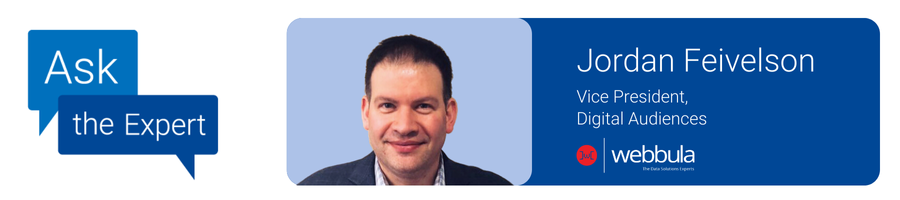
In our Ask the Expert Series, we interview leaders from our partner organizations who are helping to lead their brands to new heights in ad tech. Today’s interview is with Jordan Feivelson, VP, Digital Audiences at Webbula. Jordan is a 22-year advertising industry veteran who has worked for media properties such as WebMD and Disney. Over the past ten years, he has transitioned to the data and programmatic space, including growing the data business for Kantar Shopcom and Adstra.
What types of advertisers might benefit from utilizing Webbula audiences across various verticals? Can you provide examples of how different industries successfully leverage your data to achieve specific campaign goals?
Most advertisers can leverage Webbula’s award-winning attributes for their activation initiatives. Webbula offers approximately 3,000 syndicated segments covering categories such as Demographics, Automotive, Political, Mortgage, B2B, Hobby/Interest/Lifestyle, and Interests & Brand Preferences (brand name targeting).
Audience insights and marketing strategies
What specific types of audience segments does Webbula provide? How can advertisers leverage these segments to craft more effective, personalized marketing strategies?
Webbula has incredible depth and breadth within its verticals, giving marketers the tools to deliver targeted messaging effectively. Our Demographic, B2B, Mortgage, Automotive, and Interest and Brand Preferences segments each contain 500-1,000 segments, all built on deterministic, self-reported, and individually linked data. We ensure the best accuracy with multiple deterministic data points tied to the real world (ex., first name, last name, postal address, and email address).
Some examples of our unique syndicated audience types:
- B2B: A view of the latest industry trends with detailed cuts of the professional world, such as companies with and not within the Fortune 500 companies and job positions that are directors and below. This also includes custom capabilities, including ABM (list of target companies in an activation campaign or by industry code (ex. NAICS, SIC).
- Interest and Brand Preferences: Consumers who have shown interest and affinity to hundreds of brands (ex., Nike), genres (ex., comedy, hip hop), sports teams, and more.
- Mortgage: A detailed view of homebuyers’ purchase range, loan type (ex. jumbo loan, standard loan), mortgage amount, interest rate, and more.
With Webbula’s audience data, brands can create a comprehensive picture of their audiences down to the individual level and reach them accurately.
Data quality, sourcing, and differentiation
How is consumer data sourced and curated at Webbula? Are there data quality standards that Webbula establishes for consumer data, and how do you ensure your sources and methods meet these standards consistently?
Webbula’s data is aggregated from over 110 trusted and authenticated sources, including publishers, data partners, social media, and more. The data collected comes directly from consumers who self-report information through surveys and other methods. We apply our hygiene filters to mitigate fraud and accurately score the data.
Data Collection: The data collected comes directly from consumers who self-report information through surveys, questionnaires, transactions, and sign-ups. This ensures that brands display ads to audiences based on self-identified, cross-channel behaviors, not modeled assumptions.
Hygiene Solutions: Webbula applies multi-method hygiene solutions to mitigate fraud and accurately score the data before onboarding, ensuring that all data meets the highest quality standards.
Examples of Data Sources:
- Questionnaires: Self-reported data through surveys, offer submissions, and telemarketing.
- Transactions: Deterministic data from aftermarket parts, online purchases or services, and more.
- Sign-ups: Individually linked data from information entered through sweepstakes, infomercials, newsletters, and forms.
What differentiates Webbula’s data from other data providers in the market? Can you explain the unique value proposition that Webbula offers in terms of data depth and breadth?
Due to our extensive experience in data cleansing, we provide the most accurate data within the programmatic ecosystem. TruthSet, the leading programmatic accuracy measurement company, has ranked Webbula as having the highest number of top attributes compared to other data providers with 150M+ HEMs. Additionally, Publicis Groupe and Neutronian further validate Webbula’s data quality, underscoring its position as a leader in the industry.
Webbula’s data stands out in the market due to its unmatched accuracy and quality, achieved through years of expertise in data cleansing. Unlike other providers, Webbula’s foundation lies in its robust email hygiene process, ensuring that all data entering the programmatic ecosystem is thoroughly cleansed.
Privacy, compliance, and future-proofing
What measures does Webbula take to maintain data privacy and compliance? How do these efforts benefit advertisers in an evolving regulatory landscape and ensure ethical standards?
Webbula was created over a decade ago with a future-proof, privacy-compliant foundation. We understand the industry’s rapid changes, including government and state legislation and cookie depreciation. Our goal has always been to build long-term partnerships and ensure we are prepared for industry changes. We rely on validated offline data sources, making us resilient to external influences.
Success stories
Can you share success stories where advertisers saw significant campaign improvements using Webbula’s data? What were the key factors that contributed to these successes?
Our success is measured by client feedback and increased client spend. Webbula has helped several key advertisers achieve six-figure monthly thresholds by providing the most accurate data to meet campaign KPIs. Clients consistently return to use our data, validating our belief that “the proof is in the pudding.”
Thanks for the interview. Any recommendations for our readers if they want to learn more?
For those interested in learning more about Webbula, reach out for a personalized consultation.
Contact us
Latest posts

NEW YORK, Oct. 24, 2019 /PRNewswire/ – Tapad, part of Experian and a global leader in digital identity resolution, today announced a new partnership with Retargetly, a leading independent full stack data company. The partnership combines Tapad's cross-device identity resolution technology with Retargetly's robust data toolset, allowing brands and agencies using Retargetly's platform to seamlessly access an expanded audience across devices, without compromising precision. In addition to reach expansion, Tapad's global, privacy-safe digital cross-device solution, The Tapad Graph, enables Retargetly's brand and agency clients a more holistic digital customer journey analysis, and efficient campaign capabilities like frequency capping and online attribution. At the same time, Tapad will be able to extend its presence into the LATAM region, tapping into Retargetly's existing regional footprint. Understanding a consumer's cross-device journey is a marketing necessity. A recent study showed that 75% of consumers expect a consistent experience from brands1. With the number of devices per individual rapidly increasing, digital identity resolution becomes essential to create that streamlined experience consumers crave. "Similarly to Tapad, our goal is to offer marketers a suite of products that can increase the ROI of their campaigns," said Juan Amuchastegui, Head of Product at Retargetly. "In order to achieve this, marketers need digital cross-device identity resolution to gain attribution, acquisition and reach expansion capabilities. We chose Tapad as our partner because The Tapad Graph has differentiated global scale, and privacy-safe measures, which we knew would benefit our clients' campaigns." Santi Darmandrail, Managing Director at Retargetly added, "Across the Americas our clients choose to work with us because of our scale, our precision, and our unique approach to what data can do to transform business outcomes. In that scenario, partnering with Tapad and integrating The Tapad Graph onto our platform was really a no-brainer and we are beyond excited to be making that available for our more than 700 clients across the region." To learn more about Tapad and our digital identity resolution products, visit our identity solutions page. About Tapad Tapad, Inc. is a global leader in digital identity resolution. The Tapad Graph, and its related solutions, provide a transparent, privacy-safe approach connecting brands to consumers through their devices globally. Tapad is recognized across the industry for its product innovation, workplace culture and talent, and has earned numerous awards including One World Identity's 2019 Top 100 Influencers in Identity Award. Headquartered in New York, Tapad also has offices in Chicago, Denver, London, Oslo, Singapore and Tokyo. About Retargetly: Retargetly is the leading independent data solution from Latam. Their proprietary platform processes over 25 billion data events a month and transforms them into actionable analytics that drive business results across the board. The recently launched Retargetly Audience Platform (RAM) is the number one data exchange in Latin America, with over 1000 active buyers and millions of dollars traded every year. Regargetly provides services across Latam and has offices in Buenos Aires, Mexico City, São Paulo and New York. For more information, visit www.retargetly.com. Contact us today
NEW YORK, Oct. 16, 2019 /PRNewswire/ – Tapad, part of Experian and a global leader in digital identity resolution, and The Trade Desk, a global advertising technology leader, partnered to integrate The Trade Desk's unified ID solution in April 2019. The Trade Desk's unified ID solution's objective is to serve as a standardized cookie ID to help marketers reach more of their audience on the open internet. After an initial six month period, Tapad reports significant adoption rates and enhanced customer results since their joint integration in April. As a result of the partnership, client brands, agencies, DMPs/ DSPs, Data Providers, Mobile Networks and Measurement/Analytics Providers, saw increased match rates up to 38% and more global coverage without compromising precision. With this combined offering, Tapad's global, privacy-safe digital cross-device solution, The Tapad Graph, connects brands with consumers over 4 billion devices globally. Over 25 companies who license The Tapad Graph, such as Annalect, Semasio, Retargetly, and ThinkCX, have also included The Trade Desk's unified ID solution as a key identifier in their graph output. "The vast improvement in scale that Tapad has seen illustrates the value digital identity resolution products can bring for brands," said Nate Gawel, General Manager of Data Partnerships at The Trade Desk. "We're looking forward to continuing work with Tapad to prove that the open internet can deliver the very same benefits many reserve for large platforms." Adoption of the unified ID solution allows all parties across the supply chain (SSPs, DSPs, DMPs and data providers) to utilize The Trade Desk's cookie footprint to increase their own cookie coverage across the global independent internet. For more information, please visit The Trade Desk's unified ID solution site, or https://www.experian.com/marketing/consumer-sync to learn more about Tapad's digital identity resolution products. About Tapad:Tapad, Inc. is a global leader in digital identity resolution. The Tapad Graph, and its related solutions, provide a transparent, privacy-safe approach connecting brands to consumers through their devices globally. Our one-of-a-kind Graph Select offering enables marketers the flexibility and freedom of choice to correlate devices to varied objectives, driving campaign effectiveness and business results. Tapad is recognized across the industry for its product innovation, workplace culture and talent, and has earned numerous awards including One World Identity's 2019 Top 100 Influencers in Identity Award. Headquartered in New York, Tapad also has offices in Chicago, London, Oslo, Singapore and Tokyo. About The Trade Desk:The Trade Desk™ is a technology company that empowers buyers of advertising. Through its self-service, cloud-based platform, ad buyers can create, manage, and optimize digital advertising campaigns across ad formats and devices. Integrations with major data, inventory, and publisher partners ensure maximum reach and decisioning capabilities, and enterprise APIs enable custom development on top of the platform. Headquartered in Ventura, CA, The Trade Desk has offices across North America, Europe, and Asia Pacific. To learn more, visit thetradedesk.com or follow us on Facebook, Twitter, LinkedIn and YouTube. Contact us today

Gen Z is ready to be noticed and become a force to be reckoned with in the market. In the auto market alone, Gen Z made up 3.8 percent of all new vehicle registrations in the first quarter of 2019.