At A Glance
Holiday shopping in 2025 doesn’t follow one clear pattern, with shoppers blending early planning and last-minute purchases, digital discovery and in-store validation, and cautious spending. Marketers who embrace this complexity, by staying relevant, consistent, and connected across channels, will be best positioned to win this season.Holiday shopping in 2025 feels a lot like a complicated relationship. Shoppers want deals, but they also want trust. They start shopping early, but they’re still browsing well into December. They love the convenience of online shopping, but they still show up in-store before making the final call.
Our 2025 Holiday spending trends and insights report, created this year in collaboration with GroundTruth, explores these contradictions. Our findings show that this year’s holiday season isn’t about one big shift; it’s about managing the push and pull between what consumers say, what they do, and how marketers respond.
Here are three complicated truths you need to know.
Experian’s 2025 Holiday spending trends and insights report
Optimize your 2025 holiday shopping campaigns with our latest report with GroundTruth.
Download now1. The new rules of holiday timing
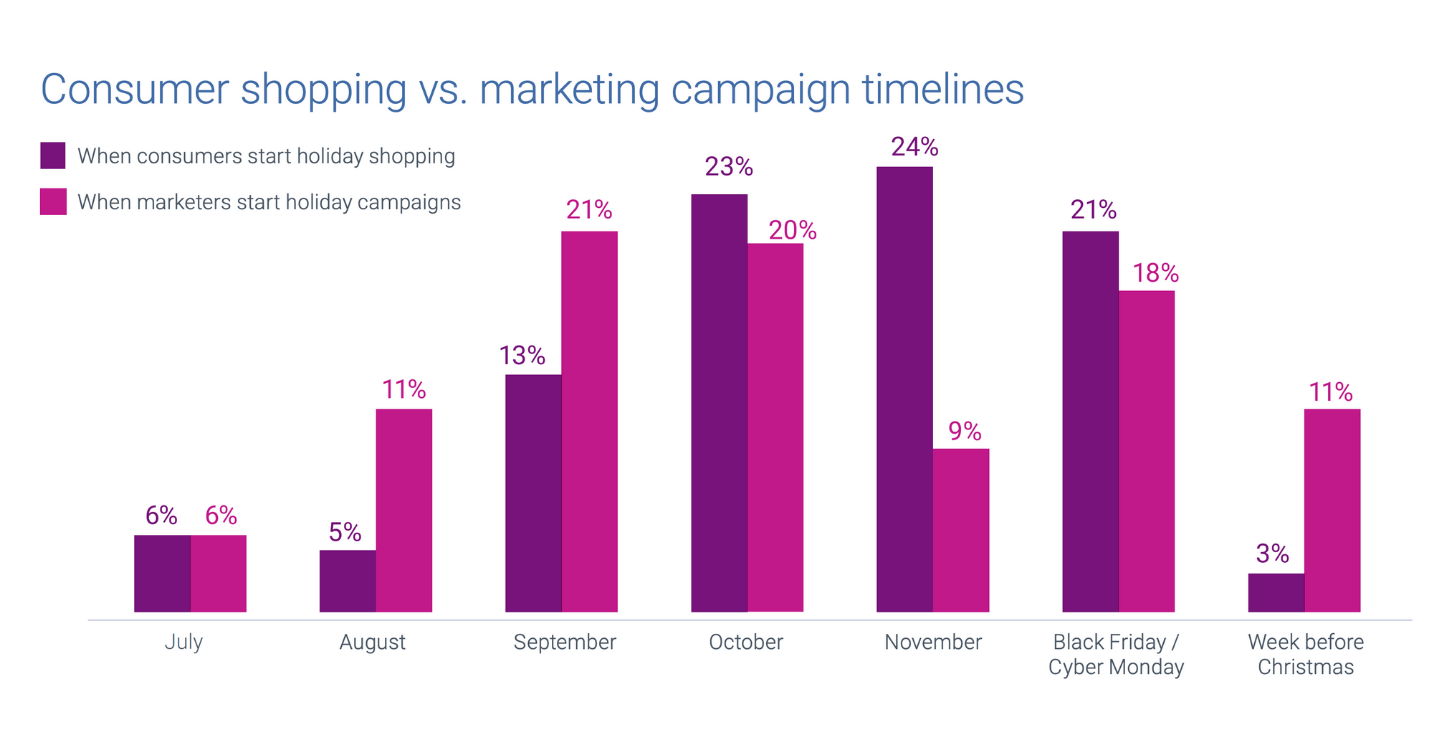
Almost half (45%) of consumers plan to start shopping before November, but 62% admit they’ll still be buying in December. And post-holiday shopping (think gift card redemptions and deal-hunting) remains a real factor.
Why it’s complicated
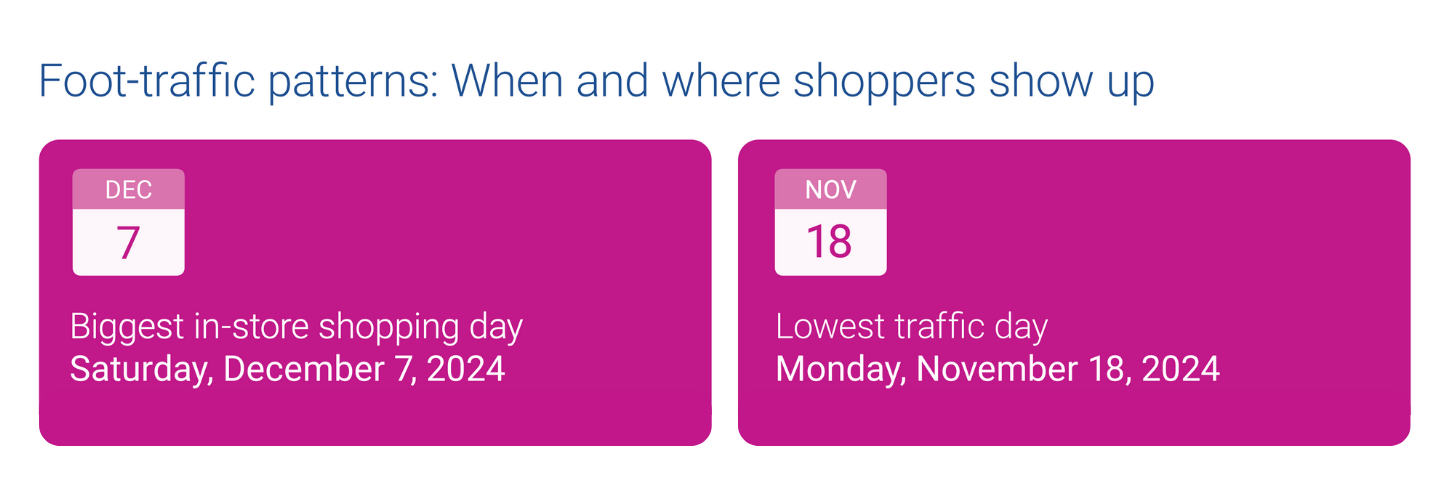
The holiday calendar isn’t what it used to be. There’s no single “big moment” anymore. Instead, shoppers are spreading purchases across months, peaking around the “Turkey 12” (the 12 days surrounding Thanksgiving) and again in the final December rush.
What to do about it
- Stretch your campaigns across the full season, not just Cyber Week.
- Refresh offers to stay relevant as shopper motivations change from deal-seeking to last-minute urgency.
- Watch for post-holiday momentum and extend your promotions into January.
How belVita nailed the timing
In celebration of National Coffee Day, belVita partnered with GroundTruth on a one-month campaign to boost product awareness and drive foot traffic to Target stores. By utilizing digital out-of-home (DOOH) and mobile ads powered by location, behavioral, and purchase-based targeting, the campaign achieved a 3.44% visitation rate, nearly $476k in products added to carts, and a low cost-per-visit of just $0.22.
2. Online leads, but in-store still seals the deal
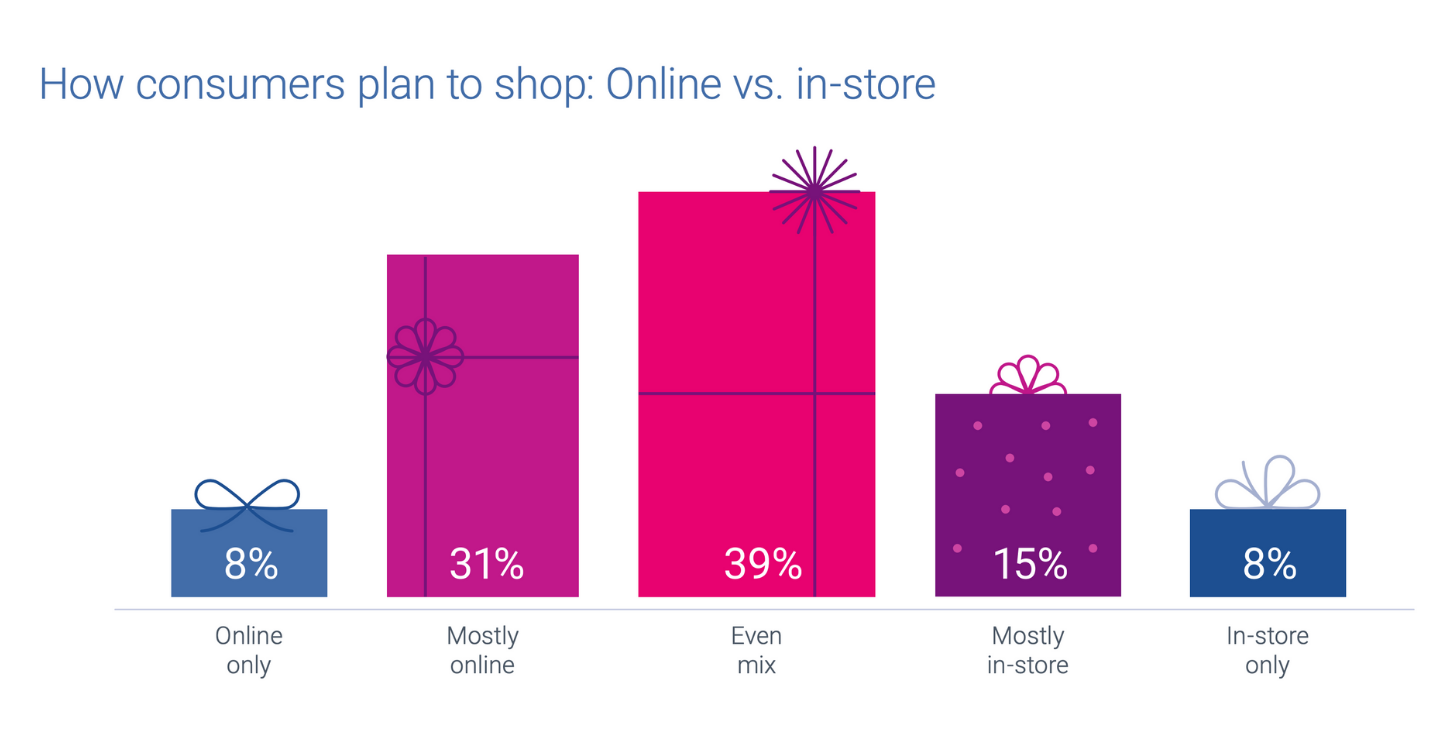
Nearly 40% of shoppers say they’ll split their purchases between online and in-store and 80% of consumers still prefer the in-store experience. Only a small fraction plan to shop exclusively in one channel. That means while digital often starts the journey, the final decision often happens in a physical store.
Why it’s complicated
Shoppers love the convenience of browsing online, but they still want the reassurance of seeing, touching, or testing products before buying. In-store isn’t just about the transaction, it’s the validation step.
What to do about it
- Build omnichannel strategies that connect digital discovery with in-store follow-through.
- Use location and identity data to tie digital impressions to real-world actions, like foot traffic and purchases.
- Focus on consistency: shoppers expect the same value, tone, and trust whether they’re on a website, in an app, or standing in a store aisle.
How Duke Cannon used on-premise targeting to drive sales lift
Duke Cannon, a premium men’s grooming brand, partnered with GroundTruth to launch a successful multichannel campaign utilizing location-based and behavioral audience targeting across CTV and mobile screens to drive in-store visits and sales.
By targeting consumers with mobile ads while they were physically in-store, the company capitalized on high purchase intent, aiding in the 12% sales lift. This strategic approach resulted in over 43.9k provable in-store visits and a significant increase in sales.
3. Marketers double down, consumers hold back
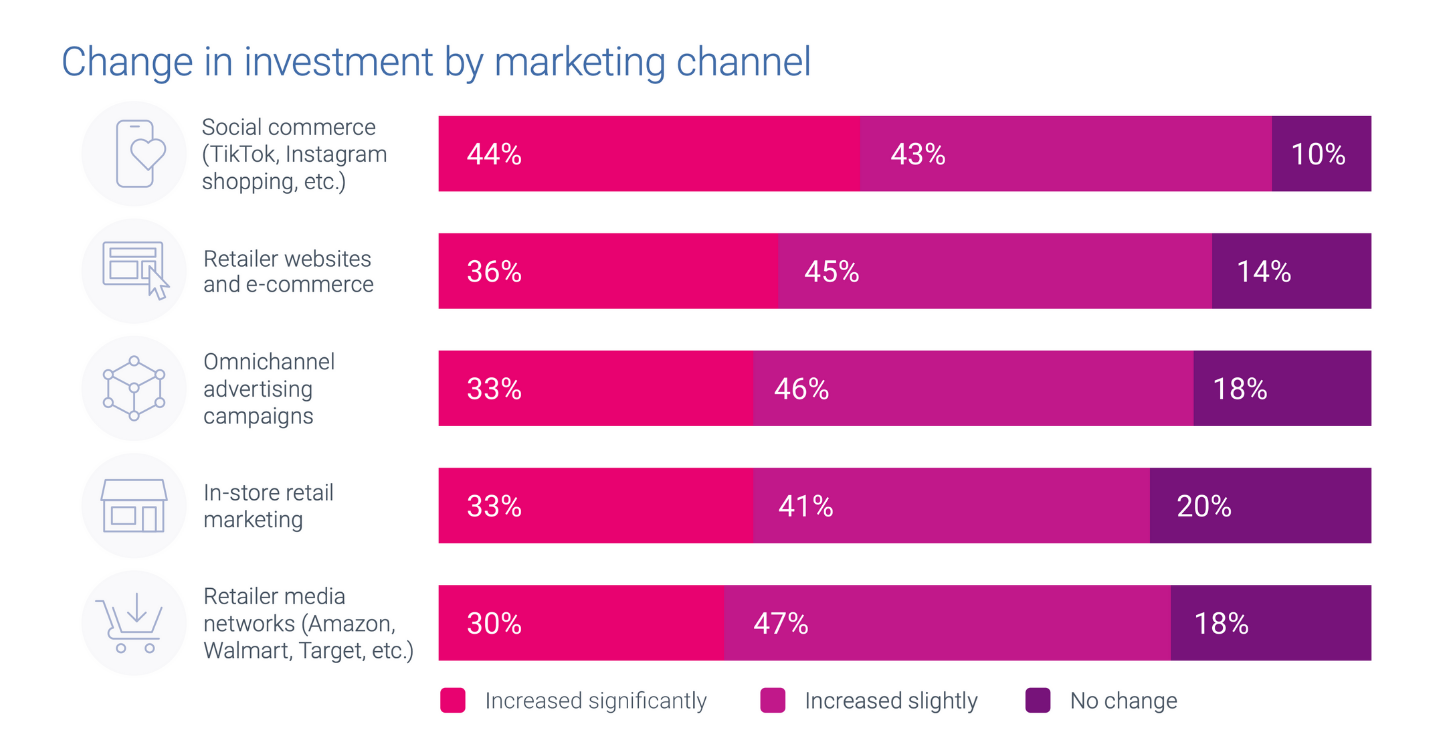
This holiday season, expectations are split. 66% of marketers expect holiday spend to rise, but only 22% of consumers agree. While brands are leaning into bigger investments across CTV, retail media, and social, shoppers are staying cautious, weighing value and waiting for the right deal.
Why it’s complicated
That disconnect introduces risk. If marketers don’t align spend with real consumer behavior, budgets can get wasted in the rush to cover every channel. Shoppers haven’t stopped spending, but they’re spending differently. They’re trading down to discount and big-box retailers while cutting back in discretionary categories like apparel and restaurants.
What to do about it
- Prioritize efficiency by focusing on the right audiences, not just more impressions.
- Make consistency your advantage: reach people once and connect across platforms instead of chasing fragmented signals.
- Balance aggressive media investment with messaging that acknowledges consumer caution — shoppers want value and trust, not hype.
Measuring TV and streaming impact with iSpot
iSpot’s Audience Builder, powered by Experian’s Marketing Attributes, helps brands reach high-value audiences. During the holiday season, a luxury retailer could target $100K+ households with affluent lifestyle interests. With iSpot’s Unified Measurement platform, they can track performance across linear TV and streaming and shift spend in real time to maximize results.
The bottom line on 2025 holiday shopping trends
This year’s holiday shopping season is, well…complicated. Shoppers are cautious but still engaged. They’re early planners and last-minute browsers. They want the ease of digital, but the confidence of in-person.
For marketers, the opportunity lies in embracing that complexity, not trying to simplify it away. The brands that balance relevance, trust, and convenience across the full season and across every channel will be the ones that win.
Download our full 2025 Holiday spending trends and insights report to explore all five shifts shaping this season and see how you can turn complexity into opportunity.
About the author

Fred Cheung
Director, Partnership Sales, Audigent, a part of Experian
Fred Cheung has spent over a decade in the programmatic advertising space, with roles at Mindshare, Jounce Media, Twitter, and The Trade Desk. His deep experience in trading and product management helps in his current function on the Experian Marketing Services’ Sales team where he focuses on data growth and adoption across the industries’ leading buy-side platforms.
2025 holiday shopping trends FAQs
Because consumer behavior is full of contradictions. People will shop earlier but also later, browse online but purchase in-store, and want deals while demanding trust. Marketers need to navigate these push-and-pull dynamics.
Nearly half (45%) say they’ll start before November, but 62% admit they’ll still be buying in December, with momentum even continuing into January through gift card redemptions and deal-hunting.
Although many consumers begin online, the majority still make their final decisions in-store. In-person shopping acts as a validation step where customers can see, touch, or try products before buying.
Instead of focusing only on Black Friday or Cyber Week, marketers should stretch campaigns across the full season, refresh offers frequently, and continue promotions into January.
Not entirely. 66% of marketers expect spending to rise, but only 22% of consumers agree. Shoppers are cautious, prioritizing value and often trading down to discount or big-box retailers.
An omnichannel approach using identity and location data can bridge digital impressions with real-world actions like store visits and purchases, ensuring consistency across touchpoints.
Brands like belVita and Duke Cannon successfully tied digital campaigns to in-store results by utilizing precise audience targeting, location data, and well-timed promotions.
You can download Experian’s 2025 Holiday spending trends and insights report to explore all five shifts shaping this season.
Latest posts

Dextro clients to achieve increased accuracy in cross-device consumer measurement and engagement NEW YORK, Feb. 6, 2017 /PRNewswire/ — Dextro Analytics, a pure play analytics company that harnesses the power of human learning and artificial reasoning to drive more informed and effective consumer marketing, is partnering with Tapad, the leading provider of unified, cross-screen marketing technology solutions and now a part of Experian. The deal is effective immediately and the scope of the partnership covers North America. Additional terms were not disclosed. Leveraging Tapad's privacy-safe Device Graph™, Dextro Analytics will be able to significantly bolster its insight engine to decode complex customer journeys. Armed with more relevant, actionable insights, marketers can use Dextro's cross-screen, closed-loop measurement systems to reach and engage the right customer at the right time through the right channel. "Being able to accurately map consumer preferences, behaviors and journeys in a privacy-safe and unified way across devices is still one of the biggest pain points for marketers," said Ajith Govind, co-founder of Dextro Analytics. "At the same time, this partnership engages customers with the right message at the right time." "Detecting latent patterns and signals, and tracing backward- and forward-looking behavioral characteristics, are keys to sustaining a competitive advantage in a crowded space," said Manmit Shrimali, co-founder of Dextro Analytics. "With the proliferation of data and devices, connecting the dots is of paramount importance." "Dextro is solving some of the biggest challenges in analytics today," said Pierre Martensson, GM of Tapad's data division. "Our partners consistently see notable improvements in both budget allocation and device optimizations after integrating with the Tapad Device Graph, and I have every confidence that Dextro will be among them." For more information about Dextro Analytics' revolutionary approach to using human learning and artificial intelligence algorithms to solve business and analytical problems, please visit http://dextroanalytics.com/. For more information about Tapad's cross-platform advertising solutions, please visit https://www.experian.com/marketing/consumer-sync. Contact us today

NEW YORK & LOS ANGELES / BUSINESS WIRE / Jan. 30, 2017– Tapad, part of Experian, and Rubicon Project (NYSE: RUBI) announced today a new global partnership offering a unified, cross-device campaign delivery solution within an automated advertising marketplace. Tapad is the leading provider of unified, cross-screen marketing technology solutions and Rubicon Projectoperates one of the largest advertising marketplaces in the world. The Tapad Device Graph™, which enables buyers to expand their high-value display data signals to associated mobile devices, will be integrated across Rubicon Project’s leading advertising exchange and Orders platform, significantly improving consumer mobile reach. The new global partnership will empower Buyers within Rubicon Project’s exchange to find and engage audiences across their entire digital experience. Rubicon Project operates one of the world’s largest mobile exchanges connecting to approximately 1 billion unique mobile devices globally. “We’re excited to partner with Tapad to continue to provide our customers the very best data for managing their advertising businesses,” said Harry Patz, Chief Revenue Officer, Rubicon Project. “Cross-device delivery is crucial for buyers today with more than 81% of internet users currently relying on more than one device for digital access[1]. Through our partnership, buyers will be able to extend their desktop private marketplace campaigns to mobile, allowing them to find and engage their audience across devices, anywhere in the world. The net result will also benefit sellers; the increase in mobile reach will better position publishers and app developers to strategically capitalize on their inventory, ultimately increasing bid rates and mobile revenue across the board.” “Our partnership with Rubicon Project marks the first time advertisers and publishers alike are able to use cross-device solutions at significant scale outside of Google and Facebook,” said Pierre Martensson, GM of Tapad’s Data Division and APAC. “Our Device Graph will help Rubicon Project’s advertisers make more informed buying decisions and find the audiences who matter most.” Barry Adams, VP of Commercial Development at Bidswitch, said, “As digital advertising moves away from desktop and increasingly toward a mobile-first model, cross device data becomes critical to finding consumers. The rich data buyers will now be able to leverage at scale through the Tapad and Rubicon Project integration will enable us to provide a state-of-the-art cross-screen solution for the 150+ buying platforms that use our service, and the tens of thousands of advertisers they represent.” For more information about Rubicon Project’s inventory, please visit www.rubiconproject.com. For more information about Tapad’s cross-platform advertising solutions, please visit https://www.experian.com/marketing/consumer-sync. Contact us today
Tapad expands linear TV analytics solution, enabling optimal reach and frequency across TV and digital platforms NEW YORK, Jan. 24, 2017 /PRNewswire/ – Tapad, now a part of Experian, has partnered with WideOrbit, the leading provider of advertising management software for media companies, to develop the industry's first programmatic TV-buying platform powered by a device graph. Tapad is the leading provider of unified, cross-screen marketing technology solutions and was first to market with a device graph, the Tapad Device Graph™. WideOrbit's robust supply platform and industry-leading footprint offers access to premium TV inventory on top networks, reaching more than 99 million households across local affiliates. The partnership pairs Tapad's demand-side technology with WideOrbit's supply-side inventory. As a result, marketers can leverage cross-device audiences in their TV buys for the first time. Additionally, integrating the Tapad Device Graph™ with digital feedback loops and audiences both accelerates optimization and enables precise audience discovery for TV marketers. "The integration of WideOrbit's quality TV supply takes orchestrated cross-screen media buys to the next level," said Marshall Wong, Tapad's SVP of TV market development. "Marketers can now optimize TV campaigns within days instead of weeks. This also untethers them from buying against generic demographics like age and gender. By allowing brands to employ their own CRM or third-party data, we can move them much closer to audiences who will take action." "Integrating Tapad's device graph with WideOrbit's programmatic marketplace delivers enormous value to marketers looking to add TV to cross-device campaigns," said Ian Ferreira, EVP of programmatic at WideOrbit. "Television still delivers the most efficient reach of any medium, and Tapad's platform now allows marketers to purchase premium broadcast inventory that extends the power of cross-screen campaigns to TV with a single, unified solution." "Our clients build lasting relationships with consumers through thoughtful and pioneering marketing," said Jeff Giacchetti, VP of digital at Mediavest Spark. "The strategic partnership of demand-side technology and supply-side inventory makes it easier for brands to find efficient, incremental reach and are critical in this endeavor." For more information about Tapad's cross-platform advertising solutions, please visit https://www.experian.com/marketing/consumer-sync. Contact us today