At A Glance
Holiday shopping in 2025 doesn’t follow one clear pattern, with shoppers blending early planning and last-minute purchases, digital discovery and in-store validation, and cautious spending. Marketers who embrace this complexity, by staying relevant, consistent, and connected across channels, will be best positioned to win this season.Holiday shopping in 2025 feels a lot like a complicated relationship. Shoppers want deals, but they also want trust. They start shopping early, but they’re still browsing well into December. They love the convenience of online shopping, but they still show up in-store before making the final call.
Our 2025 Holiday spending trends and insights report, created this year in collaboration with GroundTruth, explores these contradictions. Our findings show that this year’s holiday season isn’t about one big shift; it’s about managing the push and pull between what consumers say, what they do, and how marketers respond.
Here are three complicated truths you need to know.
Experian’s 2025 Holiday spending trends and insights report
Optimize your 2025 holiday shopping campaigns with our latest report with GroundTruth.
Download now1. The new rules of holiday timing
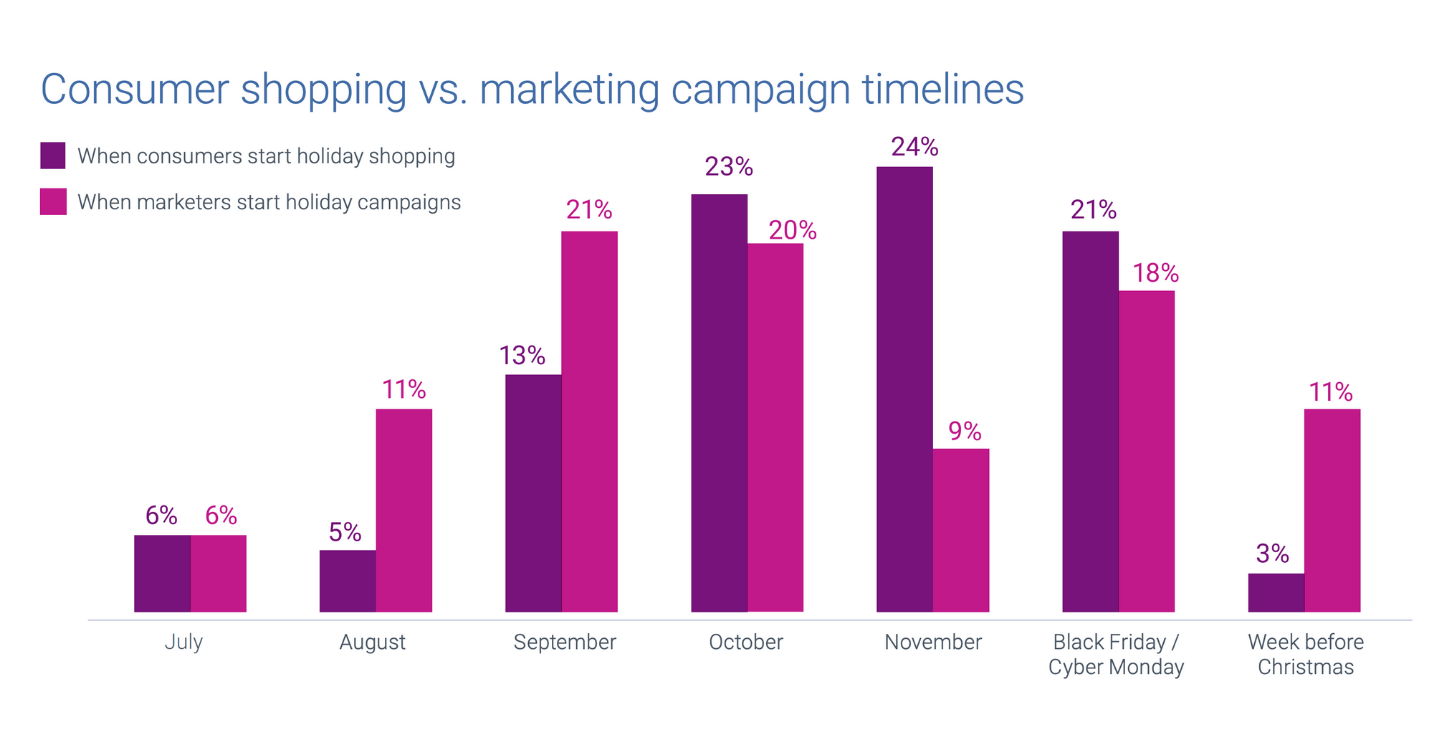
Almost half (45%) of consumers plan to start shopping before November, but 62% admit they’ll still be buying in December. And post-holiday shopping (think gift card redemptions and deal-hunting) remains a real factor.
Why it’s complicated
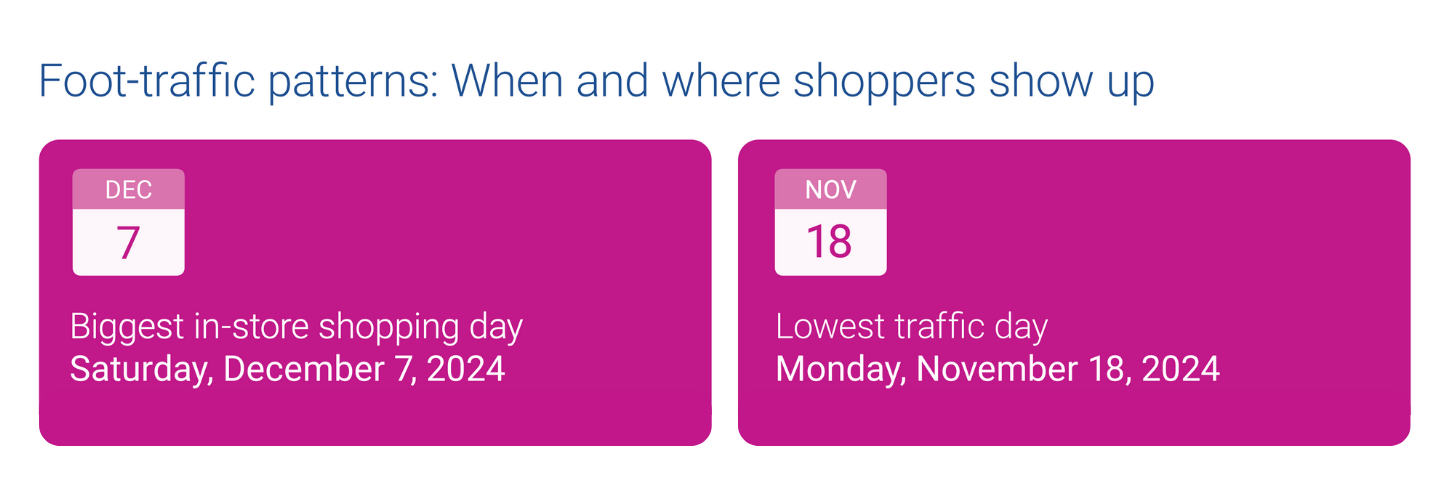
The holiday calendar isn’t what it used to be. There’s no single “big moment” anymore. Instead, shoppers are spreading purchases across months, peaking around the “Turkey 12” (the 12 days surrounding Thanksgiving) and again in the final December rush.
What to do about it
- Stretch your campaigns across the full season, not just Cyber Week.
- Refresh offers to stay relevant as shopper motivations change from deal-seeking to last-minute urgency.
- Watch for post-holiday momentum and extend your promotions into January.
How belVita nailed the timing
In celebration of National Coffee Day, belVita partnered with GroundTruth on a one-month campaign to boost product awareness and drive foot traffic to Target stores. By utilizing digital out-of-home (DOOH) and mobile ads powered by location, behavioral, and purchase-based targeting, the campaign achieved a 3.44% visitation rate, nearly $476k in products added to carts, and a low cost-per-visit of just $0.22.
2. Online leads, but in-store still seals the deal
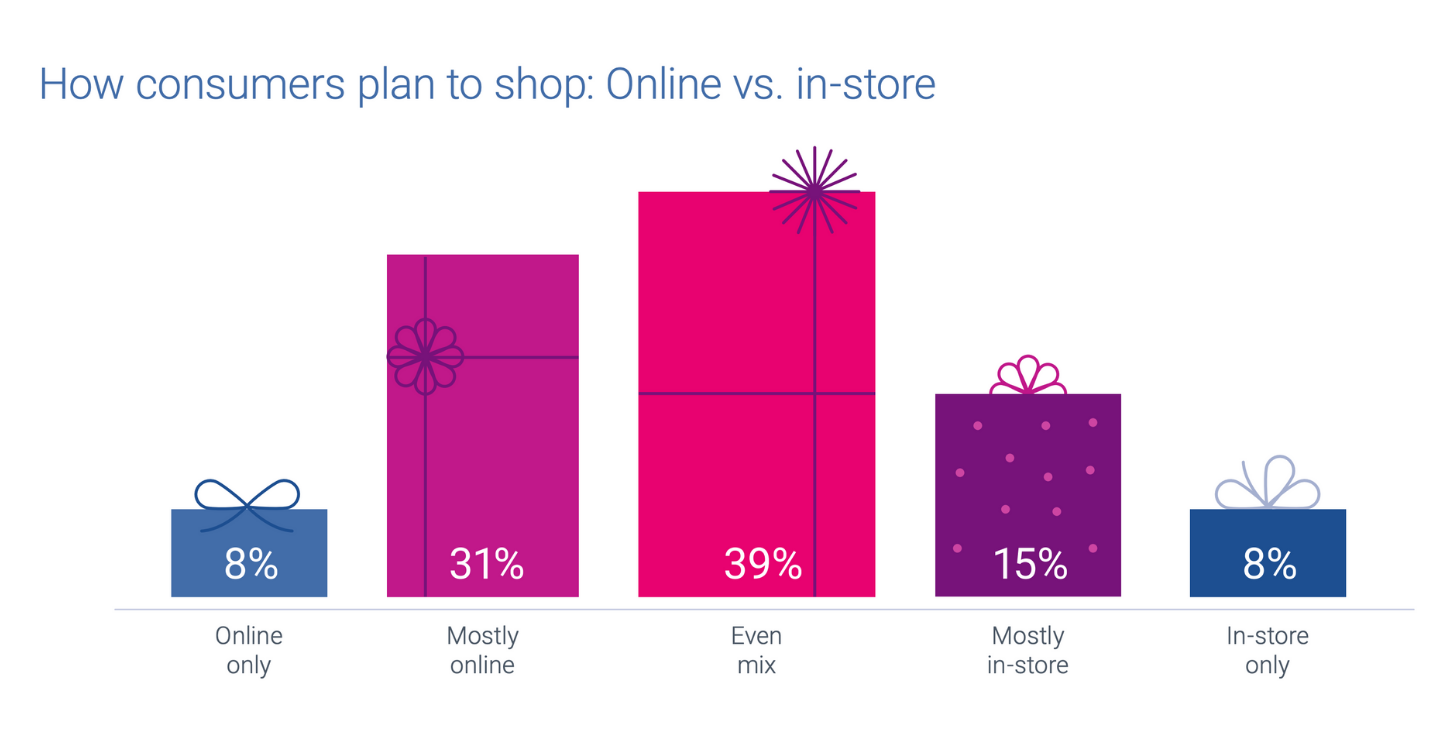
Nearly 40% of shoppers say they’ll split their purchases between online and in-store and 80% of consumers still prefer the in-store experience. Only a small fraction plan to shop exclusively in one channel. That means while digital often starts the journey, the final decision often happens in a physical store.
Why it’s complicated
Shoppers love the convenience of browsing online, but they still want the reassurance of seeing, touching, or testing products before buying. In-store isn’t just about the transaction, it’s the validation step.
What to do about it
- Build omnichannel strategies that connect digital discovery with in-store follow-through.
- Use location and identity data to tie digital impressions to real-world actions, like foot traffic and purchases.
- Focus on consistency: shoppers expect the same value, tone, and trust whether they’re on a website, in an app, or standing in a store aisle.
How Duke Cannon used on-premise targeting to drive sales lift
Duke Cannon, a premium men’s grooming brand, partnered with GroundTruth to launch a successful multichannel campaign utilizing location-based and behavioral audience targeting across CTV and mobile screens to drive in-store visits and sales.
By targeting consumers with mobile ads while they were physically in-store, the company capitalized on high purchase intent, aiding in the 12% sales lift. This strategic approach resulted in over 43.9k provable in-store visits and a significant increase in sales.
3. Marketers double down, consumers hold back
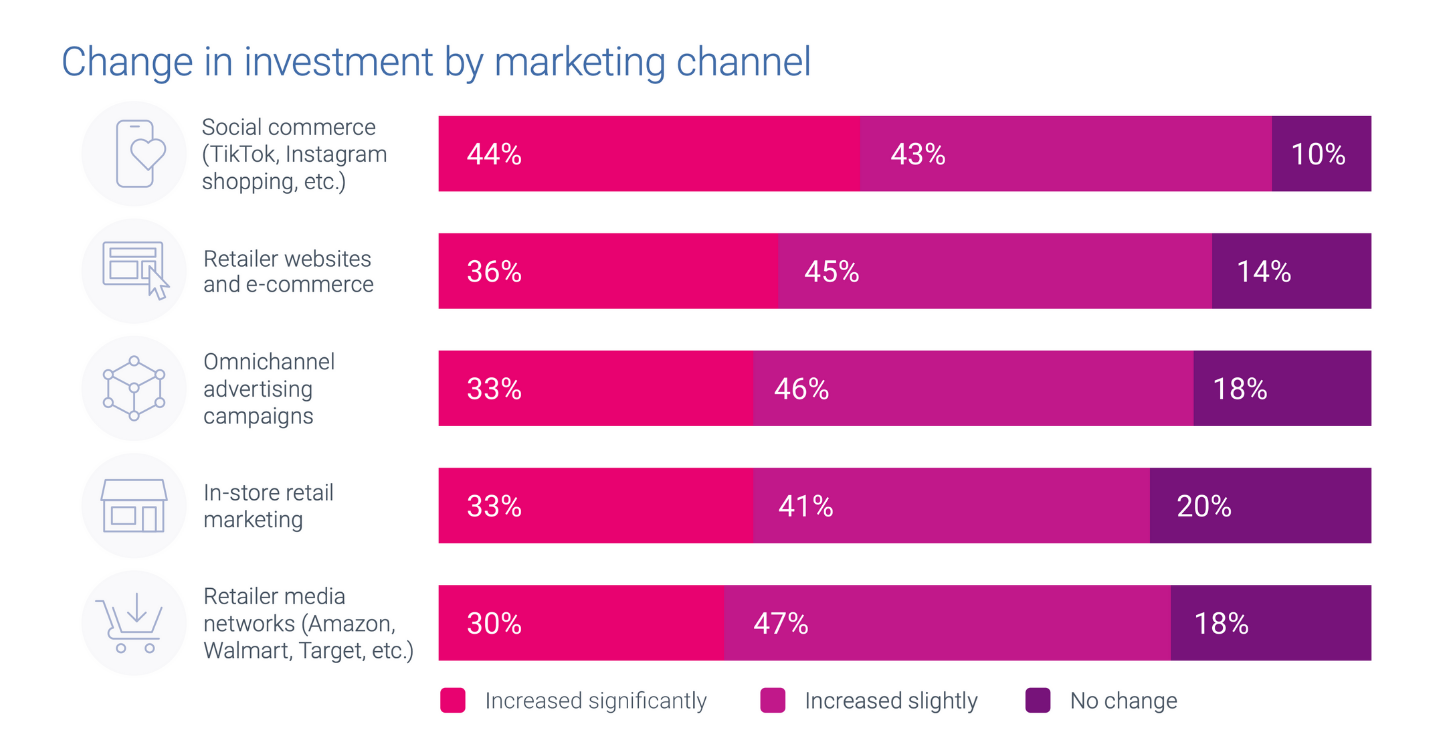
This holiday season, expectations are split. 66% of marketers expect holiday spend to rise, but only 22% of consumers agree. While brands are leaning into bigger investments across CTV, retail media, and social, shoppers are staying cautious, weighing value and waiting for the right deal.
Why it’s complicated
That disconnect introduces risk. If marketers don’t align spend with real consumer behavior, budgets can get wasted in the rush to cover every channel. Shoppers haven’t stopped spending, but they’re spending differently. They’re trading down to discount and big-box retailers while cutting back in discretionary categories like apparel and restaurants.
What to do about it
- Prioritize efficiency by focusing on the right audiences, not just more impressions.
- Make consistency your advantage: reach people once and connect across platforms instead of chasing fragmented signals.
- Balance aggressive media investment with messaging that acknowledges consumer caution — shoppers want value and trust, not hype.
Measuring TV and streaming impact with iSpot
iSpot’s Audience Builder, powered by Experian’s Marketing Attributes, helps brands reach high-value audiences. During the holiday season, a luxury retailer could target $100K+ households with affluent lifestyle interests. With iSpot’s Unified Measurement platform, they can track performance across linear TV and streaming and shift spend in real time to maximize results.
The bottom line on 2025 holiday shopping trends
This year’s holiday shopping season is, well…complicated. Shoppers are cautious but still engaged. They’re early planners and last-minute browsers. They want the ease of digital, but the confidence of in-person.
For marketers, the opportunity lies in embracing that complexity, not trying to simplify it away. The brands that balance relevance, trust, and convenience across the full season and across every channel will be the ones that win.
Download our full 2025 Holiday spending trends and insights report to explore all five shifts shaping this season and see how you can turn complexity into opportunity.
About the author

Fred Cheung
Director, Partnership Sales, Audigent, a part of Experian
Fred Cheung has spent over a decade in the programmatic advertising space, with roles at Mindshare, Jounce Media, Twitter, and The Trade Desk. His deep experience in trading and product management helps in his current function on the Experian Marketing Services’ Sales team where he focuses on data growth and adoption across the industries’ leading buy-side platforms.
2025 holiday shopping trends FAQs
Because consumer behavior is full of contradictions. People will shop earlier but also later, browse online but purchase in-store, and want deals while demanding trust. Marketers need to navigate these push-and-pull dynamics.
Nearly half (45%) say they’ll start before November, but 62% admit they’ll still be buying in December, with momentum even continuing into January through gift card redemptions and deal-hunting.
Although many consumers begin online, the majority still make their final decisions in-store. In-person shopping acts as a validation step where customers can see, touch, or try products before buying.
Instead of focusing only on Black Friday or Cyber Week, marketers should stretch campaigns across the full season, refresh offers frequently, and continue promotions into January.
Not entirely. 66% of marketers expect spending to rise, but only 22% of consumers agree. Shoppers are cautious, prioritizing value and often trading down to discount or big-box retailers.
An omnichannel approach using identity and location data can bridge digital impressions with real-world actions like store visits and purchases, ensuring consistency across touchpoints.
Brands like belVita and Duke Cannon successfully tied digital campaigns to in-store results by utilizing precise audience targeting, location data, and well-timed promotions.
You can download Experian’s 2025 Holiday spending trends and insights report to explore all five shifts shaping this season.
Latest posts

Supply-side platforms (SSPs) are expected to deliver more than inventory—they’re being asked to support sell-side targeting strategies, campaign results, and proof of performance. To meet that demand, SSPs need more than access to inventory. They need better data, better tools, and a way to bring it all together. Experian’s solutions for SSPs We built Experian’s solutions for SSPs with that demand in mind. By combining identity resolution, audience targeting, and third-party measurement, we help platforms move beyond basic transactions. Whether you’re doing sell-side targeting, supporting direct deals, or looking to support campaign validation, our tools make it easier to create value for buyers—and keep them coming back. Our solutions that help SSPs: Resolve identity across digital touchpoints using our industry-leading Digital Graph Build differentiated audiences using over 2,400 Experian Audiences and Partner Audiences in Audience Engine Support advertiser-direct relationships with tools to create, activate, and host custom segments Measure real outcomes like in-store visitation and sales through Outcomes, our third-party validated reporting suite Together, these capabilities allow SSPs to produce data-driven deals, increase addressability, and meet buyer demand for smarter, more measurable media. Campaign snapshot: Yieldmo + Experian Yieldmo, an advertising platform known for its creative formats and data-informed approach, has already put this solution to work. Here’s how they built a custom strategy for a major athletic retail client using Experian's solutions for SSPs. The challenge: Drive in-store traffic and reach new buyers Yieldmo supports a leading athletic retailer’s seasonal campaigns focused on in-store traffic. This advertiser wanted to reach new buyers—specifically those who might otherwise shop with a competitor. To do this, they needed access to strong audience segments with reliable data and the flexibility to act quickly across channels. This was the first time Yieldmo applied Experian Audiences to this retailer’s campaigns. The stakes were high: the client was looking for better in-store outcomes and a more streamlined activation workflow. The solution: Experian's activation solution for SSPs Using Experian’s Audience Engine, which includes our proprietary and third-party data marketplace, Yieldmo built a flexible, high-performing media plan that spanned display inventory and included both conquesting and primary in-store shopper segments. The team selected and activated: Apparel and footwear audiences built from Experian and partner data providers In-store shopper segments targeting retail behavior signals Competitive purchasers to capture likely buyers from other athletic brands Our data marketplace allowed Yieldmo to combine Experian Audiences with Partner Audiences from providers like Alliant, Circana, Sports Innovation Lab, and Webbula—all in one place. Manual audience creation used to take days. Now, Yieldmo can build and activate campaigns through a streamlined, self-serve workflow. By working in the Audience Engine platform, Yieldmo was able to avoid multiple contracts and manual requests. They filtered audiences by brand, tailored segments to their goals, and launched without delays. “Experian’s data marketplace in Audience Engine fills a critical gap—letting us quickly search by brand, build smarter conquest segments, and activate custom audiences fast.”Abby Littlejohn, Director of Sales Planning, Yieldmo The results: Expected lift in store visits While final in-store lift results are pending, the early performance metrics are promising: Click-through rates are at and above historical benchmarks across both conquesting and primary shopper segments. Using Audience Engine’s self-serve tools, Yieldmo created audiences faster and more easily. They reduced their workload by minimizing the need for manual data wrangling. “We include Experian audience segments in 80% of formal RFPs. Between contract simplicity, data quality, and campaign results, Experian has become our go-to for third-party audience targeting.”Nelson Montouchet, AVP, Strategic Partnerships, Yieldmo Download the full case study Bring this to your platform Whether you’re looking to monetize more effectively, build deeper advertiser relationships, or stand out with sell-side targeting offerings, we designed Experian’s solutions for SSPs to do exactly that. With our industry-leading Digital Graph, over 2,400 syndicated audiences, partner data, flexible self-serve tools, and outcome-based measurement, SSPs can now move faster and go further—without compromising scale or precision. Get in touch with our team Latest posts

After another week under the sun at Cannes Lions 2025, one thing is abundantly clear: our industry is done talking about possibilities — it’s ready to act. From speaking engagements to packed suite meetings, and even stateside through our “Can’t Cannes” activations, the appetite for change was real — and we were right at the center of it. A front-row seat to innovation Experian made a powerful impact across the Croisette, partnering with Audiostack, Basis, Infillion, IQVIA, Magnite, NextRoll, Odeeo, OpenX, The Female Quotient, and the Unplugged Collective x The Digital Marketer, to contribute to some of the week’s most insightful conversations. Our thought leaders were everywhere—on stage, in studio interviews, at executive roundtables—offering a clear voice on retail media growth, pharma advertising disruption, AI innovation, and identity-driven personalization. Three themes that defined the week 1. AI gets real If 2024 was the year of AI buzz, then 2025 is the year AI found its footing. Conversations shifted from “what if” to “what now.” While the promise of AI was front and center, conversations with clients and partners highlighted that we’re still in the foundational phase. Real-world applications—from creative optimization to predictive segmentation—are gaining traction, but long-term value will depend on robust data architecture and trustworthy identity frameworks. MiQ and PMG debuted AI-integrated platforms that demonstrated how AI can automate creative, optimize budget allocation, and personalize media in real time. AI has moved from sidekick to strategist. "Last year it was all about AI, but in a very general sense. This year, it’s about specific applications — a clear sign AI is evolving from a talking point into product.”Budi Tanzi, VP, Product 2. Outcomes > impressions Outcomes may have been a buzzword at Cannes, but as several industry leaders pointed out, simply saying “we drive outcomes” isn’t enough—it risks sounding like table stakes. In today’s performance-driven environment, what matters is how companies define and deliver those outcomes in unique ways. The most compelling conversations weren’t about generic promises, but about clear strategies: challenging assumptions, leaning into strengths, and making specific choices that tie data, media, and technology to measurable impact. "By using consistent identity across planning, activation, and measurement, marketers can connect ad exposure to real-world outcomes—whether that’s an online conversion, an in-store visit, or a new customer relationship."Chris Feo, Chief Business Officer 3. Curation isn't just a tactic Curation is quickly becoming the industry’s preferred approach to cutting through complexity. As marketers contend with signal loss and inconsistent inventory quality, the shift from broad access to intentional activation is gaining momentum. At Experian, we see curation not just as packaging, but as strategic alignment—where identity, data, and inventory come together in purpose-built environments that reduce waste, enhance safety, and drive performance. "Supply-side data activation and optimization, aka “curation,” is an alternative to the traditional approach to data activation. Unlike the traditional DMP-to-DSP activation flow, curation allows buyers to leverage supply-path data more directly. The upshot? Improved performance and pricing for media agencies and brand advertisers."Drew Stein, Managing Director, Audigent Bringing the Cannes experience stateside Not everyone can make it to the South of France—so we brought Cannes to them. Our “Can’t Cannes” events in the U.S. offered local clients a first-class experience filled with insights and networking, minus the jet lag. Final takeaways This year’s festival made one thing clear: real progress requires more than innovation; it requires integration. And that’s where Experian is focused—connecting identity to activation, and data to outcomes, in ways that are practical, scalable, and privacy-resilient. If I had to sum it up? AI is progressing from abstract to application Curation beats clutter Partnership is power And everyone’s aligned around performance We’re grateful to have been part of these conversations and even more excited about where they’ll lead next. Let’s continue the conversation If you're exploring how to connect identity to performance, or simplify the way you activate, measure, and grow, we’d love to talk. Latest posts

Originally appeared in AdExchanger Google’s decision not to deprecate cookies in the Chrome browser after all caused a stir across the industry. Companies invested heavily in developing solutions aligned with the Privacy Sandbox as a survival tactic for the post-cookie landscape. At first glance, Google’s about-face may appear to undercut those efforts. It’s easy, and perhaps even satisfying for some – but inaccurate – to say “all that effort was for nothing.” Given Chrome’s dominance among browsers, AdTech companies had no choice but to prepare for “what if” scenarios. The same goes for cookie deprecation. Google’s plan to end support for third-party cookies would have removed a mechanism that has been a cornerstone of addressability for the past 15 years. To be clear, those efforts have not been wasted. They spurred innovation across the AdTech landscape, driving progress in privacy-first targeting, alternative identifiers, supply-path data activation, and real-time data enrichment – all of which will pay dividends for years to come. Whether born directly from Privacy Sandbox participation or inspired by the broader trend toward privacy reform, industry-wide preparation for cookie loss and browser disruption has yielded tangible benefits. Pressure from Google, Apple, and evolving regulations served as a catalyst for modernization that could shape the next decade of advertising technology. An industry anchored in product innovation AdTech is a fundamentally product-driven industry defined by short innovation cycles and the imperative to build and test rapidly. This DNA enables companies to stay resilient, evolve and deliver innovation. Change is good. Disruption can be even better – but only for those who embrace it. Google’s evolving stance on cookies and Privacy Sandbox doesn’t negate what’s been learned. If anything, it underscores the need to keep innovating. The next wave of disruption is likely right around the corner. The payoff While some may argue that the time and effort spent preparing for cookie loss was wasted, those efforts have functioned as a forcing mechanism for several innovations in data activation. Supply-side data activation and optimization, aka “curation,” is an alternative to the traditional approach to data activation. Unlike the traditional data management platform (DMP) to demand-side platform (DSP) activation flow, curation allows buyers to utilize supply-path data more directly. The upshot? Improved performance and pricing for media agencies and brand advertisers. As curation continues to evolve, it’s poised to play a central role in how advertisers and publishers transact. Real-time data enrichment is another area that has benefited from this period of accelerated innovation. Many companies were compelled to improve their tech stacks to align with Sandbox protocols. These updates, particularly in real-time data enrichment capabilities, are now laying the groundwork for future data activation strategies across both the buy and sell-sides. Exiting out of tunnel vision Over the past five years, the AdTech industry has invested deeply in planning for a future without cookies. Still those investments have been well worth it. While cookies are not going away, the broader deprecation of signal continues. The work that was done to prepare will inevitably inform the next evolution of our industry. Contact us Latest posts