For decades, lenders and others have relied on core credit data focused on financial borrowing and repayment behavior. Many factors go into the decision-making process, including the length of credit history, the number of open accounts, and on-time bill payments. What happens when a consumer or small business owner relies on cash for financial transactions or has never held a mortgage or a business loan?
A significant portion of the U.S. adult population faces this problem. According to a 2020 report by the Federal Reserve, as many as 21 percent of U.S. consumers survive without a credit card. As a result, the traditional credit-scoring model doesn’t tell the full story of their financial health, and they could be labeled “credit invisible” or “unscored” due to limited access to credit.
It’s both a personal and business problem. For consumers, that might mean not being able to secure a mortgage, insurance, or even be considered for a job. Start-ups and small businesses, meanwhile, may not be able to access credit to fuel their future growth and success.
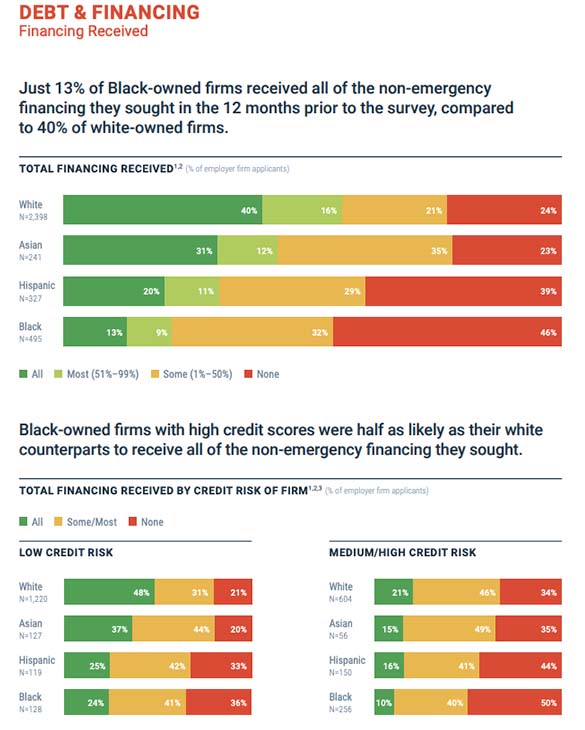
The recent explosion of new business filings brings the challenge of credit access to a head. Because small and emerging businesses can lack sufficient credit histories to qualify for credit on their own, they may rely on the owner’s personal credit profile for lending decisions. Yet, some small businesses continue to struggle to get financing. It’s especially pronounced in communities of color. For example, Black-owned businesses get turned down for bank financing at twice the rate that white-owned businesses do, according to the Federal Reserve.
Technological innovations such as Experian’s Experian Boost are shaking up the conventional scoring system by bringing in alternative credit factors to fill out the credit picture. For lenders, the emergence of alternative data, otherwise known as non-traditional data, helps them make informed business credit decisions among a wider number of customers and prospects.
What is non-traditional data?
Traditionally, lending and other credit decisions have been based on factors such as credit history and on-time payments. That can allow people and businesses that do not have a lot of cash but can demonstrate good repayment behavior to borrow. However, it’s quite another story when the situation is flipped. Some consumers and businesses don’t utilize financial products, though they might have healthy cash flow. As a result, they lack the necessary data to generate a credit score, making them appear to be unattractive credit risks.
Non-traditional data is an important way to give consumers access to better rates and open up borrowing to more consumers and businesses. This data can include things like rent and cell phone payments, giving lenders a broader range of information to consider. According to FinRegLab, 96 percent of U.S. households have a bank account or a prepaid card and 91 percent of U.S. adults have at least one utility account in their names.
Overall, including other credit data, in addition to core credit data, would bring more people into the credit system. Including non-traditional forms of data can create financial inclusion for consumers and businesses.
Where does non-traditional data come from?
Non-traditional data is generated by aggregators that scour utility accounts, public records and property information to understand the financial activities of consumers. It considers a wider range of financial behaviors than what just appears on a credit report. These can include:
Rent payments
Utility payments
Employment verification
Bank account information, including recurring payroll deposits, average account balances and withdrawal activity.
Property records
Non-traditional credit data goes one step further and supplements this data with information on consumers’ use of alternative lending arrangements such as payday loans, small-dollar credit lenders, auto financiers, rent-to-own, retail financing, and others.
Commercial lenders can also take advantage of technological innovations to gather non-traditional data for lending decisions, which can drive more approvals and greater profits.
For businesses, non-traditional credit data can include:
Social media: How many user check-ins and reviews is a business getting on social media? That can say a lot about its business. Experian Social Media Insight™ provides a social media view to help lenders better score business borrowers with thin credit profiles.
Online financial activity: An uptick in PayPal or Venmo transactions can suggest healthy cash flow.
Bank details: Borrowers can permit lenders to view their business banking account, which shows how much cash on hand they have.
Accounting software: With direct access to QuickBooks or FreshBooks, lenders can make determinations about a potential customer’s financial health in real-time.
Shipping information: For businesses moving products, analyzing shipping data allows lenders to make assumptions on cash flow.
How is non-traditional data currently used?
Financial institutions have become receptive to other credit data sources to provide additional insights. That can improve the accuracy of credit scoring and allow lenders to find more creditworthy consumers.
According to Experian’s 2020 State of Alternative Credit Data report, 96 percent of lenders believe that during times of economic stress, non-traditional credit data allows them to more closely evaluate consumers’ creditworthiness and reduce their credit risk exposure. By deeming more consumers creditworthy, financial institutions can increase financial inclusion, while uncovering new lending opportunities for themselves.
Modern tools make that possible. For example, Experian’s Clarity Services provides insights on more than 62 million U.S. consumers, helping lenders better assess and manage risk. Lenders can see consumers’ utilization of alternative finance and payment behaviors for a more holistic view of their creditworthiness.
How can non-traditional data be used to calculate credit risk?
Non-traditional credit data can help lenders gain deeper insights into their borrowers to better assess risk. For starters, it allows them to spot creditworthiness trends in real-time, rather than a snapshot in time that traditional credit data typically provides. A deteriorating financial position among prime customers and signs of improvement among marginal customers can be spotted faster with a combination of traditional and non-traditional data.
Also, some consumers may appear to be “risky” through the lens of core credit data but may prove less so when non-traditional data points are included. For example, according to FinRegLab research, cash flow data can be predictive of credit risk, not just credit utilization and history.
Owner-permissioned data lets consumers decide what lenders can see when making their credit determinations. For instance, lenders who use only traditional data might see an account that has been turned over to collections. With owner-permissioned data, on the other hand, a lender can also see a record of paying rent and cell phone bills on time. As a result, lenders can evaluate both types of behaviors in their credit decision, providing them with a fuller picture.
Looking at how consumers leverage alternative financial products to manage debt can also reveal responsible credit-management behaviors. Consumers who appear to be low-risk in the eyes of traditional credit data may actually be riskier if they do not manage their alternative finance products well – an activity that doesn’t appear on most credit reports.
The challenges of non-traditional credit data
Non-traditional credit data has the potential to open the world of credit to underserved communities. For lenders, it can unlock opportunities by bringing in a wider range of potential customers. But it’s important to recognize that there are challenges too.
For starters, lenders are still figuring out how to incorporate it into their lending decisions. While non-traditional credit data has always been available, big data collection now makes it easier to access. As lenders and regulators become more comfortable with its use, they will begin to incorporate it into credit decisions, while also being aware of its limitations.
Consumers, meanwhile, may have data security and privacy concerns about how their information will be used and who may have access to it. The Consumer Financial Protection Bureau is working on guidelines that ensure that lenders are using data appropriately and fairly.
In the wake of the Coronavirus Pandemic, thousands of companies were forced to go digital, transforming brick and mortar experiences to mobile-enabled, touchless digital experiences. Whether you were a small grocery chain or a family restaurant getting plugged into a myriad of takeout ordering platforms, the choice was simple, upgrade to a fully digital experience or go extinct.
When the $2.2 trillion CARES act passed in March of 2020, and with it the $350 billion Paycheck Protection Program, many banks had to work quickly to transform their SMB lending process to be more data-driven, risk-proof, scalable, and ready to deploy in a matter of weeks, rather than months.
The Unqork no-code solution offers a flexible alternative.
There’s a new breed of solutions that make it possible for banks to build robust, mission-critical applications without using a single line of code.
Unqork is the leading no-code enterprise application development platform. With Unqork, you can manage no-code application development throughout the entire Software Development Lifecycle without having to implement traditional coding efforts, so you can move faster at a lower cost with fewer errors to future-proof your business.
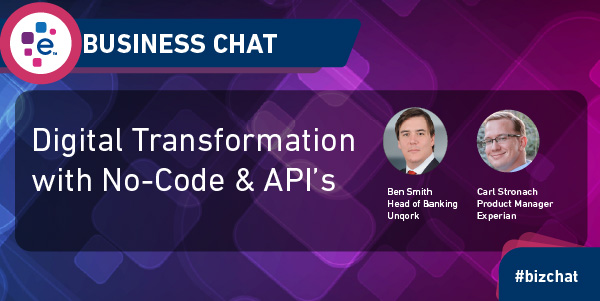
The Unqork platform makes it easy to power applications with Experian data using API’s. You can build powerful digital experiences without the scripting and coding you would normally expect. Curious? Watch our recent Business Chat interview with Unqork below.
Digital Transformation with No-Code & API's | Business Chat
Interview Transcription
We interviewed Ben Smith, Head of Banking with Unqork and Carl Stronach, Senior Product Manager with Experian met during a recent Business Chat about No-Code for Enterprise Financial Services. What follows is a lightly edited transcription of their talk.
[Gary]: Hello and welcome to Business Chat. So happy you could join us today. I'm Gary Stockton with Experian; I'm with Business Information Services here in North America. We would love to know where you're joining us from. We're streaming here from Costa Mesa, California; we're live on LinkedIn and other channels via Restream. Be sure to drop us a comment and hashtag #teamlive if you're watching us live, hashtag #teamreplay, if you're catching this on the replay, and remember sharing, is caring. We would love it if you can share this chat. If you could let your colleagues know that we're talking about APIs and No-Code by sharing this live stream, that would help us expand our audience. So they were going to be talking about no-code technology and Experian API's with two great experts. Joining us from Unqork is Ben Smith. He's the head of banking, and from Experian is Carl Stronach. He's a Senior Product Manager here at Experian, and he works on API's. Welcome gentlemen.
Ben, if you could take a moment, please tell us a bit about Unqork and your mission, where you're based, and how you got started.
[Ben]: So we were founded in 2017 by Gary Hoberman. Gary was the CIO of MetLife, and Gary had a mission to redefine software development and focus on delivering software at the enterprise-grade faster with a lower total cost of ownership and something that could be delivered by a number of different people, not necessarily people who had a significant development talent and experience. So Gary set out in 2017 to redefine how we do it. We are a no-code platform. We are totally cloud-based and agnostic. We are deployed in over ten countries with over 70 different clients. And the other thing, part of the mission that we have here around the development is we've trained over 10,000 experts globally who can develop on the platform because we believe that the no-code environment allows for rapid adoption, and we want that adoption to be significant.
[Ben]: So, what it says here is we have three major investors; we have a number of other ones. Obviously, BlackRock, Google, and Goldman Sachs are all major investors. And then, as I alluded to earlier, the mission of the firm is to develop enterprise-grade no-code solutions. So you can see at the bottom of this slide some of our major customers as well.
[Gary]: Carl, could you share a little bit about your role here at Experian you've been at Experian quite a while, and how you work with companies like Unqork?
[Carl]: So I've been with Experian for almost seven years, I'm focused on new product development. For the last four years, I have been focused on our APIs and bringing Experian business information into our global developer portal. In that time I've worked with a countless number of banks and FI's, and many of our clients across our verticals in their integration with Experian. In terms of how they are going to get our data in the most efficient way. I've supported a lot of them from the business side and the IT side and kind of sat in on both. And I've seen many of our clients really succeed with their integrations with us. That's just a direct integration to our rest API, and others, you know, take a long time.
[Carl]: So I'm sensitive to the fact that coding to APIs as easy as we can try to make them with a rest API, and as easy as we can try to make them by adding SDKs or, or other supporting information on top, it's still difficult and time-consuming. A lot of the time to code to APIs certainly gets much more complex as we get into regulated data. So it's definitely something that we want to narrow the timeline strategically. How do we get access to data and query it faster than ever before? Strategically it's something we're interested in and excited to be a part of, and working with providers like Unqork allows us to unlock some of those technologies.
[Gary]: So Ben, what's the distinction between low-code and no-code, and what drives the adoption of no-code technology?
[Ben]: The main difference is that everything that we develop on Unqork does not have any native code to it. So for you, as a developer, it's a complete visual system. And the most important thing is there's no need to maintain the code once you've written it. So even in low code environments, there is, of course, the upkeep of the code, and ultimately it becomes legacy. Whereas in our system, all of our customers are on the same platform using the same environment, or sorry, using the same software to develop their solutions. And they're always up to date. That's a big difference, there's no need to develop that last bit, and there's no need to maintain it once it's out because as soon as you write a bit of code, you've got to maintain that code going forward.
[Ben]: To the second point, how are people adopting it? We see it adopted across a number of use cases. So, for exactly that reason. Many in my world as Head of Banks, many of our customers in the banking sector are looking for ways to develop both customer-facing as well as internal-facing software that digitizes their workflows, whether that be onboarding, operations. It just depends on the needs of that particular bank. But again, the rapid development, the ability to get to market faster and the ability to not have to maintain that codebase once it's up and running have been a really powerful part of our value statement.
[Gary]: Carl, switching to data and API's. You work with a lot of clients in the banking industry. Can you tell me where in the customer life cycle does Experian API's fall?
[Carl]: It's really across the lifecycle. From campaign targeting and finding new customers to underwriting and account acquisition and customer management, even collections. It's really across the full spectrum. To take a step back. Everyone thinks of Experian as the consumer credit bureau. And, I am a very big fan of John Sina. So I think that's how Experian is generally known. But Experian's business goes well beyond just consumer credit. Obviously, we have business credit, and that's our focus here. But when it comes to our APIs, we bring everything together into a single global developer portal. So, what you can do through a single developer account is an interface with all Experian information, and we source data internally. So we've got our North America Business Information, Consumer Information, Automotive, Data, Quality, Decisioning, you name it, it's all available in one place. Also, we have an International focus too. So if you go there, you'll see API's from the UK, India, Singapore, all across the globe. We really try to be that shop for Experian data, making it much easier to code to us and eliminate those silos that used to exist in our own internal legacy systems.
[Carl]: Now, I'm really excited by some of the things that Unqork can do. When we talk about setting up one workflow that can be shared many times and doesn't have to be re-coded over and over and over again, we see the same in working with our customers. When we work with our banking customers, a lot of them execute the same exact workflows to get to Experian data. Maybe the data they need is different. Maybe the data they find predictive is different, but it's really a lot of the same workflows. And so, as we work with Unqork we can define more of these workflows, make them predefined and hopefully just speed time to market. Really eliminate a lot of the burdens with a new integration or basically offer a new product and get it out.
[Gary]: So you're finding that customers are applying these new technologies to get to market faster. I have to imagine that that was fairly active during COVID. A lot of people spinning up shopping carts and people that have brick-and-mortar stores had to innovate faster. And would you agree that platforms like Unqork are helping make that possible with API's?
[Carl]: Absolutely, so that's even a part of what we're trying to do as well. As small businesses have had to transform due to COVID, they've had to adopt more digital experiences and maybe they had to. It's a restaurant and they had to change their storefront from having tables and chairs to having just a counter and offering delivery, opening up the restaurant to more kitchen space, to handle a greater number of orders coming in. I think we are also trying to capture new data assets that can tap into that business's digital transformation. So, we've done a lot to acquire more online data on businesses, more social media data on businesses, to tap into understanding what that business activity is. Are they open? Are they closed due to COVID? And so, as we start to adopt those new data sources, our clients also face the challenge of discovering them, integrating them into their services.
[Gary]: Excellent. So, a two-part question for you Ben. How are banks deploying no code and, and are there any security considerations when using a no-code platform?
[Ben]: I think you know what we do here at Unqork for some of our customers, and what Unqork provides is the capability to both design a bank-specific user experience, but in a rapid way to deploy digitally. To solve problems that are rising quickly. PPP is a good example of that and other ones. Going forward, the ability to integrate with places like Experian on different data types such as social and some of the other ones that Carl spoke of. I think will be very important in terms of how banks redefine their small business and business offerings because post-COVID we're all going to be trying to figure out how to serve that segment in a way that makes sense from both a credit and a service point of view.
[Gary]: Excellent. So, Carl what challenges are you seeing with lenders adopting and integrating bureau and non-traditional data? I mean, non-traditional is a hot space right now.
[Carl]: Yeah. So, I think one of the challenges is just discovering the data and defining it, and being able to start working with it. I think we experienced that, even internally, so there are just so many different data sources out there. How do you really prioritize what to go after? Having it available in a single place is really key. If you had to continually define data and bring it into your database in order to work with it, it just becomes very challenging. We need to find and adopt technologies that take that burden away from our customers. Gary, we can't expect every customer to define the data source. We need to do it for them and technologies like Unqork, give us the ability to do that. And so, I'm excited by that part. If we can lower the burden there, it can unleash data analysts and data scientists to really find out which data might be predictive. So a lot of our customers want to find data that's going to be predictive of credit risk, predictive of delinquency. We need to find ways that allow them to really focus their time on finding the data, what data is actually going to be predictive. I don't want to spend all my time just defining the data just so I can test the top, a couple of fields that I have a hunch on. I want to go deeper and really find that marginal value. And technology is the key enabler that lets us do that. So go into the data.
[Gary]: Thank you, Carl. So, Ben, based on what we just heard from Carl, can you share some examples of how SMB lenders can fast-track lending applications?
[Ben]: Sure. We're working with banks around both customer onboarding and also around, the product development, into the origination cycle. I think what Carl's saying is right. To the extent that we can discover this data and get it at a deeper level, get it into the risk modeling infrastructure, through the integrations that we, as a platform can build, allows for more rapid adoption of alternative data sources. But also, better credit decisioning, you know, particularly as I sort of feel passionately about a post-COVID world and the need to take a different view as to how that credit risk moves or how credit risk is assessed.
[Gary]: Well this has been very interesting guys. And folks, if you would like to learn more about no-code and how to fast track applications and integrate with Experian API's, Unqork is hosting a webinar March 24th at 12 Eastern. Experian is going to be participating in that, we're very excited to participate. If you would like to register, you can just point your phone at the QR code or go to the link that we have there. We'll leave that in the description for this video, if you want to come back to this later. And, by all means, if you have any questions drop them in the comments. We'll be monitoring the comments in the next few days and replying to those. I want to thank both of you guys for taking time out today. I know you're both extremely busy, and looking forward to chatting with you again soon and looking forward to the webinar on the 24th.
Watch Webinar
Unqork + Experian: Smarter Small Business Lending
When insurance underwriters make mistakes, bad policies can cost billions. Alternative forms of data is helping change those outcomes, particularly for insurance providers in helping them identify blind spots and accurately underwrite policies.
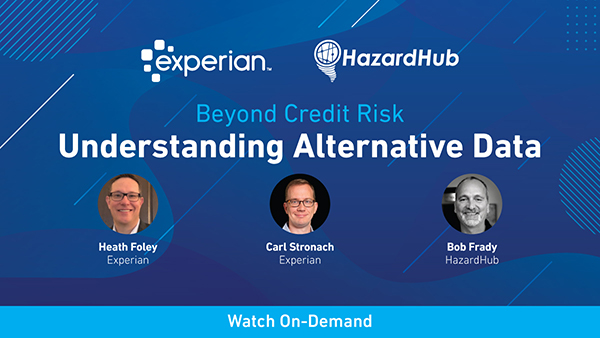
Watch our special Insurance-focused webinar titled "Beyond Credit Risk – Understanding Alternative Data" with HazardHub. Heath Foley and Carl Stronach from Experian is joined by Bob Frady from HazardHub during this lively discussion.
Alternative sources of data are growing in importance in the market. The key to our data platform is constantly investing and sourcing a wider variety of data such as geographic hazards, social media, and OSHA data in order to represent a fuller picture of the health of the business. In this one hour talk, we walk through:
Utilizing property-level hazard risk assessments
The growing importance of alternative sources of data
How to bring superior data to power comprehensive insights
Related information
What is alternative and non-traditional data/
A gastropub restaurant applies for business insurance and is approved. However, social media insights show the restaurant is declining. Even though underwriters usually take a quick look at social media postings, evaluating the trends of the business is not part of the decision process.

Costly mistakes: Underwriting using only business supplied information
How could something as basic as a business in decline be overlooked in the insurance underwriting process? Think about the process when reviewing a new business insurance application. The underwriter reviews the application and looks at traditional credit and public filing information. Although the underwriter checks out the company website, he doesn’t meet or interact with the company. He then must make a potentially costly business decision about its risk level. Even though the process appears thorough, it does not use the new wealth of information available.
How social media provides information about business health
If the insurance company had used unique and new sources of social media data, the underwriter would have seen a different picture of the restaurant. The trends in the number of reviews point to a declining business due to poor service, bland food, or increased competition. Traditional data sources miss these subtle signs that point to a higher risk of going out of business.
While one poor review shouldn’t result in a denial, a pattern of a declining business is important. This can be spotted using tools that analyze the trends in reviews and ratings for the business line. After all you cannot compare restaurants, with high volumes of social media postings, with say a dry cleaner. By correctly using social media data during the underwriting process, insurers can give an additional lift on the model to determine the risk.
Social media data can also help determine more information about the business. For example, an exercise gym may have treadmills and weight machines, or it might actually be a kickboxing studio, which has a much higher level of risk and premiums.
Underwriters also get a much more granular view than a typical application, such as the parking situation and the hours. Because risk is higher for businesses with a liquor license, insurers can often learn if a bar didn’t disclose this on their application. Customer photos also often tell a story not detectable on the application, such as broken stairs or a fireplace without proper screens.
Using artificial intelligence to analyze social media data
Looking through social media for each application takes large amounts of time. Even more importantly, humans may be subject to bias and miss word patterns in reviews. By using an artificial intelligence tool with machine learning capability to analyze social media data for business insurance applications, underwriters can gain a much more accurate picture of the risk they are assuming by insuring a business. Additionally, an AI tool can analyze business health much more quickly than an underwriter could doing the social media check manually.
Insurance companies that use artificial intelligence tools to analyze social media data during the underwriting process can more accurately predict the risk of a business. Because the processing speed, adding this additional step does not slow the process down. By reviewing what other people are saying about the business, your insurance company can decrease risk and save money on claims.
The latest insight, tips, and trends on all things related to commercial risk by the team at Experian Business Information Services. Please follow us on social media.
Stay informed by subscribing to this blog
Sign up for email notifications when new content has been published by Experian Business Information Services.