
What makes an ad impression valuable to an advertiser? The inventory where an ad appears, the audience it reaches, or its potential to contribute to a business outcome?
The answer often involves all three. Yet curation is frequently discussed in terms of site lists, audience segments, and deal IDs. These play an important role, but they don’t tell the full story of the intelligence and decisioning required to evaluate supply and media opportunities.
Advertisers want to reach relevant audiences across quality inventory, make efficient use of their media investments, and achieve measurable business outcomes. Meeting those goals requires connecting the right identity, consumer intelligence, technology, and optimization closer to the source of each impression. Making decisions too late in the transaction can mean missing more effective, direct, or cost-efficient paths to an advertiser’s target audience.
The four pillars of effective curation
Curation works best when four capabilities come together to connect advertiser objectives with relevant media opportunities.
1. Identity makes data useful across environments
Advertisers know their customers, publishers know their audiences, supply-side platforms (SSPs) understand their inventory and traffic, and demand-side platforms (DSPs) bring knowledge of campaign goals. Data partners add behavioral insights. Each may use different identifiers, making it harder to recognize the same person or household consistently across the ecosystem.
Identity provides a shared foundation for connecting these signals. A trusted, widely adopted identity graph can link permitted identifiers to a consistent view of people and households across participating ecosystem partners. This allows advertiser, publisher, and audience data to work together under appropriate privacy controls to inform media decisions.

When that identity foundation is available through real-time integrations, audience signals can be interpreted more effectively as media opportunities arise. Decisioning can apply a consistent understanding of the audience across participating supply environments, keeping audience context connected as opportunities move through the ecosystem.
2. Consumer intelligence adds context to each opportunity
Effective consumer intelligence starts with trusted data and understanding who consumers are, what they do, and what they care about, collected and used with appropriate consent, privacy protections, and permissions.
To achieve that, it’s critical to identify which data providers, audience segments, and types of data are best suited to a specific campaign and deal. Different sources offer different insights, and selecting the right combination helps advertisers identify relevant audiences and make more informed media decisions.

The right signals depend on the campaign. Retail campaigns may draw on purchase history and other behaviors that help predict future spending. Automotive campaigns may rely more on in-market signals, given longer buying cycles, to inform audience, messaging, and channel strategies. First party audiences play a crucial role in many use cases, and the ability to apply these audiences through an independent decisioning system maximizes match rates while minimizing data sharing across platforms.
Rather than relying on a predefined mix of audience segments, an advanced decisioning system can use campaign goals, brand context, and other available signals to shape the audience for each opportunity.
It can help identify which data providers, segments, and data types are most relevant, and then adjust the audience mix as performance and outcomes provide new information. This supports more tailored media decisions throughout a campaign.
3. Technology integrations connect intelligence to supply
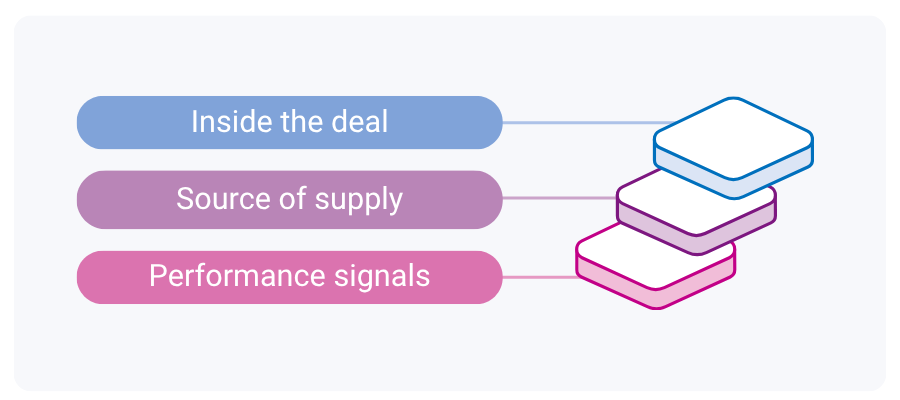
Real-time connections with SSPs let decisioning systems consider signals such as context, device information, and format alongside advertiser audience and campaign criteria as opportunities arise. But each SSP integration can expose different signals and data structures, making it difficult to apply a strategy consistently across supply. A neutral intelligence layer connected through the right technology framework can normalize those inputs across participating SSPs and return qualifying deal and audience signals through the SSP, helping DSPs prioritize relevant opportunities in their existing workflows.
4. Optimization turns insights into better decisions
Optimization becomes more informed as demand-side performance data, signals from real-time supply integrations, and online and offline conversion data come together. Connected through a consistent audience view, these signals can help categorize inventory and identify supply paths associated with stronger performance.
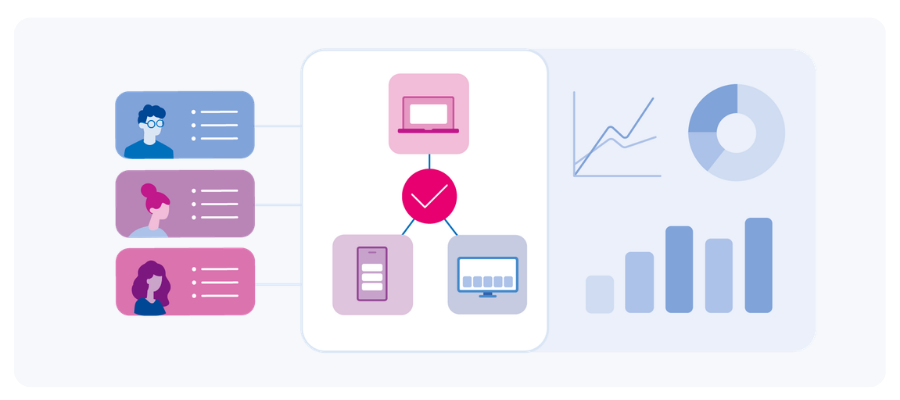
Real-time decisioning and optimization help apply those insights quickly during a campaign, while accumulated learnings can inform future campaign setup and delivery. Decisioning systems can evaluate impressions quickly. The quality, relevance, and connectivity of the information behind them determine how useful those decisions are.
Bringing intelligence closer to the impression
Advances in real-time technology are creating new opportunities to apply this intelligence earlier in the media transaction.
Traditionally, much of the intelligence informing programmatic buying has been applied through DSPs. Curation was developed and widely adopted in part because it improved decisioning and performance by layering supply side signals into the ad buying workflow. Containerization is how SSPs are extending that shift, allowing decisioning capabilities to operate within or alongside their infrastructure, closer to the source of supply.
While containers are powerful tools, containerization alone doesn’t create interoperability across supply. Each container operates within its SSP environment, therefore utilizing native features and signals available there.
Real-time integrations are needed to pass signals from participating SSP environments into a neutral decisioning layer. That layer can connect varying signals and identifiers across supply sources, helping apply decisioning more consistently across different sources and types of supply. Imagine an automotive campaign focused on test-drive bookings. Identity and audience signals help recognize likely buyers. SSP signals such as context and format describe the available placements. Campaign and conversion feedback can show which audience, context and placement combinations are performing better. Real-time integrations help apply those learnings across participating SSPs during the campaign, so the DSP can prioritize stronger opportunities while retaining control of bidding.
Advertisers, publishers, data providers, DSPs, and SSPs each contribute different signals that can inform media selection. Connecting those signals through trusted identity and interoperable technology can make decisioning more relevant to individual campaign objectives.

AI can take this a step further by analyzing connected signals and executing media decisions faster and more dynamically. As more relevant data becomes available in real time, AI-driven models could tailor how opportunities are evaluated based on an advertiser’s campaign objectives, audience priorities, and the specific requirements of a DSP. With access to appropriate performance feedback, these systems could refine their decisions over time, making curation increasingly responsive to individual campaigns.
What’s next for curation?
Curation will continue evolving into a real-time decisioning engine for the advertising ecosystem, connecting identity, consumer intelligence, technology, and optimization closer to where media opportunities become available. Neutrality and interoperability will be central to making that intelligence work across platforms and creating value for everyone involved.
Site lists and deal IDs remain useful components of programmatic activation. Relying on site lists and contextual signals alone, though, means overlooking much of what curation can offer. The broader value comes from connecting identity, consumer intelligence, technology, and optimization through real-time supply integrations to inform media decisions. As these capabilities become more connected, curation can play a greater role in how the industry evaluates and acts on media opportunities, helping advertisers and their partners make faster, more customized decisions across the open web.
That’s where the value of modern curation comes into focus, and where its future in media lies.
About the author

Budi Tanzi
SVP, Product, Experian
Budi Tanzi is the Senior Vice President of Product at Experian Marketing Services, overseeing all identity products. Prior to joining Experian, Budi worked at various stakeholders of the ad-tech ecosystem, such as Tapad, Sizmek, and StrikeAd. During his career, he held leadership roles in both Product Management and Solution Engineering. Budi has been living in New York for almost 11 years and enjoys being outdoors as well as sailing around NYC whenever possible.
Latest posts

Tapad’s technology enhances Bidtellect clients frequency capping and audience extension capabilities cross device. NEW YORK, Feb. 28, 2019 /PRNewswire/ — Tapad, part of Experian, is a global marketing technology company and leader in digital identity resolution solutions, today announced a new partnership with Bidtellect (now Simpli.fi), a leading native Demand-Side Platform (DSP). Bidtellect’s paid content distribution platform will leverage The Tapad Graph™ as its first cross-device partner. The integration will offer Bidtellect’s clients in the U.S. and Canada cross-device frequency capping and enhanced audience extension capabilities. The combination of Tapad’s leading cross-device technology, with Bidtellect’s unparalleled scale and optimization capabilities, will allow content marketers within brands and agencies to develop even more strategic, effective content marketing campaigns. The Tapad Graph™ will allow content marketers to gain greater reach and create more relevant, unified messaging with targeted delivery, when used in conjunction with Bidtellect’s technology. Marketers can expect to benefit from amplified reach, and enhanced, privacy-safe engagement with desired audiences as a result of this partnership. “Partnering with Tapad, the leaders in cross-device data, provides Bidtellect with a complete solution that leverages both probabilistic and deterministic mapping strategies,” said Mike Conway, Chief Technology Officer at Bidtellect. “The Tapad relationship expands our audience size by providing the opportunity to reach the same user across multiple devices and, when used in conjunction with our frequency capping functionality, ensures increased reach, reduced ad saturation, and elimination of wasted ad spend.” As the partnership progresses, Tapad will also work with Bidtellect to provide advanced attribution for conversions and engagement metrics including connectivity and amplification. These advanced insights will help brands and agencies develop a more holistic approach to content marketing, so they can build audiences and influence bidding algorithms that directly impact their business. Contact us today
The Tapad Graph Now Offered in Adobe Audience Manager, part of Adobe Analytics Cloud New York, NY — August 7, 2018 — Tapad, now part of Experian, is advancing personalization for the modern marketer, announced today that its proprietary Tapad Graph is now integrated with Adobe Audience Manager, part of Adobe Analytics Cloud, helping marketers expand their view of consumers and boost results through Tapad’s probabilistic solution. Tapad has been working closely with the Adobe Audience Manager team on this integration. With the Tapad Graph integration, customers based in the U.S. and Canada can use the Tapad Device Graph to expand the reach of audiences defined and activated in Adobe Audience Manager to extend first- and third-party data and deliver personalization across paid, earned and owned channels, publisher sites, programmatic, and more. Tapad worked closely with Adobe to develop the integration, allowing marketers to enable first-party data that has been previously tied to cookies and mobile. This offering has been beta-tested by leading organizations across retail, financial services, telecom providers, and more. Tapad has repeatedly proven its ability to provide marketers with a unified view of the customer across channels and screens. With the Tapad Graph, a global identity graph that currently supports more than 100 enterprise customers and 200 integration partners, marketers can extend their reach and customize messages based on user and household-level data. Contact us today
Marketers Can Now Harness The Tapad Graph In Concert With Twine’s Vetted, Verified TrueData™ Identity Graph. Los Angeles and New York – August 2, 2018 – Tapad, now part of Experian, is reinventing personalization for the modern marketer, today announced that it is partnering with mobile data leader Twine Data (now TrueData) to bring Twine’s hundreds of millions of deterministic mobile identity connections to The Tapad Graph. Together, the two companies will create one of the largest portable identity graph & CRM onboarding services in the U.S., through the integration of Tapad’s best in class cross-device capability and Twine’s deterministic identity graph. At the core of one-to-one marketing and true personalization is identity resolution. For marketers, the ability to accurately and safely connect customer activity across desktop/laptop, mobile, CTV, tablets, as well as CRM and offline touchpoints is ultimately what enables informed and personalized future conversations with each customer. Tapad is known for the precision, accuracy, and scale of their cross device connections, setting them up as an ideal partner for Twine’s TrueData deterministic identity graph. “We believe that by combining Tapad’s renowned cross-device connectivity and our deterministic identity graph, marketers will finally be able to seamlessly segment users based on digital and offline behaviors as well as easily distribute those audiences to both DMP and DSP environments for personalized messaging,” said Elliott Easterling, CEO of Twine Data. With this partnership, Tapad will build a client’s cross-device graph off of identities onboarded by Twine from a client’s offline CRM. The resulting identity graph can either be delivered directly to brands looking to host their own identity graph, or can be leveraged in a managed fashion for marketers looking for simple connectivity of their offline CRM audiences to their DSPs. To date, Twine & Tapad have seen full connectivity rates* for CRM segments from advertisers at between 259 percent and 322 percent at major DSPs. *Full Connectivity Rate is defined as {total unique desktop, laptop, and mobile devices active at DSP} / {unique CRM users in original audience post cleansing}. It represents the final match rate of the clean audience in CRM format to onboarded audience at a client’s DSP instance. This metric encompasses Twine’s onboarding & linkage validation and Tapad’s cross-device amplification. About TapadTapad, Inc. is the marketing technology company reinventing personalization for the modern marketer through its identity-driven solutions. The company’s signature Tapad Graph connects millions of consumers across billions of devices. The world’s largest brands and most effective marketers entrust Tapad to provide an accurate, privacy-conscious and unified approach to connecting with consumers across screens. In 2018, Tapad introduced its Tapad Customer Data Platform (CDP), purpose-built to offer marketers a highly personalized and privacy-safe platform to convert first-, second- and third-party data into actionable, results-driven campaigns. Tapad is based in New York and has offices in Chicago, London, Oslo, Singapore and Tokyo. Tapad’s numerous awards include: Forbes’ Most Promising Companies, Deloitte’s Technology Fast 500, Crain’s Fast 50, TMCnet Tech Culture Award and Global Startup Award’s “Startup Founder of the Year.” Tapad was acquired by the Telenor Group in 2016. Telenor Group is one of the world’s largest mobile operators across Scandinavia and Asia. About TwineTwine is a mobile data platform that believes true, honest, accurate data is the fuel that helps our partners grow their businesses efficiently and effectively; Twine’s TrueData is used by brands, agencies, and ad tech partners across the country and across the globe. Twine’s app publisher partners generate revenue while maintaining control over their data; their marketer partners get comprehensive, high quality mobile targeting and intelligence. To learn more about Twine, visit their website. Contact us today