
What makes an ad impression valuable to an advertiser? The inventory where an ad appears, the audience it reaches, or its potential to contribute to a business outcome?
The answer often involves all three. Yet curation is frequently discussed in terms of site lists, audience segments, and deal IDs. These play an important role, but they don’t tell the full story of the intelligence and decisioning required to evaluate supply and media opportunities.
Advertisers want to reach relevant audiences across quality inventory, make efficient use of their media investments, and achieve measurable business outcomes. Meeting those goals requires connecting the right identity, consumer intelligence, technology, and optimization closer to the source of each impression. Making decisions too late in the transaction can mean missing more effective, direct, or cost-efficient paths to an advertiser’s target audience.
The four pillars of effective curation
Curation works best when four capabilities come together to connect advertiser objectives with relevant media opportunities.
1. Identity makes data useful across environments
Advertisers know their customers, publishers know their audiences, supply-side platforms (SSPs) understand their inventory and traffic, and demand-side platforms (DSPs) bring knowledge of campaign goals. Data partners add behavioral insights. Each may use different identifiers, making it harder to recognize the same person or household consistently across the ecosystem.
Identity provides a shared foundation for connecting these signals. A trusted, widely adopted identity graph can link permitted identifiers to a consistent view of people and households across participating ecosystem partners. This allows advertiser, publisher, and audience data to work together under appropriate privacy controls to inform media decisions.

When that identity foundation is available through real-time integrations, audience signals can be interpreted more effectively as media opportunities arise. Decisioning can apply a consistent understanding of the audience across participating supply environments, keeping audience context connected as opportunities move through the ecosystem.
2. Consumer intelligence adds context to each opportunity
Effective consumer intelligence starts with trusted data and understanding who consumers are, what they do, and what they care about, collected and used with appropriate consent, privacy protections, and permissions.
To achieve that, it’s critical to identify which data providers, audience segments, and types of data are best suited to a specific campaign and deal. Different sources offer different insights, and selecting the right combination helps advertisers identify relevant audiences and make more informed media decisions.

The right signals depend on the campaign. Retail campaigns may draw on purchase history and other behaviors that help predict future spending. Automotive campaigns may rely more on in-market signals, given longer buying cycles, to inform audience, messaging, and channel strategies. First party audiences play a crucial role in many use cases, and the ability to apply these audiences through an independent decisioning system maximizes match rates while minimizing data sharing across platforms.
Rather than relying on a predefined mix of audience segments, an advanced decisioning system can use campaign goals, brand context, and other available signals to shape the audience for each opportunity.
It can help identify which data providers, segments, and data types are most relevant, and then adjust the audience mix as performance and outcomes provide new information. This supports more tailored media decisions throughout a campaign.
3. Technology integrations connect intelligence to supply
Real-time connections with SSPs let decisioning systems consider signals such as context, device information, and format alongside advertiser audience and campaign criteria as opportunities arise. But each SSP integration can expose different signals and data structures, making it difficult to apply a strategy consistently across supply. A neutral intelligence layer connected through the right technology framework can normalize those inputs across participating SSPs and return qualifying deal and audience signals through the SSP, helping DSPs prioritize relevant opportunities in their existing workflows.
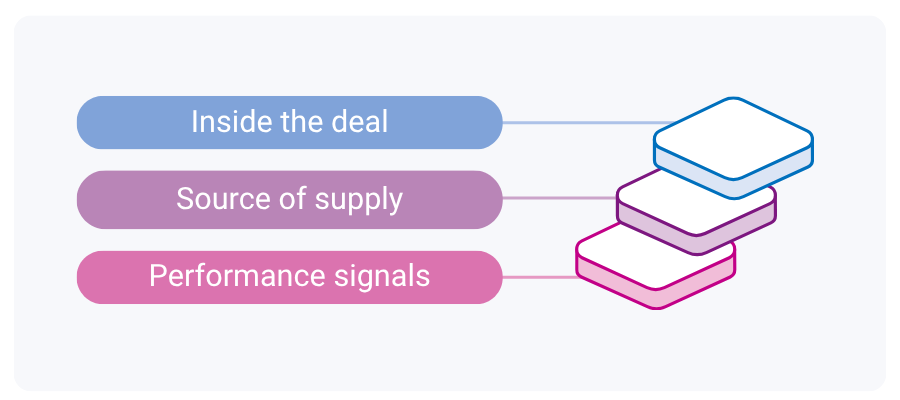
4. Optimization turns insights into better decisions
Optimization becomes more informed as demand-side performance data, signals from real-time supply integrations, and online and offline conversion data come together. Connected through a consistent audience view, these signals can help categorize inventory and identify supply paths associated with stronger performance.

Real-time decisioning and optimization help apply those insights quickly during a campaign, while accumulated learnings can inform future campaign setup and delivery. Decisioning systems can evaluate impressions quickly. The quality, relevance, and connectivity of the information behind them determine how useful those decisions are.
Bringing intelligence closer to the impression
Advances in real-time technology are creating new opportunities to apply this intelligence earlier in the media transaction.
Traditionally, much of the intelligence informing programmatic buying has been applied through DSPs. Curation was developed and widely adopted in part because it improved decisioning and performance by layering supply side signals into the ad buying workflow. Containerization is how SSPs are extending that shift, allowing decisioning capabilities to operate within or alongside their infrastructure, closer to the source of supply.
While containers are powerful tools, containerization alone doesn’t create interoperability across supply. Each container operates within its SSP environment, therefore utilizing native features and signals available there.
Real-time integrations are needed to pass signals from participating SSP environments into a neutral decisioning layer. That layer can connect varying signals and identifiers across supply sources, helping apply decisioning more consistently across different sources and types of supply. Imagine an automotive campaign focused on test-drive bookings. Identity and audience signals help recognize likely buyers. SSP signals such as context and format describe the available placements. Campaign and conversion feedback can show which audience, context and placement combinations are performing better. Real-time integrations help apply those learnings across participating SSPs during the campaign, so the DSP can prioritize stronger opportunities while retaining control of bidding.
Advertisers, publishers, data providers, DSPs, and SSPs each contribute different signals that can inform media selection. Connecting those signals through trusted identity and interoperable technology can make decisioning more relevant to individual campaign objectives.

AI can take this a step further by analyzing connected signals and executing media decisions faster and more dynamically. As more relevant data becomes available in real time, AI-driven models could tailor how opportunities are evaluated based on an advertiser’s campaign objectives, audience priorities, and the specific requirements of a DSP. With access to appropriate performance feedback, these systems could refine their decisions over time, making curation increasingly responsive to individual campaigns.
What’s next for curation?
Curation will continue evolving into a real-time decisioning engine for the advertising ecosystem, connecting identity, consumer intelligence, technology, and optimization closer to where media opportunities become available. Neutrality and interoperability will be central to making that intelligence work across platforms and creating value for everyone involved.
Site lists and deal IDs remain useful components of programmatic activation. Relying on site lists and contextual signals alone, though, means overlooking much of what curation can offer. The broader value comes from connecting identity, consumer intelligence, technology, and optimization through real-time supply integrations to inform media decisions. As these capabilities become more connected, curation can play a greater role in how the industry evaluates and acts on media opportunities, helping advertisers and their partners make faster, more customized decisions across the open web.
That’s where the value of modern curation comes into focus, and where its future in media lies.
About the author

Budi Tanzi
SVP, Product, Experian
Budi Tanzi is the Senior Vice President of Product at Experian Marketing Services, overseeing all identity products. Prior to joining Experian, Budi worked at various stakeholders of the ad-tech ecosystem, such as Tapad, Sizmek, and StrikeAd. During his career, he held leadership roles in both Product Management and Solution Engineering. Budi has been living in New York for almost 11 years and enjoys being outdoors as well as sailing around NYC whenever possible.
Latest posts

Strong Revenue Performance and Thriving Culture Contribute to Industry Recognition NEW YORK, Sept. 15, 2016 /PRNewswire/ — Tapad, the leader in cross-device marketing technology and now a part of Experian, was named a top company on Inc. Magazine’s list of the 5000 fastest-growing private companies in the U.S. In addition, Tapad won the TMCnet 2016 Tech Culture Award. The exclusive Inc. 5000 ranking highlights the fastest-growing privately-held* companies in America. These distinguished companies have achieved success in strategy, service and innovation. TMCnet recognizes talented tech professionals who are committed to building a culture that prioritizes employee growth, collaboration and engagement. Tapad continues to broaden their presence into new markets, having launched in APAC earlier this year, as well as continuing their European expansion. Tapad’s proprietary technology, The Device Graph™ is leveraged by more marketers and brands to understand digital engagement across devices. The company’s rapidly expanding client base includes numerous Fortune 500 company brands as well as all four major advertising holding companies in the U.S. “We have an exceptional team of innovative people who are all working very hard to achieve the kind of results these publications are recognizing,” said Tapad CEO and Founder, Are Traasdahl. “Given that, we have an even greater responsibility to our talent to create an environment that fosters innovation and nurtures open communication. Ultimately, this is how we will continue to reach our very ambitious goals of becoming the world’s leading unified marketing technology provider.” Tapad’s award-winning work culture is defined by its gold-standard benefits which include a six-month parental leave policy, unlimited vacation time, company-sponsored meals and office space designed to facilitate collaboration and open communication. Tapad’s highly talented team has also received multiple customer service awards in 2016. These awards include the iMedia ASPY awards for Best Customer Service and Best Mobile Partner as well as recognition from The Communicator Awards of Excellence in Interactive Media. *Prior to Tapad’s acquisition by Telenor in February 2016. Contact us today
The Tapad Device GraphTM Had Twice the Precision and Three Times the Scale as Next Competitor New York, September 14, 2016 – Just-released findings of a Hotels.com® study revealed that Tapad’s (part of Experian) cross-screen marketing technology achieved the highest levels of precision and scale among competitors. According to the leading online accommodation booking website, after a rigorous, three-and-a-half month vendor analysis, Tapad achieved twice the precision of the next highest-scoring cross-screen offering and three times greater scale. The two other companies evaluated were not named. Said Helene Cameron-Heslop, Senior Manager of Analytics of the Hotels.com brand, “Our team implemented an extremely rigorous vetting of open, cross-screen technology vendors. At the outset, we assumed we would have to compromise on either scale or accuracy – particularly given the importance to our brand of operating in a privacy-safe setting. We were surprised to find a complete package, but Tapad’s Device Graph won out on scale, accuracy and privacy; making our choice of partners very clear.” In another metric critical to the Hotels.com brand, The Tapad Device GraphTM was eight times more “unique” than the next closest offering, meaning Tapad’s graph was found to have a much greater number of connections not seen in any of the other graphs. In addition to precision, uniqueness and scale, the Tapad Device GraphTM was found to have: ● 100% higher recall● 47% more incremental matches● 53% higher North American market coverage● 101% higher F-Score* “A valuable cross-device solution should enable partners to get everything they’re looking for from a single vendor,” said Tapad Founder and CEO, Are Traasdahl. “We are deeply impressed with how thorough Hotels.com was in their vetting, and we confidently tackle the complex challenges of the martech industry thanks to our superior technology. Everyone loves a bake-off, and Tapad is no exception – delivering best-in-class results in areas that really count.” *F-score is a statistical measurement that takes precision and recall together. The calculation is 2*(precision*recall)/precision + recall). It gives you one number instead of two numbers to look at and judge performance. Contact us today
Five Norwegian startups selected to establish U.S. presence NEW YORK, Aug. 15, 2016 /PRNewswire/ — Tapad, the leader in cross-device marketing technology and now a part of Experian, has announced its new entrepreneurial mentorship initiative, the Propeller Program. Five early-stage startups from Norway have been chosen by Are Traasdahl, native of Norway and Tapad’s CEO and founder. The selected companies will share Tapad’s New York City workspace, receive C-level guidance and help establish a U.S. presence. The following companies have been selected to participate in the inaugural Propeller Program – a 12-month program beginning September 19, 2016: Bubbly – Developers of a platform that enables in-store customer feedback with dashboards and tools that facilitate real-time store response BylineMe – A marketplace for freelancers, publishers and brands to connect for content creation and distribution services Eventum – A property-sharing group that digitally assists in securing venues for meetings and corporate events Xeneta – A database that organizes the best contracted freight rates in real time and on demand “We are supporting startups that we feel represent the future of service offerings,” said Traasdahl. “It is with incredible pride that we invite these entrepreneurial teams from Norway to join us in New York Citythis year. Mentorship opportunities for early-stage companies are so important, particularly for those based outside the U.S. I look forward to giving the Propeller Program participants access to the expertise of my seasoned team and to our wide network of resources. Hopefully, it will be a game-changing year for many of them.” Contact us today