Loading...

Shopping for the right data: Data marketplaces evolve for the more selective buyer

Published: March 13, 2025 by Doug McLennan, Sr. Director, Product Management

The data marketplace shift: Quality over quantity

In a perfect world, we’d all have a single, go-to grocery store that carried everything on our shopping list – fresh produce, gourmet coffee beans, rare spices, and maybe even that special-grade olive oil, right alongside our wholesale bulk purchases at unbeatable prices. It would be convenient and efficient, and it’d save a lot of driving around town.

The changing data marketplace: From one-stop shop to specialized selection

For a long time, data buyers enjoyed something similar in their world: a small set of large-scale data marketplaces that offered a wide array of audiences, making it easy to load up on whatever you needed in one place. Not only are there fewer places to pick everything up, but new factors like privacy and signal deprecation are placing a spotlight on quality and addressability.

Just as our dinner plans are growing more ambitious insofar as we want health, flavor, value, and convenience all in one place – so are our data strategies. Instead of a single steak-and-potatoes meal, today’s data marketplace operators might be cooking up a complex menu of campaigns.

As a result, data buyers are beginning to shop around. Some still rely on large-scale marketplaces for familiar staples, but now they have reasons to explore other options. Some are turning to providers known for offering top-tier, transparently sourced segments. Others are focusing on specialty providers that excel in one area.

A more selective approach to data buying

In this environment, choosing where to “shop” for data is becoming more deliberate and selective. Data buyers aren’t just thinking about broad scale; they’re looking to prioritize quality, durability, data privacy, and differentiation. They need to place higher value on data marketplaces that can maintain audience addressability over time, despite signal loss. Sometimes, that means accepting a smaller assortment in exchange for tighter vetting and more reliable targeting. Other times it means mixing and matching – stopping by one marketplace for premium segments and another for cost-friendly, wide-reaching data sets. Either way, they can benefit from having more choices.

Experian’s marketplace: A trusted source for high-quality data

Experian’s vetted and curated blend of data partners and vertically-aligned audiences offers a trusted specialty store for data buyers. Experian’s marketplace, powered by identity graphs that include 126 million households, 250 million individuals, and 4 billion active digital IDs, enables partner audiences to be easily activated and maintain high addressability across display, mobile, and connected TV (CTV) channels. In particular, Experian’s marketplace provides:
Target with an arrow in the bullseye

Enhanced addressability and match rates

All audiences delivered from the marketplace benefit from our best-in-class offline and digital identity graphs, which ensure addressability across all channels like display, mobile, and CTV. Unlike other data marketplaces, Experian ensures all identifiers associated with an audience have been active and are targetable, improving the accuracy of audience planning.

Outline of three people

Audience diversity and scale

Access a broad range of audiences across top verticals from our partner audiences, which can be combined with one another and with 2,400+ Experian Audiences. The ability to join audiences across data providers ensures that buyers can build the perfect audience for the campaign.

A lock

Trusted compliance and oversight

With decades of experience, Experian is a trusted expert in data compliance. Our rigorous data partner review ensures available audiences comply with all federal, state, and local consumer privacy regulations.

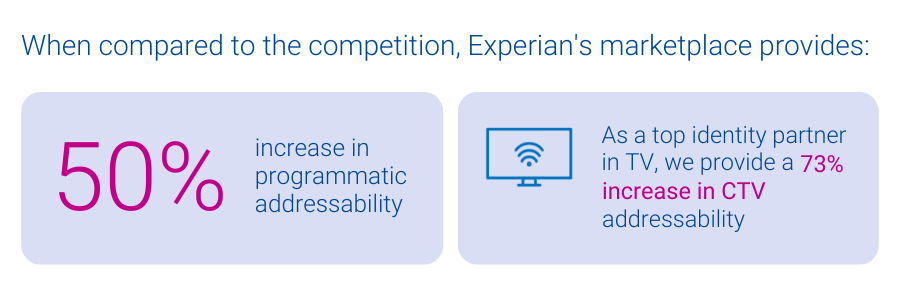
50% increase in programmatic addressability As a top identity partner in TV, we provide a 73% increase in CTV addressability
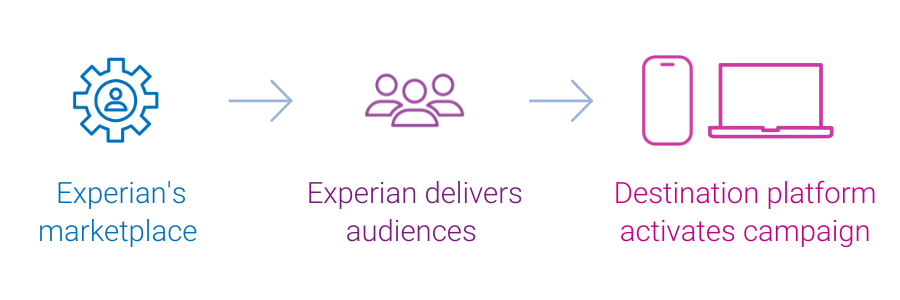
Experian marketplace -> Experian delivers audiences -> Destination platform activates campaign

The future of data marketplaces: Precision and flexibility matter

The evolution of data marketplaces reflects the industry’s shifting priorities. Data buyers seek specificity, reliability, and adaptability to align with their diverse campaign needs. The best data strategy, much like the best grocery run, isn’t about grabbing everything in one place – it’s about carefully selecting the right ingredients to create the perfect recipe for success. This shift underscores the importance of flexibility and precision as data buyers navigate a landscape shaped by privacy regulations, signal loss, and evolving consumer expectations.
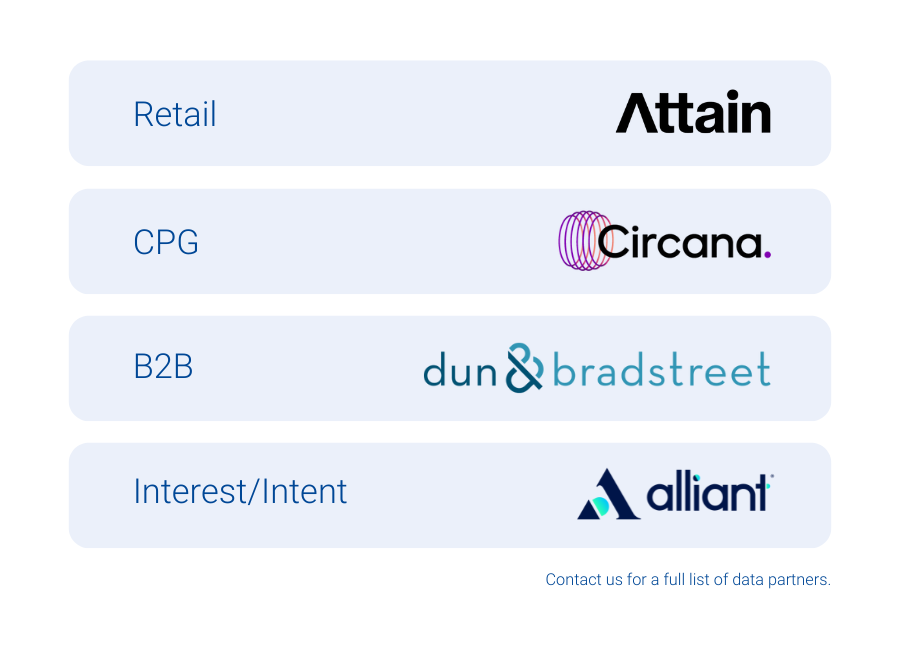
As data marketplaces adapt to meet these demands, they are redefining what it means to deliver value. Experian’s marketplace enables buyers to strike the perfect balance between reach and quality by offering enhanced match rates, precise audience planning, and seamless distribution. In this new era, data buyers have the tools and options to craft campaigns that are impactful and aligned with the increasingly selective and privacy-conscious digital landscape. The key is recognizing that today’s data strategy is about utilizing the strengths of many to create a cohesive and effective whole.

If you’re interested in learning more about Experian’s marketplace or becoming an active buyer or seller in our marketplace, please contact us.


Contact us

This site is protected by reCAPTCHA and the Google Privacy Policy and Terms of Service apply.


Latest posts

Loading…
Five considerations for the future of innovation in data and identity

Consumers engage with content and advertisements across various devices and platforms, making an identity framework essential for establishing effective connections. An identity framework allows businesses to identify consumers across multiple touchpoints, including the relationships among households, individuals, and their devices. Combined with a robust data framework, businesses can understand the relationship between households, individuals, and marketing attributes. Consequently, businesses can tailor and deliver personalized experiences based on individual preferences, ensuring seamless consumer interactions across their devices. We spoke with industry leaders from Audigent, Choreograph, Goodway Group, MiQ, Snowflake, and others to gather insights on how innovations in data and identity are creating stronger consumer connections. Here are five key considerations for advertisers. 1. Embrace a multi-ID strategy Relying on a single identity solution limits reach and adaptability. Recent data shows that both marketers and agencies are adopting multiple identity solutions. By embracing a multi-ID strategy with solutions like Unified I.D. 2.0 (UID2) and ID5, brands can build a resilient audience targeting and measurement foundation, ensuring campaigns remain effective as identity options evolve across channels. A diversified identity approach ensures that advertisers are not left vulnerable to shifts in technology or policy. By utilizing multiple ID solutions, brands can maintain consistent reach and engagement across various platforms and devices, maximizing their campaign effectiveness. "I don't think it will ever be about finding that one winner…it's going to be about finding the strengths and weaknesses and what solutions drive the best results for us."Stephani Estes, GroupM 2. Utilize AI and machine learning to enhance identity graphs Identity graphs help marketers understand the connections between households, individuals, their identifiers, and devices. This understanding of customer identity ensures accurate targeting and measurement over time. AI and machine learning have become essential in making accurate inferences from less precise signals. These technologies strengthen the accuracy of probabilistic matches, allowing brands to understand consumer behavior more effectively even when data fidelity is lower. Adopting a signal-agnostic approach and utilizing various ID providers enhances the ability to view consumers' movements across platforms. This strategy moves measurement beyond isolated channels, providing a holistic understanding of campaign effectiveness and how different formats contribute to overall performance. By integrating AI and machine learning into identity graphs, advertisers can develop more cohesive and effective marketing strategies that guide customers seamlessly through their buying journey. "What we're finding is more and more identity providers are using Gen AI to locate connections of devices to an individual or household that maybe an identity graph would not identify."David Wells, Snowflake 3. Balance privacy with precision using AI AI-driven probabilistic targeting and identity mapping provide effective solutions for privacy-focused advertising. Rather than relying on extensive personal data like cookies, AI can use limited, non-specific information to predict audience preferences accurately. This approach allows advertisers to reach their target audience while respecting privacy—a crucial balance as the industry shifts away from traditional tracking methods. According to eMarketer, generative AI can further enhance audience segmentation through clustering algorithms and natural language processing. These tools enable more granular, privacy-compliant targeting, offering advertisers a pathway to reach audiences effectively without needing third-party cookies. "I think the biggest opportunity for machine learning and AI is increasing the strength and accuracy of probabilistic matches. This allows us to preserve privacy by building models based on the features and patterns of the consumers we do know, instead of transmitting data across the ecosystem."Brian DeCicco, Choreograph 4. Activate real-time data for better engagement Real-time data enrichment introduces dynamic audience insights into the bidding process, enabling advertisers to respond instantly to user actions and preferences. This agility empowers marketers to craft more relevant and impactful moments within each campaign. "Real-time data enrichment–where data companies can have a real-time conversation with the bid stream–is an exciting part of the future, and I believe it will open the door to activating a wide variety of data sets."Drew Stein, Audigent 5. Create and deploy dynamic personas using AI Generative AI transforms persona-building by providing advertisers with richer audience profiles for more precise targeting. This approach moves beyond traditional demographic categories, allowing for messaging that connects more meaningfully with each consumer. By using generative AI to craft detailed personas, advertisers can move beyond generic messaging to create content that truly resonates on an individual level. This personalized approach captures attention and strengthens consumer relationships by addressing their specific needs and interests. "One cool thing we've built recently is a Gen AI-based personas product that generates personas to create highly sophisticated targeting tactics for campaigns."Georgiana Haig, MiQ Seize the future of data-driven engagement Focusing on these five key innovations in data and identity allows you to adapt to the evolving media landscape and deliver personalized experiences to your audience. Contact us Latest posts

Nov 21,2024 by Experian Marketing Services

Five steps retail media networks should consider when choosing a data partner

Originally appeared on Total Retail Retail media networks (RMNs) continue to demonstrate how they can be a powerful monetization driver for retailers, creating a win-win-win for everyone involved. Retailers can monetize their valuable first-party data as well as their online and in-store inventory, while customers benefit from timely, relevant content that enhances their shopping experience. At the same time, advertisers can reach highly targeted audiences at critical moments near the point of purchase Achieving this type of success requires overcoming challenges around fragmented and incomplete first-party data, which can limit a retailer's ability to organize and use their data effectively. Additionally, many RMNs lack the analytical capacity to generate customer insights, build addressable audiences, and accurately measure success. To realize the full potential of their platforms, RMNs need partners that provide complementary data, strong identity solutions, and the expertise to transform insights into actionable strategies. This allows RMNs to drive winning outcomes for themselves, marketers, and their customers. Here are the five steps an RMN should consider when selecting the right partner. 1. Build an identity foundation First, the right partner needs to be able to organize and clean customer data. Given the millions of customer records and data points that a retailer has, RMNs need to make sure their data is highly usable. Whether it is a known customer record or an unknown customer with incomplete data, partners should fill in missing information and connect fragmented customer records to a single profile. For example, RMNs need to know that a purchase made in-store is by the same customer who bought online. The best partners will then organize those profiles into households since targeting (and purchasing) is often done at the household level. Without a strong identity foundation future steps of segmentation, insights, audience creation, and activation will not be successful. Experian identity Experian's identity solutions provide RMNs with a comprehensive and accurate view of their customers across both offline and digital environments. We clean an RMN's first-party data and organize their customer records into households since targeting is often done at the household level and purchases are made at the household level. Using Experian's Offline and Digital Graphs we work with the RMN to fill in the missing information they have on their customers (e.g. name, address, phone number or digital IDs like hashed emails, mobile ad IDs, CTV IDs, Universal IDs like UID2 or ID5 IDs). This ensures that the retailers' entire customer base can be reached – and measured – across devices and channels. 2. Segment your customers An RMN’s ability to segment its customer base and derive insights depends on the availability and usability of their data assets – not to mention some serious analytical chops. Some RMNs will split their customers into different product segments based on what’s relevant to an advertiser. For example, a home improvement retailer may segment customers by who is buying DIY supplies versus improvement services.  Other RMNs may develop custom segments from their customer data and third-party data sources, so that advertisers can personalize their marketing based on life stage, age, income level, geography, and other factors. Either approach is effective but requires working with a partner who has high quality data and deep analytical expertise to develop those segments. Segment with Experian Experian Marketing Data helps an RMN learn about their customer beyond their first-party data. With access to 5,000 marketing attributes, RMNs can fill in the holes in their understanding of a customer. We provide them with demographic, geographic, finance, home purchase, interests and behaviors, lifestyle, auto data and more. RMNs can use this enriched data set to create addressable audience segments. 3. Generate actionable insights about these segments Once the RMN determines how they will segment their customers, they can utilize demographic, attitudinal, interest, and behavioral data from a trusted partner to develop a customer profile that compares its customers against a relevant sample of consumers. Here, the RMN will gain insight that will help them answer questions about its customers. Examples include:  What age and income groups are more likely to purchase my product? What is the current life stage of my customers – do they have children, are they married, are they empty-nesters? Is price or quality more important to customers in their decision-making process? What sort of activities do my customers enjoy? How frequently do my customers shop for similar merchandise? What media channels do my customers use to get their information? Expanded insights with Experian With Experian’s advanced customer profiling, RMNs can go beyond basic customer segmentation. We build detailed customer profiles by utilizing accurate, attribute-rich consumer data, so RMNs can gain a more comprehensive understanding of their customer’s preferences, life stages, and purchasing behaviors.  Having this insight enables the RMN to: Design a targeted email campaign promoting home essentials to recently married new homeowners. Develop a social media post announcing the opening of a new hardware store to users within a specific location interested in do-it-yourself products. Create brochures and flyers at a local community event tailored towards parents with small children that promote equipment for youth sports leagues. 4. Create high quality lookalike audiences The RMN now knows what distinguishes their customers from other consumers and can create audiences that enable advertisers to run personalized marketing campaigns at scale. RMNs can do this in several different ways: Work with a data provider who can create custom audiences for the RMN (e.g., Ages 40-49 and Leisure Travelers and past purchase of travel item) These custom audiences are created by joining multiple first- and third-party data attributes found to be significant in the customer profile or using machine learning techniques to develop a custom audience unique to the advertiser.   Custom audiences with Experian With an enriched understanding of their customers, RMNs can create addressable custom audience segments, including lookalike audiences, for advertisers. 5. Expand addressability of audiences and activate on multiple destinations Once audiences are created, RMNs will want to increase a marketer’s reach across on-site and off-site channels. With the right identity graph partner, an RMN can add digital identifiers to customer records that enable activation across media channels, including programmatic display, connected television (CTV), or social. RMNs should work with identity providers that are not reliant on third-party cookies. They should select partners that offer more stable digital IDs in their graph like mobile ad IDs (MAIDs), hashed emails (HEMs), CTV IDs, and universal IDs like Unified I.D. 2.0 (UID2). Experian powers data-driven advertising through connectivity Using Experian's Digital Graph, RMNs expand the addressability of their audiences by assigning digital identifiers to customer records. Marketers will be able to reach an RMNs customers onsite as well as offsite since Experian provides several addressable IDs. Audiences can be activated across an RMNs owned and operated platform as well as extended programmatically to TV and the open web through Experian's integrations across the ecosystem. Maximize your RMN’s revenue potential with Experian Organizing customer data, segmenting customers, generating insights, creating addressable audiences, and activating campaigns are all critical steps for an RMN to realize that revenue potential. RMNs should select a partner that provides the data, identity, and analytical resources to create the winning formula for marketers, customers, and retailers.  Experian’s data and identity solutions are designed to help RMNs maximize their revenue potential. Reach out to our team to discover how we can support your path to RMN success. Connect with us Latest posts

Nov 19,2024 by Steve Zimmerman, Sr. Director, Analytic Consulting & Data Modeling

Navigating the multi-ID landscape

Originally appeared on MediaPost As the digital ecosystem becomes more complex, managing multiple identifiers for consumers has emerged as a significant challenge. From cookies and IP addresses to mobile IDs and universal IDs, marketers and platforms face increasing difficulty in maintaining a unified view of their consumers. Without a coherent identity strategy, campaigns can suffer from poor targeting, limited personalization, and flawed attribution. Experian understands these challenges and offers solutions to help our partners navigate the complexities of a multi-ID landscape. By utilizing both digital and offline data, we provide the tools to unify fragmented identifiers and maintain a persistent view of consumers. As a result, marketers and platforms get rich insights, accurate cross-device targeting, improved addressability, and measurable advertising. The shifting identity landscape For years, the industry has relied on cookies to identify consumers across devices and platforms. However, with ongoing signal loss, including the uncertainty around cookies, and the evolution of privacy regulations, the digital identity landscape has grown more complicated. As consumers hop from one device to another, they are now represented by multiple signals, each tied to a different aspect of their digital behavior. While this shift brings complexity, it also opens the door for innovation. Marketers and ad platforms now have the opportunity to rethink their identity strategies and adopt more flexible approaches that are not reliant on a single identifier. This is where Experian comes in. Connecting the dots: A holistic view of the customer journey Our identity solutions are designed to help manage today’s multi-ID ecosystem by connecting digital and offline identifiers to a single customer profile. This creates a unified view of the consumer, and when combined with our understanding of customer behavior (e.g. demo, interests, shopping patterns) marketers and platforms get both insights about their customers and the addressability to reach them across channels. Four examples of what you can do with a strong identity foundation If an advertiser wants to make its first-party data more addressable, it can utilize our Digital Graph with universal IDs, hashed emails (HEMs), and connected TV (CTV) IDs to extend its reach. A publisher who wants to gain further insights into their audiences and create private marketplaces (PMPs) can achieve this goal with the use of our Digital Graph with hashed emails, universal IDs, mobile ad IDs (MAIDs), CTV IDs, and IPs. The publisher can use this in concert with Marketing Attributes to understand age, gender, household income, buying behavior, and more. The publisher can connect marketing attributes to the Digital Graph via our Living Unit ID (LUID) to understand more about consumers that fall into their segments. A demand-side platform (DSP) who wants to extend first-party and third-party audience reach across all digital devices on their platform will use the Digital Graph with all digital IDs to allow users of their platform to select cross-device extension against first-party and third-party audiences. A retail media network (RMN) can use our Offline and Digital Graphs to connect in-store and online purchases to a household profile—even when purchases are made by different people. The RMN can then reach that household across digital media platforms and accurately attribute the in-store purchase back to digital ad exposure.  Identity as a strategic asset: Today and in the future In our paradoxical world where consumers are represented by multiple identifiers, yet marketers and platforms face signal loss, identity is more than a technical issue—it’s a strategic asset. The ability to unify identity data into a single profile provides marketers with the customer intelligence needed to drive growth and stay competitive. Here’s how we do it: Deep, persistent customer understanding: With roots in offline, deterministic data like names, addresses, and emails, we provide an accurate and persistent view of identity to our customers. This allows you to maintain a consistent and comprehensive understanding of your customers and their marketing attributes over time. Highly accurate and refreshed digital identities: Our signal-agnostic graph is not reliant on any one signal as it includes HEMs, cookies, MAIDs, IPs, Universal IDs, and CTV IDs. Our Digital Graph is updated weekly, ensuring the data is always fresh and addressable. This persistent linkage of individuals and households to their identifiers and devices means your campaigns are always targeting the right people. Connected offline and digital graphs for holistic insights: We connect offline and digital identities by following privacy-first best practices, such as preventing re-identification, to allow insights from the offline world to be used in the online world. This integrated approach, enriched with marketing data, gives you better insights, more addressable advertising, and the ability to engage customers across multiple devices while accurately measuring campaign impact. Transform challenges into opportunities The rise of the multi-ID landscape presents both challenges and opportunities for the advertising industry. We stand as the trusted partner to navigate this complexity, utilizing insights from the offline world to inform decisions in the online world, enabling personalized marketing and accurate attribution, and helping you achieve your current and future goals. Get started today Latest posts

Nov 14,2024 by Budi Tanzi, VP, Product

Subscribe to our newsletter

Enter your name and email for the latest updates

This site is protected by reCAPTCHA and the Google Privacy Policy and Terms of Service apply.

About Experian Marketing Services

At Experian Marketing Services, we use data and insights to help brands have more meaningful interactions with people. As leaders in the evolution of the advertising landscape, Experian Marketing Services can help you identify your customers and the right potential customers, uncover the most appropriate communication channels, develop messages that resonate, and measure the effectiveness of marketing activities and campaigns.

Visit our website

Subscribe to our newsletter

Stay up to date on the latest industry news and receive expert tips from our marketing experts.
Subscribe now!