
Loading...

New OpenRTB specs ensure identity resolution can be done transparently with trusted partners

Published: December 18, 2024 by Budi Tanzi, VP, Product

Experian supports OpenRTB 2.6 and more transparent advertising

2024 marked a significant year. AI became integral to our workflows, commerce and retail media networks soared, and Google did not deprecate cookies. Amidst these changes, ID bridging emerged as a hot topic, raising questions around identity reliability and transparency, which necessitated industry-wide standards. We believe the latest IAB OpenRTB specifications, produced in conjunction with supply and demand-side partners, set up the advertising industry for more transparent and effective practices.

So, what exactly is ID bridging?

As signals, like third-party cookies, fade, ID bridging emerged as a way for the supply-side to offer addressability to the demand-side. ID bridging is the supply-side practice of connecting the dots between available signals, that were generated in a way that is not the expected default behavior, to understand a user’s identity and communicate it to prospective buyers. It enables the supply-side to extend user identification beyond the scope of one browser or device.
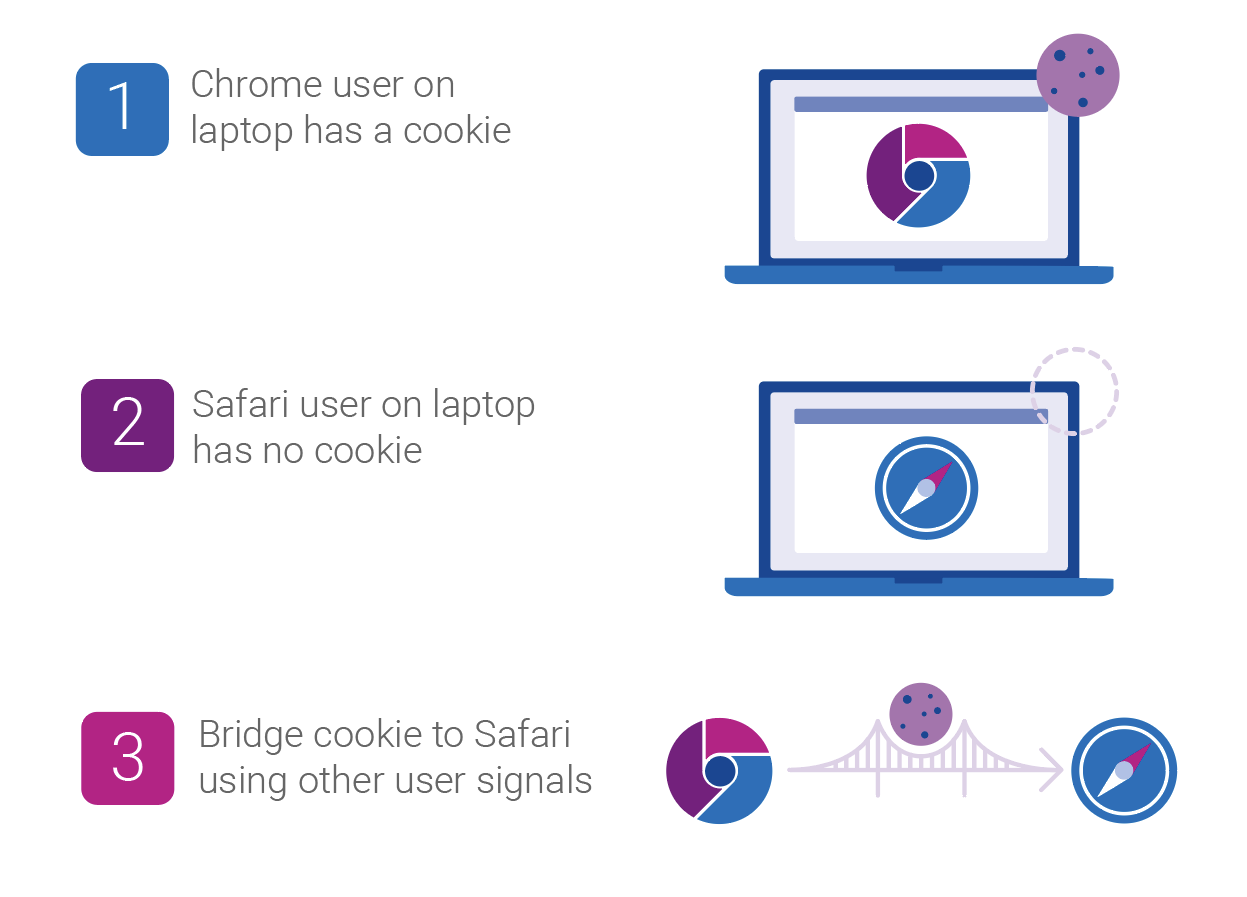
ID bridging diagram

Imagine you visit a popular sports website on your laptop using Chrome. Later, you use the same device to visit the same sports website, but this time, on Safari. By using identity resolution tools, a supply-side partner can infer that both visits are likely from the same user and communicate with them as such.

ID bridging is not inherently a bad thing. However, the practice has sparked debate, as buyers want full transparency into the use of a deterministic identifier versus an inferred one. This complicates measurement and frequency capping for the demand-side. Before OpenRTB 2.6, ID bridging led to misattribution as the demand-side could not attribute ad exposures, which had been served to a bridged ID, to a conversion, which had an ID different from the ad exposure.

OpenRTB 2.6 sets us up for a more transparent future

In 2010, the IAB, along with supply and demand-side partners, formed a consortium known as the Real-Time Bidding Project for companies interested in an open protocol for the automated trading of digital media. The OpenRTB specifications they produced became that protocol, adapting with the evolution of the industry.

The latest evolution, OpenRTB 2.6, sets out standards that strive to ensure transparency in real-time bidding, mandating how the supply-side should use certain fields to more transparently provide data when inferring users’ identities.

What’s new in OpenRTB 2.6?

Here are the technical specifications for the industry to be more transparent when inferring users’ identities:

  • Primary ID field: This existing field now can only contain the “buyeruid,” an identifier mutually recognized and agreed upon by both buyer and seller for a given environment. For web environments, the default is a cookie ID, while for app activity, it is a mobile advertising ID (MAID), passed directly from an application downloaded on a device. This approach ensures demand-side partners understand the ID’s source.
  • Enhanced identifier (EID) field: The EID field, designated for alternative IDs, now accommodates all other IDs. The EID field now has additional parameters that provide buyers transparency into how the ID was created and sourced, which you can see in the visual below:
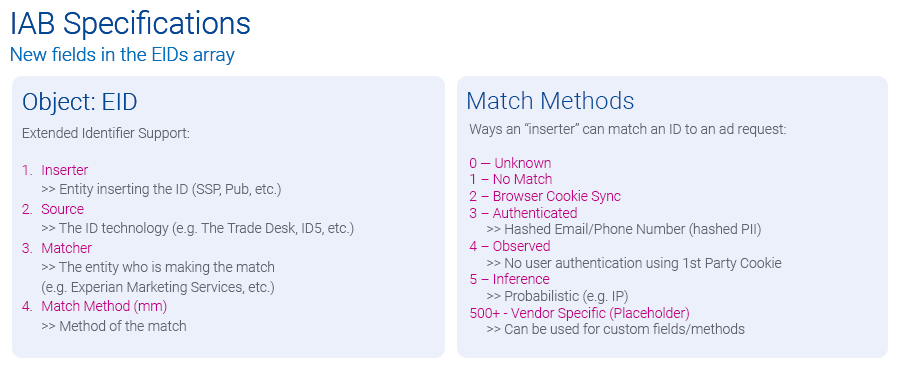
IAB specifications

Using the above framework, a publisher who wants to send a cross-environment identifier that likely belongs to the same user would declare the ID as “mm=5,” while listing the potential third-party identity resolution partner under the “matcher” field, which the visual below depicts. This additional metadata gives the demand-side the insights they need to evaluate the reliability of each ID.
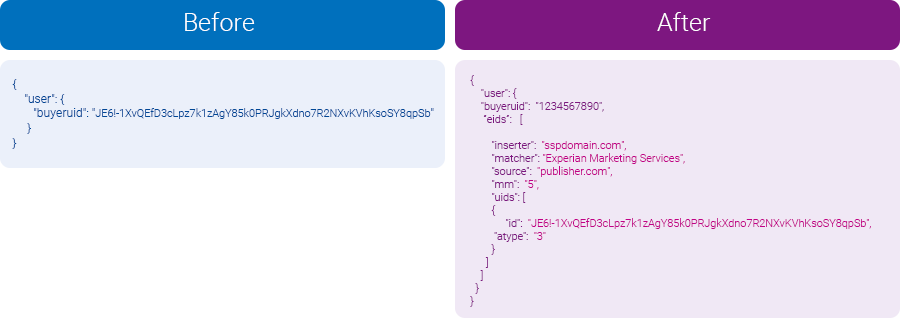
IAB before and after diagram

“These updates to OpenRTB add essential clarity about where user and device IDs come from, helping buyers see exactly how an ID was created and who put it into the bidstream. It’s a big step toward greater transparency and trust in the ecosystem. We’re excited to see companies already adopting these updates and can’t wait to see the industry fully embrace them by 2025.”

Hillary Slattery, Sr. Director, Programmatic, Product Management, IAB Tech Lab

Experian will continue supporting transparency

As authenticated signals decrease due to cookie deprecation and other consumer privacy measures, we will continue to see a rise in inferred identifiers. Experian’s industry-leading Digital Graph has long supported both authenticated and inferred identifiers, providing the ecosystem with connections that are accurate, scalable, and addressable. Experian will continue to support the industry with its identity resolution products and is supportive of the IAB’s efforts to bring transparency to the industry around the usage of identity signals.

Supply and demand-side benefits of adopting the new parameters in OpenRTB 2.6

  • Partner collaboration: Clarity between what can be in the Primary ID field versus the EID field provides clear standards and transparency between buyers and sellers.
  • Identity resolution: The supply side has an industry-approved way to bring in inferred IDs while the demand side can evaluate these IDs, expanding addressability.
  • Reducing risk: With accurate metadata available in the EID field, demand-side partners can evaluate who is doing the match and make informed decisions on whether they want to act on that ID.

Next steps for the supply and demand-sides to consider

For supply-side and demand-side partners looking to utilize OpenRTB 2.6 to its full potential, here are some recommended steps:

For the supply-side:

  • Follow IAB Specs and provide feedback: Ensure you understand and are following transparent practices. Ask questions on how to correctly implement the specifications.
  • Vet identity partners: Choose partners who deliver the most trusted and accurate identifiers in the market.
  • Be proactive: Have conversations with your partners to discuss how you plan to follow the latest specs, which identity partners you work with, and explain how you plan to provide additional signals to help buyers make better decisions.

We are beginning to see SSPs adopt this new protocol, including Sonobi and Yieldmo.

“The OpenRTB 2.6 specifications are a critical step forward in ensuring transparency and trust in programmatic advertising. By aligning with these standards, we empower our partners with the tools needed to navigate a cookieless future and drive measurable results.”

Michael Connolly, CEO, Sonobi

These additions to the OpenRTB protocol further imbue bidding transactions with transparency which will foster greater trust between partners. Moreover, the data now available is not only actionable, but auditable should a problem arise. Buyers can choose, or not, to trust an identifier based on the inserter, the provider and the method used to derive the ID. While debates within the IAB Tech Lab were spirited at times, they ultimately drove a collaborative process that shaped a solution designed to work effectively across the ecosystem.”

Mark McEachran, SVP of Product Management, Yieldmo

For the demand side:

  • Evaluation: Use the EID metadata to assess all the IDs in the EID field, looking closely at the identity vendors’ reliability. Select partners who meet high standards of data clarity and accuracy.
  • Collaboration: Establish open communication with supply-side partners and tech partners to ensure they follow the best practices in line with OpenRTB 2.6 guidelines and that there’s a shared understanding of the mutually agreed upon identifiers.
  • Provide feedback: As OpenRTB 2.6 adoption grows, consistent feedback from demand-side partners will help the IAB refine these standards.

Moving forward with reliable data and data transparency

As the AdTech industry moves toward a cookieless reality, OpenRTB 2.6 signifies a substantial step toward a sustainable, transparent programmatic ecosystem. With proactive adoption by supply- and demand-side partners, the future of programmatic advertising will be driven by trust and transparency.

Experian, our partners, and our clients know the benefits of our Digital Graph and its support of both authenticated and inferred signals. We believe that if the supply-side abides by the OpenRTB 2.6 specifications and the demand-side uses and analyzes this data, the programmatic exchange will operate more fairly and deliver more reach.


Contact us

This site is protected by reCAPTCHA and the Google Privacy Policy and Terms of Service apply.


Latest posts

Loading…
Sailing beyond the ordinary: How Experian and MMGY drove data-backed growth for Windstar Cruises

Setting sail For hospitality and travel marketers, understanding which marketing efforts lead to actual bookings can be a tidal shift. Windstar Cruises—renowned for its intimate yachts and off-the-beaten-path itineraries—wanted data-driven visibility into how digital media placements translated into confirmed reservations. Windstar turned to the strategic media expertise of MMGY, a leading integrated marketing company dedicated to the travel, tourism, and hospitality industries and Experian's marketing data and identity solutions to bridge this gap. Together, they developed a closed-loop attribution system that directly tied digital campaigns to offline passenger bookings. The challenge: Blind spots in the booking journey Windstar Cruises had plenty of top-of-funnel metrics—impressions, clicks, website sessions, cruise quote requests—but struggled to connect these indicators to confirmed reservations. Without that link, it wasn't easy to pinpoint which audience segments were most valuable in their marketing campaigns or accurately measure return on ad spend (ROAS). Traditional attribution methods and limited booking system data painted an incomplete picture, leaving Windstar to wonder which media channels and audience strategies were truly driving revenue.  MMGY and Experian: Bridging data gaps to power attribution   Comprehensive pixel tag MMGY designed an online-offline measurement strategy and coordinated with Experian to deploy pixels across Windstar's digital media placements. These pixels captured valuable event-level data—ad exposures, clicks, site visits, and more—so that every interaction could be matched back to a future booking if it occurred. Identity resolution and data enrichment Using the Experian identity graph, Experian matched Windstar’s reservation data with its extensive consumer database. This approach provided a precise, individual-level view of how digital interactions translated into real-world sales. By combining pixel data (which identifies who viewed specific ads) with reservation data (which shows who ultimately made a booking), the solution delivered a comprehensive, end-to-end, multi-touch perspective on the customer journey.  Advanced audience segmentation Utilizing MMGY’s powerful Terminal audience modeling platform—which integrates MMGY Travel Intelligence performance and intent data, Experian’s consumer intent data, and the client’s first-party data— MMGY in conjunction with Experian’s marketing analytics team developed custom audiences designed to drive incremental traveler growth. These audience segments identified travelers most likely to engage in the unique travel experiences Windstar offers. The insights revealed not only who these travelers are, but also where they consume media, how they make travel decisions, and what influences their purchasing behavior. This data guided the development of hyper-targeted media buys, ensuring Windstar’s messaging reached the right people on the right platforms at the right time—maximizing engagement and driving qualified leads. The results: Mapping spend to bookings By utilizing data connectivity and measurement, Windstar gained the insights needed to optimize every aspect of its marketing—audiences, media placements, channels, and more. This data-driven approach revealed which tactics were most effective and enabled Windstar to refine campaigns in real-time for maximum impact. 6,500+ bookings attributed to digital efforts: Over 6,500 bookings—valued at over $20 million—were tied to specific MMGY-managed placements, demonstrating which data-driven tactics led passengers to book. This level of attribution was only possible because we helped Windstar measure and connect the right data points. 13:1 ROAS: By investing $1.48 million in highly trackable, data-informed media, Windstar achieved an impressive 13:1 return on ad spend. Data connectivity gave Windstar the clarity needed to target the right audiences and channels—turning every $1 of spend into $13 of bookings. Actionable cost per booking benchmark: Armed with the ability to map ad spend to individual bookings, Windstar’s average cost per booking settled at $236. With insight into which audiences and placements performed best, Windstar adjusted its strategy in real-time, lowering acquisition costs across the board. High-value reservations: Attributed bookings were, on average, $500 higher in value than non-attributed bookings. By focusing on the right customer segments and messages—determined through precise measurement and segmentation—Windstar secured more bookings and maximized revenue per guest. Terminal Audiences outperformed: For Terminal-targeted segments, the ROAS soared to 28:1 with nearly half the cost per booking compared to non-Terminal audiences. This outcome illustrates how advanced data segmentation and connectivity deliver more profitable guests at lower acquisition costs—further proof that continuous optimization grounded in real data pays off. What this means for travel and hospitality Windstar's success story illuminates a bigger truth for the travel and hospitality industry: closing the attribution loop is no longer optional. In a fiercely competitive marketplace, brands need concrete proof that their marketing investments drive awareness and translates into real revenue. By marrying MMGY's travel-specific marketing acumen with Experian's marketing data and identity solutions, travel brands can: Invest with confidence: Marketing investment flows to the most effective channels and placements based on actual bookings, not superficial metrics. Refine strategies: Real-time attribution data creates a feedback loop marketers can use to iterate on messaging, creativity, and targeting for even stronger results. Capture higher-value guests: Pinpointing and appealing to likely travelers allows marketers to increase booking volume and total revenue per booking. Charting a course for data-driven success By seamlessly linking digital exposure to confirmed reservations, Experian and MMGY gave Windstar Cruises the compass they needed to navigate the complexities of digital marketing confidently. This new level of insight is empowering Windstar to double down on the campaigns, creatives, and segments that move the needle the most. For travel and hospitality brands worldwide, data-driven attribution goes beyond simply understanding what happened—it’s about shaping what comes next. When marketing decisions are guided by real customer journeys and precise ROI metrics, brands can make more innovative investments, foster stronger guest relationships, and chart a course toward sustainable growth. Ready to embark on your own data-driven journey? Contact us to learn how Experian and MMGY can help you create impactful, measurable marketing strategies. Contact us About MMGY MMGY is a leading integrated marketing company dedicated to the travel, tourism, and hospitality industries. With deep expertise spanning research, brand strategy, media planning, and creative execution, MMGY helps global travel brands forge meaningful connections with consumers. By utilizing data-driven insights, cutting-edge technology, and decades of experience, MMGY delivers strategic programs that capture attention and drive measurable results for its clients—ensuring that every marketing investment is tied to clear business outcomes.   Latest posts

Feb 12,2025 by Experian Marketing Services

Linear TV in 2025: Relevance, benefits, and trends

Linear TV advertising — also known as traditional or broadcast TV advertising — refers to scheduled ad programming broadcasted over traditional channels. While it doesn’t dominate the spotlight as it used to, it’s still a significant force in advertising today because of its vast potential to reach broad audiences and create memorable moments through high-profile events. Broadcast and cable TV, both forms of linear TV, still account for around 24% and 26% of U.S. TV viewership, respectively. As marketers look for ways to combine traditional and digital strategies, knowing how linear TV still fits into the mix can create value for brands and provide new opportunities for broader reach and engagement. This article explores the relevance and benefits of linear TV and how traditional broadcast television can complement digital platforms alongside changing viewing preferences. Linear TV vs. digital channels Even though linear TV has maintained impressive viewership, it’s impossible to ignore the growing influence of advanced TV platforms like OTT (over-the-top) streaming services and connected TV (CTV). These digital channels have changed how audiences consume content, complemented traditional linear TV, and created new marketing opportunities.  Each offers unique advertising value, and knowing how linear and certain forms of advanced TV stack up can help advertisers make informed choices about where to focus their efforts. Linear TV Linear TV is regularly scheduled programming on networks like ABC or NBC. The name refers to its linear delivery of content on a set schedule, with all viewers tuning in at the same time. It's great for reaching large audiences during live events or prime-time shows but lacks the precise targeting options available on digital platforms. Targeting: Advertisers can only target broad demographics (age, gender, location) but not specific interests or behaviors. Ad format: Ad formats typically take the form of non-interactive ads, usually 15-, 30-, or 60-second spots shown during commercial breaks. Viewer engagement: Viewing is passive, as ads are shown at fixed times and cannot be skipped. OTT OTT refers to streaming services that bypass traditional cable or satellite to deliver content through the internet on platforms like Netflix, Hulu, and Peacock. Content is available on-demand and accessible on devices like laptops, tablets, smart TVs, and smartphones. OTT is flexible, so viewers can watch what they want when they want. Targeting: OTT offers precise targeting using interest, viewing behavior, and location data to personalize ads. Ad formats: Formats can include pre-roll, mid-roll, sponsored content, and sometimes interactive ads to drive engagement. Viewer engagement: Viewers can control their experience with the ability to pause, skip, or replay content depending on the platform’s features. CTV CTV refers specifically to televisions connected to the internet through built-in smart features or external devices like Apple TV, Amazon Fire TV, or Roku. CTV is a delivery mechanism for streaming OTT content to the TV screen, making it like an intersection between traditional TV and digital streaming. Targeting: Similar to OTT, CTV allows precise targeting based on viewer data such as preferences, behaviors, and geographic location. Ad formats: Includes pre-roll, mid-roll, post-roll, and, in some cases, interactive ad features like clickable banners or in-ad actions. Viewer engagement: Engagement levels are higher than linear TV, as viewers are often more active participants who can pause or interact with ads. A brief comparison: Linear TV, OTT, and CTV The main differences between OTT and CTV are in their delivery and access. OTT refers to the streaming services providing content, regardless of the device, while CTV refers to the internet-enabled TV screens through which OTT content is consumed. They’re complementary, with OTT defining the content and CTV shaping the viewing experience on the largest screen in the house. Each TV platform has its own strengths. Linear TV is great for reaching a broad audience with memorable ads, while OTT and CTV offer more precise targeting and greater viewer engagement. Advertisers should consider using a mix of these platforms, taking advantage of each one’s benefits to create a well-rounded advertising strategy. Benefits of linear TV in the modern advertising landscape While consumer behavior has shifted toward digital content consumption, the sheer scale and influence of pre-scheduled, real-time broadcast TV advertising makes it a powerful tool for brand advertising within a broad media strategy. When integrated with digital strategies, linear TV can widen your reach, foster brand safety, and boost viewer engagement, to name a few benefits. Mass reach and brand visibility Broadcast TV advertising has a massive reach, especially during live events and news broadcasts. It delivers content to large, diverse audiences at once — something digital platforms, with often fragmented and niche targeting, cannot achieve on the same scale. To put things in perspective, there are nearly as many linear TV viewers today (228 million) as social media users (236 million), according to eMarketer. This helps marketers earn brand visibility and recognition across broad demographics and make an impact on their target audience. Advertisers can also use linear TV to reach multiple individuals in a single household, making it an efficient way to run household-focused marketing campaigns. Linear TV advertising increases the likelihood that a diverse audience residing in one household will see your content.  Brand safety and controlled environment One of linear TV's most important advantages is its controlled, brand-safe environment. Unlike digital platforms, where ads can appear alongside user-generated content or in unpredictable and sometimes risky settings, linear TV offers a more curated environment. Advertisers can be confident their message will be delivered in a professionally regulated context so viewers develop a positive, reliable brand association. Diversify your marketing mix Some demographics are underserved by digital channels and are more likely to see ads on linear TV than on an internet-connected device. Top U.S. advertisers obtain more impressions among adults over 55 using linear TV ads, with Baby Boomers spending an average of 5 hours and 46 minutes daily on linear TV. This highlights why it’s so critical to diversify your marketing mix with various channels that help you tap into audiences your competitors may not be.  Preferred hosting for major events Digital platforms are hosting more live events every year, but linear TV is still the most successful and reliable medium for major events like elections, breaking news, award shows, primetime TV, and the Super Bowl. In fact, linear TV dominated the 2024 U.S. Presidential election, with major networks achieving off-the-chart ratings and more than 42 million cable viewers nationwide.  Guaranteed ad exposure While many digital platforms allow viewers to skip ads, linear TV ads have stayed unskippable and ensured viewers receive full exposure to marketing content. With traditional TV ads reaching as long as 60 seconds, this guaranteed viewership is a chance you can’t miss to capture your audience's attention. Viewer engagement and ad recall Paired with CTV, linear TV is exceptionally good at engaging viewers and facilitating strong recall with high-quality content. A recent study by Brightline found that, even in 2024, linear TV maintains the highest ad attention with an attention rate of 54.5%, surpassed only by premium CTV with a 56.1% attention rate. When viewers are highly engaged with TV programming, they’re also more likely to remember the aired ads, which boosts ad effectiveness and sales potential. According to a Comcast Advertising study, long-form TV and streaming ads are also twice as memorable as short-form mobile digital ads. This study revealed that TV ads garnered more visual attention than digital mobile ads, as participants watched 71% of the TV ads compared to the 30% they watched on mobile. Ads viewed in the TV environment even resulted in 2.2x higher unaided recall and 1.3x greater purchase intent than mobile digital ads.  Traditional TV advertising, combined with digital, creates a full-screen, lean-back viewing experience that makes lasting impressions and elevates consumer memory. Current trends in TV advertising While it's true that linear TV is facing a viewership decline as audiences shift to digital platforms, it’s not disappearing entirely. Advertisers are finding new ways to innovate within the confines of linear TV and using advancements in targeting, content delivery, and OTT platform integrations.  Free ad-supported television services (FAST) For one, linear TV is finding a new lease on life through FAST services; FAST channels bridge the gap between traditional linear TV and contemporary streaming preferences to reshape how audiences engage with ad-supported content. The main appeal of FAST is its ability to deliver curated, genre-specific programming combined with on-demand options. Roughly 70% of streaming users know about FAST and have used it within the last three months.  Unlike traditional video-on-demand (VOD) platforms focused on high-profile originals and on-demand access, FAST channels bring back the structured, live grid format that mimics classic TV viewing experiences. Services like Pluto TV, Tubi, and the Roku Channel have captured significant audience share by blending nostalgia with modern accessibility. These agile, scalable platforms help media companies quickly launch new channels, as they did with NBCUniversal’s recent addition of 48 channels on Freevee and Xumo Play.  High-impact events Certain genres, like live sports and award shows, continue to dominate on linear TV, including: The Super Bowl  Other major NFL games The NBA Finals The Olympics The Oscars The Grammy Awards The Emmy Awards These events attract massive audiences and are a prime spot for advertisers. However, even live sports are transitioning to OTT platforms like Netflix, Amazon, and Peacock.  Platforms like Amazon Prime Video, Apple TV, and ESPN+ are starting to secure exclusive streaming rights for major sports events and changing viewership patterns, which creates fiercer competition for linear TV. On the flip side, marketers have new opportunities in OTT environments to enjoy the reach of traditional TV advertising with more precise targeting. Linear programmatic TV While linear TV faces growing competition from digital channels, it’s adapting to meet marketers’ needs through innovations like linear programmatic TV. This approach automates the buying and placement of ads on traditional TV so advertisers can apply data-driven insights for more precise targeting.  Unlike traditional linear ad buys, which rely on fixed schedules and broad audience demographics, programmatic technology allows for greater efficiency, flexibility, and strategic alignment. Recent forecasts show linear programmatic TV growing steadily throughout 2025 and being a valuable transitional tool that combines linear TV’s reach with digital platforms’ personalization and measurability.  Cloud TV Cloud TV modernizes the traditional TV advertising experience by combining its established infrastructure with the best features of digital streaming and OTT. Companies like Vodafone and Viacom18 are transforming linear TV into a more flexible and scalable cloud-based service that delivers linear content alongside streaming options. Users can now conveniently access live TV and on-demand content from one interface. Currently, platforms like YouTube TV and Hulu + Live TV blend linear broadcasts with OTT streaming in the cloud so that viewers can watch traditional TV channels and access on-demand shows all in one place. This means advertisers can deliver targeted, personalized messages to the right audiences without losing the large-scale reach of linear TV and engage people across live TV and digital content. Addressable TV and advanced targeting Linear TV has always been limited by broad targeting, showing the same ad to everyone, no matter who’s watching. Addressable TV changes the game, letting advertisers deliver different ads to specific households during the same program so brands can reach the right people with messages that matter to them. The key to making this work is authenticated audiences. These are viewers who log in to platforms with verified information, giving advertisers better insights into their interests, behaviors, and demographics. This level of audience data allows for smarter audience segmentation and more effective ads based on interests, demographics, and behaviors. With Experian’s addressable TV audiences and strategic partnerships, you can execute highly targeted and measurable TV campaigns. Using reliable first-party data and universal identifiers (like Unified I.D. 2.0), which link consumer profiles across devices and channels, we help brands reach the right viewers on traditional TV and CTV platforms and ensure the right person sees the right ad at the best time without overexposure. How to integrate linear TV with digital marketing strategies Integrating linear TV with digital marketing strategies starts with aligning campaigns with audience behaviors and preferences. Using data-driven insights, brands can ensure their TV efforts complement digital channels to create a unified, impactful experience. Experian simplifies this process with advanced identity resolution and audience insights. Our identity graph and syndicated audiences can help your brand: Link TV ad exposures to online engagement and create a seamless experience across platforms. Measure cross-channel performance and understand how linear TV contributes to digital outcomes. Use enriched audience data to tailor ads that resonate for relevance and consistency across TV and digital. We’re ready to help you maximize the effectiveness of your TV advertising campaigns. Ready to connect with Experian’s TV experts? Partner with a leader in data and identity to achieve the full potential of your television marketing. Our innovative tools and collaborations with top industry platforms provide exciting opportunities for you to reach and engage your ideal audience. Let us help you transform your strategies and maximize your marketing ROI with our advanced TV solutions. Talk to our TV experts Contact us Latest posts

Feb 11,2025 by Experian Marketing Services

A deep dive with an Experian partner, Yieldmo

In our Ask the Expert Series, we interview leaders from our partner organizations who are helping lead their brands to new heights in AdTech. Today’s interview is with Eric Shiffman, VP of Product Marketing at Yieldmo.  Here are five key takeaways from Eric’s insights: Tailored campaigns with Experian data: Yieldmo integrates Experian’s trusted identity and audience data to deliver creative campaigns tailored to specific audiences, ensuring more meaningful engagement.  Omnichannel activation made easy: Experian’s data marketplace helps Yieldmo expand its reach across display, mobile, and CTV, creating seamless cross-channel advertising strategies.  Advanced targeting and insights: The combination of Yieldmo’s attention signals and Experian’s identity solutions allows advertisers to pinpoint audiences with precision and confidence.  Driving results in key verticals: Retail, CPG, and automotive campaigns use Experian data on Yieldmo’s platform to achieve improved personalization, targeting accuracy, and measurable outcomes.  Scalable and privacy-conscious advertising: Yieldmo’s partnership with Experian ensures scalable solutions that balance advanced targeting with privacy-focused practices, benefiting advertisers across all industries.  About Yieldmo Yieldmo often describes itself as ‘the creative and media results company,’ using a predictive, provocative, and proven approach. Could you give us a brief overview of how this vision shaped the company and how you differentiate yourselves in ad tech?  Yieldmo was built on the belief that every ad experience should be as engaging and human centered as the content around it. By merging creative excellence with advanced technology and AI, we enable advertisers to deliver custom ad formats that spark emotion and inspire action. Our proprietary attention signals and predictive format selection allow brands to optimize for outcomes before impressions are served. This approach, combined with privacy-safe inventory curation, ensures that our solutions stand out in their ability to deliver both creativity and results.  Creative and inventory performance You’re known for delivering premium experiences across top-tier publishers. What strategies or innovations does Yieldmo employ to boost creative performance, increase engagement, and optimize inventory for your partners?  At Yieldmo, we emphasize the fusion of creative and media. We utilize predictive AI and a vast dataset to generate, customize, and match creatives with the right audiences and page contexts, enabling proven performance and learnings. On the supply side, we elevate publisher inventory by aligning high-quality ads with relevant content in innovative, non-intrusive creative formats. This dual focus ensures that every impression is primed for engagement, delivering tangible value to advertisers and optimal monetization for publishers.  Partnership with Experian As a partner of Experian, how do our identity and audience data complement Yieldmo’s platform, and why do you see this collaboration particularly beneficial for the broader advertising industry?  Experian’s robust identity and audience data ​strengthen Yieldmo’s ability to serve precisely tailored creative experiences. By integrating Experian’s insights with our proprietary attention signals and AI-driven predictive systems, we can ​optimize ​audience targeting and engagement strategies. This​ partnership represents​ the advancement of outcome​-driven advertising while giving brands the confidence of reaching the right consumers in meaningful ways.  Interest in Experian's data marketplace Experian recently introduced a new data marketplace aimed at simplifying data partner audience activation across display, mobile, and CTV. Which elements of this offering are most exciting from your perspective, and how do you anticipate it shaping Yieldmo’s solutions?  The unified approach of Experian’s data marketplace to streamline audience activation aligns seamlessly with Yieldmo’s vision of delivering data-driven creative optimization. The ability to activate comprehensive data sets across multiple channels​ expands​​ ​our omnichannel solutions, bringing precision and scalability to advertisers. Lately, we have focused resources on delivering thoughtful, cross-channel creative experiences, so aligning audiences to those is a logical extension.   Verticals using third-party data From your experience, which verticals or industries are most likely to activate third-party data campaigns on Yieldmo’s platform, and have you observed any emerging trends in how advertisers use data from Experian or other providers?  The retail,​ CPG, and automotive industries have been leading adopters of third-party data, using it to fine-tune targeting and personalize their messaging. Recently, we’ve noticed a shift toward bringing more post campaign measurement insights to the supply side–brand lift, foot traffic, conversion–for better optimization, whereas historically this valuable dataset was trapped in buy-side platforms.   Data utilization and success stories Could you share how Yieldmo’s data-driven approach has evolved and any standout success stories that highlight your platform’s impact and value to partners?  Yieldmo has always prioritized data to inform creative decisioning, from predictive ad placements to real-time optimization. In this award-winning Humane Society case study, we utilized media curation and predictive creative to drive a >170% CTR increase, 5x the campaign benchmark, leading to more page visits and donations.   Thanks for the interview. Any recommendations for our readers if they want to learn more? To learn more about our solutions and partnership opportunities, visit the Yieldmo website or contact your Experian account representative to schedule your free match test.  Contact us About our expert Eric Shiffman, Vice President of Product Marketing, Yieldmo Eric Shiffman is a product marketing leader with extensive experience in advertising technology. At Yieldmo, he drives strategies that blend AI, creative optimization, and privacy-conscious solutions to deliver measurable creative and media results. Eric ​translates​​ ​complex technologies into actionable messaging, positioning, and insights, and evangelizing products and solutions. His expertise spans creative optimization, data-driven advertising, CTV, and audience solutions.  Latest posts

Feb 04,2025 by Experian Marketing Services

Subscribe to our newsletter

Enter your name and email for the latest updates

This site is protected by reCAPTCHA and the Google Privacy Policy and Terms of Service apply.

About Experian Marketing Services

At Experian Marketing Services, we use data and insights to help brands have more meaningful interactions with people. As leaders in the evolution of the advertising landscape, Experian Marketing Services can help you identify your customers and the right potential customers, uncover the most appropriate communication channels, develop messages that resonate, and measure the effectiveness of marketing activities and campaigns.

Visit our website

Subscribe to our newsletter

Stay up to date on the latest industry news and receive expert tips from our marketing experts.
Subscribe now!