At A Glance
Experian and Yieldmo collaborate to help marketers navigate signal loss with privacy-safe contextual advertising. By combining Experian’s identity solutions with Yieldmo’s advanced targeting, this collaboration enables effective audience engagement in a world with fewer traditional signals.Note: While third-party cookies are no longer being phased out, this webinar was recorded in 2023 when cookie deprecation was still a key industry focus. The strategies discussed reflect that time frame and remain relevant for addressing broader signal loss challenges.
With major browsers discontinuing support for third-party cookies, marketers must rethink how to identify and engage their audiences. Contextual advertising offers a privacy-safe solution by combining contextual signals with machine learning to deliver highly targeted campaigns. In a Q&A with our experts with eMarketer, Jason Andersen, Senior Director of Strategic Initiatives and Partner Solutions at Experian, and Alex Johnston, Principal Product Manager at Yieldmo, we discuss how contextual advertising addresses signal loss, improves addressability, and delivers better outcomes for marketers.

The macro trends impacting marketers
How important is it for digital marketers to stay informed about the changes coming to third-party cookies, and what challenges do you see signal loss creating?
Jason (Experian): Third-party cookies have already been eliminated from Firefox, Safari, and other browsers, while Chrome has held out. It’s just a matter of time before Chrome eliminates them too. Being proactive now by predicting potential impacts will be essential for maintaining growth when the third-party cookie finally disappears.

Alex (Yieldmo): Third-party cookie loss is already a reality. As regulations like the General Data Protection Regulation (GDPR) and the California Consumer Privacy Act (CCPA) take effect, more than 50% of exchange traffic lacks associated identifiers. This means that marketers have to think differently about how they reach their audiences in an environment with fewer data points available for targeting purposes. It’s no longer something to consider at some point down the line – it’s here now! Also, as third-party cookies become more limited, reaching users online is becoming increasingly complex and competitive. Without access to as much data, the CPMs (cost per thousand impressions) that advertisers must pay are skyrocketing because everyone is trying to bid on those same valuable consumers. It’s essential for businesses desiring success in digital advertising now more than ever before.
Solving signal loss with contextual advertising
How does contextual advertising help marketers engage audiences with new strategies like machine learning and artificial intelligence (AI)?
Jason (Experian): Contextual advertising helps marketers engage audiences by combining advanced machine learning with privacy-safe strategies. We focus on using AI and machine learning to better understand behavior, respect privacy, and deliver insights. As third-party cookies go away, alternative identifiers are coming to market, like Unified I.D. 2.0 (UID2). These are going to be particularly important for marketers to be able to utilize them. As cookie syncing becomes outdated, marketers will have to look for alternative methods to reach their target audiences. It’s essential to look beyond cookie-reliant solutions and use other options available regarding advertising.
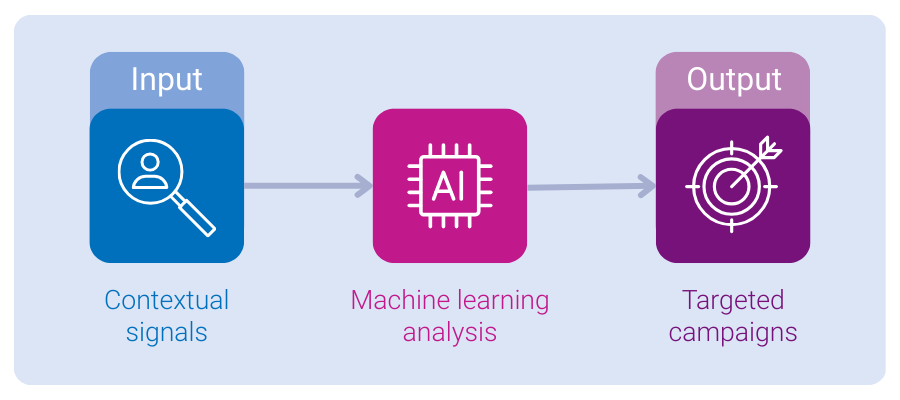
Alex (Yieldmo): There’s been a renaissance in contextual advertising over the last couple of years. Three key drivers are shaping this shift:
- The loss of identity signals is forcing marketers to rethink how they reach audiences.
- Advances in machine learning allow us to analyze more granular contextual signals, identifying patterns that are most valuable to advertisers.
- Tailored models now use these signals to deliver more effective campaigns. This transformation is occurring because of our ability to capture and operate on richer, more detailed data.
Reach consumers with advanced addressability
How does advanced contextual advertising help marketers reach non-addressable audiences?
Jason (Experian): Advanced contextual advertising helps marketers reach non-addressable audiences by taking a set of known data (identity) and drawing inferences from it with all the other signals we see across the bidstream. It’s about using a small seed set of customers, those who have transacted with you before or match your target audience, and training contextual models to make the unknown known. Now we can go out and find users surfing on any of the other sites that traditionally don’t have that identifier for that user or don’t at that moment in time and start to be able to advertise to them based on the contextually indexed data.

Alex (Yieldmo): I think the exciting opportunity for many people in the industry is figuring out how to reach your known audience in a non-addressable space, that is based on environmental and non-identity based signals, that helps your campaign perform. Machine learning advancements allow you to take your small sample audience and uncover those patterns in the non-addressable space. High-quality, privacy-resilient data sets are critical for building these campaigns. Companies like Experian, with deep, rich training data, are well positioned to support advertisers in building extension audiences.
Creative strategies that improve ad performance
Why does creative strategy remain essential for digital advertising success?
Jason (Experian): Creative strategy remains essential because it provides valuable signals for targeting and engages audiences effectively. In this advanced contextual world, good creative in the proper ad format that you can test and learn from is paramount. It comes back to that feedback loop. We can use that as another signal in this equation to develop and refine the right set of audiences for your targeting needs.
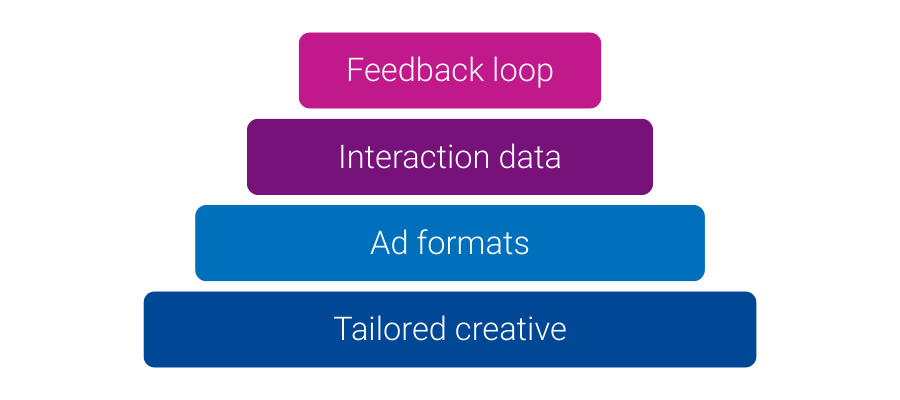
Alex (Yieldmo): Creative and ad formats are powerful signals for understanding audience engagement. At Yieldmo, we collect interaction data every 200 milliseconds, such as scrolling behavior or time spent on an ad. This data fills the gap between clicks and video completions, helping us build models that predict downstream actions. Tailoring creative to specific audience groups has always been one of the best ways to improve performance, and it remains essential in this new era of contextual advertising. Throughout my career, I learned that designing or tailoring your creative to different audience groups is one of the best ways to improve performance. We ran many lift studies with analysis to understand how you can tailor creative customized for individual audiences. That capability and the ability to do that on an identity basis is.
Our recommendations for actionable marketing strategies
Do you have recommendations for marketers building out their yearly strategies or a campaign strategy?
Jason (Experian): My recommendation for marketers building out their yearly strategies is to be proactive and start testing and learning these new solutions now. I mentioned addressability and being in the right place at the right time. That’s easier in today’s third-party cookie world. But as traditional identity is further constricted, you will have these first-party solutions that will not be at scale, so you’re less likely to find your user at the scale you want. It would be best if you thought about how to reach that user at the right place at the right time. They may not be seen from an identity basis. They might not be at the right place at the right time when you were delivering or trying to deliver an ad. But you increase your chance of reaching them by building these advanced contextual targeting audiences using this privacy-safe seed ‘opted-in’ user set; this is a way to cast that wider net and achieve targeted scale.
Alex (Yieldmo): Build your seed lists, test your formats with different audiences, and understand what’s resonating with whom. Take advantage of some of the pretty remarkable advances in machine learning that are allowing us, really, for the first time to fully uncork the potential and the opportunity with contextual in a way that we’ve never done before.
Contact us
About our experts

Jason Andersen
Senior Director, Strategic Initiatives and Partner Solutions, Experian
Jason Andersen heads Strategic Initiatives and Partner Enablement for Experian Marketing Services. He focuses on addressability and activation in digital marketing and working with partners to solve signal loss. Jason has worked in digital advertising for 15+ years, spanning roles from operations and product to strategy and partnerships.

Alex Johnston
Principal Product Manager, Yieldmo
Alex Johnston is the Principal Product Manager at Yieldmo, overseeing the Machine Learning and Optimization products. Before joining Yieldmo, Alex spent 13 years at Google, where he led the Reach & Audience Planning and Measurement products, overseeing a 10X increase in revenue. During his time, he launched numerous ad products, including YouTube’s Google Preferred offering. To learn more about Yieldmo, visit www.yieldmo.com.

About Yieldmo
Yieldmo is an advertising platform that fuses media and creative to meet audiences in the moments that matter. Using proprietary data and AI, Yieldmo uses advanced targeting to deliver context-aware creative when and where it’s most effective, all while respecting user privacy. The result: ads that belong on inventory brands trust. For more information, please visit www.yieldmo.com.
Contextual advertising FAQs
Contextual advertising works by targeting audiences based on the content they’re engaging with, rather than relying on personal identifiers or traditional tracking methods. Yieldmo’s platform uses advanced contextual signals and machine learning to deliver relevant ads in privacy-safe ways.
Contextual advertising addresses signal loss by focusing on environmental and content-based signals instead of relying on thir-dparty cookies or other traditional identifiers. Experian’s identity solutions complement this approach by enabling marketers to connect with audiences in a compliant and scalable way.
Creative is important in contextual advertising because it engages audiences and provides valuable signals for targeting. Yieldmo’s platform collects interaction data, such as scrolling and time spent on ads, to refine campaigns and improve performance.
Marketers can reach non-addressable audience through advanced contextual targeting, which uses known data, like seed audiences, to identify patterns and extend reach. Experian’s identity solutions and contextual data from, Audigent, a part of Experian, help marketers connect with these audiences in privacy-safe and effective ways.
Latest posts

2024 marked a significant year. AI became integral to our workflows, commerce and retail media networks soared, and Google did not deprecate cookies. Amidst these changes, ID bridging emerged as a hot topic, raising questions around identity reliability and transparency, which necessitated industry-wide standards. We believe the latest IAB OpenRTB specifications, produced in conjunction with supply and demand-side partners, set up the advertising industry for more transparent and effective practices. So, what exactly is ID bridging? As signals, like third-party cookies, fade, ID bridging emerged as a way for the supply-side to offer addressability to the demand-side. ID bridging is the supply-side practice of connecting the dots between available signals, that were generated in a way that is not the expected default behavior, to understand a user’s identity and communicate it to prospective buyers. It enables the supply-side to extend user identification beyond the scope of one browser or device. Imagine you visit a popular sports website on your laptop using Chrome. Later, you use the same device to visit the same sports website, but this time, on Safari. By using identity resolution tools, a supply-side partner can infer that both visits are likely from the same user and communicate with them as such. ID bridging is not inherently a bad thing. However, the practice has sparked debate, as buyers want full transparency into the use of a deterministic identifier versus an inferred one. This complicates measurement and frequency capping for the demand-side. Before OpenRTB 2.6, ID bridging led to misattribution as the demand-side could not attribute ad exposures, which had been served to a bridged ID, to a conversion, which had an ID different from the ad exposure. OpenRTB 2.6 sets us up for a more transparent future In 2010, the IAB, along with supply and demand-side partners, formed a consortium known as the Real-Time Bidding Project for companies interested in an open protocol for the automated trading of digital media. The OpenRTB specifications they produced became that protocol, adapting with the evolution of the industry. The latest evolution, OpenRTB 2.6, sets out standards that strive to ensure transparency in real-time bidding, mandating how the supply-side should use certain fields to more transparently provide data when inferring users’ identities. What's new in OpenRTB 2.6? Here are the technical specifications for the industry to be more transparent when inferring users’ identities: Primary ID field: This existing field now can only contain the “buyeruid,” an identifier mutually recognized and agreed upon by both buyer and seller for a given environment. For web environments, the default is a cookie ID, while for app activity, it is a mobile advertising ID (MAID), passed directly from an application downloaded on a device. This approach ensures demand-side partners understand the ID’s source. Enhanced identifier (EID) field: The EID field, designated for alternative IDs, now accommodates all other IDs. The EID field now has additional parameters that provide buyers transparency into how the ID was created and sourced, which you can see in the visual below: Using the above framework, a publisher who wants to send a cross-environment identifier that likely belongs to the same user would declare the ID as “mm=5,” while listing the potential third-party identity resolution partner under the “matcher” field, which the visual below depicts. This additional metadata gives the demand-side the insights they need to evaluate the reliability of each ID. "These updates to OpenRTB add essential clarity about where user and device IDs come from, helping buyers see exactly how an ID was created and who put it into the bidstream. It’s a big step toward greater transparency and trust in the ecosystem. We’re excited to see companies already adopting these updates and can’t wait to see the industry fully embrace them by 2025."Hillary Slattery, Sr. Director, Programmatic, Product Management, IAB Tech Lab Experian will continue supporting transparency As authenticated signals decrease due to cookie deprecation and other consumer privacy measures, we will continue to see a rise in inferred identifiers. Experian’s industry-leading Digital Graph has long supported both authenticated and inferred identifiers, providing the ecosystem with connections that are accurate, scalable, and addressable. Experian will continue to support the industry with its identity resolution products and is supportive of the IAB’s efforts to bring transparency to the industry around the usage of identity signals. Supply and demand-side benefits of adopting the new parameters in OpenRTB 2.6 Partner collaboration: Clarity between what can be in the Primary ID field versus the EID field provides clear standards and transparency between buyers and sellers. Identity resolution: The supply side has an industry-approved way to bring in inferred IDs while the demand side can evaluate these IDs, expanding addressability. Reducing risk: With accurate metadata available in the EID field, demand-side partners can evaluate who is doing the match and make informed decisions on whether they want to act on that ID. Next steps for the supply and demand-sides to consider For supply-side and demand-side partners looking to utilize OpenRTB 2.6 to its full potential, here are some recommended steps: For the supply-side: Follow IAB Specs and provide feedback: Ensure you understand and are following transparent practices. Ask questions on how to correctly implement the specifications. Vet identity partners: Choose partners who deliver the most trusted and accurate identifiers in the market. Be proactive: Have conversations with your partners to discuss how you plan to follow the latest specs, which identity partners you work with, and explain how you plan to provide additional signals to help buyers make better decisions. We are beginning to see SSPs adopt this new protocol, including Sonobi and Yieldmo. “The OpenRTB 2.6 specifications are a critical step forward in ensuring transparency and trust in programmatic advertising. By aligning with these standards, we empower our partners with the tools needed to navigate a cookieless future and drive measurable results.” Michael Connolly, CEO, Sonobi These additions to the OpenRTB protocol further imbue bidding transactions with transparency which will foster greater trust between partners. Moreover, the data now available is not only actionable, but auditable should a problem arise. Buyers can choose, or not, to trust an identifier based on the inserter, the provider and the method used to derive the ID. While debates within the IAB Tech Lab were spirited at times, they ultimately drove a collaborative process that shaped a solution designed to work effectively across the ecosystem.”Mark McEachran, SVP of Product Management, Yieldmo For the demand side: Evaluation: Use the EID metadata to assess all the IDs in the EID field, looking closely at the identity vendors’ reliability. Select partners who meet high standards of data clarity and accuracy. Collaboration: Establish open communication with supply-side partners and tech partners to ensure they follow the best practices in line with OpenRTB 2.6 guidelines and that there’s a shared understanding of the mutually agreed upon identifiers. Provide feedback: As OpenRTB 2.6 adoption grows, consistent feedback from demand-side partners will help the IAB refine these standards. Moving forward with reliable data and data transparency As the AdTech industry moves toward a cookieless reality, OpenRTB 2.6 signifies a substantial step toward a sustainable, transparent programmatic ecosystem. With proactive adoption by supply- and demand-side partners, the future of programmatic advertising will be driven by trust and transparency. Experian, our partners, and our clients know the benefits of our Digital Graph and its support of both authenticated and inferred signals. We believe that if the supply-side abides by the OpenRTB 2.6 specifications and the demand-side uses and analyzes this data, the programmatic exchange will operate more fairly and deliver more reach. Contact us Latest posts

Note: This Ask the Expert was recorded prior to Experian’s acquisition of Audigent and discusses industry trends and how we’ve worked together in the past. Adopting new strategies based on trust due to evolving privacy regulations and the gradual loss of traditional signals, like third-party cookies, is essential to successfully navigating the future of digital advertising. Advertisers and marketers are at a crossroads, facing the challenge of maintaining personalization and precision while respecting consumer expectations around privacy. To stay competitive, brands must adopt future-ready strategies that focus on trust, privacy-forward technologies, and scalable solutions. In our latest Ask the Expert segment, recorded before Experian acquired Audigent, we explore how first-party data and advanced contextual audience targeting are two critical approaches for successfully navigating these changes. With insights from Greg Williams, President of Audigent, now part of Experian, and Crystal Jacques, VP of Sales at Experian, we discuss how these tools can empower your brand for long-term success. First-party data as a cornerstone strategy First-party data, a powerful tool for building meaningful connections with your audience, has emerged as a fundamental pillar of future-ready strategies. When collected and used effectively, it provides brands with a detailed understanding of consumer preferences and behaviors, enabling real-time campaign adjustments for maximum impact. “Data has become part of every step of the digital advertising supply chain, and should be part of everybody’s buys… the more you can include data in your digital marketing, the better off and the more power you have."Greg Williams, President, Audigent With the continual loss of signal, including third-party cookies, first-party data has proven to be key for brands to stay both competitive and privacy-compliant. Brands using first-party data are better positioned to overcome the challenges of signal loss. This data facilitates improved media targeting and personalized messaging, driving greater engagement and return on investment. Contextually-Indexed Audiences build relevance Experian’s Contextually-Indexed Audiences enable advertisers to target users based on their interests in real-time, without relying on cookies or mobile ad IDs. Machine learning analyzes and maps traffic from over two million websites, linking to Experian’s 2,400 audience segments. With added benefits like audience customization and flexible activation through Audigent’s private marketplaces (PMPs) or demand-side platforms, Experian is setting a new standard for scalable audience targeting. For automotive advertisers, this could mean reaching consumers actively researching luxury electric vehicles on relevant sites. Unlike outdated methods, contextual targeting aligns the message with consumer intent, balancing high precision with consumer privacy. Automotive success story Audigent’s innovative solutions have delivered tangible results. Williams mentions how they helped an automotive brand achieve double the scale and triple their goal of driving test drives. This stands as a testament to the real-world effectiveness of contextual audience strategies and Experian's role in executing them. How to stay ahead of change Here are five strategies to help your brand remain future-ready amid privacy challenges and signal loss: Prioritize first-party data: Build trust and improve targeting accuracy by relying on data that you own directly from your consumers. Test privacy-forward tools: Experiment with solutions like contextual targeting and Google’s Privacy Sandbox to future-proof your advertising. Strengthen identity framework: Create systems to securely manage and use data for cross-channel decision making. Use scalable tools: Partner with trusted providers to deploy solutions that adapt to changing industry standards. Stay proactive and flexible: Continuously evaluate trends and refine approaches to align with emerging consumer and regulatory expectations. A deeper conversation For additional insights, watch our full Q&A. Greg Williams and Crystal Jacques discuss the future of audience targeting, how first-party data reshapes marketing strategies, and how Experian and Audigent have collaborated in the past. Watch now Contact us About our experts Greg Williams, President, Audigent Greg Williams is Audigent's President, responsible for managing Audigent’s vast portfolio of ecosystem partners, enterprise sales, marketing, and client success. An innovator in programmatic ad buying, Williams co-founded MediaMath and was instrumental in building and scaling that company in the US and internationally. He led MediaMath's international expansion in 2011 and grew that business from zero to a top revenue driver for the company in three years. During his 14 years at the company, Williams held global roles and built teams across every function of the organization — most notably leading business and market development, product development, and partnerships. Prior to co-founding MediaMath, Williams held senior positions at [X+1] (which was later acquired by RocketFuel), Nielsen, and Accenture. Crystal Jacques, Head of Enterprise Sales, Experian Head of Enterprise Partnerships, leading Experian's go-to-market team across all verticals. With over ten years of experience in the Identity space, Crystal brings a wealth of expertise to her role. She joined Experian in 2020 through the Tapad acquisition, following her successful stint as the head of Global Channel Partnerships for Adbrain, which The Trade Desk later acquired. Latest posts

CES 2025 will be an exciting opportunity to explore how we can work together to shape the year ahead. Here are four themes we expect to take center stage at the event. “There is no better way to kick off the calendar year than with clients and industry peers that are excited to collaborate on new business opportunities. People come straight off the holidays energized by CES and with a pipeline of deals to work on for the coming month. In-person meetings always trump virtual calls and everyone in the industry comes together to make it a fruitful week.”Crystal Jacques, Head of Enterprise Partnerships 1. Addressability in a signal-loss world Addressability has become a cornerstone in AdTech as brands aim to deliver personalized experiences while navigating evolving privacy regulations and signal loss. This shift has prompted advertisers to rethink how they reach and engage audiences. In this environment, alternative identifiers such as UID2 and ID5 have gained traction, offering brands new avenues to target consumers across platforms while respecting privacy. Addressability has shifted from a straightforward tracking mechanism to a multifaceted strategy that combines identity solutions, contextual insights, and collaboration across the ecosystem. ID Bridging and the new OpenRTB 2.6 specs As the industry loses identity signals, it becomes increasingly difficult to identify audiences on the supply-side and make them reachable for the demand-side. The supply-side has used the practice of ID bridging to do just that. ID bridging is the supply-side practice of connecting the dots between available signals to infer a user’s identity and communicate it to prospective buyers. This practice sparked debate, as buyers want full transparency into the use of a deterministic identifier versus an inferred one. "The OpenRTB 2.6 specifications are a critical step forward in ensuring transparency and trust in programmatic advertising. By aligning with these standards, we empower our partners with the tools needed to navigate a cookieless future and drive measurable results.”Michael Connolly, CEO, Sonobi The industry needs widely accepted standards, and that's what we believe the industry has with the IAB Tech Lab's OpenRTB 2.6. The specifications dictate the data the supply-side needs to include in the Primary ID and Enhanced Identifier (EID) fields. In doing so, the demand-side receives more transparent information on when bids have inferred IDs and where they came from. As authenticated signals decrease due to cookie deprecation and other consumer privacy measures, we will continue to see a rise in inferred identifiers. Experian’s industry-leading Digital Graph has long supported both authenticated and inferred identifiers, providing the ecosystem with connections that are accurate, scalable, and addressable. Experian will continue to support the industry with its identity resolution products and is very supportive of IAB’s efforts to bring transparency to the industry around the usage of identity signals. 2. Commerce media consolidation As the world of commerce media expands beyond traditional retail media, we’re seeing a surge of networks across various verticals—financial, travel, and beyond—all competing to capture shoppers’ attention. With each company independently building its own media network, the need for strategic partnerships has never been more evident. Key players face challenges in scaling these networks and meeting growth targets due to infrastructure and funding limitations. In response, the industry is shifting toward partnerships – and potentially consolidation – to create networks that allow advertisers to reach customers across the entire shopping journey – from digital to in-store. To succeed, commerce media networks must form strategic partnerships to enhance their data and identity capabilities and provide advertisers with a complete view of their customer. “With annual growth in billions of dollars, the revenue potential for RMNs is massive. Organizing customer data, segmenting customers, generating insights, creating addressable audiences, and activating campaigns are all critical steps for a RMN to realize that revenue potential. RMNs should select a partner that provides the data, identity and analytical resources to create the winning formula for marketers, customers and retailers.”Steve Zimmerman, Director of Analytics With Experian’s expertise in data and identity solutions, commerce media networks can overcome data fragmentation, create high-quality audiences, and maximize addressability across their entire customer base. This collaborative, partner-led approach empowers retailers to utilize their first-party customer data but not be limited by in-house resources. As the commerce media space matures, those who embrace these partnerships and data-driven solutions will be well-positioned to capture the full potential of this expanding market. 3. Navigating complex privacy regulations With privacy concerns intensifying, consumers are more conscious about data usage, and a series of state-level privacy laws are poised to take effect across the U.S. Multiple state-level laws makes compliance more challenging for marketers since no two laws are the same. While a federal privacy law remains unlikely for 2025, discussions around data ethics, compliance, and transparency will be prominent at CES, especially as a new administration assumes office. Our privacy-forward audience solutions Our Geo-Indexed and Contextually-Indexed Audiences help marketers reach the right consumers while prioritizing data privacy. Created without sensitive personal information, these audiences utilize geographic and contextual signals – not personal identifiers — to offer relevant targeting. These new tools provide both privacy and accuracy, giving advertisers and publishers a competitive edge. “By embracing innovations in geo-based targeting and adhering to responsible data strategies, you can not only comply with these laws but continue to reach your intended audiences effectively.”Jeremy Meade, VP, Marketing Data & Operations As privacy regulations evolve, marketers need trusted allies who can provide transparent, compliant solutions. With deep roots in data protection and security, you can confidently partner with Experian as we proactively stay ahead of regulations and strictly follow all consumer privacy laws. 4. Rise of curation As privacy regulations and signal loss reshape the AdTech ecosystem, curation can optimize programmatic campaigns by connecting advertisers with valuable audiences. This emerging trend utilizes audience, contextual, and supply chain signals to curate high-quality inventory packages for advertisers. By blending insights with inventory, curation ensures greater addressability, efficiency, and performance for both advertisers and publishers. Supply-side platforms (SSPs) are taking a more active role in curating audiences and inventory. SSPs now collaborate with data providers to match buyer and publisher first-party data in real-time, creating curated private marketplaces (PMPs) that deliver transparency, efficiency, and improved match rates. SSPs can send deal IDs to multiple DSPs, which allows advertisers to deploy audience-based campaigns without restrictions on which DSPs or identifiers can be used. However, curation isn’t without challenges. It can add complexity, lead to redundant buys, and even reduce publisher control over inventory. Transparency, quality benchmarks, and strategic partnerships will be critical for maximizing the benefits of curation in 2025. Experian, in partnership with Audigent and others, is at the forefront of enabling privacy-forward curation strategies. Experian and Audigent’s combined capabilities bring together first-party publisher data, contextual signals, and advanced identity resolution to create curated PMPs that empower marketers to deliver precise, impactful campaigns. Follow us on LinkedIn or sign up for our email newsletter for more informative content on the latest industry insights and data-driven marketing. What were the top themes at CES 2025? Read our CES recap to find out. Read now Contact us Latest posts