In 2022, Google began changing the availability of the information available in User-Agent strings across their Chromium browsers. The change is to use the set of HTTP request header fields called Client Hints. Through this process, a server can request, and if approved by the client, receive information that would have been previously freely available in the User-Agent string. This change is likely to have an impact on publishers across the open web that may use User-Agent information today.
To explain what this change means, how it will impact the AdTech industry, and what you can do to prepare, we spoke with Nate West, our Director of Product.
What is the difference between User-Agents and Client Hints?
A User-Agent (UA) is a string, or line of text, that identifies information about a web server’s browser and operating system. For example, it can indicate if a device is on Safari on a Mac or Chrome on Windows.
Here is an example UA string from a Mac laptop running Chrome:

To limit the passive fingerprinting of users, Google is reducing components of the UA strings in their Chromium browsers and introducing Client Hints. When there is a trusted relationship between first-party domain owners and third-party servers, Client Hints can be used to share the same data.
This transition began in early 2022 with bigger expected changes beginning in February 2023. You can see in the above example, Chrome/109.0.0.0, where browser version information is already no longer available from the UA string on this desktop Chrome browser.
How can you use User-Agent device attributes today?
UA string information can be used for a variety of reasons. It is a component in web servers that has been available for decades. In the AdTech space, it can be used in various ad targeting use cases. It can be used by publishers to better understand their audience. The shift to limit access and information shared is to prevent nefarious usage of the data.
What are the benefits of Client Hints?
By using Client Hints, a domain owner, or publisher, can manage access to data activity that occurs on their web properties. Having that control may be advantageous. The format of the information shared is also cleaner than parsing a string from User-Agents. Although, given that Client Hints are not the norm across all browsers, a long-term solution may be needed to manage UA strings and Client Hints.
An advantage of capturing and sharing Client Hint information is to be prepared and understand if there is any impact to your systems and processes. This will help with the currently planned transition by Google, but also should the full UA string become further restricted.
Who will be impacted by this change?
Publishers across the open web should lean in to understand this change and any potential impact to them. The programmatic ecosystem supporting real-time bidding (RTB) needs to continue pushing for adoption of OpenRTB 2.6, which supports the passing of client hint information in place of data from UA strings.
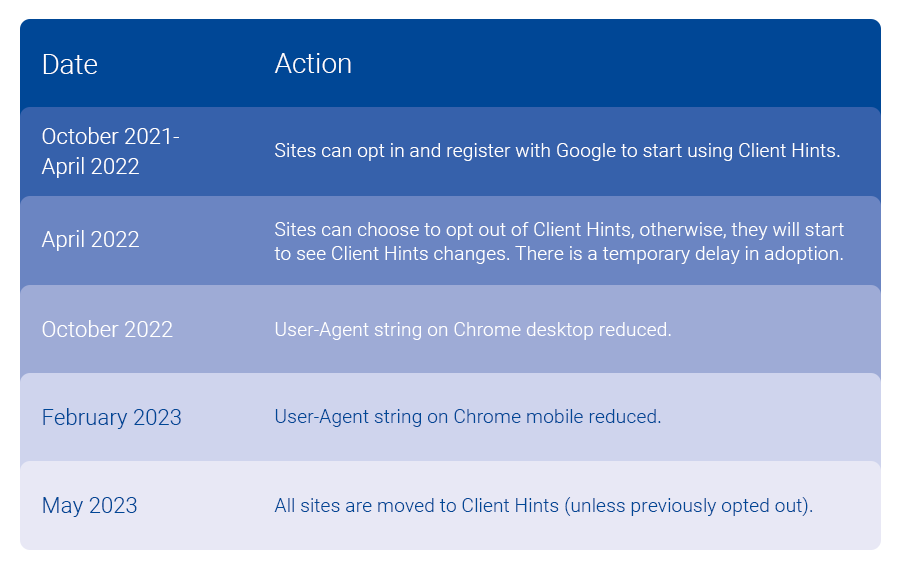
What is Google’s timeline for implementing Client Hints?
Do businesses have to implement Client Hints? What happens if they don’t?
Not capturing and sharing with trusted partners can impact capabilities in place today. Given Chromium browsers account for a sizable portion of web traffic, the impact will vary for each publisher and tech company in the ecosystem. I would assess how UA strings are in use today, where you may have security concerns or not, and look to get more information on how to maintain data sharing with trusted partners.
We can help you adopt Client Hints
Reach out to our Customer Success team at tapadcustomersuccess@experian.com to explore the best options to handle the User-Agent changes and implement Client Hints. As leaders in the AdTech space, we’re here to help you successfully make this transition. Together we can review the options available to put you and your team on the best path forward.
Get in touch
About our expert

Nate West, Director of Product
Nate West joined Experian in 2022 as the Director of Product for our identity graph. Nate focuses on making sure our partners maintain and grow identity resolution solutions today in an ever-changing future state. He has over a decade of experience working for media organizations and AdTech platforms.
Latest posts
Cuebiq’s mission, as an offline intelligence and measurement company, is to quantify how digital marketing impacts offline consumer behavior. This case study shows how Cuebiq partnered with Experian to continue delivering in-store lift analyses despite signal loss. To achieve this, Cuebiq used Experian’s Activity Feed to resolve digital ad exposures to mobile ad IDs, so that marketers could know the effectiveness of their media campaigns on in-store visits and purchases. Even as Google backs away from third-party cookie deprecation, the need for flexible, future-proof identity solutions remains. By working with Experian, Cuebiq could help their clients more accurately measure their campaigns and optimize their media. Challenge: Increasing match rates across digital platforms Cuebiq wanted to enhance how well they connect digital ad exposures, across web, mobile, and connected TV (CTV), to mobile ad IDs (MAIDs), of consumers who visited their clients’ stores. They needed a single technology partner who could collect data across these environments and improve these connections. With the ability to resolve exposures to households, individuals, and MAIDs to then facilitate attribution of digital exposures to offline store visitation, Cuebiq could continue to provide accurate reports on how digital ads impact offline consumer behavior. This clarity in data enables their clients to fine-tune their marketing strategies. Cuebiq’s key objectives included: Resolving digital exposures to MAIDs Increase overlap of offline and online data Improving the effectiveness of offline measurement offerings Activity Feed: The solution to increase match rates Experian’s Activity Feed pulls together fragmented digital event data from all digital channels, including browsers like Safari and Firefox that restrict traditional tracking methods. Activity Feed ingests and ties digital ad exposure and website activity data to household or individual profiles hourly, helping client's associate ad exposures to impact by a household or individual. Activity Feed plays a crucial role in overcoming fragmented data and helping marketers accurately measure their cross-channel marketing efforts. Cuebiq used Activity Feed to resolve exposure data from all environments, even cookieless ones, to a single household or individual and saw significantly higher match rates. Cuebiq received their clients’ ad exposure data resolved to mobile ad IDs (MAIDs) and correlated it to their clients’ in-store visitation and sales. To do so, Cuebiq implemented the Experian pixel, which they placed to track all their marketers’ impressions (mobile, CTV, web traffic, etc.). The Experian pixel collects information in real-time, such as: Timestamp Cookies Device ID (MAID/CTV) when available IP address User-Agent Impression ID “Before we started working with Experian, we couldn’t fully maximize ad views across the complex digital landscape. In just a few weeks, they were able to maximize the match rate across the fragmented digital inventory, solving a huge problem when it comes to cross-channel attribution.” Luca Bocchiardi, Director of Product, Cuebiq Results Activity Feed combines separate data streams and matches them back to a household. This enables Cuebiq to expand household IDs and accurately identify MAIDs that are seen in-store for cross-channel measurement. Over a 21-day period, Cuebiq passed ~1 billion events to Experian. Activity Feed resolved 85% of total events to a household, 91% of which were tied to MAIDs. By implementing Activity Feed, Cuebiq was successfully able to: Gain clearer insights into the success of their client‘s campaigns Match consumer engagements in a privacy-compliant manner Tell the story of the key performance indicators (KPIs) related to their marketing efforts A solution for measurement across cookied and cookieless environments Activity Feed is prepared for whatever the future of signal loss holds in store, capable of using third-party cookies and alternative IDs, like UID2.0s, ID5 IDs, hashed emails, and IPs for identity resolution. Experian remains fully committed to exploring a suite of next-generation solutions and prioritizing continued testing of different industry solutions to help customers maintain consumer visibility amidst signal loss. We’ve identified six viable alternatives to third-party cookies, how these alternatives fall short, and how Experian can help you navigate these alternatives. “Experian’s customer service is extremely efficient and collaborative. We trust them to keep putting our business first long-term.”Luca Bocchiardi, Director of Product, Cuebiq Download the full case study to discover how Cuebiq used Activity Feed to overcome their challenges. Your path to maximizing match rates and resolving data from cookieless environments starts here. Download the full case study Contact us About Cuebiq Cuebiq is transforming the way businesses interact with mobility data to providing a high-quality and transparent currency to map and measure offline behavior. They are at the forefront of all industry privacy standards, establishing an industry-leading data collection framework, and making it safe and easy for businesses to use location data for innovation and growth. To learn more, visit their website at www.cuebiq.com Latest posts

Today, Experian announced a suite of next-generation solutions that will help marketers navigate the challenges of cookie deprecation. Powered by the Experian Graph, these solutions will enable marketers to maintain behavioral targeting at scale. In partnership with Audigent, Experian announced the early-stage limited availability of Experian Audiences inside the Privacy Sandbox through the Protected Audiences API. Experian has also co-developed, with Audigent, an AI-driven contextual targeting solution layered with Experian’s rich Experian Marketing Data to continue delivering marketers scale and performance from their campaigns. Finally, Experian continues to evolve its signal-agnostic Graph, including coverage for industry-leading universal IDs, and plans to support IPv6 and phone-based UID2s. With these solutions, marketers can confidently deliver behavioral targeting after cookie deprecation and benefit from the power of Experian Marketing Data in their contextually targeted campaigns. As the industry prepares for ongoing signal loss and tightened privacy regulations, these solutions and further investments in Experian's identity Graph ensure Experian continues to power data-driven advertising and achieves the needs of modern marketers: addressable advertising, cross-device targeting, and measurement. Experian’s Graph allows marketers to target audiences in Privacy Sandbox via Audigent Building off Audigent’s work with Privacy Sandbox, Experian and Audigent tested the scale of Experian audience data in Privacy Sandbox and found that over 15 days, they were able to match audiences to over 150M Chrome browsers in the US. This solution – now in alpha – is powered by Experian’s Graph, leveraging an array of identifiers, including hashed emails and Hadron IDs. While the scale of targetable users and ad opportunities is still growing with the adoption of Privacy Sandbox by publishers and SSPs, the results are strong and provide a real-life illustration of how advertisers will be able to reach audiences in this new environment. “As the industry’s leader in building Interest Group segments in PAAPI, Audigent is thrilled to see world-class data partners like Experian work with us to build innovative solutions that deliver value now and will be absolutely critical as third-party cookies are deprecated in 2025.”DREW STEIN, FOUNDER AND CEO, AUDIGENT Data-driven contextual targeting is available through partnerships with Audigent and Peer39 As marketers prepare for cookie deprecation, they are turning to tried and true methods of targeting, like contextual, as they offer targeting strategies based on content and behavior instead of user identity. Experian is co-developing ID-less solutions that upgrade contextual targeting by intelligently indexing and infusing Experian’s rich Experian Marketing Data against contextual signals. By using these products, advertisers gain the ability to reach their audiences with a new and improved solution that delivers scale, performance, and value. We have beta launched a unique solution with Audigent that indexes Experian syndicated audiences against contextual signals through the power of the Experian Graph and Audigent’s Hadron ID to create PMPs that can be activated on any DSP. As part of the beta, a leading national advertiser ran a test via Audigent to see if this fully cookieless solution could deliver results at parity or better than today's ID-based options. The scaled 15-day flight not only met existing campaign delivery targets but also exceeded CTR goals by 25%. Experian has also partnered with Peer39 to make our geo-indexed syndicated audiences (e.g., Purchase Affinity and Demographic data) available through Peer39's contextual integrations. This allows marketers to confidently reach the right audiences in their digital marketing campaigns without third-party cookies. Experian's Graph now includes leading Universal IDs With the ever-changing nature of signal and identity, we’re continuing steps to be interoperable, and Experian's signal-agnostic Graph now supports the leading universal IDs: UID2s, ID5 IDs, and Hadron IDs. This is in addition to hashed e-mails, mobile ad IDs, and Connected TV IDs. Our strong coverage against cookieless identifiers means marketers will maintain addressable advertising as the Graph continues resolving data back to consumers and households in a privacy-centric way. In addition to providing greater breadth and depth of signals to reach US consumers, Experian's Graph is rebuilt weekly, which means our connections are highly accurate, refreshed, and addressable. “Experian is a valued partner in Nexxen's unified identity graph powering the Nexxen data platforms, which bring us the ability to seamlessly onboard client data, activate campaigns, and measure performance while maximizing biddable opportunities for our advertisers. They help ensure our clients can continue reaching audiences at scale and successfully execute campaigns.”Chance Johnson, Chief Commercial Officer, Nexxen Investments planned over the next year continue to ensure a Graph resilient to signal loss As connected TV (CTV) viewing continues to dominate, the importance of being able to match to IPv6 increases. Later this year, we’ll add support for IPv6 in our Graph as well as phone-based UID2s. This is in addition to our current coverage of IPv4 and email-based UID2s. As a result, all IP signals and UID2s will be resolved back to Experian’s household and individual profiles and their associated devices, which means marketers and platforms can better understand the full customer journey and reach people across their devices. Experian’s toolkit of cookieless solutions maintains addressability and ensures marketers can continue to do privacy-safe behavioral targeting at scale As the industry braces for the challenges posed by signal loss and evolving regulation, the unparalleled breadth, depth, and stability of Experian’s Graph empowers our partners across the ad tech ecosystem to confidently achieve their objectives and navigate uncertainty. What are you waiting for? Fill out the form to begin testing one of these cookieless solutions. Get started About the author Budi Tanzi, VP of Product and Solution Engineering, Experian Marketing Services Budi Tanzi is the Vice President of Product at Experian Marketing Services, overseeing all Identity Products. Prior to joining Experian, Budi worked at various stakeholders of the ad-tech ecosystem, such as Tapad, Sizmek and StrikeAd. During his career, he held leadership roles in both Product Management and Solution Engineering. Budi has been living in New York for almost 11 years and enjoys being outdoors as well as sailing around NYC whenever possible. Latest posts

At Experian, we power data-driven advertising through connectivity. Today, we're excited to introduce our newest offering, which drives that connectivity: Experian Third-Party Onboarding. This new capability empowers third-party data providers by streamlining the monetization of their audiences through Experian’s expansive network of over 20 programmatic, social, and TV platforms. Data onboarding typically presents challenges, including complicated integration processes, limited ID matching capabilities, and opaque pricing structures, all compounded by less-than-ideal customer service. Experian Third-Party Onboarding eliminates the common barriers in the onboarding process and leaves users with a simple yet powerful solution for data providers to increase the adoption of their audiences and maximize their revenue. A leap forward in data connectivity Experian Third-Party Onboarding builds upon the investment and infrastructure used to distribute Experian's own audience segments. Notably, in 2020, we began the transformation of moving away from third-party partners to using our own direct connections for audience distribution. Compared to the competition, Experian’s Third-Party Onboarding capabilities offers data providers: Enhanced programmatic addressability: 50% increase in programmatic addressability compared to the competition. Superior CTV addressability: As a top identity partner in TV, we provide a 73% increase in CTV addressability as compared to the competition. Vast digital reach: Approximately 3.8B digital IDs that are active and addressable on a weekly basis. The first data providers to use Experian’s third-party onboarding capabilities are Adentro, Kontext, L2, and Webbula. "Moving beyond cookie-only third-party onboarding solutions is critical for our users in the age of cookie deprecation, and Experian's identity capabilities do that. Experian's match rates and speed to turn around audiences to a large number of platforms is critical for our political buyers during this very busy campaign season."Paul Westcott, EVP, L2 Benefits to Experian Third-Party Onboarding Experian’s unique onboarding process enhances current capabilities and sets new benchmarks in the industry. The comprehensive benefits of Experian’s Third-Party Onboarding include: Future-proof your addressability: With Experian's advanced digital and offline identity capabilities embedded within this new onboarding solution, user audiences will automatically be expanded to a deep set of identifiers (e.g., CTV IDs, MAIDs, IPs, UID2s, ID5s, and more) to ensure scale and maximum addressability. Seize the CTV opportunity: Tap into the explosive growth of connected TV (CTV), the fastest-growing major ad channel in the U.S., with connectivity to more than ten TV destinations. Simple pricing structure: Straightforward revenue-share pricing structure free of hidden costs, ensuring clarity and trust in all financial dealings. Streamlined reporting: Gain valuable insights with self-service reporting available within days of receiving data from the platform. Drive growth and adoption with faster reporting, allowing you to track usage by segment, advertiser, or destination effortlessly. Efficiency and support: A self-service, user-friendly interface gives you control over taxonomy field names, CPMs, and destinations. It is complemented by a dedicated account team, which reduces the burden on user resources and guarantees a seamless experience from onboarding to activation to reporting. Support for syndicated and custom audiences: Seamlessly onboard bulk syndicated audience taxonomies and custom audiences to programmatic, social, and TV platforms through our existing integrations. “Both activation platforms and data providers familiar with our world-class identity capabilities and top-notch service have proactively asked Experian to provide third-party onboarding services. After listening carefully to how we can improve upon their current setup, we are excited to bring a solution to the market that directly addresses their needs.”Scott Kozub, VP, Product Management, Experian Stay ahead of the curve Maintaining a competitive edge with your data is no longer optional; it's imperative. Experian Third-Party Onboarding arms users with advanced connectivity, unparalleled data expertise, and thorough support, positioning them at the forefront of industry innovations. Reach out to our team today to learn more about Experian Third-Party Onboarding and how it can make your data go further. Go further now Read the AdExchanger press release about Third-Party Onboarding Learn more Latest posts