In 2022, Google began changing the availability of the information available in User-Agent strings across their Chromium browsers. The change is to use the set of HTTP request header fields called Client Hints. Through this process, a server can request, and if approved by the client, receive information that would have been previously freely available in the User-Agent string. This change is likely to have an impact on publishers across the open web that may use User-Agent information today.
To explain what this change means, how it will impact the AdTech industry, and what you can do to prepare, we spoke with Nate West, our Director of Product.
What is the difference between User-Agents and Client Hints?
A User-Agent (UA) is a string, or line of text, that identifies information about a web server’s browser and operating system. For example, it can indicate if a device is on Safari on a Mac or Chrome on Windows.
Here is an example UA string from a Mac laptop running Chrome:

To limit the passive fingerprinting of users, Google is reducing components of the UA strings in their Chromium browsers and introducing Client Hints. When there is a trusted relationship between first-party domain owners and third-party servers, Client Hints can be used to share the same data.
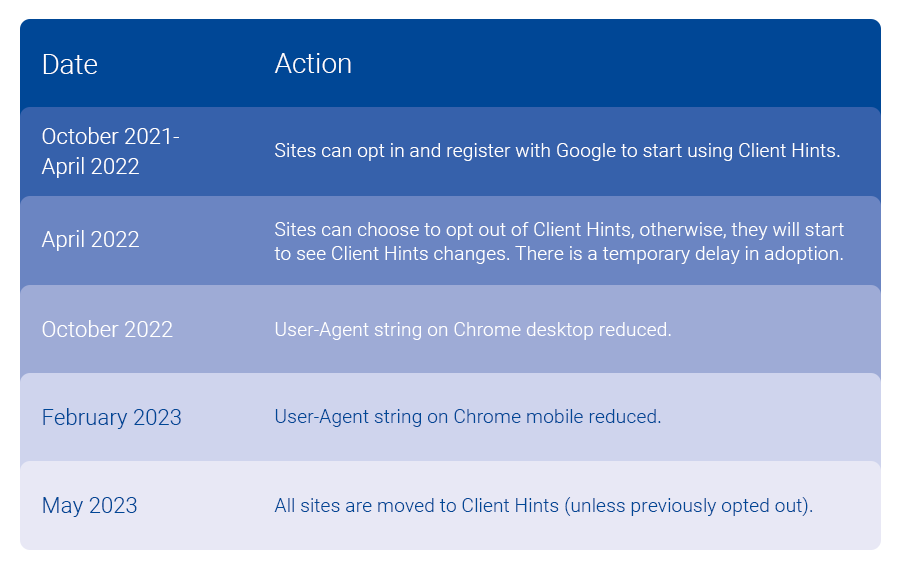
This transition began in early 2022 with bigger expected changes beginning in February 2023. You can see in the above example, Chrome/109.0.0.0, where browser version information is already no longer available from the UA string on this desktop Chrome browser.
How can you use User-Agent device attributes today?
UA string information can be used for a variety of reasons. It is a component in web servers that has been available for decades. In the AdTech space, it can be used in various ad targeting use cases. It can be used by publishers to better understand their audience. The shift to limit access and information shared is to prevent nefarious usage of the data.
What are the benefits of Client Hints?
By using Client Hints, a domain owner, or publisher, can manage access to data activity that occurs on their web properties. Having that control may be advantageous. The format of the information shared is also cleaner than parsing a string from User-Agents. Although, given that Client Hints are not the norm across all browsers, a long-term solution may be needed to manage UA strings and Client Hints.
An advantage of capturing and sharing Client Hint information is to be prepared and understand if there is any impact to your systems and processes. This will help with the currently planned transition by Google, but also should the full UA string become further restricted.
Who will be impacted by this change?
Publishers across the open web should lean in to understand this change and any potential impact to them. The programmatic ecosystem supporting real-time bidding (RTB) needs to continue pushing for adoption of OpenRTB 2.6, which supports the passing of client hint information in place of data from UA strings.
What is Google’s timeline for implementing Client Hints?
Do businesses have to implement Client Hints? What happens if they don’t?
Not capturing and sharing with trusted partners can impact capabilities in place today. Given Chromium browsers account for a sizable portion of web traffic, the impact will vary for each publisher and tech company in the ecosystem. I would assess how UA strings are in use today, where you may have security concerns or not, and look to get more information on how to maintain data sharing with trusted partners.
We can help you adopt Client Hints
Reach out to our Customer Success team at tapadcustomersuccess@experian.com to explore the best options to handle the User-Agent changes and implement Client Hints. As leaders in the AdTech space, we’re here to help you successfully make this transition. Together we can review the options available to put you and your team on the best path forward.
Get in touch
About our expert

Nate West, Director of Product
Nate West joined Experian in 2022 as the Director of Product for our identity graph. Nate focuses on making sure our partners maintain and grow identity resolution solutions today in an ever-changing future state. He has over a decade of experience working for media organizations and AdTech platforms.
Latest posts
Experian, the leader in powering data-driven advertising through connectivity, is thrilled to unveil our latest solution, Digital Graph and Marketing Attributes. This joint solution supplies marketers and platforms with the insights and connectivity needed to understand who their customers are and reach them across digital channels. The uncertainty around third-party cookies in Chrome and the overall decline in signal complicates the industry’s ability to reach the right consumer. Omnichannel media consumption results in scattered data, making it harder for marketers and platforms to understand consumer behavior and reach them across channels. These challenges call for a comprehensive solution. Our Digital Graph and Marketing Attributes solution addresses these challenges by providing identifiers for seamless cross-channel engagement. By adding Marketing Attributes, like demographic and behavioral data, marketers and platforms also gain a better understanding of their customers. This solution uses Experian’s Living Unit ID (LUID) to combine offline and digital data, giving customers deeper insights into consumer behavior, greater audience reach, and improved cross-channel visibility. Benefits of Digital Graph and Marketing Attributes Both our Digital Graph and Marketing Attributes provide value to clients as standalone products. When clients license our Digital Graph and Marketing Attributes joint solution, they have more data at their fingertips, unlocking: Consumer connectivity: When clients license Experian’s Digital Graph, they get access to digital identifiers like mobile ad IDs (MAIDs), connected TV (CTV) IDs, hashed emails (HEMs), and universal IDs so they can target the right consumers with the relevant messages across all digital media channels. Consumer insights: Experian’s 5,000 Marketing Attributes provide our clients with detailed consumer information and insights, such as age, gender, purchase behaviors, and content consumption habits. Marketing Attributes help clients create more relevant messaging and informed audience segmentation. Client examples How OpenX offers richer targeting and more connectivity with Experian OpenX is an independent omni-channel supply-side platform (SSP) and a global leader in audience, data, and identity-targeting. With industry-leading technology, exceptional client service, and extensive scalability across all formats, including CTV, app, mobile web, and desktop, OpenX has a legacy of innovating products that enhance buyer outcomes and publisher revenue while addressing complex challenges in programmatic. In recent years, OpenX has licensed Experian’s Digital Graph with identifiers, contributing to the SSP’s largest independent supply-side identity graph, which offers advanced audiences to buyers and improved data resolution to content owners. More recently, OpenX licensed Experian’s Marketing Attributes to enrich its supply-side identity graph, which includes IPs, MAIDs, and client IDs, with a variety of attributes. This strategic move has helped OpenX’s clients benefit from enhanced consumer insights and addressability, in turn delivering greater reach to the demand side and higher revenue for publishers, despite industry signal loss. "We built on our long-term partnership with Experian to enrich our digital IDs with Experian’s Marketing Attributes, which help provide buyers better insights to audiences, thereby helping our publishers monetize their inventory. With partners like Experian, OpenX effectively facilitates the value exchange between demand and supply, ensuring our partners are able to drive results for their business in the era of signal loss"Craig Golaszewski, Sr. Director of Strategic Partnerships, OpenX How StackAdapt licenses our product bundle to address three different use cases StackAdapt is the multi-channel programmatic advertising platform trusted by marketers to deliver exceptional campaigns. They drive superior results through a variety of solutions, like contextual and first-party targeting, brand lift measurement, and optimization through insights. StackAdapt licensed a similar yet unique product combination, our Digital Graph and our Audiences. StackAdapt uses the Digital Graph to allow clients to onboard their first-party data in a seamless, self-serve manner that allows them to further segment their data using Experian Audiences. “StackAdapt has been recognized as the most trusted programmatic platform by marketers, and with the integration of Experian’s Digital Graph and Audiences, we are strengthening our leadership in the space. This partnership improves our ability to deliver precise cross-channel segmentation, reach, and measurement, helping advertisers run more successful campaigns. Our collaboration with Experian allows us to offer a differentiated solution in the market and ensure our clients can deliver the most precise and impactful ads to their audiences.”Denis Loboda, Senior Director of Data, StackAdapt We recently announced a new partnership with StackAdapt. This collaboration brings the power of Experian's identity graph, syndicated and custom audiences directly to the StackAdapt platform. Read the full details in our press release here. Four ways to use Digital Graph and Marketing Attributes When these two products come together, our clients have a 360-degree view of their consumers, which helps them power four critical use cases: Analytics and insights: Learn more about your consumers by connecting our Marketing Attributes with our Digital Graph's identifiers. For example, a retailer can discover that their recent customers over-index as pickleball fans and players, leading the retailer to sponsor a professional pickleball event. Inventory monetization: When supply-side partners know their audience better, they can attract advertisers in search of that audience. For example, a publisher might find out that their audience is full of pickleball fans, leading them to reach out to brands that want to reach this audience. Activation: Companies with access to more digital identifiers from our Digital Graph can reach more people, while controlling frequency across channels. A company might know that they want to reach pickleball fans. Now, they have the digital identifiers needed to reach pickleball fans across all digital channels where they consume content, leading to increased reach. Measurement and attribution: Use the Digital Graph’s support for various digital identifiers to understand all consumer touchpoints, from media impressions to conversions. Then, lean on our Marketing Attributes to determine who your messaging resonated with. For example, a company uses our Digital Graph to know if it was the same individual who was exposed to an ad on CTV and converted via e-commerce. On top of that, the company can use our Marketing Attributes data to find out that the people who purchased were overwhelmingly pickleball fans. Connect with us to learn more about how our Digital Graph and Marketing Attributes joint solution can provide the data and insights you need to create, activate, and measure cross-channel media campaigns. Get in touch with us Latest posts

After a six-month beta period, collaboration in Snowflake Data Clean Rooms using Experian's offline or digital graph is now generally available for all clients. As part of this, Experian is excited to announce that Experian's identity graph will be integrated into Snowflake's Data Clean Rooms. With the growing importance of data privacy and marketing efficiency, this partnership builds off of Experian's previously-announced integration into Snowflake's AI Data Cloud for Media. Adding Experian's identity graph to Snowflake Data Clean Rooms helps advertisers, advertising platforms, and measurement partners work more effectively. Built upon Experian’s rich offline and digital identity foundation, with support for various identifiers across platforms, collaboration in Snowflake Data Clean Rooms helps clients maximize the value of their data and meet the diverse needs of modern business: Collaborate with partners for richer data insights Achieve higher match rates Improve audience building Produce more accurate and complete reports Ensure data privacy Seamless integration of AdTech and MarTech platforms Regardless of the identifier type you are looking to collaborate on, Experian has the identity data in Snowflake Data Clean Rooms to support you and your partner. This leads to higher match rates and more resolved data for you to use to benefit your media initiatives. "Integrating Experian's identity graph into Snowflake Data Clean Rooms marks a transformative leap for digital marketing. This collaboration empowers advertisers, programmatic platforms, and measurement partners with unparalleled accuracy, privacy, and efficiency. Together, we are excited to provide innovative solutions to meet the evolving needs of our clients."Kamakshi Sivaramakrishnan, Head of Data Clean Rooms at Snowflake The Experian and Snowflake partnership showcases how collaboration can enhance scalability and cost-efficiency. Data clean rooms provide a secure environment where multiple parties can share, join, and analyze their data assets without leaving the clean room or exposing the underlying data. By integrating Experian's identity graph within Snowflake's secure platform businesses of all sizes can receive advanced data collaboration and identity tools without the high costs usually involved. The integration prioritizes consumer privacy and data security. Backed by Experian’s Global Data Principles, Experian's deep roots in data protection and security provide customers with the most trusted way to share data and protect consumer privacy. With Experian's graph in Snowflake Data Clean Rooms, customers will get a solution that respects customer consent, safeguards sensitive data, and ensures that processing occurs with the utmost respect for user confidentiality and preferences. Further, Snowflake Data Clean Rooms uses advanced methods to preserve privacy, such as differential privacy and secure computations on encrypted data, enabling data security and integrity. Together, these methods prevent unauthorized access by keeping sensitive data within the secure confines of the cleanroom on a strict, collaboration-to-collaboration basis. The collaboration between Experian and Snowflake significantly enhances data matching and identity resolution within the Snowflake Data Cleanroom. Experian’s identity solution uses digital identifiers like hashed emails, MAIDs, and CTV IDs and offline identifiers like name and address. This allows advertisers to reach more consumers and enrich their data. Marketers can easily use their first-party data in the cleanroom, and with Experian's Graph, they get higher match rates for more accurate targeting and campaign measurement. The continued partnership between Snowflake and Experian provide advertisers, platforms, and measurement providers a secure and effective way to collaborate. This sets the stage for continued innovation in programmatic advertising, ensuring that our solutions evolve in step with our clients' needs. If you're not utilizing clean rooms for collaboration but have advanced identity needs, you can license our Graph and seamlessly integrate it into your Snowflake account. Reach out to our team to learn more Latest posts

With U.S. brands expected to invest over $28 billion in connected TV (CTV) in 2024, balancing linear TV and CTV is now a top priority. Advertisers need to integrate these platforms as the TV landscape evolves to reach audiences with various viewing habits. A successful strategy requires both linear and CTV approaches to effectively reach audiences at scale. We interviewed experts from Comcast Advertising, Disney, Fox, Samsung Ads, Snowflake, and others to gain insights on the evolving landscape of linear and CTV. In our video, they discuss audience fragmentation, data-driven targeting, measurement challenges, and more. Watch now to hear their perspectives. Five considerations for connecting with linear TV and CTV audiences 1. Adapt to audience fragmentation With consumers' rapid shift toward streaming, it's easy to overlook the enduring significance of linear TV, which still commands a large portion of viewership. According to Jamie Power of the Walt Disney Company, roughly half of the current ad supply remains linear, highlighting the need for brands to adapt their strategies to target traditional TV viewers and cord-cutters. As streaming continues to rise, ensuring your strategy integrates both CTV and linear TV is crucial for reaching the full spectrum of audiences. "I don't think that we thought the world would shift so quickly to streaming, but it's not always just all about streaming; there's still such a massive audience in linear."Jamie Power, Disney 2. Combine linear TV’s reach with CTV’s precision Blending the reach of linear TV with the granular targeting capabilities of CTV allows advertisers to engage both broad and niche audiences. Data is critical in understanding audience behavior across these platforms, enabling brands to create highly relevant campaigns tailored to specific audience segments. This strategic use of data enhances engagement and ensures that the right viewers see advertising campaigns. "The future of TV is really around managing the fragmentation of audiences and making sure that you can reach those audiences addressably wherever they're watching TV."Carmela Fournier, Comcast Advertising 3. Manage frequency across platforms Cross-platform campaigns require managing ad frequency to avoid oversaturation while ensuring adequate exposure. With a variety of offline and digital IDs resolved to consumers, our Digital and Offline Graphs can help maintain consistent messaging across linear TV and CTV. This approach allows advertisers to strike the right balance, preventing ad fatigue and delivering the right audience reach for campaign impact. "You've got to make sure that you're not reaching the same homes too many times, that you're reaching everybody the right amount of times."Justin Rosen, Ampersand 4. Focus on consistent measurement Linear TV and CTV offer different data granularities, necessitating tailored approaches for accurate cross-platform campaign measurement. Bridging these data gaps requires advanced tools that streamline reporting for both mediums. As the industry moves toward consistent measurement standards, advertisers must adopt solutions that provide a comprehensive view of campaign performance, enabling them to optimize their cross-platform efforts. "Where I think there are pitfalls are with the measurement piece, it's highly fragmented, there's more work to be done, we're not necessarily unified in terms of a consistent approach to measurement."April Weeks, Basis 5. Align with shifts in audience behavior The success of cross-platform campaigns hinges on staying agile and responsive to shifting audience preferences. As CTV adoption grows, advertisers must proactively adjust their strategies to align with how viewers engage across linear and streaming platforms. Ideas include: Regularly updating creative Adjusting the media mix Utilizing real-time data insights to ensure campaigns remain relevant "At Fox we were a traditional linear company, and essentially what we're trying to do is merge the reach and the scale of TV as well as the reach and the scale of all the cord-cutters and cord-nevers that Tubi possesses." Darren Sherriff – FoxDarren Sherriff, Fox As streaming TV rapidly changes, brands must stay ahead of trends and shifts in consumer behavior to tap into CTV's growing potential. By focusing on these opportunities, advertisers can blend linear TV and CTV, ensuring their campaigns reach audiences wherever they watch. Connect with Experian's TV experts As a trusted leader in data and identity services, Experian offers the expertise to help you succeed in television marketing. With our strong partnerships with key players in the TV industry, we provide access to unique marketing opportunities. Learn how Experian’s data and identity solutions can deliver outstanding results in advanced TV advertising. Partner with us today to enhance your marketing strategies using our Consumer View and Consumer Sync solutions. Connect with our TV experts Contact us Latest posts