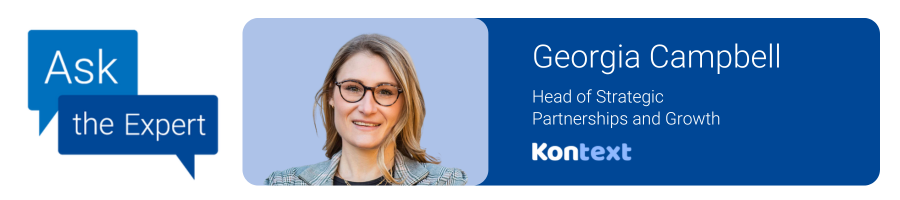
In our Ask the Expert Series, we interview leaders from our partner organizations who are helping lead their brands to new heights in adtech. Today’s interview is with Georgia Campbell, Head of Strategic Partnerships at Kontext.
What types of audiences does Kontext provide, and what are some top use cases for these insights in marketing strategies?
Kontext leverages its 1st-party, deterministic shopping data to generate real-time online audiences. What sets Kontext apart is our ability to see the entire consumer journey, from shopping interest to intent and purchases, at a SKU-level. This comprehensive visibility allows us to create purchase-based audiences across various consumer verticals, such as frequent online shoppers, consumers shopping for beauty, segments using Mastercard, or Black Friday enthusiasts.
Our data engine, built on a foundation of approximately 100 million consumer profiles and over 10 billion full-funnel, real-time shopping events, enables the creation of precise audience segments. This real-time 1st-party shopper data is invaluable for partners aiming to understand and engage with consumers more effectively.
Whether a brand wants to activate past shoppers in a specific category or reach new audiences with a propensity to buy, Kontext provides the insights needed to make informed decisions.
Some examples of audience types include these (and hundreds more):
- In-Market Shoppers: Consumers showing high intent to purchase specific categories, like skincare or electronics, based on recent online behavior.
- Past Purchasers: Shoppers who have made verified purchases within specific time frames, such as beauty products in the last 18 months.
- Frequent Shoppers: High-frequency buyers identified through repeated purchasing behaviors.
- Seasonal Shoppers: Consumers active during key shopping seasons, like Black Friday, Mother’s Day, Valentine’s Day, etc
- Premium Buyers: Shoppers who used a premium CC (eg. Amex) and a higher AOV (average order value)
- Beauty Buyers: an audience that has indicated intent to purchase beauty products (deterministic past purchasers also avail)
By using Kontext data, brands can identify the right audiences across multiple verticals, such as retail, CPG, health & wellness, auto, business, energy & utility, financial, and travel. Additionally, our collaboration with Experian allows further refinement of these audiences through layered data from specialty categories like demographics, lifestyle & interests, mobile location, and TV viewing habits.
How is Kontext’s data sourced, and what differentiates it from other data providers?
Kontext’s data is unique because it is deterministic, 1st-party, and collected as transactions occur. We capture the entire path-to-purchase, down to the SKU-level product detail, across 100 million consumer profiles and more than 10 billion real-time shopping events. Our proprietary technology, embedded in widgets across our 5 million premium online destinations, tracks the full consumer journey—from reading an article of interest to clicking on our dynamic commerce modules, adding items to cart, and completing purchases.
This real-time data collection ensures there is no lag between digital events and their connection to consumer profiles.
Unlike other providers, we do not aggregate data from multiple platforms; instead, we focus on building our models and insights based on authentic online consumer behavior.
Our data stands out due to its:
- Deterministic Nature: We capture 1st-party data as transactions occur (all in real time)
- Full-Funnel Coverage: We capture consumer journeys from awareness to purchase, providing a complete view of consumer behavior.
- Real-Time Insights: Our data engine processes events in real-time, enabling timely and relevant marketing actions.
How does Kontext ensure the accuracy and reliability of its audience data?
Kontext ensures accuracy and reliability through our unique technology and direct data sourcing. By not aggregating data from other platforms, we maintain control over the quality and integrity of our insights. Our continuous investment in refining our models around online consumer behavior further enhances the precision of our audience data.
What types of brands or verticals might resonate the most with Kontext audiences for activation?
Any brand looking to understand and activate online shopping behavior – informed by 1st-party transaction data – will resonate with Kontext audiences. Essentially, any vertical that benefits from understanding real-time shopping behaviors, such as retail, health & wellness, auto, and financial services, will find our data invaluable. We have particularly strong insights in beauty, hair care, health & wellness, and values-based online shopping habits, as well as the food & beverage space.
- Retail & Consumer Goods: Leveraging shopping behavior data for targeted campaigns.
- Health & Wellness: Identifying consumers with specific health and wellness interests.
- Automotive: Targeting potential buyers of electric vehicles or eco-friendly products.
- Financial Services: Engaging high-value shoppers with premium credit card usage.
- And many more
How does Kontext’s data help advertisers navigate the challenges posed by the deprecation of third-party cookies?
As third-party cookies become less reliable, Kontext’s 1st-party data becomes invaluable. Our deterministic data engine, which does not rely on cookies, offers:
- Direct Consumer Insights: Accurate and consented data directly from consumer interactions.
- Privacy Compliance: Our data collection methods are fully compliant with privacy regulations, ensuring secure usage.
- Cross-Device Coverage: We use verified digital identifiers, allowing seamless unification and targeting across multiple devices.
What measures does Kontext take to maintain data privacy and compliance, and how does this benefit advertisers?
Data privacy and compliance are fundamental to Kontext. We meet or exceed all privacy compliance and security standards, ensuring that our data sourcing and usage are transparent and comply with regulations (CCPA, CPRA, VCDPA, etc). Kontext prioritizes data privacy and compliance through:
- Consented Data Collection: All data is collected with explicit consumer consent.
- Robust Security Protocols: Data is encrypted and secured with industry-leading practices.
- Compliance with Regulations: We adhere to global privacy laws, including GDPR and CCPA.
- User Control: Consumers have the ability to opt-out and manage their data preferences.
Can you share success stories / use-cases where advertisers significantly improved their campaigns using Kontext’s data?
To give you a sense of how Kontext data can be applied, here are two use-cases:
- Beauty Brand Campaign: An agency hoping to activate an audience of beauty purchasers for a Major Beauty Brand could utilize Kontext’s custom audience of high-value beauty product purchasers. By targeting those consumers who had bought similar products in the last 12 months and had an average cart size of over $50, the campaign would significantly increase performance and ROAS.
- Electric Vehicle Launch: For a major auto manufacturer’s EV launch, Kontext could be used to identify eco-friendly consumers who had not yet purchased an EV but had shown interest in sustainable products. This precise targeting could lead to higher engagement and conversion rates for the campaign.
Thanks for the interview. Any recommendations for our readers if they want to learn more?
For those interested in learning more about Kontext, reach out for a personalized consultation.
Contact us
About our expert

Georgia Campbell, Head of Strategic Partnerships, Kontext
In her current role as Head of Strategic Partnerships at Kontext, Georgia plays a pivotal role in shaping the company’s strategic direction within the data space. With a deep-seated expertise in leveraging data to drive impact for companies, Georgia has been forging key partnerships that enhance the effectiveness and reach of Kontext’s offerings.
Georgia comes from a background in emerging technology, where she has been focused on cultivating partnerships and employing data-driven approaches to spearhead market expansion efforts. She started her career in finance, managing investments across equity, debt, and alternative assets at Brown Advisory.
In this Q&A, Georgia shares her insights on Kontext’s Onboarding partnership with Experian, offering perspective on how Kontext’s unique insights can unlock new opportunities for advertisers and brands alike.
Latest posts

Madison Logic partners with Tapad, a part of Experian, to realize attribution across every channel for global B2B marketers
FeaturedB2B marketers can now deliver the right message to the right user at the right time across devices and channels NEW YORK, NY–(Marketwired – Jun 1, 2016) – Madison Logic, one of the world’s fastest growing companies dedicated to solving the digital needs of B2B marketers, is partnering with Tapad, the leading provider of unified and now a part of Experian, cross-screen marketing technology solutions. Now business-to-business (B2B) marketers can power targeted advertising and content syndication programs across all channels, including smartphones, computers and tablets. The increasing shift in content consumption across mobile devices makes cross-device identification and attribution a top priority for B2B marketers. The Madison Logic and Tapad partnership gives B2B marketers unprecedented reach and scale with the ability to run always-on, cross-device, account-based marketing programs targeting decision makers who are actively researching similar products and services. “Screens are everywhere and so is the B2B buyer,” said Vin Turk, SVP of Audience Development for Madison Logic. “This partnership allows marketers to harness the power of Madison Logic’s intent data and combine it with Tapad’s cross-device solutions to connect with the most-likely-to-convert prospects with hyper-relevant content wherever and whenever they’re doing their research.” “Relevance is essential to the success of B2B marketers, particularly now, when breaking through the clutter is difficult,” said Dave Fall, COO of Tapad. “This partnership with Madison Logic allows marketers to leverage their existing customers while identifying and reaching new audiences with messaging tailored to every device.” For more information about Madison Logic’s account-based marketing platform, please visit https://www.madisonlogic.com/account-based-marketing/. For more information about Tapad’s cross-platform advertising solutions, please visit https://www.experian.com/marketing/consumer-sync. Contact us today
NEW YORK, June 1, 2016 /PRNewswire/ — Are Traasdahl, CEO and founder of Tapad, the leader in cross-device marketing technology and now a part of Experian, has been named Founder of the Year by the Nordic Startup Awards. The Nordic Startup Awards’ Founder of the Year Award recognizes an individual that has shown exceptional achievements in fundraising, customer growth, financial savvy, and/or leadership throughout the past year. The Nordic Startup Awards evaluates hundreds of players in the startup ecosystem, ranging from investors and founders, to developers and journalists in Denmark, Sweden, Iceland, Norway and Finland. Taking place in two stages, each country selects its nominees for consideration for the regional awards which were held in Iceland on May 31, 2016. Traasdahl is recognized for his continuous investment in Tapad as a whole, as well as his dedication to growing and developing Tapad since founding the company in 2010. He has led Tapad from startup through a steady period of growth resulting in an acquisition by the Telenor Group for $360 million in February 2016. “I am truly honored to be named Founder of the Year by the Nordic Startup Awards, among so many other remarkable leaders in the space,” said Traasdahl. “That said, this has always been a team effort. We started Tapad with the goal of giving employees unprecedented growth opportunities while developing breakthrough solutions for our clients. This is a win for everyone at Tapad who has committed themselves to these principles over the past four-and-a-half years.” Tapad is reinforcing its commitment to fostering entrepreneurship with the launch of their new Propeller Program. Through Propeller, Tapad will host five early-stage companies at Tapad’s New York headquarters for a year to set them up for global expansion. In its inaugural year, the first participants will come from Traasdahl’s native Norway. For more information on the Nordic Startup Awards, please visit: http://www.nordicstartupawards.com. Contact us today
Tapad, a part of Experian, wins iMedia ASPY awards for Best Customer Service and Best Mobile Partner
FeaturedNEW YORK, May 4, 2016 /PRNewswire/ — Tapad, the leader in cross-device marketing technology and now a part of Experian, has been honored with two iMedia ASPY Awards. Announced on May 3rd at the iMedia Summit in Lost Pines, TX, Tapad’s 2016 ASPY Awards include “Best Customer Service” and “Best Mobile Partner.” In 2015, Tapad’s proprietary technology, Tapad Device Graph™, was named “Best New Media Innovation” and Tapad employee Chris Martin was awarded the “Rising Star Award.” The iMedia ASPY Awards – determined exclusively by agency votes – recognize the industry’s top marketing technology, media companies and publishers for outstanding service to agencies. The award for “Best Customer Service” recognizes Tapad’s client services team and their dedication to helping agencies fully understand their consumers’ behavior and achieve the best cross-screen campaign ROI through Tapad’s Campaign Pulse and TV Pulse analytics reporting. The “Best Mobile Partner” win recognizes the abilities of the Tapad Device Graph™ to deliver unified cross-screen solutions for the company’s partners. “We are privileged to have a talented and dynamic group of people on our client services team, and we are honored to be recognized by iMedia Connection and our agency partners,” said Tapad Founder and CEO, Are Traasdahl. “We have always strived to provide the best solutions and the best customer support, so it’s extremely gratifying to be rewarded for our efforts. If our clients and partners are happy, we are happy.” For more information on the iMedia ASPY Awards please visit: http://aspyawards.com. Read the full press release here. Contact us today