Loading...

New OpenRTB specs ensure identity resolution can be done transparently with trusted partners

Published: December 18, 2024 by Budi Tanzi, VP, Product

Experian supports OpenRTB 2.6 and more transparent advertising

2024 marked a significant year. AI became integral to our workflows, commerce and retail media networks soared, and Google did not deprecate cookies. Amidst these changes, ID bridging emerged as a hot topic, raising questions around identity reliability and transparency, which necessitated industry-wide standards. We believe the latest IAB OpenRTB specifications, produced in conjunction with supply and demand-side partners, set up the advertising industry for more transparent and effective practices.

So, what exactly is ID bridging?

As signals, like third-party cookies, fade, ID bridging emerged as a way for the supply-side to offer addressability to the demand-side. ID bridging is the supply-side practice of connecting the dots between available signals, that were generated in a way that is not the expected default behavior, to understand a user’s identity and communicate it to prospective buyers. It enables the supply-side to extend user identification beyond the scope of one browser or device.
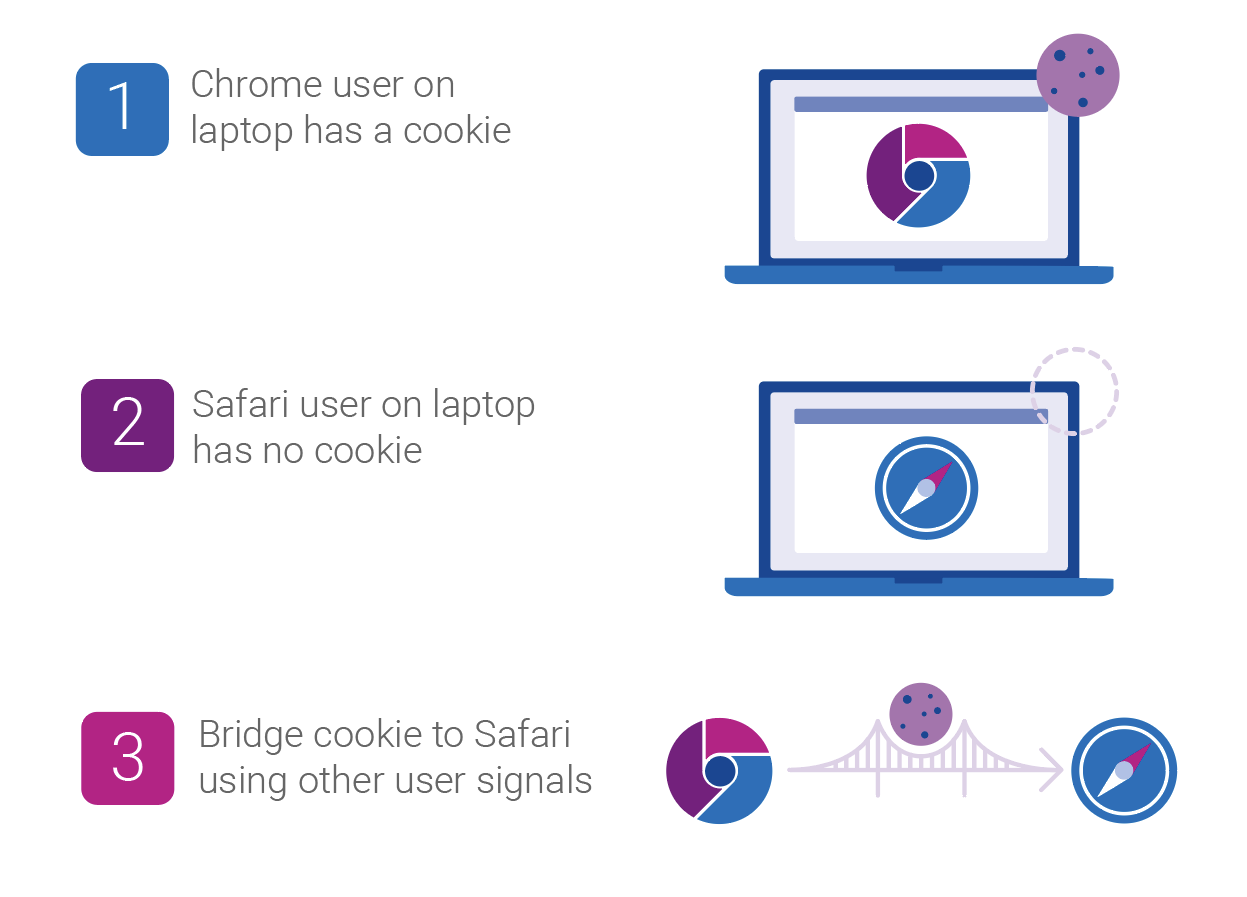
ID bridging diagram

Imagine you visit a popular sports website on your laptop using Chrome. Later, you use the same device to visit the same sports website, but this time, on Safari. By using identity resolution tools, a supply-side partner can infer that both visits are likely from the same user and communicate with them as such.

ID bridging is not inherently a bad thing. However, the practice has sparked debate, as buyers want full transparency into the use of a deterministic identifier versus an inferred one. This complicates measurement and frequency capping for the demand-side. Before OpenRTB 2.6, ID bridging led to misattribution as the demand-side could not attribute ad exposures, which had been served to a bridged ID, to a conversion, which had an ID different from the ad exposure.

OpenRTB 2.6 sets us up for a more transparent future

In 2010, the IAB, along with supply and demand-side partners, formed a consortium known as the Real-Time Bidding Project for companies interested in an open protocol for the automated trading of digital media. The OpenRTB specifications they produced became that protocol, adapting with the evolution of the industry.

The latest evolution, OpenRTB 2.6, sets out standards that strive to ensure transparency in real-time bidding, mandating how the supply-side should use certain fields to more transparently provide data when inferring users’ identities.

What’s new in OpenRTB 2.6?

Here are the technical specifications for the industry to be more transparent when inferring users’ identities:

  • Primary ID field: This existing field now can only contain the “buyeruid,” an identifier mutually recognized and agreed upon by both buyer and seller for a given environment. For web environments, the default is a cookie ID, while for app activity, it is a mobile advertising ID (MAID), passed directly from an application downloaded on a device. This approach ensures demand-side partners understand the ID’s source.
  • Enhanced identifier (EID) field: The EID field, designated for alternative IDs, now accommodates all other IDs. The EID field now has additional parameters that provide buyers transparency into how the ID was created and sourced, which you can see in the visual below:
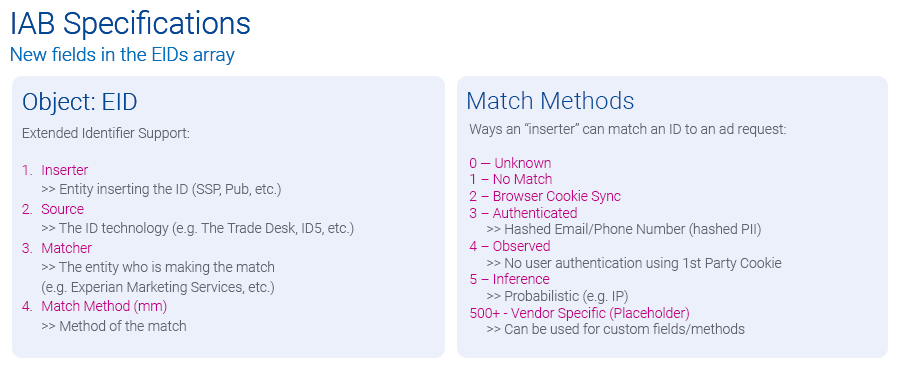
IAB specifications

Using the above framework, a publisher who wants to send a cross-environment identifier that likely belongs to the same user would declare the ID as “mm=5,” while listing the potential third-party identity resolution partner under the “matcher” field, which the visual below depicts. This additional metadata gives the demand-side the insights they need to evaluate the reliability of each ID.
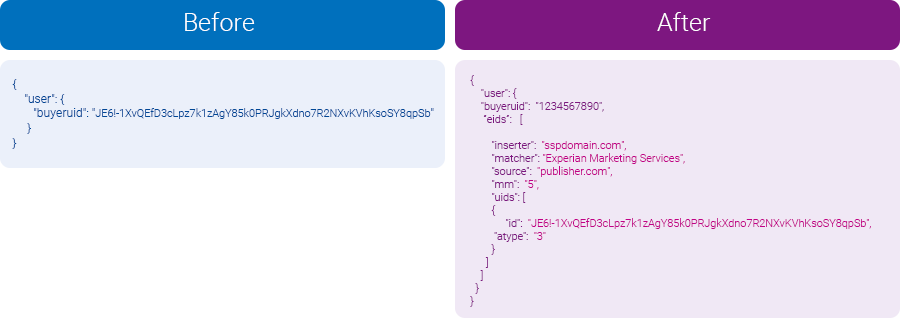
IAB before and after diagram

“These updates to OpenRTB add essential clarity about where user and device IDs come from, helping buyers see exactly how an ID was created and who put it into the bidstream. It’s a big step toward greater transparency and trust in the ecosystem. We’re excited to see companies already adopting these updates and can’t wait to see the industry fully embrace them by 2025.”

Hillary Slattery, Sr. Director, Programmatic, Product Management, IAB Tech Lab

Experian will continue supporting transparency

As authenticated signals decrease due to cookie deprecation and other consumer privacy measures, we will continue to see a rise in inferred identifiers. Experian’s industry-leading Digital Graph has long supported both authenticated and inferred identifiers, providing the ecosystem with connections that are accurate, scalable, and addressable. Experian will continue to support the industry with its identity resolution products and is supportive of the IAB’s efforts to bring transparency to the industry around the usage of identity signals.

Supply and demand-side benefits of adopting the new parameters in OpenRTB 2.6

  • Partner collaboration: Clarity between what can be in the Primary ID field versus the EID field provides clear standards and transparency between buyers and sellers.
  • Identity resolution: The supply side has an industry-approved way to bring in inferred IDs while the demand side can evaluate these IDs, expanding addressability.
  • Reducing risk: With accurate metadata available in the EID field, demand-side partners can evaluate who is doing the match and make informed decisions on whether they want to act on that ID.

Next steps for the supply and demand-sides to consider

For supply-side and demand-side partners looking to utilize OpenRTB 2.6 to its full potential, here are some recommended steps:

For the supply-side:

  • Follow IAB Specs and provide feedback: Ensure you understand and are following transparent practices. Ask questions on how to correctly implement the specifications.
  • Vet identity partners: Choose partners who deliver the most trusted and accurate identifiers in the market.
  • Be proactive: Have conversations with your partners to discuss how you plan to follow the latest specs, which identity partners you work with, and explain how you plan to provide additional signals to help buyers make better decisions.

We are beginning to see SSPs adopt this new protocol, including Sonobi and Yieldmo.

“The OpenRTB 2.6 specifications are a critical step forward in ensuring transparency and trust in programmatic advertising. By aligning with these standards, we empower our partners with the tools needed to navigate a cookieless future and drive measurable results.”

Michael Connolly, CEO, Sonobi

These additions to the OpenRTB protocol further imbue bidding transactions with transparency which will foster greater trust between partners. Moreover, the data now available is not only actionable, but auditable should a problem arise. Buyers can choose, or not, to trust an identifier based on the inserter, the provider and the method used to derive the ID. While debates within the IAB Tech Lab were spirited at times, they ultimately drove a collaborative process that shaped a solution designed to work effectively across the ecosystem.”

Mark McEachran, SVP of Product Management, Yieldmo

For the demand side:

  • Evaluation: Use the EID metadata to assess all the IDs in the EID field, looking closely at the identity vendors’ reliability. Select partners who meet high standards of data clarity and accuracy.
  • Collaboration: Establish open communication with supply-side partners and tech partners to ensure they follow the best practices in line with OpenRTB 2.6 guidelines and that there’s a shared understanding of the mutually agreed upon identifiers.
  • Provide feedback: As OpenRTB 2.6 adoption grows, consistent feedback from demand-side partners will help the IAB refine these standards.

Moving forward with reliable data and data transparency

As the AdTech industry moves toward a cookieless reality, OpenRTB 2.6 signifies a substantial step toward a sustainable, transparent programmatic ecosystem. With proactive adoption by supply- and demand-side partners, the future of programmatic advertising will be driven by trust and transparency.

Experian, our partners, and our clients know the benefits of our Digital Graph and its support of both authenticated and inferred signals. We believe that if the supply-side abides by the OpenRTB 2.6 specifications and the demand-side uses and analyzes this data, the programmatic exchange will operate more fairly and deliver more reach.


Contact us

This site is protected by reCAPTCHA and the Google Privacy Policy and Terms of Service apply.


Latest posts

Loading…
Adapting to life without Oracle

Originally appeared on Adweek The advertising industry is experiencing a significant shift resulting from Oracle's market exit. Over the years, Oracle’s advertising tools—built through key acquisitions like Crosswise, BlueKai, Datalogix, and Grapeshot—have become essential for many marketers, data providers, and platforms. With Oracle’s departure, stakeholders are left searching for reliable alternatives to maintain their data-driven strategies. While this transition may seem daunting, it presents a unique opportunity to reassess audience and identity solutions. With the growing importance of adaptability and interoperability, now is the perfect time for advertisers, agencies, publishers, and platforms to adopt future-focused strategies. Oracle’s legacy: A combination of acquisitions Oracle’s advertising business wasn’t a unified solution but a collection of acquired technologies. Crosswise provided a cross-device identity graph; BlueKai offered a robust data management platform (DMP); Datalogix specialized in offline purchase data; and Grapeshot was known for its contextual targeting. Together, these tools powered a comprehensive offering for advertisers, data providers, and platforms. Yet, much of Oracle’s advertising success stemmed from the external data it used. For example, many of Oracle’s automotive audiences relied heavily on third-party data, largely powered by Experian data. This means that while Oracle may no longer be an option, many of the services marketers depended on through Oracle are still available from Experian, ensuring continuity. What this means for advertisers and agencies For advertisers and agencies, Oracle’s exit means losing access to its syndicated audiences. Fortunately, this doesn’t have to cause a major disruption. As one of Oracle’s primary data providers, we've mapped Oracle’s audiences to our own, ensuring marketers can easily maintain their targeting strategies without losing performance or efficiency. With access to over 2,400 syndicated audiences across key verticals such as demographics, automotive, retail purchases, or financial data, advertisers can continue their campaigns with confidence and precision. What sets us apart? Powered by data ranked #1 in accuracy by Truthset, our audiences are built on reliable, offline, deterministic data — like name, address, phone number, and email. This means advertisers can be confident that they are reaching the right audiences across all channels. With our audiences available across 30+ ad platforms, including programmatic, TV, and social media, advertisers and agencies have easy access to keep their campaigns running. For advertisers that ran audience targeting using Grapeshot's Contextual Platform, our new Contextually-Indexed Audiences are a replacement built for the evolving digital media landscape. By combining the precision of audience targeting with the flexibility of contextual targeting, marketers get a privacy-safe, yet scalable way to target audiences that is not reliant on cookies or other user identifiers. Marketers can activate these audiences through leading demand-side platforms (DSPs) or through Audigent private marketplaces (PMPs).   A new opportunity for data providers Oracle’s marketplace has long been a crucial distribution channel for third-party data providers, particularly through BlueKai. With its closure, providers have an opportunity to explore new onboarding services and marketplaces that offer similar or even better reach and effectiveness. New alternative onboarding solutions are emerging, particularly in areas like TV and digital, ensuring that the loss of Oracle’s services does not leave a significant gap. These solutions are being built to overcome the challenges typically present with data onboarding — complicated integration processes, limited ID matching capabilities, and opaque pricing structures. One such solution is Experian’s new Third-Party Onboarding.  What sets us apart? With our digital and offline identity capabilities embedded within this solution, data providers receive superior programmatic and connected TV (CTV) reach and addressability compared to the competition. The first data providers – Adentro, Kontext, L2, and Webbula – are already using this solution to increase the adoption of their audiences and maximize their revenue. Additionally, new marketplaces are emerging that aim to fill the void left by Oracle, offering distribution to key destinations and providing data providers with continued access to advertisers who require high-quality, third-party data. Platforms shift to new audience solutions Platforms that relied on Oracle for third-party data and audience onboarding are now facing challenges in maintaining their ability to target specific audiences. This could affect their inventory's attractiveness to buyers. However, we offer a seamless solution for platforms looking to replace Oracle’s capabilities. As one of Oracle’s primary data providers, we've already mapped Oracle’s audiences to our catalog of over 2,400 syndicated audiences. Platforms can continue providing precise audience targeting and ensure advertisers receive the performance that they demand. Additionally, Third-Party Onboarding builds upon the investment and infrastructure used to distribute our own audience segments, providing platforms with audiences from leading third-party data providers.  Moving forward: Embracing connectivity We're dedicated to powering data-driven advertising through connectivity. With best-in-class syndicated audiences, new Contextually-Indexed Audiences, and an easy-to-use Third-Party Onboarding solution, we're enabling advertisers, agencies, data providers, and ad platforms to improve their marketing operations. Oracle’s departure marks the end of one era, but it also opens the door to a future where collaboration, interoperability, and connectivity define the landscape. By choosing partners like us, advertisers, agencies, and platforms can ensure they remain agile, innovative, and well-equipped to thrive in this new era of data-driven marketing. Reach out to your account representative or our audience team for information about our comprehensive audience mapping and finding the right audiences for your campaigns. Download our audience lookbook to discover more about Experian’s audiences. Contact us Latest posts

Nov 07,2024 by Scott Kozub, VP, Product Management

Your guide to targeting New Year’s resolution audiences

It's almost the start of a new year, so it's time to plan your marketing strategy. One-third of U.S. adults planned to make a New Year's resolution in 2024, with adults under 30 being the most likely to do so. From living healthier lifestyles to traveling more often, there is an opportunity to capture customers with well-targeted messaging. But how do you know which audiences are most interested in these goals?  In this blog post, we’ll reveal audience segments designed for you to reach the most relevant shoppers for your New Year’s resolutions campaigns according to shoppers' goals and resolution categories. You can find the complete audience segment name in the appendix. Start the year strong with Experian's audience insights With the New Year almost upon us, it’s the perfect time for a fresh start. Utilize Experian’s syndicated audiences to ensure your marketing messages resonate with your ideal customers.  Experian’s 2,400+ syndicated audiences are available directly on over 30 leading television, social, programmatic advertising platforms, and directly within Audigent for activation within private marketplaces (PMPs).   Reach consumers based on who they are, where they live, and their household makeup. Experian ranked #1 in accuracy by Truthset for key demographic attributes. Access to unique audiences through Experian’s Partner Audiences available on Experian’s data marketplace, within Audigent for activation in PMPs and directly on platforms like DirectTV, Dish, Magnite, OpenAP, and The Trade Desk. Five New Year's resolution audience categories to embrace this new year There are many different types of New Year's Resolutions that people set come January 1st. Here are five common New Year's Resolutions: Healthy habits Get organized Explore new experiences Live life to the fullest New Year’s budgeteers Let's break down each resolution category and which audiences you can use to target consumers based on their New Year’s resolutions. Healthy habits A significant portion of consumers set their sights on adopting healthier lifestyles and maintaining newfound habits. Target audiences could include those who have recently purchased gym memberships and are shopping at health stores, demonstrating a commitment to their resolutions.  Here are five audience segments that you can activate to target consumers focused on healthy habits in the new year: NEW! New Year's Health/Fitness/Gym Membership Shoppers NEW! Frequent Gym Goers Vitamins/Supplements Shoppers New Year's Food/Healthy Food Shoppers New Year's Vitamins/Diet Supplement Shoppers By strategically targeting these segments, your marketing efforts are more likely to resonate with those determined to make a year of lasting, healthy change.  Get organized Many consumers pledge to declutter and get organized. One key target audience could consist of those who have recently purchased organizational tools or storage solutions. Additionally, consider reaching out to homeowners or individuals in the midst of a major life change, such as moving or expanding their families, as they often seek ways to simplify and organize their spaces.  Here are seven audience segments that you can activate to target consumers focused on getting organized in the new year: NEW! Furniture and Home Decor: Deals Discounts Affordable High Spend Spenders Shoppers  NEW! Post Holiday Shoppers Household Goods: Frequent Spenders Home Improvement/DIY: Frequent Spenders Furniture & Home Decor In Store: Frequent Spenders Garden & Landscaping Stores: Frequent Spenders Hardware & Home Improvement Stores: In Store Frequent Spenders To expand or reach new audiences, you can layer in purchase predictors to reach those who are likely to spend on home maintenance and improvement products or are expanding their families. Home Maintenance and Improvement Explore new experiences Many consumers want to embark on a journey of self-improvement by exploring new experiences, whether it's picking up a new hobby or visiting a place they've never been. One primary target audience could be vacation and leisure travelers, as they often seek new destinations and opportunities to make the most of their seasonal getaways. Additionally, sports enthusiasts are always looking to boost their outdoor adventures through fresh experiences and specialized equipment.  Here are six audience segments that you can activate to target consumers focused on exploring new experiences in the new year: Play Golf Pickleball Enthusiast Wilderness Sports and Camping Enthusiasts Activities: Camping  Summer Airline Travel  Summer Travel: Vacation/Leisure  Live life to the fullest A considerable number of individuals make resolutions aimed at embracing life to the fullest. One prime target audience includes those who have recently booked travel experiences or adventures, showcasing their commitment to exploring new horizons. Additionally, consider reaching out to individuals who are likely to visit sports stadiums and arenas. Here are seven audience segments that you can activate to target consumers focused on living life to the fullest in the new year: NEW! Budget Savvy Air Travelers  Air Travel: Frequent Spenders Cruises: Frequent Spend NFL Stadium Visitors Ski Resort Visitors Vacation/Leisure Travelers: Weekend Getaways Culinary Experience To expand or reach new audiences, you can layer in purchase predictors to reach consumers who are likely to spend on travel and travel-related products. Travel New Year's budgeteers As the new year begins, many consumers are rethinking their finances and seeking smarter ways to spend and save. These audiences are focused on achieving their financial goals by utilizing budgeting tools, finding flexible payment options, and taking control of their debt. With financial wellness top of mind, they are ready to explore solutions that align with their resolution to be more financially savvy. Here are seven key audience segments that reflect the mindset of consumers eager to make 2024 a year of financial empowerment: In market for Buy Now Pay Later In market for Mortgage Refinance In market for Auto Loan Refinance Credit Card High Utilization Likely to Transfer Credit Card Balance Loyal Rewards Enthusiast, Low Credit Card Balance Secure, Savvy Credit User, High Home Equity Balance We can help you reach consumers in the new year Connect with consumers pursuing their New Year's resolutions to kick off 2025. Whether your audience seeks to embrace healthy habits, get organized, explore new experiences, budget their personal finances, or live life to the fullest, Experian Marketing Data provides a solid foundation for targeting, enrichment, and activation As we get ready for 2025, let the power of Experian’s data-driven insights guide your marketing strategies, helping consumers turn their resolutions into reality. Connect with our audience team Need a custom audience? Reach out to our audience team and we can help you build and activate an Experian audience on the platform of your choice. Additionally, work with Experian’s network of data providers to build audiences and send to an Audigent PMP for activation.  You can activate our syndicated audiences on-the-shelf of most major platforms. For a full list of Experian’s syndicated audiences and activation destinations, download our syndicated audiences guide. Explore our other seasonal audiences that you can activate today.  View now Contact us Appendix Here are the complete audience segment names (taxonomy path) for all audience segments discussed in this blog post. Healthy habits NEW! Retail Shoppers: Purchase Based > Seasonal > New Year's Health/Fitness/Gym Membership Shoppers  NEW! Retail Shoppers: Purchase Based > Health and Fitness > Frequent Gym Goers Retail Shoppers: Purchase Based > Health and Fitness > Vitamins/Supplements: Vitamins/Supplements Retail Shoppers: Purchase Based > Seasonal > New Year's Food/Healthy Food Shoppers Retail Shoppers: Purchase Based > Seasonal > New Year's Vitamins/Diet Supplement Shoppers Get organized NEW! Retail Shoppers: Purchase Based > Home Furnishings > Furniture and Home Decor: Deals Discounts Affordable High Spend Spenders Shoppers NEW! Retail Shoppers: Purchase Based > Seasonal > Holiday Shoppers: Post Holiday Shoppers Purchase Transactions > Household Goods > Frequent Spenders Purchase Transactions > Home Improvement/DIY > Frequent Spenders Retail Shoppers: Purchase Based > Home Improvement & DIY > Furniture & Home Decor In Store: Frequent Spenders Retail Shoppers: Purchase Based > Home Improvement & DIY > Garden & Landscaping Stores: Frequent Spenders Retail Shoppers: Purchase Based > Home Improvement & DIY > Hardware & Home Improvement Stores: In Store Frequent Spenders Purchase Predictors > Shoppers All Channels > Home Maintenance and Improvement Explore new experiences Lifestyle and Interests (Affinity) > Activities and Entertainment > Play Golf Retail Shoppers: Purchase Based > Sporting Goods, Apparel > Pickleball Enthusiast Retail Shoppers: Purchase Based > Outdoor Activities > Wilderness Sports and Camping Enthusiasts  Travel Intent > Activities > Camping Retail Shoppers: Purchase Based > Seasonal > Summer Airline Travel  Retail Shoppers: Purchase Based > Seasonal > Summer Travel: Vacation/Leisure  Retail Shoppers: Purchase Based > Travel > Vacation/Leisure Travelers: Summer Trips Live life to the fullest NEW! Retail Shoppers: Purchase Based > Seasonal > Budget Savvy Air Travelers  Retail Shoppers: Purchase Based > Travel > Air Travel: Frequent Spenders Retail Shoppers: Purchase Based > Travel > Cruises: Frequent Spend Mobile Location Models > NFL Stadium Visitors Mobile Location Models > Ski Resort Visitors Retail Shoppers: Purchase Based > Travel > Vacation/Leisure Travelers: Weekend Getaways Travel Intent > Activities > Culinary Experience Purchase Predictors > Shoppers All Channels > Travel New Year’s budgeteers Financial > In Market > Buy Now Pay Later Financial FLA Friendly > In Marketing Mortgage Refinance   Financial FLA Friendly > In Market Auto Loan Refinance  Financial FLA Friendly > Credit Card High Utilization Financial FLA Friendly > Likely to Transfer Credit Card Balance Financial Personalities > Credit Card Financial Personality > Loyal Rewards Enthusiast, Low Credit Card Balance Financial Personalities > Home Equity Financial Personality > Secure, Savvy Credit User, High Home Equity Balance Latest posts

Oct 31,2024 by Lucy Simmonds, Content Marketing Specialist

Five considerations for the future of addressability and personalization

Brands are increasingly focused on offering personalized experiences while respecting consumer privacy. Addressability enables them to reach specific audiences with relevant messages, and personalization crafts unique content that aligns with each audience's interests and needs. By combining these strategies, brands can create more relevant and effective marketing campaigns. With new regulations and signal loss reshaping the landscape, alternative identifiers like the ID5 ID and The Trade Desk's Unified I.D. 2.0 (UID2) are gaining importance. These tools give advertisers a more holistic view of consumers across channels, enhancing personalization and addressability even as traditional third-party cookies lose relevance. To shed light on this topic, we interviewed experts from Audigent, Basis Technologies, CvE, ID5, MiQ and others. They shared insights on navigating privacy, utilizing new identifiers, and enhancing personalization with consent. Drawing from their perspectives, we've identified five considerations to help brands adapt and succeed in this evolving landscape. 1. Embrace a privacy-centric approach With the increasing focus on consumer data protection, prioritizing privacy in your addressability efforts is essential. Implement strict data guidelines to protect personally identifiable information (PII) and maintain compliance with state-specific regulations. To achieve this, empower consumers by providing clear and transparent choices about data sharing and honoring their preferences. Avoid targeting based on protected categories or sensitive information. By adopting a privacy-first mindset, you can build consumer trust while still delivering relevant advertising experiences. “It's important to champion consumer privacy and the free internet. We need to strike a balance between the two. This balance is essential for our jobs, the economy, news, politics, and all the valuable content and information we rely on.”Drew Stein, Audigent 2. Personalize with consent Consumers are more willing to share their information when they see clear benefits. In fact, over half of shoppers—and two-thirds of Gen X and Millennials—express a desire to receive holiday shopping deals directly from their preferred brands1. By offering value through loyalty programs, special offers, or interactive platforms, you can personalize experiences without compromising privacy. To implement this strategy, encourage consumers to share their preferences and needs by being transparent and giving them control over their data. This approach builds trust, empowers your audience, and enhances personalization. “Building personalization based on the data consumers have consented to share should lead to a positive experience that drives better engagement because it's relevant to them.” April Weeks, Basis Technologies 3. Personalize with contextual targeting Contextual targeting involves delivering ads based on the content users are currently engaging with rather than user identifiers. By focusing on personalization through contextual targeting and dynamic content, you can align your strategies with your audience's real needs and interests. This approach allows advertisers to reach consumers on websites with more visitors matching the demographics, behaviors, or interests they want to target. “Personalization absolutely can thrive. We have various solutions, all utilizing IDs for targeting and personalization. Beyond that, we can also personalize using context, geo-contextual data, and creative strategies.” Georgiana Haig, MiQ 4. Use alternative identifiers As advertisers move beyond third-party cookies, exploring alternative identifiers offers reliable means to connect with consumers. Options like email addresses or device IDs provide direct connections, improving targeting accuracy. Utilize identity graphs to link different signals and identifiers to establish strong ties to individual users or households. This approach maintains, and can even enhance, your ability to reach the right audience and measure campaign performance. “It's not just about maintaining addressability. It's about massively improving addressability. When we run tests with some of our clients, they're seeing 30, 40, 50, 60% incremental reach by using ID5 versus cookies.” Mathieu Roche, ID5 5. Build partnerships Navigating the complexities of addressability doesn't have to be a solo effort. Partnerships between brands, publishers, and tech providers can lead to innovative solutions that benefit everyone. Consider engaging in data partnerships to access new audience segments without maintaining extensive data. Collaborations focused on your tech stack can enhance your ability to deliver personalized content effectively and at scale. “The rise of second-party data partnerships is going to be an interesting trend over the next couple of years. And if you need mass scale across the world, I think that's a much more cost effective and scalable way to do it.”  Paul Frampton, CvE Steering toward success The future of addressability and personalization hinges on your ability to adapt to the changing privacy landscape while delivering meaningful, personalized experiences. By focusing on these five key considerations, you can navigate the complexities of modern advertising, build stronger relationships with consumers, and drive sustainable growth. Connect with our addressability experts Footnote Online survey conducted in June, 2024 among n=1,000 U.S. adults 18+. Sample balanced to look like the general population on key demographics (age, gender, household income, ethnicity, and region). Latest posts

Oct 24,2024 by Experian Marketing Services

Subscribe to our newsletter

Enter your name and email for the latest updates

This site is protected by reCAPTCHA and the Google Privacy Policy and Terms of Service apply.

About Experian Marketing Services

At Experian Marketing Services, we use data and insights to help brands have more meaningful interactions with people. As leaders in the evolution of the advertising landscape, Experian Marketing Services can help you identify your customers and the right potential customers, uncover the most appropriate communication channels, develop messages that resonate, and measure the effectiveness of marketing activities and campaigns.

Visit our website

Subscribe to our newsletter

Stay up to date on the latest industry news and receive expert tips from our marketing experts.
Subscribe now!