Loading...

New OpenRTB specs ensure identity resolution can be done transparently with trusted partners

Published: December 18, 2024 by Budi Tanzi, VP, Product

Experian supports OpenRTB 2.6 and more transparent advertising

2024 marked a significant year. AI became integral to our workflows, commerce and retail media networks soared, and Google did not deprecate cookies. Amidst these changes, ID bridging emerged as a hot topic, raising questions around identity reliability and transparency, which necessitated industry-wide standards. We believe the latest IAB OpenRTB specifications, produced in conjunction with supply and demand-side partners, set up the advertising industry for more transparent and effective practices.

So, what exactly is ID bridging?

As signals, like third-party cookies, fade, ID bridging emerged as a way for the supply-side to offer addressability to the demand-side. ID bridging is the supply-side practice of connecting the dots between available signals, that were generated in a way that is not the expected default behavior, to understand a user’s identity and communicate it to prospective buyers. It enables the supply-side to extend user identification beyond the scope of one browser or device.
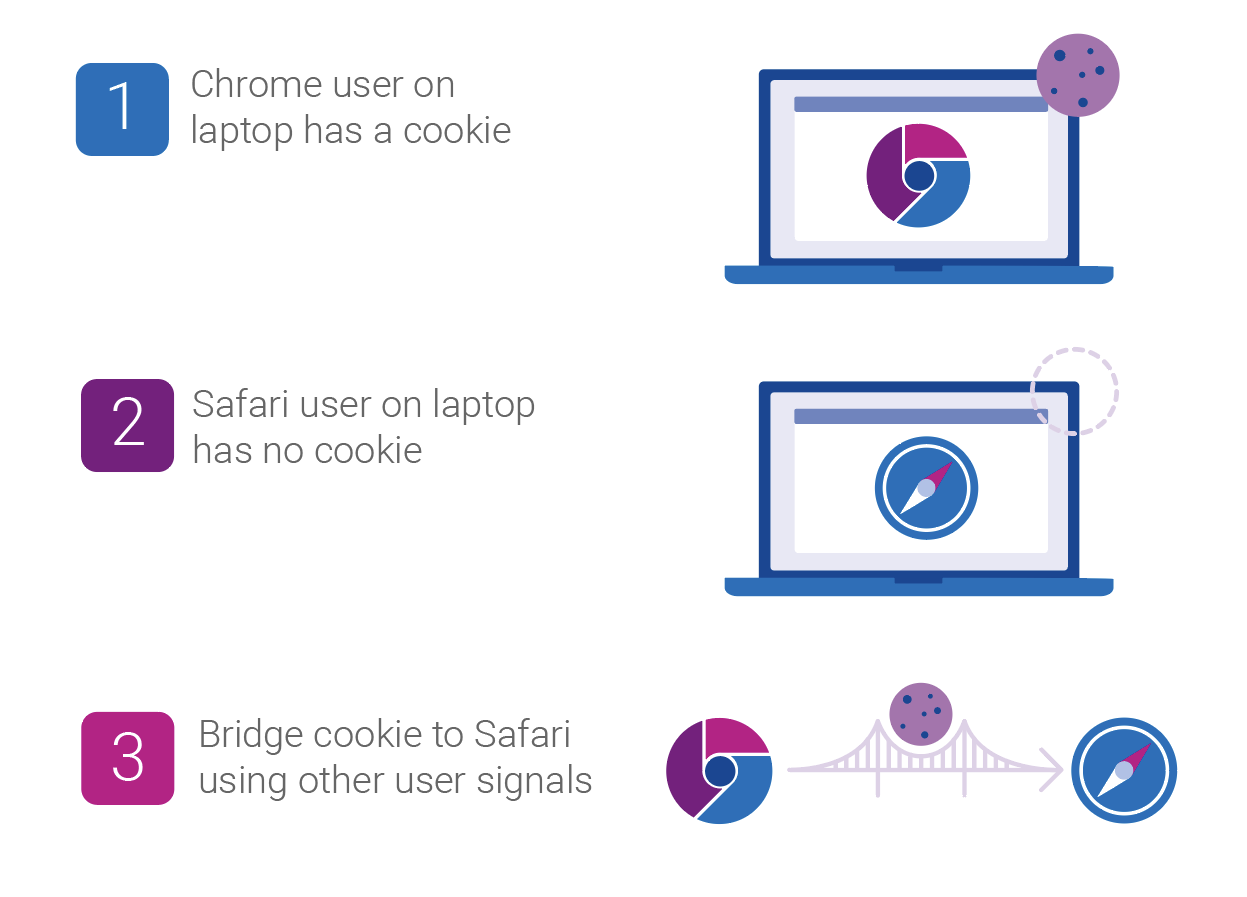
ID bridging diagram

Imagine you visit a popular sports website on your laptop using Chrome. Later, you use the same device to visit the same sports website, but this time, on Safari. By using identity resolution tools, a supply-side partner can infer that both visits are likely from the same user and communicate with them as such.

ID bridging is not inherently a bad thing. However, the practice has sparked debate, as buyers want full transparency into the use of a deterministic identifier versus an inferred one. This complicates measurement and frequency capping for the demand-side. Before OpenRTB 2.6, ID bridging led to misattribution as the demand-side could not attribute ad exposures, which had been served to a bridged ID, to a conversion, which had an ID different from the ad exposure.

OpenRTB 2.6 sets us up for a more transparent future

In 2010, the IAB, along with supply and demand-side partners, formed a consortium known as the Real-Time Bidding Project for companies interested in an open protocol for the automated trading of digital media. The OpenRTB specifications they produced became that protocol, adapting with the evolution of the industry.

The latest evolution, OpenRTB 2.6, sets out standards that strive to ensure transparency in real-time bidding, mandating how the supply-side should use certain fields to more transparently provide data when inferring users’ identities.

What’s new in OpenRTB 2.6?

Here are the technical specifications for the industry to be more transparent when inferring users’ identities:

  • Primary ID field: This existing field now can only contain the “buyeruid,” an identifier mutually recognized and agreed upon by both buyer and seller for a given environment. For web environments, the default is a cookie ID, while for app activity, it is a mobile advertising ID (MAID), passed directly from an application downloaded on a device. This approach ensures demand-side partners understand the ID’s source.
  • Enhanced identifier (EID) field: The EID field, designated for alternative IDs, now accommodates all other IDs. The EID field now has additional parameters that provide buyers transparency into how the ID was created and sourced, which you can see in the visual below:
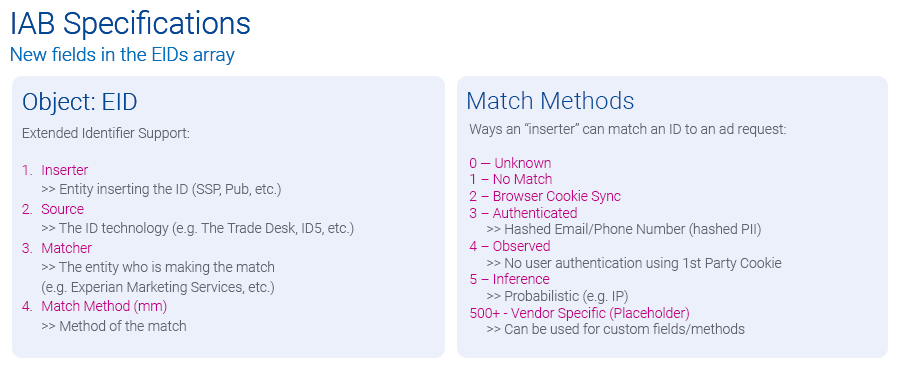
IAB specifications

Using the above framework, a publisher who wants to send a cross-environment identifier that likely belongs to the same user would declare the ID as “mm=5,” while listing the potential third-party identity resolution partner under the “matcher” field, which the visual below depicts. This additional metadata gives the demand-side the insights they need to evaluate the reliability of each ID.
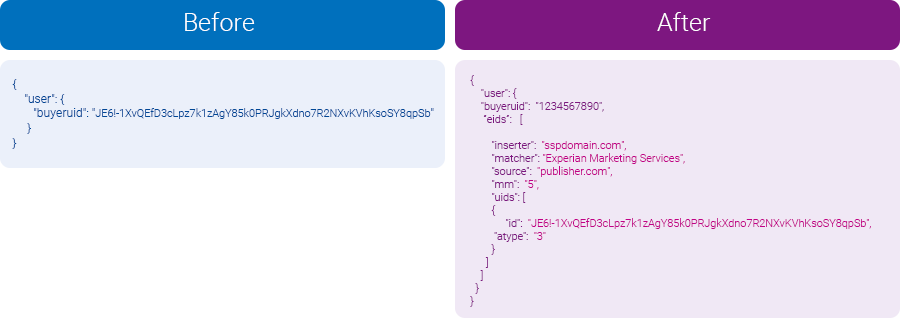
IAB before and after diagram

“These updates to OpenRTB add essential clarity about where user and device IDs come from, helping buyers see exactly how an ID was created and who put it into the bidstream. It’s a big step toward greater transparency and trust in the ecosystem. We’re excited to see companies already adopting these updates and can’t wait to see the industry fully embrace them by 2025.”

Hillary Slattery, Sr. Director, Programmatic, Product Management, IAB Tech Lab

Experian will continue supporting transparency

As authenticated signals decrease due to cookie deprecation and other consumer privacy measures, we will continue to see a rise in inferred identifiers. Experian’s industry-leading Digital Graph has long supported both authenticated and inferred identifiers, providing the ecosystem with connections that are accurate, scalable, and addressable. Experian will continue to support the industry with its identity resolution products and is supportive of the IAB’s efforts to bring transparency to the industry around the usage of identity signals.

Supply and demand-side benefits of adopting the new parameters in OpenRTB 2.6

  • Partner collaboration: Clarity between what can be in the Primary ID field versus the EID field provides clear standards and transparency between buyers and sellers.
  • Identity resolution: The supply side has an industry-approved way to bring in inferred IDs while the demand side can evaluate these IDs, expanding addressability.
  • Reducing risk: With accurate metadata available in the EID field, demand-side partners can evaluate who is doing the match and make informed decisions on whether they want to act on that ID.

Next steps for the supply and demand-sides to consider

For supply-side and demand-side partners looking to utilize OpenRTB 2.6 to its full potential, here are some recommended steps:

For the supply-side:

  • Follow IAB Specs and provide feedback: Ensure you understand and are following transparent practices. Ask questions on how to correctly implement the specifications.
  • Vet identity partners: Choose partners who deliver the most trusted and accurate identifiers in the market.
  • Be proactive: Have conversations with your partners to discuss how you plan to follow the latest specs, which identity partners you work with, and explain how you plan to provide additional signals to help buyers make better decisions.

We are beginning to see SSPs adopt this new protocol, including Sonobi and Yieldmo.

“The OpenRTB 2.6 specifications are a critical step forward in ensuring transparency and trust in programmatic advertising. By aligning with these standards, we empower our partners with the tools needed to navigate a cookieless future and drive measurable results.”

Michael Connolly, CEO, Sonobi

These additions to the OpenRTB protocol further imbue bidding transactions with transparency which will foster greater trust between partners. Moreover, the data now available is not only actionable, but auditable should a problem arise. Buyers can choose, or not, to trust an identifier based on the inserter, the provider and the method used to derive the ID. While debates within the IAB Tech Lab were spirited at times, they ultimately drove a collaborative process that shaped a solution designed to work effectively across the ecosystem.”

Mark McEachran, SVP of Product Management, Yieldmo

For the demand side:

  • Evaluation: Use the EID metadata to assess all the IDs in the EID field, looking closely at the identity vendors’ reliability. Select partners who meet high standards of data clarity and accuracy.
  • Collaboration: Establish open communication with supply-side partners and tech partners to ensure they follow the best practices in line with OpenRTB 2.6 guidelines and that there’s a shared understanding of the mutually agreed upon identifiers.
  • Provide feedback: As OpenRTB 2.6 adoption grows, consistent feedback from demand-side partners will help the IAB refine these standards.

Moving forward with reliable data and data transparency

As the AdTech industry moves toward a cookieless reality, OpenRTB 2.6 signifies a substantial step toward a sustainable, transparent programmatic ecosystem. With proactive adoption by supply- and demand-side partners, the future of programmatic advertising will be driven by trust and transparency.

Experian, our partners, and our clients know the benefits of our Digital Graph and its support of both authenticated and inferred signals. We believe that if the supply-side abides by the OpenRTB 2.6 specifications and the demand-side uses and analyzes this data, the programmatic exchange will operate more fairly and deliver more reach.


Contact us

This site is protected by reCAPTCHA and the Google Privacy Policy and Terms of Service apply.


Latest posts

Loading…
Swipe right on the perfect data and identity partner

Originally appeared in AdExchanger Navigating the world of data and identity partners feels like scrolling through a dating app: a sea of options, but only a select few worth swiping right. To find your perfect match, look for a partner who ticks all the right boxes. Here’s your guide to finding your perfect match. 1. Identity resolution: It all starts with a strong foundation Great identity resolution depends on a rock-solid foundation. The best partners rely on offline data—like names, addresses, and emails—that rarely change, ensuring a consistent view of households, individuals, and their devices over time. You want someone who gives you the same understanding of your audience across every stage of a campaign. 2. In search of: A well-rounded, reliable identity partner When evaluating identity graphs, it’s essential to distinguish between digital-only graphs, offline graphs, and those rare gems who combine both. Digital graphs rely on digital identifiers, while offline graphs are grounded in persistent identifiers like name, address, and phone number. A partner who offers both creates a more complete and reliable view of consumers across channels, resulting in more effective targeting and measurement. 3. Match rates are like dating profiles—don’t be fooled by the numbers Match rates can look impressive, but they’re often misleading. They can also vary widely depending on the methodology and the IDs being tested. Some providers inflate match rates by limiting the scope of comparison or tweaking their standards. The real indicators of quality are the depth of the data, the quality of matches, and how often the graph is refreshed. Ideally, your partner updates their graph weekly or monthly. The inclusion of inactive IDs may inflate the perceived scale without reflecting the true addressable audience. It's like having a profile photo from ten years ago–a major no-no. 4. Authentic origins: Is their data genuine or just a catfish? Look into your partner’s data sources and place a premium on those with public records or direct to consumer relationships. Ask if they have the experience and expertise when it comes to all aspects of data processing from accuracy to privacy and security. Look for some clear third-party indicators for accuracy, like ratings from Truthset, but there is also a basic reality: either your partner is focused on privacy and accuracy, or they are just playing the scale game. Swipe left on those playing games. 5. The breadth to impress Depth matters as much as quality. Seek a partner with wide-ranging attributes that span key audience categories like demographics, interests, and purchase behavior. They should offer the flexibility to deliver both granular data scores and broad audience segments, empowering you to reach the right consumers across channels effectively. 6. The total package: Does your partner really have it all? A true, lifelong partner connects the dots seamlessly, offering a blend of data and identity that link households to devices while layering in rich marketing insights. This approach helps advertisers better understand their customers, reach the right audiences across channels, and measure the impact of their campaigns. The right partner is well-connected and ensures that all the pieces—identity, data, and activation—work in harmony. 7. Future-proof charm: Will they ghost you when cookies crumble? With the Identifier for Advertisers (IDFAs) gone, cookies on the wane, and IP addresses under scrutiny, a partner’s ability to adapt is critical. The most future-proofed solutions are based on offline identifiers like names and addresses, which are user provided and consented data points–making them more resistant to privacy changes. Additionally, look for partners who have made the necessary investments and are prepared to support the new wave of addressable IDs emerging as alternatives to traditional signals. 8. Privacy savvy: Do they respect boundaries? As privacy laws evolve, you need a partner with a strong history in privacy compliance and proactive leadership in navigating new regulations. Strong and transparent privacy policies and participation in privacy organizations are a good indicator of trustworthiness, especially as new rules emerge across different states. Look for a partner who takes data privacy as seriously as you do and gives you peace of mind when handling sensitive information. 9. Seamless connectivity: Do they play well with others? Data is only as useful as it is actionable. Connectivity across platforms is essential, so choose a partner with seamless integrations into the major platforms you rely on for advertising. This ensures your data quality and identity resolution remain intact throughout your campaigns, avoiding loss from multiple handoffs. 10. Killer customer service: Are they in it for the long haul? A great partner collaborates to solve challenges, not just to sell or upsell. Long-standing partnerships and testimonials about strong customer service are key indicators of reliability. Choose a partner who educates and guides you through technical and strategic challenges, fostering an environment where problem-solving and innovation thrive. Keep your standards high Only a handful of companies can meet these rigorous criteria, and you should refuse to settle for a partner that lacks any of these key dimensions. Successfully navigating signal loss, privacy compliance, and seamless omnichannel integration requires extensive resources, robust infrastructure, and years of expertise. Download our full matchmaking guide So, swipe right on a partner who can handle the complexities of modern marketing and deliver consistent, scalable successful marketing outcomes. Could we be your perfect match? Find out if it's a match today Latest posts

Feb 19,2025 by Scott Kozub, VP, Product Management

Driving success: Five practical applications of Experian’s Marketing Attributes

Delivering personalized customer experiences is essential, with 81% of customers preferring a personalized approach to their relationships with brands. However, 80% of consumers are concerned about how their data is used, presenting businesses with the challenge of balancing data collection and privacy with personalization. Despite consumer appetite for personalization, many organizations lack the data to make data-driven decisions: 68% of businesses don't understand how their customers think, and 82% don't confidently know their customers' pain points.  Without this critical data, businesses cannot effectively create personalized consumer connections. Experian offers businesses robust and unique data through our Marketing Attributes to empower businesses with the insights required to derive accurate insights into consumers and drive personalized experiences.  How Experian can help businesses with their data acquisition needs through Marketing Attributes Experian's Marketing Attributes allow businesses to license Experian's data attributes in part or full to provide reliable and accurate data solutions. These solutions assist companies in finding, reaching, and influencing their customers. They are supported by rigorous quality and privacy controls which has earned Experian a #1 data accuracy ranking by Truthset helping our clients reach people based on who they are, where they live, and what they do. Download our Marketing Attributes one sheet Experian has built a strong foundation of consumer behavioral and demographic data with over 5,000 attributes available across over 15 categories and verticals, helping our clients gain deep insights into their consumers. Below we go through five common use cases we have seen using Experian’s data to power various business initiatives. Exploring everyday use cases for Experian's Marketing Attributes 1. Understand areas of the country where your products or services are underserved For instance, a brand offers a diverse range of products that cater to various market segments and audience personas. They seek to gain a deeper understanding of geographic distribution to refine their marketing strategies. Specifically, they aim to identify which market areas are currently underserved, presenting a valuable opportunity for targeted marketing campaigns to boost product adoption in regions that have not fully embraced their offerings.  Utilizing Marketing Attributes from Experian, the brand can access detailed data aggregated at the geographic level. This data provides crucial insights into markets where their products have seen limited adoption yet show a strong potential for success based on the preferences of their target audiences. This approach will help the brand strategically direct its marketing efforts to areas with high growth potential. Learn how Swiss Sense drove market-specific growth strategies with Experian 2. Better understand consumers who purchase within a category Brands frequently operate based on assumptions regarding their customers' preferences and interests, yet they may lack the comprehensive data necessary to substantiate these beliefs.  Experian's Marketing Attributes provides brands with access to extensive data across 15 diverse verticals and categories. This wealth of information allows businesses to develop a holistic understanding of their customer base, enabling them to validate their assumptions and uncover valuable insights into customer behaviors. By utilizing this data, brands can significantly enhance their marketing strategies, refine their product offerings, and implement personalized tactics that resonate with their audiences on a deeper level.  3. Reach a new segment of the market for a new product offering Introducing a new product to a new segment of the market presents unique brand challenges. Without any historical customer data to draw upon, companies lack vital insights that could help them identify and reach their target audience. This absence of foundational knowledge makes it challenging to understand consumer preferences, craft suitable messaging, or determine the most effective channels for connecting with potential customers. To navigate these hurdles, brands frequently turn to Marketing Attributes for consumer research within the new segment. Analyzing demographics, common behaviors within a geographic region, or previous purchase behaviors can uncover patterns and preferences among potential customers. This deeper understanding enables them to create tailored audience models, allowing brands to develop and activate customized messaging based on common interests, identify channels consumers are most likely to engage by using TrueTouch data from Experian. 4. Create custom lookalike models based on your current customers We have found brands trying to launch an acquisition campaign to look at consumers whose behaviors and interests closely mirror those of their highest-converting customers. However, they often lack the necessary data to find new customers that look like their most loyal base.   To address this gap, they turn to Marketing Attributes in combination with Experian’s Offline Graph or Digital Graph, which allow them to pinpoint and analyze the key characteristics and behaviors that define their top customers and reach these consumers on digital or offline channels. Marketing Attributes power the insights into their client’s behaviors and Experian’s Offline or Digital Graph create the linkage to their customer base. Using these insights, the brand can develop a distinct audience model tailored to reflect their most successful customers' unique traits and preferences. This customized approach will help them reach potential new customers who will likely engage and convert. 5. Develop unique audience products We have seen clients use their own first-party data alongside Experian Marketing Attributes and other data sets they own or lease. With Experian's Offline Graph or Digital Graph, they can connect the different data sources together to create a tailored audience solution that meets the specific needs of the brand's clients and the requirements of their market segment. Exploring joint solutions Combining Experian’s Offline Graph with Marketing Attributes Many customers use Experian’s Offline Graph with Marketing Attributes to connect Experian’s data to the brand’s offline marketing strategy. Experian’s Offline Graph offers companies a license of stable offline data points, like name, address, phone number, email, geographic, date of birth, and more that provide a complete view of household and individual identities. Powering use cases like: Regional consumer insights for marketing strategy, media activation, product and location planning Offline media activation, including direct mail, telemarketing, out-of-home, and more Client-driven enrichment The combination of Offline Graph and Marketing Attributes provides unmatched consumer connectivity, enabling clients to generate custom insights, inform product strategy, and activate marketing campaigns. Offline Graph acts as the link between consumers insights and activation. Download our Offline Graph + Marketing Attributes one sheet Combining Experian's Digital Graph with Marketing Attributes The uncertainty around third-party cookies in Chrome and the overall decline in signal complicates the industry’s ability to reach the right consumer. Omnichannel media consumption results in scattered data, making it harder for marketers and platforms to understand consumer behavior and reach them across channels. These challenges call for a comprehensive solution. Our Digital Graph and Marketing Attributes solution addresses these challenges by providing identifiers for seamless cross-channel engagement. By adding Marketing Attributes, like demographic and behavioral data, marketers and platforms also gain a better understanding of their customers. This solution uses Experian’s Living Unit ID (LUID) to combine offline and digital data, giving customers deeper insights into consumer behavior, greater audience reach, and improved cross-channel visibility. Transform insights into loyalty with Experian’s Marketing Attributes Experian's Marketing Attributes enable businesses to gain valuable insight into their prospects and customers. Through this deeper understanding, they can deliver personalized experiences while successfully navigating the complexities of data acquisition and privacy. This helpful information allows brands to make strategic, informed decisions that enhance their marketing efforts. Ultimately, these insights foster more substantial, meaningful connections between businesses and their customers, leading to enhanced customer satisfaction. Get started today Latest posts

Feb 13,2025 by James Esquivel, Product Marketing Manager

Sailing beyond the ordinary: How Experian and MMGY drove data-backed growth for Windstar Cruises

Setting sail For hospitality and travel marketers, understanding which marketing efforts lead to actual bookings can be a tidal shift. Windstar Cruises—renowned for its intimate yachts and off-the-beaten-path itineraries—wanted data-driven visibility into how digital media placements translated into confirmed reservations. Windstar turned to the strategic media expertise of MMGY, a leading integrated marketing company dedicated to the travel, tourism, and hospitality industries and Experian's marketing data and identity solutions to bridge this gap. Together, they developed a closed-loop attribution system that directly tied digital campaigns to offline passenger bookings. The challenge: Blind spots in the booking journey Windstar Cruises had plenty of top-of-funnel metrics—impressions, clicks, website sessions, cruise quote requests—but struggled to connect these indicators to confirmed reservations. Without that link, it wasn't easy to pinpoint which audience segments were most valuable in their marketing campaigns or accurately measure return on ad spend (ROAS). Traditional attribution methods and limited booking system data painted an incomplete picture, leaving Windstar to wonder which media channels and audience strategies were truly driving revenue.  MMGY and Experian: Bridging data gaps to power attribution   Comprehensive pixel tag MMGY designed an online-offline measurement strategy and coordinated with Experian to deploy pixels across Windstar's digital media placements. These pixels captured valuable event-level data—ad exposures, clicks, site visits, and more—so that every interaction could be matched back to a future booking if it occurred. Identity resolution and data enrichment Using the Experian identity graph, Experian matched Windstar’s reservation data with its extensive consumer database. This approach provided a precise, individual-level view of how digital interactions translated into real-world sales. By combining pixel data (which identifies who viewed specific ads) with reservation data (which shows who ultimately made a booking), the solution delivered a comprehensive, end-to-end, multi-touch perspective on the customer journey.  Advanced audience segmentation Utilizing MMGY’s powerful Terminal audience modeling platform—which integrates MMGY Travel Intelligence performance and intent data, Experian’s consumer intent data, and the client’s first-party data— MMGY in conjunction with Experian’s marketing analytics team developed custom audiences designed to drive incremental traveler growth. These audience segments identified travelers most likely to engage in the unique travel experiences Windstar offers. The insights revealed not only who these travelers are, but also where they consume media, how they make travel decisions, and what influences their purchasing behavior. This data guided the development of hyper-targeted media buys, ensuring Windstar’s messaging reached the right people on the right platforms at the right time—maximizing engagement and driving qualified leads. The results: Mapping spend to bookings By utilizing data connectivity and measurement, Windstar gained the insights needed to optimize every aspect of its marketing—audiences, media placements, channels, and more. This data-driven approach revealed which tactics were most effective and enabled Windstar to refine campaigns in real-time for maximum impact. 6,500+ bookings attributed to digital efforts: Over 6,500 bookings—valued at over $20 million—were tied to specific MMGY-managed placements, demonstrating which data-driven tactics led passengers to book. This level of attribution was only possible because we helped Windstar measure and connect the right data points. 13:1 ROAS: By investing $1.48 million in highly trackable, data-informed media, Windstar achieved an impressive 13:1 return on ad spend. Data connectivity gave Windstar the clarity needed to target the right audiences and channels—turning every $1 of spend into $13 of bookings. Actionable cost per booking benchmark: Armed with the ability to map ad spend to individual bookings, Windstar’s average cost per booking settled at $236. With insight into which audiences and placements performed best, Windstar adjusted its strategy in real-time, lowering acquisition costs across the board. High-value reservations: Attributed bookings were, on average, $500 higher in value than non-attributed bookings. By focusing on the right customer segments and messages—determined through precise measurement and segmentation—Windstar secured more bookings and maximized revenue per guest. Terminal Audiences outperformed: For Terminal-targeted segments, the ROAS soared to 28:1 with nearly half the cost per booking compared to non-Terminal audiences. This outcome illustrates how advanced data segmentation and connectivity deliver more profitable guests at lower acquisition costs—further proof that continuous optimization grounded in real data pays off. What this means for travel and hospitality Windstar's success story illuminates a bigger truth for the travel and hospitality industry: closing the attribution loop is no longer optional. In a fiercely competitive marketplace, brands need concrete proof that their marketing investments drive awareness and translates into real revenue. By marrying MMGY's travel-specific marketing acumen with Experian's marketing data and identity solutions, travel brands can: Invest with confidence: Marketing investment flows to the most effective channels and placements based on actual bookings, not superficial metrics. Refine strategies: Real-time attribution data creates a feedback loop marketers can use to iterate on messaging, creativity, and targeting for even stronger results. Capture higher-value guests: Pinpointing and appealing to likely travelers allows marketers to increase booking volume and total revenue per booking. Charting a course for data-driven success By seamlessly linking digital exposure to confirmed reservations, Experian and MMGY gave Windstar Cruises the compass they needed to navigate the complexities of digital marketing confidently. This new level of insight is empowering Windstar to double down on the campaigns, creatives, and segments that move the needle the most. For travel and hospitality brands worldwide, data-driven attribution goes beyond simply understanding what happened—it’s about shaping what comes next. When marketing decisions are guided by real customer journeys and precise ROI metrics, brands can make more innovative investments, foster stronger guest relationships, and chart a course toward sustainable growth. Ready to embark on your own data-driven journey? Contact us to learn how Experian and MMGY can help you create impactful, measurable marketing strategies. Contact us About MMGY MMGY is a leading integrated marketing company dedicated to the travel, tourism, and hospitality industries. With deep expertise spanning research, brand strategy, media planning, and creative execution, MMGY helps global travel brands forge meaningful connections with consumers. By utilizing data-driven insights, cutting-edge technology, and decades of experience, MMGY delivers strategic programs that capture attention and drive measurable results for its clients—ensuring that every marketing investment is tied to clear business outcomes.   Latest posts

Feb 12,2025 by Experian Marketing Services

Subscribe to our newsletter

Enter your name and email for the latest updates

This site is protected by reCAPTCHA and the Google Privacy Policy and Terms of Service apply.

About Experian Marketing Services

At Experian Marketing Services, we use data and insights to help brands have more meaningful interactions with people. As leaders in the evolution of the advertising landscape, Experian Marketing Services can help you identify your customers and the right potential customers, uncover the most appropriate communication channels, develop messages that resonate, and measure the effectiveness of marketing activities and campaigns.

Visit our website

Subscribe to our newsletter

Stay up to date on the latest industry news and receive expert tips from our marketing experts.
Subscribe now!