Download Latest Studies
- Viewpoint: How the CFPB will impact collections
- New vehicle loans for subprime consumers increase by 22.4 percent in Q2 2011, according to Experian Automotive
- Delinquent debt on the rise for very small and largest businesses, according to Experian's latest Business Benchmark Report
- Experian report shows credit card delinquencies are below precession levels; mortgage delinquencies are increasing
- Auto lenders financing more subprime consumers in Q1, according to Experian Automotive
- Strategic defaults off from peak, but still high
Other Research
- Percentage of delinquent dollars showed dramatic increase in Q4 2010, according to Experian's latest Business Benchmark Report
- Experian study finds that consumers are paying less on monthly payments than three years ago
- U.S. business payment behavior is stabilizing, and delinquent balances are reducing, according to Experian's Q3 Business Benchmark Report
- New vehicle registrations rise for third consecutive quarter, according to Experian Automotive industry analysis
- New Vehicle Registrations up 12.8 percent in Q1 2010 vs. Q1 in 2009
- Experian Helps Client Exceed Its ROI Target By Almost 200 Percent
- Experian Ranks The Top 20 Major U.S. Metropolitan Areas By Average Debt Per Consumer
- U.S. Businesses Paying Bills More Slowly
- First Half Of 2010 Shows Major Improvement In Risk Scores For Very Large Businesses
- All Industry Sectors Showing Marked Improvement In Their Risk Scores
- Experian Provides Insight Into Credit Card Trends Of The Top 20 Major Metropolitan Areas
- Understanding Small Business Risk through The Economic Down Cycle
- Preparing Your Business For The Economic Upswing
- Late-Breaking Insight Into New And Used Vehicle Loan Performance
- The Changing Mortgage Landscape
- Future Of Underwriting
- Business Benchmark Report: First quarter shows U.S. businesses are making a comeback (April 2010)
- Business Benchmark Report: Large businesses showing greatest signs of improvement (March 2010)
- Automotive lending continuing to show signs of stabilization (March 2010)
- Business Benchmark Report: Businesses of all sizes showing signs of improvement (February 2010)
- Vehicle registrations drop, but sales decline slowing; Ford Motor Company and Hyundai shine in Q3 2009 (February 2010)
- Portrait of a fraud victim: affluent suburbans most at risk (January 2010)
- Consumer Loan Process: Adapting to a New Economy (November 2009)
- Small businesses continue to feel the squeeze as credit tightens (November 2009)
- Most creditworthy consumers also are most likely to be identity theft victims (June 2009)
- With age comes wisdom…and a higher credit score (March 2009)
Exploring Current Economic Trends
As our clients continue to face the challenges of today’s economy, information and data analysis are essential to help guide their strategic, operational, risk management and asset valuation decisions.
This site provides you with analyses compiled from Experian credit data and explores current trends that affect all areas of lending.
Franklin Mint Podcast
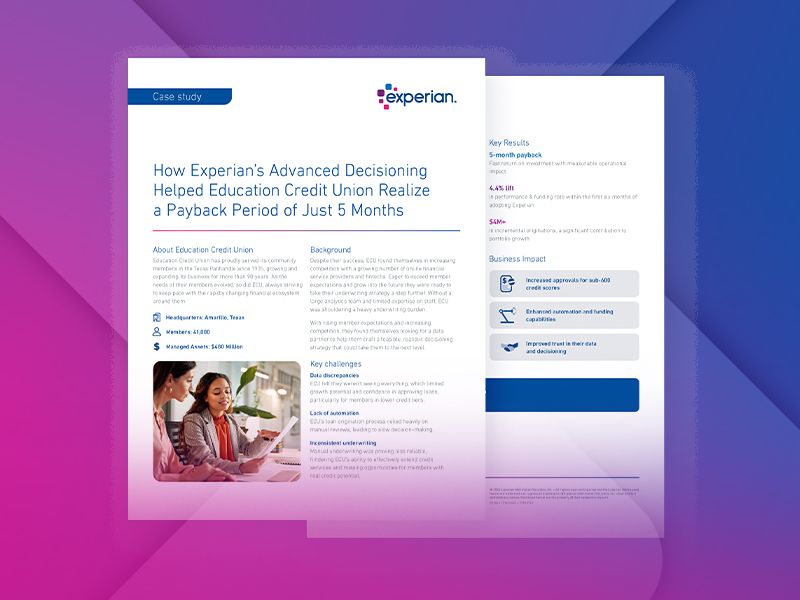
Experian helps Franklin Mint Federal Credit Union increase its one-year campaign net profit by 60 percent. By implementing an auto prescreen campaign, FMFCU exceeded its return on investment goal by nearly 200 percent.
Click play below to listen to the podcast.
Latest Studies
Viewpoint: How the CFPB will impact collections
Read Experian's thoughts on what effects the CFPB is likely to have on the collection industry.
New vehicle loans for subprime consumers increaes by 22.4 percent in Q2 2011, according to Experian Automotive
Experian Automotive today announced that lenders continued to increase their appetite for risk in Q2 2011, with new vehicle loans for customers with credit outside of prime increasing by 22.4 percent, when compared to the previous year. In Q2 2011, 22.29 percent of all new vehicle loans went to customers in the non-prime, subprime and deep subprime categories, increasing from 18.21 percent in Q2 2010.
Delinquent debt on the rise for very small and largest businesses, according to Experian's latest Business Benchmark Report
Findings from the Q2 report showed that the amount of delinquent debt has increased significantly for the largest and smallest businesses. Very large businesses (those with more than 1,000 employees) had the greatest shift in percentage of dollars delinquent, going from 11.6 percent in June 2010 to 18.2 percent in June 2011, and very small businesses (those with one to four employees) had the greatest shift in percentage of dollars considered severely delinquent, going from 9.9 percent in June 2010 to 11.7 percent in June 2011.
Experian report shows credit card delinquencies are below prerecession levels; mortgage delinquencies are increasing
Experian study released its findings on the credit card and mortgage payment behaviors* of consumers both nationally and in the top 30 Metropolitan Statistical Areas (MSAs). Nationally, since 2007, 20 percent fewer credit card payments are 60 days late, but 25 percent more consumers are paying their mortgage 60 days late.
Auto lenders financing more subprime consumers in Q1, according to Experian Automotive
Experian Automotive today announced findings from its quarterly analysis of the automotive credit industry. The latest report shows that the share of loans to credit-challenged new vehicle shoppers grew by 11.1 percent in Q1 2011 compared with Q1 2010. Share of loans to nonprime customers rose from 9.81 percent in Q1 2010 to 10.57 percent in Q1 2011. For subprime customers, share of loans jumped from 5.68 percent to 6.16 percent, while share of loans to deep-subprime customers rose from 1.38 percent to 2.00 percent.
Strategic defaults off from peak, but still high
The study found that in 2008, strategic defaults peaked in Q4, accounting for 20 percent of all mortgage defaults 60 days past due or greater and have fallen below that percentage every quarter through Q2 of 2010. The last quarter in 2009 indicated a 16 percent strategic default rate and 17 percent in Q2 of 2010. Although percentages slightly dropped since 2008, they still remain high creating a continual issue for lenders.